Blog Archives
“A Poem and a Mistake”

Poetic Justice follows a poet in Rome who is exiled by the emperor and winds up in a town plagued by a mysterious murder. What was the inspiration for the setup of your story?
It started with a question much asked by Classicists – why did the Emperor Augustus exile the poet Ovid? We still don’t really know though it hasn’t stopped people guessing. Ovid himself – the real poet Ovid, that is – hints that he offended the Emperor with “a poem and a mistake”. From there I started to wonder how Ovid would have coped living in a small Greek town on the edge of Empire. And when I discovered that, in his youth, the real Ovid possibly spent a year working in the world of law and order in Rome, that gave me the idea for him turning detective.
What kind of research did you do for this novel to ensure you captured the essence of the story’s theme?
I read Ovid’s poems – the ones he wrote in exile – and was struck by how badly he seemed to be coping. Of course, this is a portrait of himself that he wanted to convey in the poems. Interesting that he wants us to see him constantly complaining and wailing. No Roman endurance here!
I also had to research the town of Tomis, now covered by the modern Romanian city of Constanta. I was fortunate in that Constanta has a wonderful Museum of History and Archaeology, and its website freely publishes many useful documents.
I read a lot about how witchcraft is depicted in Roman writers, and I discovered that Ovid stopped at Samothrace on the way to Tomis. It is likely that he was initiated into the mysteries of the Great Gods at the huge temple complex on the island. You know the famous Winged Victory statue in the Louvre? That comes from Samothrace. These cults from the east were embraced by the Romans quite readily, which I found interesting.
What were some themes that were important for you to explore in this book?
I always like to explore the difference between what the sources tell us and what common sense tells us. If you just read Ovid, then you would wonder why anyone ever lived in Tomis, so I wanted to show life here as normal, relatable. A small town like Tomis would have a long history but there would be none of the huge buildings we see in Rome, none of what I call the Hollywood element. There would be far fewer slaves than in Rome, and the population would be mixed – Greeks, some Romans, people who had settled from around the Black Sea, lots of locals from the tribes around the Danube, and traders from around the Mediterranean. And Ovid would have been the most famous person ever to live in Tomis – just imagine if your favourite writer came to live in your ordinary, nobody’s-heard-of-it small town!
When will book 2 be available? Can you give us an idea of where that book will take readers?
Book 2 should be available by the autumn, and it takes the reader away from Tomis to an extent, giving an Empire-wide view. It’s set around the death of Augustus, and this was important because an Emperor had never died before. Everyone was waiting to see what would happen. I’m afraid our hero is still in trouble – we find out what it was that was so terrible that Augustus could never forgive Ovid…
Author Links: Goodreads | Twitter | Facebook | Website | Amazon
Rome’s celebrated love poet Ovid finds himself in exile, courtesy of an irate Emperor, in the far-flung town of Tomis.
Appalled at being banished to a barbarous region at the very edge of the Empire, Ovid soon discovers that he has a far more urgent – and potentially perilous – issue to address. A killer is at large in Tomis.
Somebody is slaughtering animals in a parody of ritual, and the Governor’s advisor Marcus Avitius is under pressure to apprehend the perpetrator.
Romans are held in low esteem by the local populace, however, and assistance is hard to come by. When the killer progresses from animal to human victims, Avitius reluctantly allies himself to the mercurial, tipsy Ovid.
It seems that Ovid has an inexplicable link to the murderer too, with his poetry providing the timetable by which the killer works.
After a secret visit from the elite Praetorian Guard, Ovid realises he is in mortal danger in Tomis. If he doesn’t follow the Emperor’s line, more than just his freedom is at risk.
With Avitius distracted by the demands of the Governor, Ovid becomes a target for dark forces at work in Tomis – and in Rome.
Recommended for fans of Steven Saylor, Lindsey Davis and Simon Scarrow.
Fiona Forsyth studied Classics at Oxford before teaching the subject for 25 years. Fiona is also the author of the Lucius Sestius Mysteries.
Poetic Justice
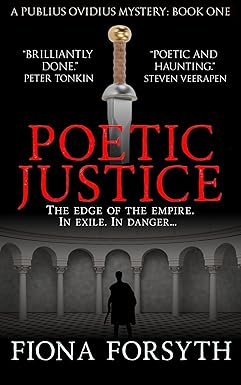

In the dwindling twilight of Roman dominion, Poetic Justice by Fiona Forsyth transports readers to Tomis, a remote outpost at the Empire’s edge, where the esteemed poet Ovid finds himself in exile. Initially dismissive of the locals as mere barbarians, Ovid’s attention swiftly shifts to a more sinister matter: a series of ritualistic murders, eerily escalating from animal to human sacrifices. As the macabre acts begin to mirror the unsettling themes of Ovid’s own verses, he forms an unlikely partnership with Marcus Avitius, the Governor’s advisor, in a bid to unravel the mystery. Together, they delve into the dark underbelly of Tomis, seeking to expose the chilling truth behind the violence.
As the inaugural installment of the Publius Ovidius Mysteries, Forsyth’s novel is an ambitious foray into historical fiction, ingeniously casting the ancient Roman poet Ovid as a central figure in a gripping murder mystery. Against the odds, the narrative captivates with its richly woven tapestry of historical intrigue and literary imagination. Forsyth demonstrates a profound command over the era, bringing Roman life’s societal and political nuances into sharp relief, thus enabling readers to immerse themselves fully in the period.
The depiction of Ovid and Avitius stands out, with both characters meticulously crafted and offering a compelling dynamic. They are supported by a cast of vividly drawn figures, each contributing to the unfolding drama and deepening our understanding of Roman society. Forsyth’s narrative prowess shines through in every element of the book, from the authentic dialogue and well-measured pacing to the underlying tension that simmers throughout, hinting at the lurking dangers in the shadows of Tomis.
Forsyth’s work is a testament to the power of historical fiction, demonstrating an ability to educate about a bygone era and entertain and engage through a story that is as thrilling as it is unlikely. Poetic Justice is a testament to the genre, proving that with enough skill and creativity, even the most obscure historical figures and moments can spring vividly to life, offering readers a window into the past that is both enlightening and profoundly entertaining.
Pages: 283 | ASIN : B0CP9HW9SJ




 LITERARY TITAN