Blog Archives
Historical Imagination

Survival Secrets is the second book in The Magi’s Encounters series and follows Akilah and the Wise Men on a layered journey through Egypt, politics, threats, family wounds, and spiritual uncertainty. How did the idea for Survival Secrets first take shape?
Survival Secrets is rooted in the final verse the Bible records about the Wise Men. Matthew 2:12 says, “And having been warned in a dream to not return to Herod, they returned to their country by another route.” What seems like a footnote to their story is really a beginning. They couldn’t return home on the Roman roads because Herod would have alerted those guards to watch for the Wise Men and drag them back to Jerusalem in chains. Roman roads were peppered with watchtowers every 10 miles, and their guards’ main job was to snag runaway slaves and other “illegals.” The Wise Men were added to that list as soon as Herod realized they wouldn’t return to him as he’d commanded. So where did they go? Without access to Roman roads, their choices were limited. Judea’s geography further narrowed their choices. By process of elimination, I mapped the most plausible route they might have taken. It was circuitous and dangerous. They had to hide their identity to protect themselves from Herod and other enemies. I believe their returning home “by another route” was also the first acid test of their newfound faith–and each Wise Man responded to that challenge differently.
How did you balance biblical tradition with historical imagination?
The Bible is my north star for writing the series. It’s infallible in recording what happened, but it doesn’t always say why things happened. For that, I dig into world history, using accounts by 1st-century historians and other reliable resources to understand how world politics, religions, and culture influenced people’s thoughts, motivations, and actions. The Wise Men were priest-scholars in Magi society, a powerful, influential entity in the Parthian Empire. They were duty-bound to uphold the empire’s official religion, plus officiate for other religions. What if they suddenly believed in something other than what their empire’s official religion espoused? That’s exactly what happened with the Wise Men when they found Yeshua/Jesus. Think of what conflict and danger that caused for them. History records a lot about Herod as well as how the Roman and Parthian empires treated Jews long before Jesus’ ministry started. That tension is the backdrop behind Matthew 2:12. That tension is where I judiciously exercise my historical imagination.
One of the book’s strengths is its patience with faith as a process rather than an instant transformation. Why was that important to you?
A common misconception is that a person can “grow” their own faith–but the Bible doesn’t say that. The apostles could have asked Jesus for many things, but they said, “Increase our faith!” (Luke 17:5), They inherently knew that faith didn’t come from them, but from God. In that verse, the Greek word “increase” is the root of our English word “prosthesis.” It literally means “to add or increase.” Its connotation is to make something stronger and more functional–which is exactly what a prosthetic (and faith) does. Put another way, when we let God work in our lives, He lays down more train tracks to guide our lives, which increases our faith and strengthens our resolve to trust Him more.
Can you give us a glimpse inside Book 3 of The Magi’s Encounters series? Where will it take readers?
Geographically, Book 3 will take readers to the northern fringes of the Parthian Empire, where small, semi-autonomous vassal states form a buffer zone that controls the tensions between the mighty Roman and Parthian Empires. Emotionally, Book 3 shows each Wise Man’s faith on trial. It differs for each of them, but taking center stage is our main character, Akilah, whose pursuit of the prophesied child-king (Yeshua/Jesus) lands him in prison. Now he must answer to allegations of civil and religious crimes against the Parthian Empire that could cost him his life.
Author Links: GoodReads | Facebook | X (Twitter) | Website | Amazon
Hunted by Herod’s forces and others who fear what the Magi know about Yeshua, Akilah and his companions flee into the Wilderness of Paran—a land as merciless as the enemies pursuing them. To reach Egypt’s safety, his caravan must survive the elements and the strain of maintaining their anonymity while protecting the many secrets that jeopardize their lives.
But the greatest danger isn’t the wilderness.
Bound by their shared knowledge of Yeshua, the group carries a truth powerful enough to upend empires yet tenuous enough to fracture their resolve. When calamity tears one Wise Man away from the others, the group’s newfound faith start to crumble. Faith once sparked by wonder is now tested by hardship and the silence of unanswered prayers.
Farther from their goal of returning to Persia than ever before, Akilah encounters Yeshua’s family again. Its ramifications raise the stakes for the Magi’s cost of belief in the Hebrew God.
Meanwhile, two thousand miles away, Akilah’s estranged cousin Farzaneh begins her own dangerous search for truth, uncovering secrets her husband carried to the grave after embracing the Hebrew faith.
Survival Secrets is a gripping continuation of the Magi’s journey. As they struggle to return home while facing an uncertain future, costly obedience replaces the early awe of their belief—underscoring that faith doesn’t travel in a straight line, endurance is often learned in the wilderness, and trust rests with an unfathomable, sovereign God.
Perfect for fans of biblical fiction rich in tension, clean adventure, and faith journeys shaped by doubt, hardship, and quiet courage.
Follow belief into dangerous territory.
Survival Secrets


Survival Secrets, by Lana Christian, follows Akilah and the Wise Men after their encounter with Yeshua, as their obedience to a warning sends them away from Herod and into a far more dangerous route home. What begins as an escape through the Wilderness of Paran becomes a layered journey through Egypt, Parthian politics, Nabataean threats, family wounds, and spiritual uncertainty. The title proves apt: nearly every character carries something hidden, and the novel keeps asking which secrets preserve life and which ones must be brought into the light.
I enjoyed how Christian turns a brief biblical afterthought, “they returned another way,” into a full-bodied adventure with grit under its fingernails. The desert is not decorative here; it presses on the caravan with hunger, fear, suspicion, and heat. Akilah’s leadership especially held my attention because he is not a polished saint but a learned man trying to shepherd people while his own convictions are still taking shape. His half-truths, hesitations, and burdens make him feel human, and the tension around Tallis adds a bracing current of danger.
What surprised me most was the novel’s patience with faith. The story doesn’t treat belief as an instant transformation but as something tested by thirst, politics, old grief, and the uneasy cost of knowing too much. Farzaneh’s storyline brings a welcome emotional counterweight to the caravan’s physical peril, and the historical texture, maps, customs, names, power struggles, and gives the book a pleasing density without smothering the plot. I found myself appreciating the way Christian lets scholarship and suspense share the same road.
This book is for readers who enjoy biblical fiction, historical fiction, adventure, and suspense with political intrigue and a reflective heart. Readers who like Angela Hunt’s biblical novels or the immersive historical sweep of Francine Rivers will likely feel at home here, though Christian’s focus on the Magi gives the story its own uncommon constellation. Survival Secrets is a thoughtful, sand-swept sequel that turns hidden knowledge into visible courage.
Pages: 338 | ISBN : 978-1649175021

Knowledge is Power

Sisters of Twelve follows a woman known as the final Custodian who must determine if the world is prepared for what the Voynich Manuscript contains. What was the inspiration for the setup of your story?
The story really began with the Voynich Manuscript itself. Like many people, I became fascinated by the fact that it has resisted explanation for centuries. But instead of focusing only on how to decode it, I found myself asking different questions: Who could have created something like this, and more importantly, what was it actually for?
I wanted to approach the manuscript not simply as a puzzle, but as part of a larger system. From there, I became interested in the kinds of people history tends to overlook, especially those who preserve knowledge quietly in the background while others receive recognition for it. I began imagining a lineage of women whose role was not just to protect information, but to determine when humanity was ready to receive it.
In many ways, the novel also became an homage to the strong women in my own life and to the countless individuals throughout history whose contributions were never fully acknowledged. Many of them were not seeking recognition at all, yet their work became part of the invisible foundation upon which later discoveries and institutions were built. That idea stayed with me throughout the writing of the book.
The novel treats knowledge as a burden as much as power. Was that one of the central ideas you wanted to explore?
Yes, absolutely. Knowledge is power, but power without wisdom or timing can become dangerous very quickly. One of the central ideas I wanted to explore in Sisters of Twelve is that possessing knowledge is only part of the burden. The greater burden is deciding when, how, and even if it should be shared.
For generations, the Custodians of the Sisterhood preserved accumulated discoveries and systems of knowledge, but Gia is the first to fully realize that time itself is running out. Previous Custodians had the luxury of patience. Gia does not. She understands that revealing certain discoveries too early could destabilize civilizations in ways history has repeatedly shown us, while withholding them for too long could deny humanity gifts that might alleviate suffering or fundamentally improve the world.
That tension becomes deeply personal for her. At times, the responsibility of deciding what humanity is ready to receive becomes almost suffocating.
The novel argues that women have often preserved culture, memory, and knowledge without recognition. What historical examples most influenced that idea?
As a college student, I remember first hearing the idea that much of history is really “His Story,” not “Her Story.” That concept stayed with me. History is often written by the winners, and historically, those winners were usually men whose names filled textbooks, monuments, and institutions.
But the survival of knowledge has rarely depended only on the visible people history remembers.
Across centuries, there were always others working quietly in the background. Archivists preserving fragile documents, translators carrying ideas across languages, assistants organizing the work of scholars, daughters inheriting memory when no formal record remained. Many of these people, especially women, lived and died without recognition, even though the ideas they protected survived because of them.
That became one of the emotional foundations of Sisters of Twelve. The book is fiction, but the spirit behind it comes from a very real truth: if knowledge from the past has reached us at all, it is because someone chose to carry it forward, often quietly, often without credit, and sometimes without anyone ever knowing they had done so.
In many ways, the novel is dedicated to those unseen custodians of knowledge.
Did you want readers to leave the novel feeling hopeful, unsettled, or intellectually uncertain?
At times, it feels like we are constantly being conditioned to believe the world is always on the verge of collapse. Maybe it is, or maybe it only feels that way because uncertainty has become such a constant part of modern life. I didn’t want Sisters of Twelve to reinforce the idea that humanity is doomed or incapable of growth.
I wanted to tell a story that acknowledges the world will probably never be perfect, but that does not mean it cannot become better. The ending is meant to leave readers with a sense of cautious hope. Not the kind that arrives overnight or solves everything at once, but the belief that people are still capable of learning, adapting, and choosing something better for the future.
If readers walk away from the novel feeling that maybe, just maybe, humanity still has the capacity to get things right, then I think the story succeeded.
Author Links: GoodReads | Amazon
A hidden sisterhood that has safeguarded its meaning for two thousand years.
And a world rapidly approaching the moment it was never meant to reach.
Sisters of Twelve
For centuries, the Voynich Manuscript has defied every attempt at translation. Historians, cryptographers, scientists, and codebreakers have all failed to explain its meaning.
Because the manuscript was never meant to be read in the conventional sense.
In Sisters of Twelve, the Voynich Manuscript is revealed as the current vessel of a system preserved across generations by a hidden lineage of women known as the Sisterhood. Their purpose has never been to conceal knowledge forever, but to control its release, ensuring that discoveries capable of reshaping civilization enter the world only when humanity is ready to survive them.
Now that responsibility belongs to Dr. Gia Braccia, the Sisterhood’s newest Custodian.
As technological advances begin to erode centuries of secrecy, Gia realizes the system can no longer remain hidden indefinitely. The manuscript and its ancient counterpart, the Roman dodecahedron, exist in a world of artificial intelligence, distributed data, 3D imaging, and limitless replication. Time, once the Sisterhood’s greatest advantage, is running out.
What the manuscript contains could transform medicine, science, language, agriculture, and human longevity.
Or it could destabilize governments, deepen inequality, weaponize scarcity, and fracture a civilization already struggling to hold itself together.
As pressure mounts from institutions, private actors, and factions within the Sisterhood itself, Gia must confront the question her predecessors spent centuries avoiding.
Not whether the world deserves the truth.
But whether it can survive it.
Blending historical intrigue with speculative science and philosophical suspense, Sisters of Twelve explores the hidden systems that preserve knowledge across generations and the unseen people history rarely remembers.
From the author of Time Lines comes a story about memory, stewardship, and the dangerous moment when the future arrives before humanity is prepared for it.
Sisters of Twelve
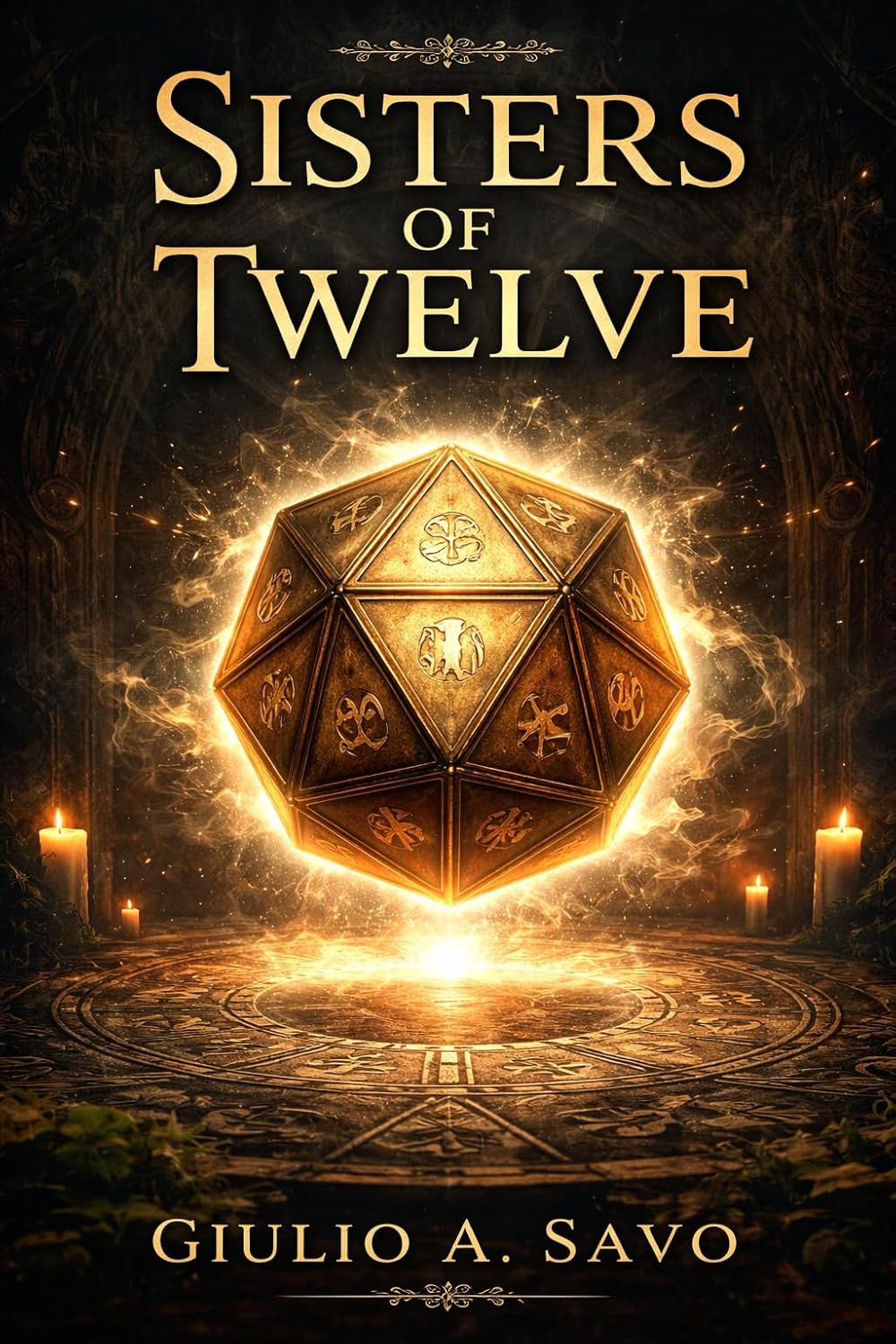

Sisters of Twelve is a historical mystery thriller built around the Voynich Manuscript, imagining that its unreadable pages are not a failed puzzle but a deliberately protected vault of knowledge, carried across centuries by a hidden lineage of women called the Custodians. At the center is Gia Braccia, the final Custodian, who must decide whether the world is finally ready for what the manuscript contains—and whether preservation has become its own kind of captivity. The novel braids real historical figures, archival intrigue, secret societies, scholarly obsession, and speculative systems into a story about women who kept knowledge alive when history preferred them nameless.
The book doesn’t rush toward revelation; it understands that secrecy has texture, procedure, dust, paperwork, and dread. The scenes inside libraries and archives have an almost mineral stillness, and I liked how the novel makes bureaucracy feel thrilling, not through car chases or melodrama, but through delayed emails, loan agreements, box numbers, and the soft violence of institutional language. Its best passages treat knowledge not as treasure, but as burden: something that must be timed, guarded, doubted, and eventually released.
I also found the book most compelling when it resisted the easy glamour of conspiracy. The Sisterhood is not simply a clever hidden order; it is an argument about history’s missing hands. The novel’s emotional current comes from its insistence that preservation is work, and that women have often done that work without signatures, monuments, or applause. The scale of the mythology can feel heavy, but that weight is also part of the book’s design. It wants to feel like a codex being opened slowly, page by page, with each layer asking whether understanding is always a gift.
This book is for readers who enjoy mysteries, thrillers, historical fiction, and the intrigue of the Voynich Manuscript. Fans of The Da Vinci Code may recognize the pleasure of symbols, suppressed histories, and dangerous knowledge, but Giulio A. Savo’s approach is quieter and more contemplative, closer in spirit to Umberto Eco’s fascination with texts, interpretation, and the peril of certainty. Sisters of Twelve is a novel about the moment a secret stops being protected and starts becoming responsible to the world.
Pages: 509 | ASIN : B0GTW2FJ1P
Rome’s Culture

In The Altar of Victory, you take readers on a journey into the days of the Western Roman Empire and the political fallout following the death of Emperor Valentinian I. Why was this an important book for you to write?
It was important to me for several reasons. My interest in this era began long ago, when I was a European History major in college and had taken a class on the period from Late Antiquity through Charlemagne (300-800 AD roughly). The period up to Constantine was well covered, as was the actual catastrophe of the sack of Rome in 410 AD and the subsequent barbarian invasion. However, the course jumped past the last half of the 4th Century, when the Roman empire was still intact and just before these catastrophes began to increase. The more I read in the intervening years, the more evident this gap appeared. Even Gibbon’s Decline and Fall of the Roman Empire tended to treat this critical period of European history in summary fashion.
I also decided that the question of how such a technologically advanced civilization like Rome, with the most organized army and engineering in the world, could fail to see the threat and fall so quickly to less organized enemies. Was there a point when the decline could have been arrested? Did it really come down in part to the deaths of perhaps three key emperors (Valentinian, Valens, and Gratian)? Was it cultural change and the loss of a Roman identity? What role did the advent of organized Christianity play? It was a host of puzzles that I wanted to understand, if not solve.
Can you share with us a little about the research that went into putting this book together?
Before I began writing, I spent several years accumulating various non-fiction sources- books by more contemporary historians like David Brown and Michael Grant; biographies of Ambrose of Milan, etc. I also went to the limited primary sources- Ammianus Marcellinus, of course, Zosimus, the letters of Symmachus, St. Jerome, Ausonius, the Notitia Dignitatum, and others; the military manual of Vegetius. Even as I began to outline the plot and write the first chapters, I continued to read and learn what I could, and still felt that so much was still missing from the historical record. Which was also good, because it enabled me to fill in with a plot of my own devising!
What were some themes that were important for you to explore in this book?
I wanted to explore what remained of Rome’s culture in the 4th Century, and how it had been eroded or replaced as the empire had grown and the city of Rome was no longer the center of the empire. I was also interested in the courts of the emperors, when the emperors no longer came from Rome or even visited very much. The idea that the key military and administrative figures had now become Gauls, Franks, and other nationalities/tribes who had only recently been enemies of Rome seemed to me to be critical in understanding how “Romanness” could have been disappearing for decades before a military transition occurred.
Another theme of importance to me was the figure of Gratian. By all accounts, he was a decent and brave military leader and tried to be a good emperor. He was also a fairly devout Christian and took an interest in the ecumenical issues of the day. And yet, he did not last, and after his reign, the Roman army did not do well in the west. I wanted to explore whether he was the last, best hope for Rome and what factors worked against his success.
Can we look forward to more work from you soon? What are you currently working on?
I am both researching and writing the sequel to The Altar of Victory, in which I intend to conclude Gratian’s story. I am also trying valiantly to finish a collection of short stories set in the 19th and early 20th centuries of Louisiana and Texas before year end.
Author Links: GoodReads | Facebook | Website | Amazon
The Altar of Victory
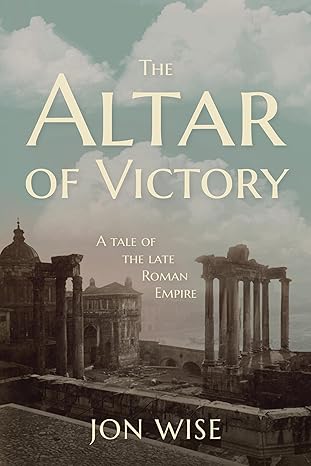
The Altar of Victory is a historical novel that plunges the reader into the waning days of the Western Roman Empire, centering around the death of Emperor Valentinian I and the political maneuvering that follows. Set in 375 A.D., it opens with Valentinian’s dealings with barbarian tribes and internal dissent, leading to his sudden death after a fit of imperial rage. The story then shifts into high-stakes political chess as the ambitious general Merobaudes races to install young Valentinian II on the throne before rivals can seize control. Along the way, the novel wrestles with themes of legacy, power, faith, loyalty, and the slow unraveling of an empire.
I found myself immediately immersed in its stark, lived-in world. The writing is richly atmospheric and historically informed, without ever feeling like a lecture. Every decision, every letter, and every small detail, like the crack in the aqueduct or the placement of a chair, feels purposeful. The prose is tight, clear, and evocative. What struck me most was how human the characters felt, especially Valentinian. He’s brutal, weary, proud, and oddly sympathetic. When he collapses mid-sentence, the emotional weight lands hard. The tension is just as strong in the quieter moments, furtive whispers in palace halls, long rides through uncertain terrain, as it is in battles and tribunals. I especially appreciated the balance between dialogue and action; the pacing kept me glued.
That said, what I really liked was the depth of the ideas. The book takes a hard look at power and how it mutates in uncertain times. The clash between the old gods and Christianity is not just window dressing; it’s a lens through which every character sees the world. Merobaudes, in particular, is a fascinating figure. He’s clever, opportunistic, not fully Roman yet entirely molded by Rome’s ideals. The women in the story, especially Justina and Mirjeta, are sharp and compelling, with agency that matters. There’s also an aching sense of decay in every corner of the empire, ruined towns, forgotten monuments, fading gods, that gives the story a haunting quality. I found myself thinking a lot about how empires die, not just politically, but spiritually.
I’d recommend The Altar of Victory to anyone who enjoys political intrigue, ancient history, or character-driven stories with bite. It’s a slow burn, but a rewarding one. If you like your historical fiction thoughtful, gritty, and emotionally textured, this one delivers. It’s not light reading, but it’s deeply satisfying, and in more than a few places, surprisingly moving.
Pages: 537 | ASIN : B0DCQ783YW
A Rich Tapestry

The Sword and the Hearth follows a young Brittonic boy thrust into leadership and survival as Saxon invaders threaten to crush his tribe and way of life, forcing him to mature quickly and navigate the complexities of war, leadership, and personal sacrifice.
What was your writing process to ensure you captured the essence of the characters?
My writing process for capturing the essence of the characters in “The Sword and the Hearth” was deeply iterative and rooted in a blend of imagination and focused development. It started with extensive brainstorming and profiling. Before I even wrote the first chapter, I created detailed character profiles for each main character, outlining not just their physical appearance but also their backstories, core beliefs, fears, desires, quirks, and even their favorite foods. This initial immersion helped me understand them as complete individuals, especially considering the varied backgrounds and social strata present in “The Sword and the Hearth.”
Then, during the actual writing, I employed method acting for authors. I’d often pause and ask myself, “How would this character react in this exact situation?” or “What would their internal monologue sound like right now?” This involved stepping into their shoes and genuinely trying to inhabit their perspective, particularly when exploring the nuanced relationships and internal conflicts central to the story. I paid close attention to their voice—ensuring that their dialogue, vocabulary, and even their thought patterns felt distinct and authentic to them, reflecting their individual journeys and development.
Finally, revision was crucial for refinement. I’d read scenes aloud, sometimes even acting out the dialogue, to catch any inconsistencies in character voice or motivation. I also relied on trusted beta readers who would provide feedback specifically on character believability, helping me to polish their nuances until they felt truly alive on the page, like companions in the reader’s own hearth.
What were some themes that were important for you to explore in this book?
Several themes were important for me to explore in “The Sword and the Hearth,” and they often interwove to create a richer tapestry:
The Enduring Strength of Family (Chosen and Blood): Whether it’s the bonds of biological family or the connections forged with individuals who become like family through shared trials, the strength and complexities of these relationships were central to the narrative. I wanted to show how these connections can be both a source of comfort and conflict, truly forming the ‘hearth’ aspect of the title.
The Nature of Identity and Belonging: Many characters grapple with who they are, where they fit in, and what truly defines them, especially when faced with challenging circumstances or new environments. This theme often explored the tension between individual desires and societal expectations, particularly within the feudal setting.
The Power and Peril of Secrets: Secrets, both personal and generational, play a significant role. I wanted to examine how secrets can shape relationships, influence decisions, and ultimately lead to either liberation or destruction, often with far-reaching consequences for the characters and the realm.
Redemption and Second Chances: I was keen to explore the idea that even after mistakes or difficult pasts, there’s often an opportunity for characters to find redemption, to change, and to build a better future for themselves and those around them, irrespective of their station or previous choices.
Will there be a follow-up novel to this story? If so, what aspects of the story will the next book cover?
While “The Sword and the Hearth” stands as a complete narrative in its own right, the literary journey for me, Ciaran MacLeod, has continued with “Echoes of the Ancient Isle,” which serves as the next significant novel in my bibliography.
“Echoes of the Ancient Isle” explores entirely new facets of the world and delves into different aspects of fantasy. It primarily focuses on the unearthing of forgotten histories and the resurgence of ancient magic. Readers will find themselves immersed in a world where the past literally resonates through the present, uncovering secrets tied to long-lost civilizations and powerful artifacts. The story examines themes of legacy, the enduring influence of ancestral spirits, and the profound consequences of disturbing dormant forces. While it features a new cast of characters and a distinct setting, it represents the continuation of my overarching storytelling themes of discovery, personal growth through adversity, and the intricate dance between human will and destiny. It expands the scope of my fictional universe, inviting readers to explore entirely different realms and challenges.
Author Links: GoodReads | Instagram | Website
Raised in the northern hills of Britannia, Cadric must navigate the complexities of war, leadership, and personal sacrifice as he becomes the unlikely leader of his tribe. Alongside him is Maev, a woman whose strength and determination challenge Cadric’s own sense of duty and love. Together, they must face not only the violent Saxon forces gathering at their borders but also the internal struggles that threaten to tear their community apart.
Amidst brutal battles, moments of heartbreak, and triumphs of courage, The Sword and the Hearth is a tale of resilience, the ties that bind people together, and the price of leadership. Will Cadric be able to unite his people and protect the hearth of his homeland, or will the Saxons prove too powerful to resist? This is a story of honor, loyalty, and the strength to protect what truly matters.
The Sword and the Hearth

The Sword and the Hearth follows Cadric, a young Brittonic boy thrust into leadership and survival as Saxon invaders threaten to crush his tribe and way of life. From the fog-choked forests of Eboracum to the blood-soaked hillforts of ancient Britain, this novel delivers an unflinching look at resistance, loyalty, and legacy. It is as much a coming-of-age story as it is a meditation on the costs of war, culture, and identity. As Cadric transforms from a frightened adolescent into a hardened leader, the reader is taken through heart-pounding battles, devastating losses, and the ever-tightening grip of fate.
I found the writing both gritty and poetic. The prose often reads like folklore, earthy, elemental, steeped in loss and myth. There are no wasted words here. Every paragraph drips with atmosphere. The mist, the blood, the grit in Cadric’s boots, it’s all vivid, almost cinematic. And the dialogue is sparse, sharp, and realistic. It respects the silence of trauma. What hit hardest for me were the quiet moments. Cadric watching smoke rise on the horizon or whispering a promise to his dying mother. The action scenes thrum with intensity, but it’s the quiet heartbreaks that linger.
The book is heavy, relentless even. There are stretches where the despair almost chokes the page, and the pacing slows as characters dig deeper into pain and politics. But maybe that’s the point. The story doesn’t pretend there are easy answers or heroic victories. It feels honest to the bone. Cadric’s growth isn’t triumphant; it’s painful, earned in blood and grief. The portrayal of the Saxons isn’t cartoonish either. There’s nuance here, a mutual alienation and brutality that makes the conflict feel tragically human.
The Sword and the Hearth shook me. It made me angry, sad, and strangely hopeful. It’s a story for readers who want their historical fiction raw and emotionally complex, who don’t need neat endings or pretty resolutions. I’d recommend this to fans of Bernard Cornwell or Mary Renault, basically anyone who appreciates richly textured worlds, stoic characters, and the ache of endurance. It’s not a casual read, but it’s a worthy one.
Pages: 368 | ASIN : B0DKPYGZDK



