Blog Archives
Imperatrix: The Empress who was once a Slave


Imperatrix: The Empress who was once a Slave, the second installment in S. P. Somtow’s riveting trilogy, transports readers back to the opulence and peril of the Roman Empire, seen through the eyes of a young slave named Sporus. As the favored companion of the notoriously unpredictable Emperor Nero, Sporus navigates a world of luxury and danger, where his beauty both elevates and endangers him. The narrative is a delicate balance of splendor and terror, as Sporus must continually evade the whims of a virtually insane emperor.
The author’s adept storytelling makes Imperatrix an engaging read, with a brisk pace that artfully conveys the treacherous twists of life in Nero’s court. Somtow’s thorough research enriches the narrative, weaving in intricate details of ancient Roman life, from the decadent foods to the societal norms, lending an air of authenticity to the tale.
Sporus is a compelling protagonist, his resilience and vulnerability drawing the reader into his plight and rooting for his survival amidst the debauchery and madness of the imperial surroundings. While the novel does not shy away from the explicit realities of the time, including graphic scenes, Nero’s portrayal stands out—his divine madness and capricious nature are as fascinating as they are frightening. This depiction offers a glimpse into the life of a man treated as a god yet indulged and isolated to the point of lunacy. The novel’s concise nature only leaves readers more captivated and eager to delve deeper into Sporus’s journey—a clear testament to the immersive world Somtow has crafted. This brevity fuels anticipation, making the prospect of the next chapter in this enthralling saga all the more enticing.
Imperatrix: The Empress who was once a Slave is a compelling dive into a notorious epoch, offering a vivid exploration of a young slave’s struggle for survival and identity amidst the grandeur and madness of Nero’s Rome. The novel promises and delivers a journey filled with danger, intrigue, and the relentless pursuit of a place within a world where every moment could be your last.
Pages: 273 | ASIN : B0C62LB2NM

There’s No Filter

Nirvana Express: Journal of a Very Brief Monkhood shares your exsperances of deciding at almost 50 years old to visit Thailand and enter a Buddhist monastery. Why was this an important book for you to write?
I am most well-known as a novelist, and my stories are set in disparate planets, or distant periods in history. I try to create or reimagine these worlds as clearly as possible, yet there are those who try to understand my work through the “biographical approach” — difficult because I’ve never been an alien, or a gender-transition slave in ancient Rome, or a civil war zombie. I still have to pull out these characters from the deepest parts of my own psyche.
I thought, for a change, I’d tell some of my own story. I’ve selected five or six things I’ve done that could be interesting to my readers. My time as a Buddhist monk was one of those things. To my surprise, Nirvana Express has been a popular book though I am not sure that its audience has much crossover with the fans of my science fiction and horror novels.
But, it’s rare for someone to undergo this experience, yet be articulate enough in any western language to be able to explain what it’s really like to people in western cultures. It’s also rare to do this while already having passed through many of life’s adventures, because becoming a monk in Thai culture is usually something that happens on the brink of adulthood, not when one is already mature. That’s why I decided to do the book.
What were some ideas that were important for you to share in this book?
As a bicultural person, I spend a lot of time explaining people’s viewpoints to each other. But in this book I’m talking about a time in which I learned many things that people who have grown up in Thailand take for granted. I never experienced these things first hand and to me many commonplace things evoked a sense of wonder. I wanted to share this.
I appreciated the candid nature with which you told your story. What was the hardest thing for you to write about?
In novels, one also writes about oneself in a way — but not directly. You’re digging things out of hidden corners of your psyche and bringing them into the foreground. You’re saying “what if” a lot, because you know that you are not your characters. In a memoir like this, there’s no filter, and readers always know if you’re not telling the truth. So yes, it’s always hard. In real life, you try to hide the blemishes, but a book like this is about the blemishes in a sense.
What is one thing you hope readers take away from your story?
Perspectives. Even in late middle age, I was seeing the world from a viewpoint I hadn’t really thought about. I wanted to share not just how different and alien this inner world seems, but also how universal the truths that I learned were and how they applied even in a life far removed from meditation and contemplation. Buddhism isn’t a “religion” if you define a religion as an organized system of relationships with a supreme being or beings, because there’s nothing being “worshipped” as such. Sometimes its view of reality is closer to that of, say, quantum physicists. At the same time, Buddhism doesn’t reject the idea of religion. What I learned most is that sometimes taking a break from the real world can help you embrace the real world with deeper tolerance, understanding and enthusiasm.
Author Links: GoodReads | Twitter | Facebook | Website
Novelist, composer and conductor Somtow Sucharitkul (who writes books under the name S.P. Somtow) had an extraordinary epiphany while driving downthe California coast.
At almost 50 years of age, having spent very little time in his native Thailand, Somtow was seized by an overwhelming desire to enter a Buddhist monastery.
This is the story of that journey, full of surprises, culture shock, discoveries, humor and spirituality!
Visions, dreams, comedy, philosophy, wisdom and superstition mingle in an unforgettable fusion.
Join the journey and discover your inner spirituality, by ordering your copy of Nirvana Express, today!
Nirvana Express
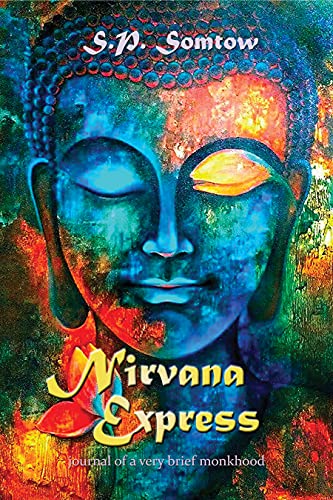
In Nirvana Express, author S.P. Somtow embarks on a highly personal journey, recounting his transformational experience of becoming a monk in Thailand. This special edition is poignantly dedicated to his father’s memory, who passed away in May 2023 and had himself been a monk at Wat Somanas.
Unlike his father, who was steeped in the traditions of Buddhism and the Pali language, Somtow was relatively unfamiliar with both the spiritual philosophy and the Thai culture when he made the seemingly impulsive decision to follow in his father’s footsteps. What emerges from this backdrop is a rich narrative detailing his daily life and duties in the monastery. From the solemnity of an Ordination Ritual to the humble act of carrying a begging bowl, from learning the art of detachment to the discipline of meditation, Nirvana Express provides a vivid glimpse into monastic life.
I approached Nirvana Express with both eagerness and anticipation, driven by my own fascination with spirituality and philosophy that has developed over the past few years. The idea of becoming a monk had long intrigued me, and I found in Somtow’s work a kindred spirit. Far from disappointing, this book is a comprehensive and enlightening guide to the physical environment, practices, and contemplative depths of monastic existence.
Somtow’s prose is both poetic and evocative, weaving sensational descriptions that stimulate the senses and the mind. Sentences like “Coruscating, scintillant rainbow rivers spiral and twist and whirl” left me enraptured, feeling almost as though I was floating through a dreamlike landscape.
Beyond the aesthetic beauty of his writing, Somtow’s intellectual depth shines through. His insightful perspectives on the contrasts between Buddhism and what he identifies as “the world’s great religions” mark him as both a deep thinker and a well-read individual. His contemplations on the synergy between Buddhism and modern scientific principles, such as the Third Law of Thermodynamics, added further intrigue.
The author’s voice resonates clearly throughout the text, creating an intimate connection with the reader. As Somtow explores one monastic practice after another, he candidly shares his emotions and reflections, allowing us to accompany him on this profound spiritual journey.
Nirvana Express is more than a detailed account of one man’s quest to become a monk. It is an engaging discourse on Buddhism, emphasizing the universal values of compassion and acceptance. Whether you’re a seeker on the spiritual path or simply curious about the monastic life, this book offers a memorable, engrossing, and thought-provoking read that promises to stay with you long after you turn the last page.
Pages: 245 | ASIN : B07GC889CG
I’ve Always Been Interested in Ancient History
Delicatus follows a young boy from ancient Rome who is enslaved by pirates and becomes a key player in Poppeae’s plot to become the Divine Empress. Where did the idea for this novel come from?
I first encountered Sporus at Eton, studying Alexander Pope with the remarkable teacher Michael Meredith, a guru to generations of literary and stage personalities. Pope’s satire on an 18th century local aristocrat notorious for sexual ambiguity led me to be fascinated by this figure, who was well known enough in 18th century England for a poet to allude to him in a satire, yet mostly just a footnote in history books about ancient Rome today if he appears at all. I would encounter this character from time to time (there’s an illusion, for instance, in the TV series “Succession”) but there are only scraps in the historical record. But what scraps they were! Not just the relatively well-known bit about Sporus getting castrated by the emperor Nero and made his wife … but what happened to Sporus in the year 69 AD when four different emperors held the throne and all had a different relationship with Sporus … from a second wedding to an order to execute him in the arena … and all before Sporus turned twenty. But it took me another fifty years before thinking of it as a novel.
What kind of research did you do for this novel to ensure you captured the essence of the story’s theme?
I’ve always been interested in ancient history and I’ve written both serious and satirical novels in that setting, so I have been doing research for decades. It’s a way of taking revenge on my bullying Latin teacher, as well. I’ve read most of the primary sources (some in the original) but more important, I spent a lot of time daydreaming about what that world, with its radically alien attitudes, was really like … because, despite its weirdness, it is a world populated by real people who speak to us today. One of the things that is hardest to wrap one’s mind around is that absolutely no one that there was anything wrong with slavery, and that because slaves could not be distinguished by race, there was a kind of continuum where you rise to a position of great power and still technically be a slave. Big things like that influence the world-view, but also little things, like human urine being collected to use in laundries. This is a very well studied period so there is a lot of consensus about what this world was like. But there are still gaps in the consensus and this is where imagination comes in.
What is one pivotal moment in the story that you think best defines Sporus?
When Sporus receives his freedom from Petronius, and realizes that in many ways nothing has changed. In a sense this is a central theme of the story. Even the Emperor, we’ll see in the second book, suffers from a kind of enslavement.
To be honest, I didn’t originally conceive of this as a trilogy but as a big fat book. But I’m getting on in years and I want to make sure the whole story comes out. In terms of the trilogy, the real pivotal moment probably happens in the middle of Book Two … I am writing that moment even as we speak.
Can you tell us what the second book will be about and when it will be available for fans to purchase?
The second book will be on sale Dec 1 and is already available for pre-order. The second book deals with Sporus actually becoming Empress and takes us to the humiliating end of his reign … and the third book deals with Sporus’s life in the Year of Four Emperors … perhaps the most eventful time of all.
If readers can’t wait, and have a U.S. Amazon account, they can find the Delicatus series posted in installments on the amazon vella platform, where we are almost half-way through the second book.
Author Links: GoodReads | Twitter | Facbook | Website
World Fantasy Award winner S.P. Somtow weaves a vivid adventure about one of the most colorful personalities in ancient Rome. Delicatus, the first volume in a trilogy, speaks of Sporus, from his enslavement by pirates in a remote corner of the Empire to his meeting with the great satirist Petronius and the woman to whom he bears a striking resemblance, the beautiful Poppaea with her manipulative plans to seduce the Emperor Nero and become Divine Empress.
Delicatus: From Slave to Empress in Imperial Rome
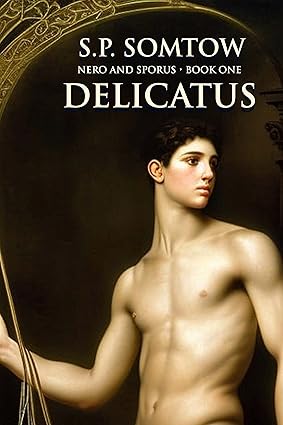
The Roman Empire stands as a repository of numerous invaluable treasures, ranging from priceless works of art to awe-inspiring feats of engineering and architecture. Rome, over the course of millennia, has indelibly carved its legacy. However, greatness is not achieved without a steep cost, and in the case of Rome, that cost was borne by the countless lives of enslaved individuals. Sporus, among the millions who enabled the grandeur of Rome, emerges as a protagonist whose narrative traces the trajectory of a young boy ensnared by slavery, transformed into a plaything for the affluent and influential. His tale epitomizes internal fortitude, adaptability, and an unwavering yearning for freedom in the face of seemingly insurmountable odds.
Within the pages of Delicatus by S.P. Somtow, readers are invited to embark on a deeply personal journey, experiencing the world through the eyes of a young child ensnared and subjugated by Romans. The narrative casts a revealing light upon the lives of the opulent and influential of Nero’s era, all observed from the unique vantage point of an enslaved child who was procured and conditioned to satiate the carnal desires of his masters. This unfiltered portrayal immerses us in the complexities arising from personal and cultural disparities, as sex, politics, and personal safety intertwine, weaving a tapestry that resounds with authenticity and relevance.
Delicatus is an exceptionally well-crafted work of fiction that seamlessly transports its readers into the unrefined facets of Roman life. The author deftly incorporates nuanced themes of gender identity and human sexuality, skillfully avoiding the imposition of modern values upon the subject matter. The prose emulates the style and language of contemporary writers of that era, effectively channeling the spirit of the time. While the narrative delves into graphic and mature content, the author’s discerning approach ensures that it is rendered with consummate taste. This book comes highly recommended for discerning and mature readers who seek to truly immerse themselves in the sights, sounds, and smells of authentic life within Nero’s Rome, all from the perspective of an unlikely protagonist.
Pages: 246 | ASIN : B0BR88V6VZ



 LITERARY TITAN