Blog Archives
The Paradox of Progress: Book 2: The Roses and Thorns of Artificial Intelligence


Michael M. Karch’s The Paradox of Progress is a thoughtful and personal exploration of artificial intelligence and the tangled web of benefits and risks it brings to modern life. The book is framed around the central idea that progress never comes without a price. Each chapter highlights a paradox, such as self-driving cars that promise safety yet pose new dangers, batteries that drive clean energy but scar the environment, and AI in war that might save lives but could also escalate conflicts. Karch skillfully balances the roses with the thorns, using vivid historical parallels, personal anecdotes, and contemporary case studies to show how every leap forward reshapes society in both hopeful and unsettling ways.
Karch’s writing feels conversational, even playful at times, yet it never loses sight of weighty ethical questions. I especially liked how he wove his own experiences into the narrative. The self-checkout story, his Ironman accident, and his work as a surgeon with AI-driven tools. These moments gave the book texture and heart, reminding me that discussions about AI are not just technical but deeply human. The prose is clear, free of jargon, and sprinkled with humor, which makes even the most complex topics easier to digest.
What I liked most was the author’s mix of optimism and unease. His fascination with AI’s potential is genuine, but so is his fear of its misuse. I shared his awe at the possibilities. Medical breakthroughs, global problem-solving, and smarter systems that could ease human suffering. And I shared his anxiety about the darker flipside. Bias in algorithms, surveillance, widening inequality, war machines that act faster than human conscience. The book stirred both excitement and caution in me, sometimes within the same page. It left me reflecting not just on AI, but on human nature, since at its core, this isn’t a book about machines. It’s about us, our flaws, our hopes, and our choices.
I think The Paradox of Progress is a book best suited for readers who are curious about AI but not looking for a technical manual. It’s written for people who want to think, not just learn facts. I’d recommend it to policymakers, students, teachers, and anyone who has felt both wonder and dread at the pace of change around us. It’s not a book that will tell you what to believe about AI. Instead, it invites you into a bigger conversation, one that we all need to be having before the thorns outgrow the roses.
Pages: 236 | ASIN : B0FNDN4FYY

Tech Confidential: The Insider’s Playbook for Daring Entrepreneurs
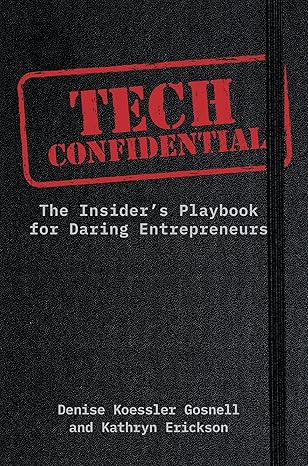
Tech Confidential by Denise Koessler Gosnell and Kathryn Erickson is part memoir, part survival guide, and part no-nonsense startup playbook. Structured in four “levels,” it blends personal war stories from Silicon Valley with lessons on leadership, resilience, and strategy. The authors pull back the curtain on the tech industry’s chaos, highlighting ego traps, toxic culture, funding realities, and the gritty human side of innovation. It’s blunt, funny, and practical, written to prepare readers for the messy reality of building a career and company in tech without losing their health or their soul.
The writing has a raw and punchy style that keeps you hooked, moving from hard-earned truths to ridiculous anecdotes without losing momentum. I loved that they owned their mistakes as openly as they exposed bad actors. It made the lessons feel earned rather than preached. Some of the analogies are wild, dumpster phoenix and gladiator arena, and yet they stick with you because they capture the absurdity of working in high-stakes tech. It’s not polished in the corporate sense, and that’s exactly why it works.
I enjoyed the balance between cynicism and hope. The authors don’t whitewash the burnout, politics, and plain bad behavior that plague the industry, but they never let it slip into pure bitterness. There’s a steady thread of belief in people’s ability to change, to lead better, and to protect their own boundaries. At times, the bluntness hits hard, and at others it feels like a pep talk you didn’t know you needed. I also appreciated how they mixed in concrete, tactical advice, like how to spot ego traps, how to build real teams, and how to survive acquisitions, without burying you in jargon or theory. It’s written for people, not for résumés.
I’d recommend Tech Confidential to anyone considering a leap into the startup world, to mid-career tech leaders wondering if the next rung up the ladder is worth it, and to anyone who’s ever felt like an outsider in the industry. It’s a book for people who can laugh at the chaos while still wanting to make something meaningful out of it. If you’re looking for a glossy playbook with neat frameworks, this isn’t it. But if you want the messy, funny, and often sobering truth, and a reminder that you’re not alone in the madness, you’ll get a lot out of this.
Pages: 203 | ASIN : B0FM4DZHCR



 LITERARY TITAN