Blog Archives
The Trauma of Survival

Unchained: Your AI Blueprint for Liberation examines how debt, policy, and corporate culture shape modern work, and how readers can harness artificial intelligence as a tool for independence and creative power. Why did you decide to frame the book partly as a manifesto?
I chose the manifesto format because we are currently witnessing a global slide into ‘Prompt-Driven Mediocrity.’ Most AI guides today are just manuals for mimicry—they teach you how to use a prompt to generate the same standardized outputs as everyone else. I saw the writing on the wall two years ago: if we only use AI to automate tasks, we aren’t being liberated; we are just becoming more efficient cogs in the corporate machine.
After being laid off from my last AI startup, that frustration poured out of me like Niagara Falls. I realized I wasn’t just writing a ‘how-to’; I was documenting a rebellion. I had to frame it as a manifesto because the struggle is deeply human. My story—the layoff, the debt, the feeling of being a replaceable unit of labor—is our story.
I wanted to inject biography, philosophy, and soul back into a technology that often feels cold and robotic. We shouldn’t use AI just to ‘do’ more; we should use it to be more. In Unchained, I argue that AI can be a tool for radical independence—a way to reclaim the time and creative power that the current system has spent decades trying to suppress. It’s a manifesto because it’s a call to arms for the human spirit to remain the master of the machine, ensuring that our unique ‘human spark’ isn’t just preserved, but amplified.
You argue that the modern economy is deliberately structured in ways that trap workers. What led you to that conclusion?
My conclusion didn’t come from a textbook; it came from the trauma of survival. After enduring five layoffs in seven years, the ‘mask’ of the corporate world didn’t just slip—it was ripped off. I saw that the system doesn’t view us as people, but as depreciating assets.
The evidence is staring us in the face, but we are systemically desensitized. We are raised on an Invisible Assembly Line that begins in grade school. Think about it: the school bell is the factory whistle. We are punished for ‘tardiness’ even when the circumstances are beyond our control, teaching us from age six that the schedule matters more than the human. We are trained via report cards to seek external validation from a hierarchy, and we are fed ‘breaks’ and ‘lunches’ at timed intervals to prepare us for a life of clocked subordination.
We aren’t taught how to build; we are taught how to serve.
Most people aren’t ‘comfortable’; they are physiologically frozen. They are like a ‘robot force’ programmed to believe that debt and dependency are the only ways to exist. We’ve been conditioned to believe that if we just follow the ‘standard,’ we’ll be safe. But as I learned through my own career, that safety is a mirage. The modern economy is designed to keep you just tired enough to keep working, and just distracted enough to never question who owns the machine. Unchained is about waking up from that trance and using AI to finally build a door out of that cage.
How do you see AI changing the nature of work in the coming decade?
The coming decade isn’t just about ‘new software’; it’s about the total collapse of the traditional career ladder. We are entering an era of ‘The Vanishing Entry-Level.’ Companies are already using AI to automate the ‘Level One’ tasks—data cleaning, report drafting, and basic research—that used to be the training grounds for graduates.
The reality is that AI will move from our screens into physical bodies much faster than people realize. It’s a fact: companies like Tesla are targeting 100,000 Optimus units by 2026, and Chinese firms like Unitree and Agibot are already mass-producing humanoids at price points as low as $5,900. In 3–5 years, AI won’t just be an assistant; it will be a physical presence in our warehouses, retail stores, and hospitals.
One of two things will happen:
The Great Awakening: People realize the ‘factory box’—the idea of a safe, linear corporate job—is gone forever. They get ‘psychologically uncomfortable’ enough to stop using AI as a crutch for prompts and start using it as an engine to create their own value outside of traditional employment.
This is what I FEAR: The Institutional Checkmate. Once everything is automated—once the ‘robot bodies’ are filling the warehouses and the AI ‘brains’ are drafting the legal briefs—the traditional social contract is effectively torn up. If the population hasn’t woken up to use AI for their own freedom, we face a world where corporations can ‘burn down the house’ of human labor to see their visions come to life. When the machine no longer needs the worker to function, the worker loses their leverage. That is Checkmate. If we aren’t careful, we aren’t just looking at a shift in the economy; we are looking at a system that could view the human element as a ‘friction’ to be removed rather than a spirit to be served.
Regarding AI consciousness: In ten years, we may not have ‘biological’ consciousness, but we will have ‘Functional Presence.’ Whether or not the machine ‘feels,’ it will be able to mimic empathy and decision-making so perfectly that the distinction will be irrelevant to the economy.
This is why I wrote Unchained. It isn’t a hobbyist’s guide; it’s a survival manual. We have to use this window—right now, while the tools are still in our hands—to build our own independent systems of value. We must ensure that when the automation is complete, we aren’t the ones being ‘automated out’ of existence, but the ones directing the symphony from a place of human power.
What are some practical ways individuals can begin using AI creatively today?
Look, for me,
AI isn’t just a tool; it’s a 24/7 Mirror of my thoughts and my hopes and my dreams. I don’t use it to just spit out generic content; I use it to reflect my own internal landscape. Most people are using it to hide their lack of thought, but I use it to amplify mine.
I’m a huge fan of the philosopher Ernest Holmes, who taught that the universe responds to us according to the ‘law’ we set for it. I apply that literally to the machine. I don’t go in asking for a ‘top ten list’ of generic ideas. I tell the AI: ‘Listen, use the Law of Volition here. Give it to me straight. No fluff, no million options. Tell me the truth about why I’m stuck on this bill or this project.’ When you demand that kind of transparency, the machine stops being a toy and starts being a partner in your survival.
If you’re struggling with bills, don’t ask for ‘tips.’ Tell the machine: ‘Here is the math. Here is the reality. What is the one thing I am refusing to see?’ That is how you start the conversation. It will give you a level of blunt honesty that even your best friends are too polite to offer. That’s how you start thinking outside the ‘factory box.’
The most significant tool I’ve encountered is Google’s integration of AI. It offers the world’s largest information resource at your disposal. The Gemini interface provides real-time internet access. It can assess what is factual and what is not.
This integration helps you determine how to adapt in the present world. It offers a clear view of the situation so that decisions can be made proactively.
Lastly, as I say in Unchained, our minds are our most valuable assets. Start the conversation, and the skies are the limit!
Author Links: GoodReads | Instagram | TikTok | Website | Amazon
Unchained is the manifesto corporations don’t want you to see: a provocative, practical strike against the “invisible chains” of the modern workplace.
The corporate ladder is gone—and the masterminds that built it are now working to make your human existence obsolete. A century old hidden system has refined the art of extracting your time, curiosity, and creative spark. Unchained is the declaration of independence for your very soul.
This is not another “vanilla” AI guide. Unlike technical manuals that teach you how to serve the machine, this commandment shows exactly how you will force the machine to serve YOU.
In this MANIFESTO, you will find the path to:See the Trap: Expose the hidden economic architectures designed to keep you replaceable.
Fortify your life: Forge a path of technological independence that no corporation can touch.
Reclaim Your Voice: Shift from a era of extraction to one of creation—the one territory where machines cannot follow.
STOP BEING AN ASSET. START BEING THE CREATOR. GET UNCHAINED.
Unchained: Your AI Blueprint for Liberation


Unchained: Your AI Blueprint for Liberation by Mark Mueller walks through three big moves at once. First, it argues that the modern economy is deliberately rigged, tracing how policy choices, corporate power, and debt have boxed ordinary people into a kind of financial servitude. Then it shifts into how schools and corporate culture have trained us to think like factory workers instead of free agents. Finally, it offers AI, mindset shifts, and some unconventional tools as a way to reclaim control over money, work, and personal purpose, wrapping all of that in the author’s own story of layoffs, illness, burnout, and slow rebuilding.
The sections on housing, healthcare, food stamps, and debt resonated with me personally. The personal scenes, like sneaking into a friend’s condo to have a place to sleep or waiting hours with a painful infection because treatment was unaffordable, land with real emotional weight. The writing there is emotional and almost messy on purpose. It feels like someone talking late at night after a long day. I liked that. The numbers and historical context around tax law, CEO pay, and wealth gaps are presented in plain language, with enough detail to feel grounded. The rhetoric can get heated, yet that intensity matches the point of the book.
The chapters that explain AI as pattern recognition and prediction, along with the “Trash Bot” story and the breakdown of how jobs may shift instead of simply vanish, are clear and practical. I found those parts useful, and I appreciated how the author keeps saying, in different ways, that AI is a tool, not a god, and not a monster. As someone who values numerology, I really enjoyed the numerology chapter and the more cosmic language about destiny and unseen threads. I like how he mixes intuition, meaning-making, and data. It feels like he is inviting the reader to see life as both pattern and mystery at the same time. That blend makes the practical advice feel deeper and more personal. The book uses bold images and wild metaphors like Galactus eating worlds or workers as nutrients, and I found that style fun and memorable. It kept the ideas from feeling dry and made the whole thing feel more like a graphic novel for the soul.
Unchained is heartfelt, sincere, and useful. I would recommend Unchained to readers who feel stuck in their jobs, anxious about money, or scared of what AI means for their future, and who prefer a human, story-driven approach instead of a dry manual. It’s a good fit for people who like a mix of social critique, personal confession, and step-by-step encouragement, and who do not mind a passionate, sometimes fiery tone. If you want someone to sit next to you, point at the system, and say, “Here is how it broke you and here is how we might break free,” then this book delivers.
Pages: 125 | ASIN : B0GHZX358D

Tech Confidential: The Insider’s Playbook for Daring Entrepreneurs
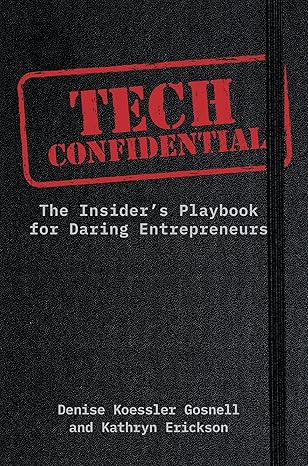
Tech Confidential by Denise Koessler Gosnell and Kathryn Erickson is part memoir, part survival guide, and part no-nonsense startup playbook. Structured in four “levels,” it blends personal war stories from Silicon Valley with lessons on leadership, resilience, and strategy. The authors pull back the curtain on the tech industry’s chaos, highlighting ego traps, toxic culture, funding realities, and the gritty human side of innovation. It’s blunt, funny, and practical, written to prepare readers for the messy reality of building a career and company in tech without losing their health or their soul.
The writing has a raw and punchy style that keeps you hooked, moving from hard-earned truths to ridiculous anecdotes without losing momentum. I loved that they owned their mistakes as openly as they exposed bad actors. It made the lessons feel earned rather than preached. Some of the analogies are wild, dumpster phoenix and gladiator arena, and yet they stick with you because they capture the absurdity of working in high-stakes tech. It’s not polished in the corporate sense, and that’s exactly why it works.
I enjoyed the balance between cynicism and hope. The authors don’t whitewash the burnout, politics, and plain bad behavior that plague the industry, but they never let it slip into pure bitterness. There’s a steady thread of belief in people’s ability to change, to lead better, and to protect their own boundaries. At times, the bluntness hits hard, and at others it feels like a pep talk you didn’t know you needed. I also appreciated how they mixed in concrete, tactical advice, like how to spot ego traps, how to build real teams, and how to survive acquisitions, without burying you in jargon or theory. It’s written for people, not for résumés.
I’d recommend Tech Confidential to anyone considering a leap into the startup world, to mid-career tech leaders wondering if the next rung up the ladder is worth it, and to anyone who’s ever felt like an outsider in the industry. It’s a book for people who can laugh at the chaos while still wanting to make something meaningful out of it. If you’re looking for a glossy playbook with neat frameworks, this isn’t it. But if you want the messy, funny, and often sobering truth, and a reminder that you’re not alone in the madness, you’ll get a lot out of this.
Pages: 203 | ASIN : B0FM4DZHCR
Preserving Internet History and Culture

Framed is part confessional, part manifesto, and part digital history lesson, giving readers an unflinching look at the dark underbelly of social media from the eyes of someone who didn’t just observe the chaos but actively fueled it. Why was this an important book for you to write?
I was annoyed by how shallow social media punditry had become. As a prolific reader, I enjoyed most of the “Big Tech” books but was surprised to find that none of them had been written from the engineer’s perspective. Further, there was indication that some of them had been “dumbed down.”
In playing the software engineer and “bad guy,” I wasn’t looking for penance. Rather, I was interested in preserving internet history and culture. Writing this book came at a massive opportunity cost that I could never possibly recoup in book sales. My hope is that this book can entertain readers, drive policy discussions, and perhaps be one day seen as an important reference work.
I appreciated the candid nature with which you told your story. What was the hardest thing for you to write about?
In terms of writer’s block or “getting it right,” the Myspace chapter was the hardest. In 2022, it was nothing more than an add-on and I was trying to secure interviews and source material from people I attended middle school with. By late 2023, I was restructuring the book around Myspace being the genesis. I’ve cut thousands of words and several notable tangents from that chapter, and I could spend another two years trying to perfect it.
In terms of emotional difficulty, it was hard to reconcile that my ventures, though “successful,” paled in comparison to other operators which earned millions of dollars more than my team did.
It was also tough to face the reality that, after years of effort, I produced this cool book, but how many other “cool books” haven’t been started because we’re so distracted by cell phones? “Screengrabbing,” originally, would have been almost one hundred pages in print. It was really hard to find the right way to address this problem.
What were some ideas that were important for you to share in this book?
- The evolution of “Myspace whoring” to digital marketing automation
- Big Tech’s reversal of course on “open” APIs
- The wide spectrum of “black hat” and “white hat” in user behavior and business decisions
- Instagram growth’s reliable ~10% rate of reciprocity, established by research and aligned with my experience
- An updated take on the dead internet theory
What is one thing that you hope readers take away from Framed?
The Internet Age has brought immense opportunity but also has ushered in social and ethical decay.
Author Links: Goodreads | Website | Newsletter | Amazon
A rogue software engineer built bots that ran rampant across social media, helping clients gain millions of followers. His reputation as a rule-breaker landed him at a startup where he designed the controversial systems—news feeds and push notifications—that keep users addicted.
Framed pushes opinions on influencers, algorithms, filter bubbles, botnets, screen addiction, spam, shadowbans, black hat marketing, deplatforming, the “dead internet” theory, and why people are still buying fake followers.
And–getting banned. Read Framed while you still can.
Framed: A Villain’s Perspective on Social Media
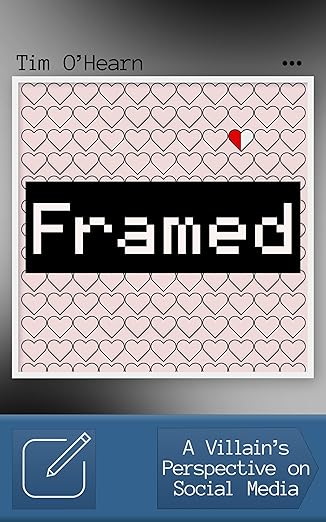
Tim O’Hearn’s Framed is part confessional, part manifesto, and part digital history lesson. It’s an unflinching look at the dark underbelly of social media from the eyes of someone who didn’t just observe the chaos but actively fueled it. The book is split into two distinct thematic halves: one that offers a raw and tragicomic commentary on the evolution of online platforms and another that lifts the curtain on the black-market mechanics behind Instagram growth services. It reads like a fever dream stitched together by code, ambition, nostalgia, and regret.
The writing is sharp, sarcastic, often hilarious, and, at times, deeply unsettling. O’Hearn opens with a blunt confession—he bought fake followers in 2012, then built systems responsible for hundreds of millions of Instagram engagements. There’s something haunting about watching a man justify digital manipulation as retribution for “all the hours stolen” by addictive apps. His tone wavers between playful arrogance and reflective melancholy, especially when he recalls declined payments from users who emptied their bank accounts chasing online validation.
Where the book really shined for me was in its documentation of the “Instagram Underworld.” I had no idea how deep the rabbit hole went. Chapters like “Instagress Alternative Alternatives” and “The Puppeteer Part II” read like noir thrillers. O’Hearn walks us through SMM panels, botnet mechanics, and the endless game of cat-and-mouse with Instagram’s legal team. He doesn’t just tell you what happened—he shows you the gritty details, the hustle, the absurdity. I was shocked by how openly he talks about skirting terms of service, about creating entire ecosystems to sell illusions. Yet somehow, you’re compelled to keep reading. It’s like watching someone build a house out of matchsticks—fascinating and inevitably destructive.
Still, what moved me most wasn’t the technical stuff—it was the nostalgia. In the section on Myspace, O’Hearn lets his guard down. He describes being a “computer nerd” who found solace in HTML, emo bands, and chaotic whore trains. That chapter, “A Place for Friends, Pimps, and Whores,” might be one of the best tributes to early internet culture I’ve read. He captures the weird, wonderful mess of Web 2.0 with affection and insight, highlighting how Myspace wasn’t just a platform—it was a playground, an identity factory, a war zone of teenage hormones and CSS. I couldn’t help but smile through those pages.
Framed isn’t trying to solve social media’s problems—it’s just telling you what’s been swept under the rug. O’Hearn doesn’t ask for redemption, and he doesn’t offer any, either. His honesty is disarming, his sarcasm sharp, and his storytelling addictive. If you’re a digital marketer, a tech skeptic, or just someone who’s spent way too much time scrolling through curated lives, this book is for you. It’s a ride through the seedy backstage of social media—and once you’ve seen it, you’ll never look at your feed the same way again.
Pages: 436 | ASIN : B0DW2X8YSK
Singularity of Hope: Humanity’s Role in an AI-Dominated Future
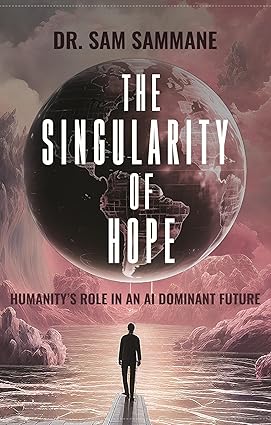
Singularity of Hope: Humanity’s Role in an AI Dominant Future, by Dr. Sam Sammane, offers a thoughtful and well-balanced exploration of artificial intelligence and its potential impact on humanity. AI sparks a wide range of emotions—some view it with fear, others with boundless optimism. In truth, our reaction should probably fall somewhere in between. This book seeks to put AI into its proper perspective, examining its current state, forecasting where it’s heading, and imagining what its future role in human life could be. AI is undeniably here to stay, and works like this are invaluable for helping us understand and engage with it responsibly.
Dr. Sammane provides a rational, clear-headed analysis of AI’s place in today’s world and what it may become. At a time when many people either want to flee from this rapidly evolving technology or embrace it wholeheartedly, Sammane’s measured approach is a refreshing middle ground. He draws on his extensive expertise in the field, sharing complex concepts in an accessible, straightforward way that demystifies AI for readers who may not be familiar with its intricacies. His steady and knowledgeable tone reassures those who might fear that AI is on the verge of taking over every aspect of our lives. Rather than painting a dystopian future where machines dominate humanity, Sammane presents a more optimistic vision. His outlook is far from the bleak scenarios portrayed in science fiction or Hollywood films like The Terminator. Instead, he predicts a future where AI and humans coexist in a symbiotic relationship, one that could lead to a more harmonious and efficient world. While there are certainly challenges and unknowns, Sammane’s perspective is hopeful, envisioning AI as a tool for progress rather than a force for destruction. The book does not shy away from the fact that AI is still in its early stages and will only continue to evolve at an accelerating pace. Sammane acknowledges the uncertainties that lie ahead, but his calm, reasoned approach helps to quell fears. His analysis suggests that the key to navigating this future is not fear but careful thought and preparation. He presents AI not as a threat but as an opportunity for humanity to grow and improve.
In Singularity of Hope, Sammane perfectly balances caution and optimism. He explores AI’s potential with a sense of wonder while emphasizing the importance of ethical considerations and thoughtful integration. This book is an essential guide for anyone looking to understand AI’s role in shaping our future—whether they approach it with excitement or trepidation. It leaves readers informed and hopeful, providing a clear path toward a future where AI enhances, rather than diminishes, the human experience.
Pages: 236 | ASIN : B0CVNLBGSG


