Blog Archives
The Leaders You Leave Behind


Robert Moore’s The Leaders You Leave Behind is a practical, personal leadership book built around one steady conviction: the mission matters, but people are the way the mission survives. Drawing from his Army career, his work in Iraq, his shift into civilian technology leadership, and his years as a school district CIO, Moore argues for a leadership style that blends military discipline with servant-hearted care. The book moves through principles like leading by example, decentralized trust, clear standards, communication, adaptability, and leadership development, all ending with the idea that a leader’s real legacy isn’t a finished project or a polished résumé, but the people they helped become capable enough to lead after them.
I appreciated that Moore doesn’t write like someone trying to impress me with a theory. He writes like someone who’s been humbled by the work. There’s a grounded warmth in the way he returns again and again to the human cost of leadership, whether he’s describing the technician “John” who was struggling and needed support instead of punishment, or the boss who told him the best way to get the CIO job someday was to leave and grow elsewhere first. Those moments gave the book its pulse for me. The ideas are familiar in places, especially if you’ve read much leadership literature, but Moore’s strongest pages make them feel lived-in. I liked the way he refuses the cheap split between being results-driven and people-focused. His insistence that care is not softness, and that standards are not cruelty, feels both humane and hard-won.
The writing is clearest when Moore is telling stories. The image of soldiers in Iraq communicating with calm precision during a mission, or the “little groups of paratroopers” scattered across Normandy who still knew enough of the larger purpose to act, gives his arguments texture and movement. I also found his civilian examples surprisingly effective, especially the payroll outage, where he sets up hotspots and works alongside the team instead of managing from a safe distance. Moore is trying to hand the reader a usable compass, and I found that sincerity quietly persuasive.
By the end, what stayed with me wasn’t a single tactic, but a mood of responsibility. Moore’s idea of a personal leadership constitution could sound stiff in another book, but here it feels like a natural conclusion, a way of asking leaders to stop improvising their values only when pressure arrives. The Leaders You Leave Behind is a thoughtful, steady, emotionally honest book about leadership as stewardship, and its best pages carry the weight of someone who knows that people remember how they were led. I’d recommend it to new managers, military veterans moving into civilian leadership, school and nonprofit leaders, and anyone who wants a leadership book that’s practical without being cold and principled without being preachy.
Pages: 224 | ASIN : B0H24433M8

Exceptional Leadership

In The Exception Code, you share a framework for leadership that results in customer loyalty and profitability. Why was this an important book for you to write?
Because I’ve seen how organisations lose trust long before they lose revenue. Culture doesn’t collapse with a bang. It erodes quietly, in the meetings we tolerate, the standards we lower, and the good people we exhaust until they leave. Customer loyalty follows that same pattern. It doesn’t disappear overnight. It drifts.
I wrote The Exception Code because leaders deserve more than inspiration. They need an operating system. Something they can use when the pressure is real, when the targets are tight, when the team is tired, and the customer is one poor experience away from walking. This book is my answer to the question I kept hearing, even from strong leaders: “What do I do next, in a way that actually holds?”
Why Courageous Mindset first? Is courage the gateway trait to the other three pillars?
Yes. Courage is the gateway because it’s the first thing pressure tries to steal. Without courage, leaders manage appearances. They avoid the hard conversation, protect comfort, and call it “stability.” But stability built on silence is just delayed damage.
Courageous Mindset comes first because it gives you permission to face reality and act on it. It’s what makes an Original Approach possible, because you stop borrowing safe answers. It’s what makes Driven Impact sustainable, because you stop chasing wins that cost you people. And it’s what makes Enduring Legacy real, because you stop building cultures that collapse the moment you step away.
What is one meeting habit you believe most organizations get fundamentally wrong?
They use meetings to share information instead of making decisions. They confuse activity with progress. The calendar fills, the slides get sharper, and everyone leaves with the same unresolved issues they walked in with, just more tired.
A meeting should earn its time. It should produce clarity, decisions, and ownership. If it doesn’t, it becomes a slow leak in culture. People learn that truth is optional, accountability is negotiable, and momentum is something we talk about instead of creating. One of the fastest ways to change a culture is to change what your meetings reward.
What is one thing you hope readers take away from The Exception Code?
That exceptional leadership is not a label. It’s a discipline. And it’s available to any leader willing to stop leading by default.
If readers walk away with one thing, I want it to be this: you can build a culture that performs without burning people out, retains talent without begging, and earns customer loyalty without gimmicks. But it requires a code, not charisma. The book gives you that code, and it gives you a way to apply it immediately, starting with the next decision you make and the next standard you refuse to lower.
Author Links: GoodReads | Facebook | Website | Amazon
It’s failing because too many are leading by default.
Caught between quarterly pressures, cultural fatigue, and constant change, capable leaders are doing everything “right” while still watching engagement, innovation, and loyalty slip through their fingers.
So,The Exception Code is written for leaders who know there’s more to leadership than metrics, titles, and optics. It’s for CEOs, founders, and purpose-driven teams who want to build cultures that perform because they are principled, and keep performing even when the leader isn’t in the room.
Johnathan Johannes writes from the front lines of real change. He led one of the Caribbean’s oldest banks through pandemic disruption, a major transformation agenda, and a landmark acquisition in the Eastern Caribbean.
The lesson was clear: culture, retention, and customer loyalty aren’t “soft stuff.” They are the levers of sustainable profit.
This book gives you the clarity, conviction, and tools to lead that way.
No fluff. No jargon. No performative inspiration.
At its core, The Exception Code is not a collection of leadership hacks. It’s an operating system for leaders who want to build organizations worth believing in.
This book doesn’t offer easy answers. It offers a mirror, a method, and a movement for leaders willing to trade convention for conviction, and short-term wins for lasting influence.
If you’re ready to stop performing and start being the exception in your organization, this book is for you.
The Exception Code: How to Make Culture, Retention, and Customer Loyalty Profitable by Leading Like No One Else
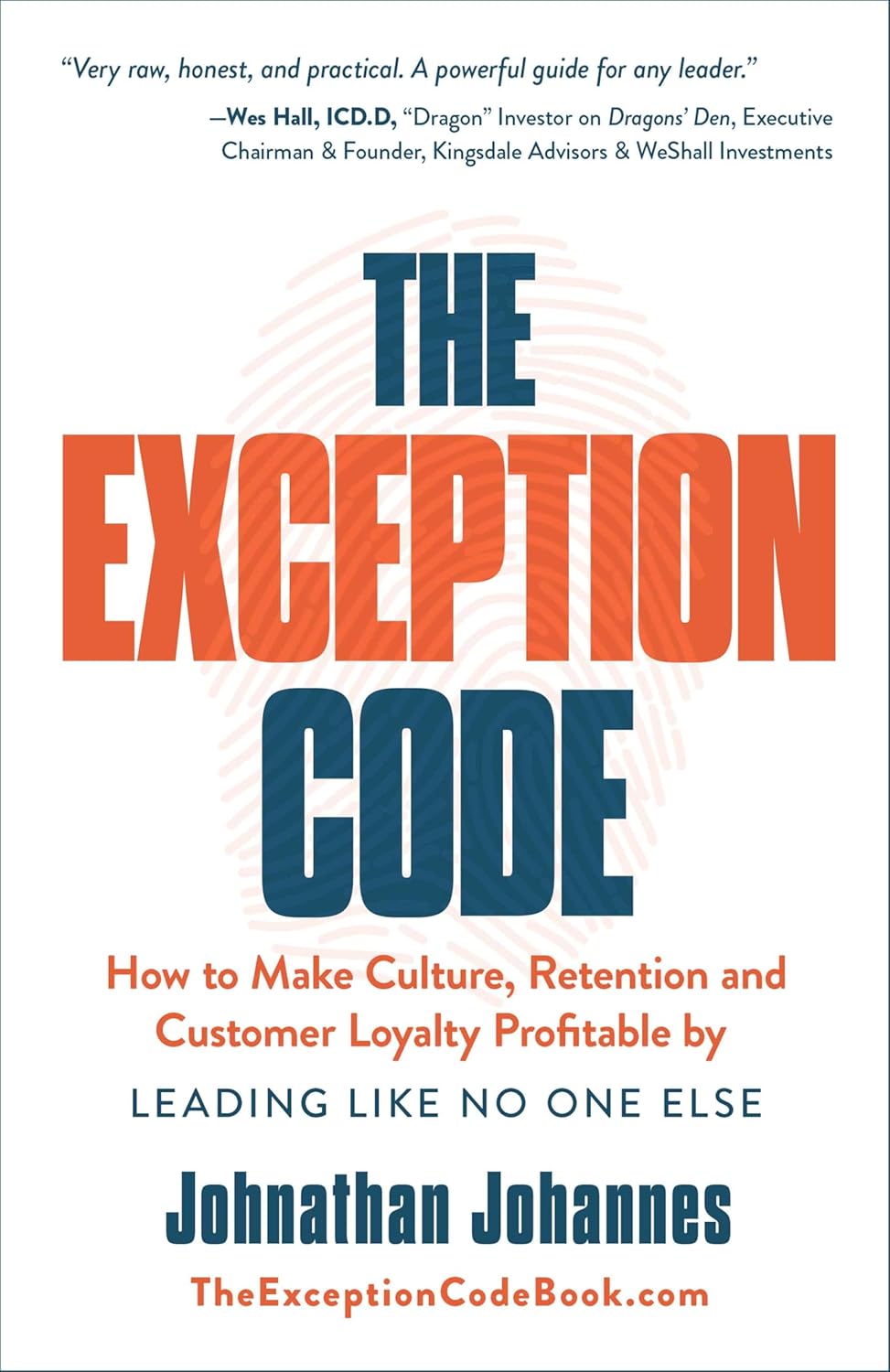

The Exception Code is a leadership book that blends manifesto and field manual. Author Johnathan Johannes draws on his experience leading a Caribbean bank through undercapitalization, a major acquisition, and the COVID crisis to argue that leaders need to stop performing and start being “the exception.” He organizes the book around the C.O.D.E. framework: Courageous Mindset, Original Approach, Driven Impact, and Enduring Legacy, and fills each part with stories, tools, and models like the Purpose Power Core and the Purpose Alignment Map that link culture, retention, and customer loyalty to real profitability.
The tone feels like a seasoned mentor talking across a table, not a distant guru on a stage. The personal stories really resonated with me. The scene where he discovers the bank’s capital hole and starts hustling for investment, and the episode with his wife in the hospital during the pandemic, give the book emotional weight and make the big ideas feel earned rather than rehearsed. I also liked how he circles back to a few anchor themes, especially purpose and integrity, so the argument feels cohesive. The content behind them is usually solid, clear, and easy to act on.
I think the book is strongest when it links purpose to daily behavior. The sections on meetings, onboarding, and performance reviews show how “exceptional” leadership can show up in very simple routines. His insistence that innovation is often cultural, not technological, felt very true, and the examples from Patagonia, Unilever, and Warby Parker help connect his banking world to a wider business landscape. While the book stays focused on clear lessons rather than deep dives into every tradeoff or setback, the streamlined case numbers and fast-paced success stories keep the narrative tight and energizing, and the core claim that purpose is anchored in conviction, compassion, and contribution not only feels right, it feels genuinely practical.
I would recommend The Exception Code to leaders who are already in the arena and feel the gap between their metrics and their meaning. Founders, senior managers, HR and culture leaders, and ambitious middle managers who sense “I’m winning the wrong game” will get the most from it. If you want a reflective, practical nudge to rethink how you show up, how you run your team, and what legacy you are quietly building every day, this book is a good fit and worth your time.
Pages: 335 | ASIN : B0G2YTBRLL
CULTURE RE-WIRED: Unleash Your Inner AI CEO

Culture Re-wired is part wake-up call, part playbook, and part pep talk. Author Ida Byrd-Hill dives straight into the heart of how artificial intelligence is reshaping business and insists that culture, not tech alone, determines who wins in this race. She draws on case studies, industry data, and real-life examples to demonstrate that both frontline workers and CEOs need to view AI as a partner, not a replacement. The book argues that human creativity, emotional intelligence, and culture are what turn AI into a genuine growth engine.
The writing style took me by surprise. It’s bold, loud, and packed with metaphors that sometimes felt like a pep rally. But the energy worked for me because the subject is urgent. The author doesn’t whitewash the fears people have about losing their jobs to AI, and she doesn’t dismiss those fears either. Instead, she shows how fear can kill innovation if it’s ignored. I found myself nodding along when she described middle managers as bottlenecks. I’ve seen that happen, and her advice on rewiring leadership training to focus on people skills resonated with me.
At the same time, I caught myself smiling at her bluntness. She doesn’t dance around her points, and that made the book fly by. The mix of statistics and case studies kept things grounded, but what I really liked were the stories of companies like Ford and Bank of America that had to push past cultural resistance to make AI stick. It’s one thing to say “culture matters,” but it’s another to show how culture literally makes or breaks billion-dollar rollouts. Reading those sections made me feel hopeful that AI doesn’t have to be a cold or scary thing. It can make work better if leaders get it right.
I’d recommend this book to managers, executives, and anyone who feels anxious about AI creeping into their job. It isn’t a technical manual. It’s about mindset. If you want to understand how culture drives technology instead of the other way around, I highly recommend this book. It’s equal parts practical advice and rallying cry, and it left me energized.
Pages: 128 | ASIN : B0FMYH3RQ1
Tech Confidential: The Insider’s Playbook for Daring Entrepreneurs
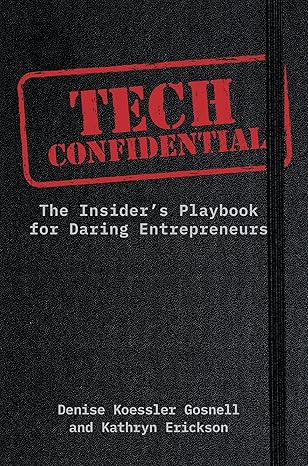
Tech Confidential by Denise Koessler Gosnell and Kathryn Erickson is part memoir, part survival guide, and part no-nonsense startup playbook. Structured in four “levels,” it blends personal war stories from Silicon Valley with lessons on leadership, resilience, and strategy. The authors pull back the curtain on the tech industry’s chaos, highlighting ego traps, toxic culture, funding realities, and the gritty human side of innovation. It’s blunt, funny, and practical, written to prepare readers for the messy reality of building a career and company in tech without losing their health or their soul.
The writing has a raw and punchy style that keeps you hooked, moving from hard-earned truths to ridiculous anecdotes without losing momentum. I loved that they owned their mistakes as openly as they exposed bad actors. It made the lessons feel earned rather than preached. Some of the analogies are wild, dumpster phoenix and gladiator arena, and yet they stick with you because they capture the absurdity of working in high-stakes tech. It’s not polished in the corporate sense, and that’s exactly why it works.
I enjoyed the balance between cynicism and hope. The authors don’t whitewash the burnout, politics, and plain bad behavior that plague the industry, but they never let it slip into pure bitterness. There’s a steady thread of belief in people’s ability to change, to lead better, and to protect their own boundaries. At times, the bluntness hits hard, and at others it feels like a pep talk you didn’t know you needed. I also appreciated how they mixed in concrete, tactical advice, like how to spot ego traps, how to build real teams, and how to survive acquisitions, without burying you in jargon or theory. It’s written for people, not for résumés.
I’d recommend Tech Confidential to anyone considering a leap into the startup world, to mid-career tech leaders wondering if the next rung up the ladder is worth it, and to anyone who’s ever felt like an outsider in the industry. It’s a book for people who can laugh at the chaos while still wanting to make something meaningful out of it. If you’re looking for a glossy playbook with neat frameworks, this isn’t it. But if you want the messy, funny, and often sobering truth, and a reminder that you’re not alone in the madness, you’ll get a lot out of this.
Pages: 203 | ASIN : B0FM4DZHCR
Why Aren’t Things Improving?

Unlocking Innovation introduces leaders to a framework called the ABCs—Behavior, Architecture, and Culture — by blending personal anecdotes, fictionalized case studies based on real people, and practical tools to guide readers through the psychological, structural, and cultural challenges that make or break innovation efforts. Why was this an important book for you to write?
For a long time, I resisted the idea of writing a book. Having spent most of my career in corporate innovation, the one thing I knew for certain was that the world did NOT need another book about innovation! There are thousands, maybe millions, out there, yet none of them have changed the results that corporates get from their innovation investments.
But then it hit me: If there are so many books about how to improve something, why aren’t things improving?
As I reflected on my experiences, patterns emerged: brilliant executives treating innovation like operations, teams getting crushed by unrealistic expectations, and 90% of corporate labs shutting down within three years. But it all boiled down to one thing.
Innovation isn’t an idea problem. It’s a leadership problem.
We’ve got plenty of ideas. What we don’t have are leaders who understand that everything that made them successful operators will doom them as innovators. This book exists because every executive tasked with innovation deserves better than innovation theater and false hope.
What were some ideas that were important for you to share?
First, do the opposite of your instincts. Like George Costanza, if every instinct you have is wrong, then the opposite would have to be right. It’s a simple concept that is incredibly hard to adopt. After all, your professional success created and honed your instincts, so ignoring them isn’t just difficult, it’s illogical. But innovation and operations are opposite worlds, which is why you need to do the opposite of the instincts that made you a successful operator.
Second, stop obsessing over finding the perfect process or structure for innovation. Those things are necessary but not at all sufficient for success. Instead, take a holistic approach by building the ABCs: Architecture, Behavior, and Culture. And focus on leadership behavior first because that’s what makes or breaks innovation investments.
Third, innovation is not an event. Stop wasting time and money on one-off hackathons, shark tanks, and startup field trips. Innovation ROI requires long-term investment not a one-day offsite.
What is one piece of advice you wish someone had given you when you were younger?
“I don’t have time” means “It’s not a priority,” and that’s perfectly fine because not everything can be a priority. As leaders, though, we need to own it and be honest about why we’re not engaging in something. And, as innovators, if we think something should be a priority, we need to work to figure out why it’s not and how to make it one.
Also, reflection isn’t navel-gazing; it’s how you turn experience into wisdom. Make time for it.
What is one thing you hope readers take away?
Success isn’t about beating the odds—it’s about changing lives. Every time you show someone they’re capable of more than they imagined, you’ve won. The real innovation isn’t the product you launch. It’s proving that doing the impossible is actually possible.
Plus, you should definitely have a cookie while doing all this. I recommend chocolate chip.
Only 1 in every 50,000 incubated ideas reaches $1 million in sales. If you ask most corporate executives why their companies’ innovation efforts fail, they’ll blame a lack of ideas or not enough big ideas. Innovation expert Robyn M. Bolton knows that innovation isn’t an idea problem, it’s a leadership problem. To drive real innovation, executives must defy the very instincts and behaviors that made them successful operators.
In Unlocking Innovation, Bolton draws on her twenty-five years of advising leaders to provide a practical, holistic innovation framework. Her ABCs of Innovation show leaders how to reshape their roles, teams, and organizations to create new value and catalyze corporate renewal from within. Using real-life stories, Bolton follows innovation leaders’ trajectories from heading up a new team and generating first results to navigating the inevitable crosswinds, complications, and conflicts—and ultimately delivering success. Unlocking Innovation is the essential guide for any leader tasked with innovating inside an established organization.
Unlocking Innovation: A Leader’s Guide for Turning Bold Ideas Into Tangible Results
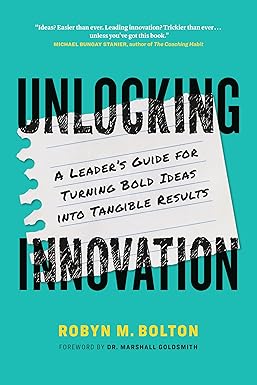
After reading Robyn M. Bolton’s Unlocking Innovation, I can confidently say this book is a grounded, clear-eyed roadmap for any leader tasked with driving innovation inside a large organization. Structured around a three-year journey, the book presents a framework called the ABCs—Behavior, Architecture, and Culture—to help leaders navigate the real-world messiness of turning ideas into results. Bolton blends personal anecdotes, fictionalized case studies based on real people (like Hope, Faith, and Victor), and practical tools to guide readers through the psychological, structural, and cultural challenges that make or break innovation efforts. It’s not about dreaming up ideas; it’s about executing them.
Bolton’s voice is smart and strategic without being stiff. She has a gift for calling out corporate B.S. in a way that makes you laugh. Her stories, especially those that show leaders hitting roadblocks or being sidelined, felt familiar. The emphasis on behavior was a refreshing twist. Most business books obsess over frameworks and processes, but this one starts with the leader’s instincts, habits, and emotional resilience. It reminded me that sometimes, the biggest barrier to innovation isn’t the budget or the board, it’s us. Her advice to “do the opposite” of what made you successful in traditional roles resonated with me.
The year-by-year breakdown sometimes felt rigid, but even then, Bolton anticipates this and builds in flexibility. Her “Know Your” sections and TL;DR summaries are smart additions—like breadcrumbs through a dense forest. And the running joke about cookies was both charming and weirdly effective.
Unlocking Innovation is one of the few business books I’d recommend without hesitation to anyone leading innovation inside a complex organization. It’s especially useful for middle and senior managers who feel stuck between the C-suite’s demands and their team’s frustrations. If you’re tired of fluffy innovation talk and want something that respects both your intelligence and your time, this book is for you.
Pages: 223 | ASIN : B0DTRXX23S

Radicle Growth: Transform into an Unstoppable Leader through Mastering the Art of Questions

Radicle Growth is all about flipping the script on leadership. Dave Reynolds argues that the best bosses aren’t the ones with all the answers; they’re the ones with all the right questions. He shares a coaching framework rooted in asking purposeful questions to help employees grow into problem-solvers and leaders themselves. The book is part how-to, part mindset shift, and full of stories and analogies that make it stick. From managing up, down, and across to creating systems that build accountability, Reynolds wants you to stop managing and start coaching.
I dove into this book expecting another corporate pep talk with catchy buzzwords and vague advice. What I got instead was something surprisingly personal and kind of refreshing. Reynolds opens with a simple question he poses to new managers: “Who was your toughest boss?” and then follows it up with, “Who was your best boss?” The aha moment is that they’re often the same person. That cracked me open a bit. It’s so real. We remember the ones who pushed us because they made us better. I loved how Reynolds used this to frame the rest of the book. It sets the tone: this isn’t about making people feel good all the time; it’s about helping them grow. And sometimes growth feels like friction.
One of my favorite parts was the “don’t feed the ducks” story. Reynolds shares an anecdote about a high-performing salesperson who regularly handed off his leads to underperforming teammates. At first glance, this might seem generous or even admirable. However, Reynolds reframes the situation, revealing that such behavior fosters dependence rather than growth. He points out that the guy was actually creating dependency and hurting everyone’s growth in the long run. That’s what coaching solves. You guide people to find their own fish instead of tossing them one. This idea stuck with me. Reynolds makes it clear that it’s a short-term win and a long-term loss.
I also appreciated that Reynolds didn’t try to be some untouchable guru. He admits he learned all this the hard way, first in telecom, then across industries. The anecdote involving Reynolds offering impromptu coaching to a banking executive during an NHL game stands out as particularly impactful. It’s not about having all the technical knowledge; it’s about knowing how to ask questions that spark clarity. The idea that the less you know, the more you can help blew my mind. It reframes the whole idea of expertise.
Radicle Growth is less of a manual and more of a mindset shift. It’s a book for anyone in a leadership role who feels like they’re constantly stuck in the weeds, answering questions, solving problems, never really freeing up their time or developing their people. If you’ve ever felt like you’re just putting out fires instead of building something lasting, this book is for you. It’s great for managers, coaches, and even parents. Anyone who wants to learn how to lead with intention, not just authority.
Pages: 172 | ASIN : B0DWYQ7HDK


