Blog Archives
The Dangers of Time Travel

Furniture Sliders follows a former intelligence officer who is pulled back in to discover what has happened to a classified project and the people working on it, which controls time, memory, and identity, and is now missing. What was the inspiration for the setup of your story?
I have always been a fan of both film noir and espionage novels plus I have a tech background and a fascination with quantum mechanics. I wanted to write a story that felt like a 1940s Cold War spy thriller written in noir style—then break it wide open with the addition of speculative science fiction. I had a question: what if you take the characteristics of quantum mechanics such as superposition and entanglement and instead of applying them to atomic particles, you applied them to human beings? To spies? Can you be in two places at once or two timelines at the same time? Firstly, apply the ability to manipulate space and time and then take it even further by playing in panpsychism – the concept that every inanimate object can be sentient. Of course, you would have to have some form of technology to do all of this – the Mirror is exactly that inspired by the one in my hall at home. The title literally came from a box of plastic furniture sliders that were on the table at home with the box looking like a paperback book – Furniture Sliders on the spine! Sliders was a perfect description for agents moving through space and time and their organization is called the Bureau, along with the Mirror, giving the initial tongue-in-cheek furniture connection.
I found Max Calder to be an intriguing character. What was your inspiration for this character?
Max Calder is the kind of character I love; deeply broken but still pushing forward through the fog. It isn’t about a single character or character flaw but about weaving influences together. I guess Max carries echoes of Raymond Chandler’s Philip Marlowe and Graham Greene’s morally ambiguous operatives. He isn’t polished like Bond, but weary, suspicious, and prone to moral compromise – a man affected by the machine he serves. I tried to deliberately write against cliché by grounding him in history and psychology. His gaps, duplications, and doubts reflect not only the dangers of espionage but the fragility of identity itself. Unlike many spy archetypes, Calder isn’t defined by conquest or success, but by survival, mistrust, and fear of irrelevance — hopefully making him come across as human, flawed, and complex. In many espionage novels, agents and spies are unaffected by what they do and are amazing at executing their role. In the case of Max, I wanted him to be very affected. Remorse, regret, and inner demons.
What themes were particularly important for you to explore in this book?
Primarily the consequences of messing with time and how doing so can also mess with you physically, potentially drive you insane and affect your memory while creating echoes or even doppelgangers as time threads overlap. All caused by, or underpinned by, the human-applied characteristics of quantum mechanics. It was important to explore relationships especially between protagonists and antagonists and between espionage agents and technology pitching various spy agencies against each other – even if they are supposed to have great relationships. I also wanted to introduce fictionalized real-life characters to the storyline which in this book includes Alan Turing, Hugh Sinclair and William Stephenson.
Where does the story go in the next book, and where do you see it going in the future?
There are two more books coming in the series. Angus Sliders and Cuban Sliders. Angus Sliders is planned to publish on the 15th December. One of the challenges with quantum-based technology like the Mirror is that many want to get their hands on it in many cases for various nefarious reasons. In Furniture Sliders it was the Russians and ex Nazis. In Angus Sliders, Max Calder discovers that some major occurrences in Furniture Sliders didn’t really happen and that MI6 is very involved. Even a fictionalized Kim Philby is involved as is Charles Fraser-Smith who was the inspiration for James Bond’s Q. Max Calder is more and more affected by what the Mirror can do to you. In Cuban Sliders the Russians are back in the game and so is the CIA. Through all of this the Mirror becomes even more difficult to control or destroy. The big question is – can it be destroyed at all or even stopped and who gets to control it? Are there more storylines past the initial trilogy? Yes indeed!
Author Links: Facebook | Blog | Website | Amazon | Barnes & Noble
The Bureau is chasing a secret called the Mirror—a project so classified that even its architects have vanished or been silenced. It’s said to control time, memory, even identity itself. As Calder tracks the Mirror’s echoes across empty safehouses and wartime graveyards, the lines between hunter and hunted begin to blur.
Artemis may be an ally. Or she may be a weapon. And Calder? He may not even be who he thinks he is.
As bodies pile up and truths unravel, Calder must navigate a world where nothing stays still—where every room slides just a few inches sideways when you’re not looking. In the end, he’ll face one impossible choice:
Burn the truth… or become it.
Furniture Sliders – A Max Calder Mystery
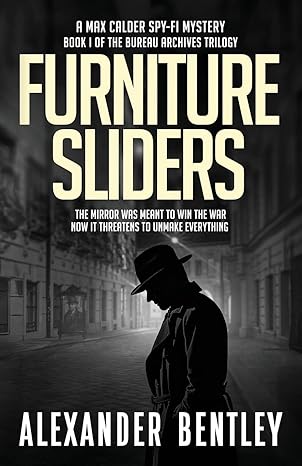

Furniture Sliders is a post-war spy-fi romp that kicks off The Bureau Archives Trilogy with a smoky, rain-slicked bang. Set in 1947, it follows Max Calder, a former intelligence officer with holes in his memory, who is pulled back into the shadows by a mysterious woman named Artemis. A cryptic file, a vanished scientist, and a strange device known only as “the Mirror” set the stage for a chase that spans seedy New York bars, crowded transatlantic ships, and the broken glamour of Vienna. The novel threads together espionage, noir atmosphere, and science-fiction intrigue, with time manipulation simmering under its cloak-and-dagger surface.
I loved how this book felt. The writing drips with mood. Fog curling down city streets, cigarette smoke blurring the edges of a room, the distant hum of jazz over clinking glasses. The pacing dances between languid observation and sudden bursts of violence. Bentley’s style pulls you into Max’s fractured mind. We’re not just following a spy, we’re feeling the tug of his half-buried memories and the unease of not knowing which shadows to trust. Sometimes the dialogue leans into pulp, almost like a wink to the genre’s roots, and it works. It kept me grinning even when the stakes turned deadly.
The ideas themselves are a bold mix. The “Mirror” concept, which is a device that remembers rather than reflects, opens the door for paranoia, philosophical tangents, and deliciously weird possibilities. Bentley resists over-explaining it, letting the mystery breathe. The interplay between Artemis and Max is sharp, edged with mutual suspicion and unspoken history. There’s a lot of world-building baked into their exchanges, which I appreciated, though now and then I wanted the plot to lunge forward faster. Still, I was hooked. Even the side characters, like the poison-bead-wielding Bishop, feel like they’ve stepped out of their own fully formed novellas.
Furniture Sliders is a strong start to what promises to be a stylish, time-twisting spy trilogy. It’s a book for readers who love their thrillers with a noir heartbeat, for fans of John le Carré who won’t mind a dash of science fiction, and for anyone who likes peeling back the layers of a protagonist who isn’t even sure of himself. It’s atmospheric, it’s clever, and it leaves you wanting the next mission right away.
Pages: 314 | ASIN : B0FF6RD921



 LITERARY TITAN