Blog Archives
Bombs to Boardrooms

The Teller Threshold follows Giles and Lucy through a Cold War maze of espionage, science, and psychological manipulation as they confront a technology that makes consensus feel natural while erasing the freedom to choose. Why was 1955 the right historical moment for this story?
I chose 1955 because it was a fascinating year. The Cold War was shifting away from reliance on conventional weapons. The hydrogen bomb had fundamentally changed strategic thinking. The Soviet Union and the United States were trying to understand each other’s intentions. Institutions on both sides were seeking certainty in an increasingly uncertain world. It’s also the year when Edward Teller and the Livermore Laboratory began shaping the future of nuclear strategy.
That gave me a solid historical background. Instead of creating an entirely different history, I wanted to ask a different question. What if, alongside the race to build bigger and better weapons, there had been a quieter competition to influence the decisions that determined whether those weapons would ever be used?
That idea fascinated me because it shifts the battlefield from missiles and bombs to boardrooms and cabinet meetings. The most dangerous technology in the novel doesn’t explode. It simply removes hesitation. History shows us that it has often prevented catastrophe. The Teller Threshold considers what happens when someone views hesitation as a flaw to be engineered out of human decision-making.
Giles and Lucy bring very different energies to the book. How did their partnership evolve as you wrote?
From the beginning, I never wanted Giles and Lucy to become the typical thriller duo where one handles the action, and the other offers emotional support. It wasn’t going to work. They’re equals. But they approach problems in fundamentally different ways.
Giles is almost to a fault analytical. He relies on observation, logic, and careful reasoning. He believes that most crises worsen when people act too quickly. Lucy is instinctive. She reads people exceptionally well and recognizes motives long before Giles does. She’s decisive without being reckless, and, unlike Giles, she’s comfortable navigating the moral ambiguity that intelligence work often involves.
What I wanted to develop wasn’t the conflict between them, but how they complement one another’s thinking. Giles constantly questions systems. Lucy questions people. Giles seeks evidence. Lucy observes behavior. Neither is entirely correct on their own, but they show that real understanding often comes from two smart people who are willing to challenge each other before making a decision. They’re actually defending the process of disagreement itself.
The novel treats disagreement and uncertainty as safeguards rather than weaknesses. Was that theme present from the beginning?
Definitely. Meetings that end early are seen as successful. Leaders who seem decisive are admired. However, history shows that some of humanity’s worst catastrophes happened because dissent was silenced at the critical moment. I became intrigued by how often the world avoided disaster because someone challenged the mainstream view. One person asking, “What if we’re wrong?” has consistently changed history.
Decision Locking turns that principle on its head. It doesn’t make people obey. It simply makes disagreement feel unnecessary. That idea disturbed me more because the affected people still think they have free will. No one feels controlled. They just become more convinced that everyone else must already be right.
The novel isn’t really about technology. It’s about the importance of friction. Democracy, science, and intelligence all rely on disagreement. Once disagreement becomes inefficient, or worse, unwanted, you lose something essential about how free societies truly work.
How did you balance real Cold War history with the speculative science at the heart of the thriller?
That was the challenge! I wanted readers to occasionally pause and wonder, “Wait… did that really happen?”It only works if the historical foundation is solid.
Every major event and every historical figure appear in the story because they truly occupied that role at that time. Edward Teller, Allen Dulles, James Angleton, Sidney Gottlieb, Livermore Laboratory, and the hydrogen bomb program aren’t fictional additions. They are the framework within which the story unfolds.
In some sense, I guess I approached it more like an intelligence historian than a science-fiction thriller writer! I wasn’t interested in futuristic fantasy gadgets. I wanted readers to feel that if such a technology had existed, this is exactly how governments would have classified it, how intelligence agencies would have competed for it, and how scientists would have debated its ethics.
Yes – the science is speculative, but the politics are real. Ultimately, that, I think, is what can make real Cold War storytelling so engaging. It often feels more bizarre than fiction. By inserting imagined ideas into an otherwise genuine historical setting, I wanted to encourage readers to rethink not just what happened, but why it happened, and how much of history relies on people maintaining the freedom to disagree.
Author Links: Facebook | Instagram | GoodReads | Website | Amazon | Apple Books
The bomb changed the world. But the greatest threat of the Cold War was never nuclear war.
In 1955, intelligence services on both sides of the Iron Curtain pursued a technology so dangerous that even Edward Teller feared its consequences.
When ODI agents Giles Harrington and Lucy Howard investigate a strange incident at Edwards Air Force Base, they track the existence of Decision Locking—a covert system capable of narrowing human judgment until dissent simply ceases to exist.
Meetings end early. Arguments vanish. Opposition evaporates. And everyone leaves convinced the outcome was inevitable.
As the CIA, MI6, and Soviet intelligence battle to control the technology, Giles and Lucy discover that the struggle is no longer about nuclear superiority. It is about who will decide the future itself.
With rogue operatives, hidden laboratories, and political conspiracies, the Cold War is becoming something far more terrifying than a contest between nations. It is becoming a war against uncertainty.
From California test ranges to Washington back rooms, from Camp Hero on Long Island to London intelligence offices, and the frozen shipyards of Murmansk, The Teller Threshold delivers a tense blend of espionage, science, and political intrigue in a world where the greatest threat is not a weapon that can destroy civilization—but one that can make everyone agree.
The Teller Thresholdis the electrifying first installment of The Consensus Files, a sophisticated spy-fi thriller that combines espionage, science, and political intrigue in a world where the battle for the future is fought not with weapons, but with the disappearance of dissent.
The Teller Threshold


Alexander Bentley’s The Teller Threshold is a Cold War spy-fi thriller built around a chilling idea: what happens when governments discover a way to make people agree before they’ve truly chosen? Set in 1955, the novel follows Giles and Lucy through a web of intelligence rooms, military tests, Soviet research sites, hidden freight routes, and scientific briefings where the real danger isn’t just nuclear power, but the quiet manipulation of uncertainty. It’s a book about espionage, science, and the fragile value of disagreement.
The central concept, Decision Locking, gives the story its strongest pull. This technology doesn’t bark orders or turn people into puppets. It narrows the range of choices until consensus feels natural. That’s what makes it unsettling. Bentley understands that the scariest kind of control is the kind people don’t recognize as control. The line “Names govern conscience” captures one of the book’s sharpest ideas: once something has a name, people are forced to confront what it really does.
Giles makes a strong narrator because he’s observant, dry, and more human than heroic. He’s often overwhelmed, sometimes afraid, and usually trying to think his way through events that keep moving faster than he’d like. Lucy gives the book much of its spark. She’s blunt, capable, funny in a clipped way, and deeply sensitive to the horror of being controlled. Their partnership keeps the story from becoming too technical, giving the science and spycraft a steady human pulse.
The novel’s Cold War atmosphere is dense and convincing, moving from California and Washington to Guatemala, London, Norway, and Murmansk without losing its sense of pressure. Bentley mixes real historical figures and speculative science in a way that feels purposeful rather than decorative. The book is at its best when committee rooms, laboratories, and field operations all start to feel like different versions of the same battlefield. By the end, the phrase “A tyranny by relief” lands with real force because the story has shown how tempting certainty can be.
The Teller Threshold is a thoughtful, tense, and idea-driven thriller with plenty of movement, but its real subject is the cost of frictionless agreement. It’s a spy novel with science fiction machinery, a political thriller with philosophical teeth, and a character story about people trying to preserve the messy, necessary space where doubt still exists. Bentley has written a book that treats hesitation, argument, and uncertainty not as weaknesses, but as safeguards worth defending.
Pages: 496 | ASIN: B0H6RGHJY6

What If No One Controlled You At All

Cuban Sliders follows a former operative who is sent to 1951 Havana, where a time-fracturing technology has evolved into a machine that locks the future into a single path, and he needs to stop it before it is too late. “Decision Locking” is deeply unsettling. Where did that idea originate?
It began with a quieter question than people expect. We spend a great deal of time worrying about machines that control minds. That’s a familiar fear. It belongs to dystopia. It’s theatrical.
What interested me more was something subtler: what if no one controlled you at all—but the range of available futures narrowed before you even knew you were choosing?
Decision Locking came from observing how institutions behave under pressure. In intelligence work, in politics, in war planning—there’s always a desire to remove friction. Debate is messy. Delay is dangerous. Consensus feels efficient.
So I asked myself: what if you could remove dissent without coercion? Not by force, not by persuasion, but by altering the timing of thought itself. That is more frightening than brainwashing. Most moral failure doesn’t occur in chaos. It occurs in clarity.
Decision Locking doesn’t insert ideas. It doesn’t rewrite personality. It simply ensures that one conclusion arrives first—and that all others arrive too late to matter.
The technology in Cuban Sliders is speculative. However, the impulse behind it is not. We are always tempted by certainty, especially when the stakes are high. The novel just pushes that temptation to its logical extreme.
How has Max changed since the first book, and how has the Mirror evolved across the trilogy?
Max, in the first book, is disoriented. He’s a man trying to survive an anomaly. The Mirror is something external—dangerous, mysterious, almost mythic. He reacts to it.
By Cuban Sliders, Max understands that the real danger isn’t the physical distortion of time. It’s the ethical distortion of responsibility. Max isn’t heroic in the traditional sense. He’s not decisive. He’s not ideologically pure. What he does possess is hesitation. That hesitation becomes a form of resistance.
He’s become more deliberate. More haunted. Less reactive. At first, he wants to repair the fracture. Later, he realizes that fractures are sometimes honest. It’s false smoothness that frightens him. I think Max survives because he refuses to reach conclusions too quickly.
In the first book, the Mirror bends time. In the second, it destabilizes identity. In the third, it stops pretending to be about physics at all.
By Cuban Sliders, the Mirror has become infrastructural. It isn’t just a device. It’s an influence. A method. A way of structuring decisions. And that evolution mirrors Max’s own realization: the enemy isn’t time travel. It’s inevitability. And Max doesn’t trust it.
The book seems deeply concerned with choice. Was that always central, and were you exploring power as control over time, or over people?
Choice was always the center. But not in the heroic sense. I’m less interested in whether someone chooses bravely than in whether they are allowed to choose slowly. I’m drawn to the moment after the decision—when a character realizes something irreversible has just occurred.
The trilogy examines two kinds of power: Power over time and power over people. The unsettling truth is that they converge.
If you control the timing of decisions, you control the outcome. Not because you force anyone, but because you compress the space in which doubt lives. And doubt is where moral weight accumulates.
So yes, the books are about time. But they’re also about institutions that prefer efficiency to accountability. About systems that reduce friction in the name of progress. And convenience, historically, has been far more transformative than malice. I wanted readers to feel unease at the smoothness of how things play out. What sounds like it might be a good idea actually isn’t!
Do you see yourself returning to this world someday?
Yes.
Not because I think there are any loose ends. But because the core question hasn’t gone away. It hasn’t ended. One of the misconceptions about the early Cold War is that it was purely ideological theater. In reality, it was procedural. Committees. Authorization chains. Redundancy systems.
The hydrogen bomb wasn’t just a weapon—it was a decision problem. Once destructive capability exceeded moral comprehension, the question became: who decides, and how?
The next novel, Teller Threshold, moves into the early Cold War thermonuclear era and examines what happens when Decision Locking intersects with nuclear doctrine. If the hydrogen bomb represents destruction at scale, Decision Locking represents certainty at scale. The combination is potentially highly volatile.
More importantly, what happens when a room tasked with deciding on irreversible action is deprived of dissent? Decision Locking is fictional, but the desire to remove dissent from high-stakes environments is very real. The ethical tension still feels alive and worthy of further exploration. The stakes become explicit: what happens if the most destructive weapon ever built is paired with a technology that eliminates dissent in the room deciding whether to use it?
What interests me now is whether a society can fracture dissent so thoroughly that it mistakes silence for stability. I don’t think I’m finished with that question. It isn’t about control of territory or control of weapons. The deeper anxiety is about control of outcomes. It’s not about expertise overriding democracy—it’s about timing overriding deliberation. The whole subject feels like it fits well with Cold War noir-style espionage storytelling!
When a Soviet scientist from a Cuban rum distillery is found in Havana, grotesquely aged, former Bureau operative Max Calder is dragged back into a world he thought he’d escaped. The Mirror — an experimental technology capable of fracturing time — has returned, no longer as a single machine, but as a growing web that entangles minds as easily as moments.
As Calder and Alicia Rayes uncover the truth, they discover a terrifying spinoff: Decision Locking, a process that removes dissent and collapses debate until only one future remains – clearing the path for, among other outcomes, a coming Cuban coup.
Caught between Soviet pursuit, CIA ambition, and betrayal from within British intelligence, Calder must decide whether the Mirror can be contained—or erased entirely.
Cuban Sliders is a noir-inflected Cold War thriller about memory, power, and the danger of a world where certainty arrives too soon.
Some technologies change history.
This one decides it.
Cuban Sliders

Cuban Sliders is a spy-fi mystery that drops Max Calder back into the shadows of 1951, where a Soviet scientist dies in Havana in a way that screams “impossible,” and the trail points to a rum distillery in Cárdenas hiding Project Oracle V4, a new incarnation of the Mirror tech everyone thought had been stamped out. Max and Alicia Rayes move through Havana and the Grenadines chasing leads, rescuing people the Soviets cannot afford to lose, and trying to get close enough to the machine to kill it without letting it rewrite the rules of the world. Meanwhile, Angleton and Lucy Howard circle the edges of the operation with their own motives, and the book keeps tightening one big question: what happens when power stops arguing and starts narrowing your ability to choose?
What I liked right away is the voice. It’s first-person noir without feeling like a costume, and Bentley is good at giving you the sensory hooks that make the danger feel physical, not abstract. Kingstown’s waterfront “smelled of fish, rum, and diesel,” Basil’s bar hums with calypso and cigarette smoke, and those details do real work because they keep pulling the story back down to street level. The chapter titles have that pulpy snap, too, like the book wants you to keep turning pages even when the ideas get heavy. Sometimes the machinery and briefings threaten to crowd the room, but the writing usually finds its way back to people and place before it goes stale.
The author’s big swing is making the Mirror less about flashy time travel and more about the slow, creepy management of uncertainty. The concept of “Decision Locking” is unsettling because it isn’t mind control in the cartoon sense. It’s closer to a hallway where all the doors quietly vanish except one. That idea lands best when it brushes up against history, like the suggestion that what’s really stolen is dissent, not just secrets or even sovereignty. There are also a few scenes that stick with me because they show the theme instead of explaining it, like Mustique feeling calm and almost immune to the Mirror’s pulse, right up until it “flicker[s]” and the surf hits the sand twice. And by the end, the book makes a choice I respected: it doesn’t pretend everything is cleanly solved.
I’d recommend Cuban Sliders most to readers who like Cold War espionage with a science-fiction twist, especially if you enjoy a film-noir mood and you’re up for a thriller that wants to leave you a little uneasy, not just entertained. If you like spy fiction that asks moral questions while still delivering infiltration, double motives, and that smoky feeling of history sliding into place, this one will hit.
Pages: 411 | ASIN : B0GJQHPCB7

Skilled At Handling Lies

Angus Sliders follows Max as he struggles to remember what versions of history are real and what is made up from Mirror’s effects, causing history to fracture further, and possibly in irreparable ways. What was the inspiration that created the journey Max goes on in this book?
Max’s journey in Angus Sliders originates from a core question. What happens to a spy when his most trusted asset, his memory, fails him? The Mirror has always posed a threat because it warps time, but the greater threat is psychological. I aimed to examine how an experienced intelligence officer, skilled at handling lies, disinformation, and shifting loyalties, would react when his internal compass fails him.
The inspiration came from three connected ideas. The first is the fallibility of memory in espionage, where spies operate within constructed realities such as covers, legends, and half-truths. The second is what could be called post-war trauma. The fear of misremembering. Lastly, there’s the ethics of changing history. If altering one moment could save lives or end them, how does someone like Max resist the temptation or cope with the guilt of decisions made in unstable times?
So, his journey ultimately revolves around identity under pressure. Max becomes a man forced to navigate through multiple versions of his own past, aware that each step could deepen the cracks. The tension in Angus Sliders comes from whether he can hold onto the truth long enough to repair the present, or if the Mirror will completely overwrite him.
I find that authors sometimes ask themselves questions and let their characters answer them. Do you think this is true for your characters?
Absolutely. For me, that’s one of the engines behind the entire Sliders universe. I often start with a question I’m unsure how to answer, for example, what would it feel like to step into a version of history that remembers you differently? How much of your identity remains when memory becomes negotiable? What does loyalty mean when time itself can be rewritten? Then I stop answering as the author and begin listening to the characters.
Max and Alicia are both shaped by the worlds they navigate. Max, for example, rarely gives the easy answer; he provides the necessary one. Alicia responds with accuracy and restraint, revealing the cost of knowing more than she can admit. So yes, my questions start the conversation, but the characters finish it. That’s the value of writing in this universe: the characters live close to points of fracture such as history, memory, and time, and their answers often reveal truths I wouldn’t have reached on my own. In that sense, I’m not just writing them. I’m discovering what they’re willing to tell me.
I felt that there were a lot of great twists and turns throughout the novel. Did you plan this before writing the novel, or did the twists develop organically while writing?
The honest answer is both. I always start with a skeleton. The main plot points, structural pivots, and key revelations that the whole story depends on. In a book like Angus Sliders, where the narrative twists around time distortion and espionage, those anchors are crucial. Certain twists must happen for the story to have the right impact. But the best twists are the ones that seem inevitable in hindsight yet are surprising in the moment. They tend to happen naturally. They appear when characters react honestly to pressure. They surface when a secondary detail suddenly becomes essential. They occur when the logic of the world requires a new fracture in the timeline.
As I write, the characters often reveal parts of the story I didn’t fully see during the outline stage. Max, for example, rarely acts like someone who wants his arc to stay linear. The Mirror’s influence almost encourages unexpected angles. Alicia makes choices that challenge the neat structural plan, deepening the stakes. So, the process becomes a balance. Plan the structure and, to some degree, let the characters decide how to move through it. That’s where the twists come from. Structure supported by surprise, and surprise supported by character truth. If I’ve done it right, the reader feels both the inevitability and the shock.
Can you tell us more about what’s in store for Max Calder and the direction of the third book?
Without revealing too much, the third book pushes Max into the most dangerous territory he’s faced yet. Not because the enemies are stronger, but because the consequences of what he’s already survived finally catch up with him. Cuban Sliders, based in the Caribbean, leaves Max standing at the edge of a world where the Mirror has been dismantled, but its influence hasn’t disappeared – it’s just increased. The third book poses a more complex question: What does a man do when the past he fought to fix begins rewriting itself around him? Max has learned to navigate fractured histories. But now he must decide which version of himself he’s willing to live with. The third book will force him to confront timelines he thought he’d closed and choices that refuse to stay buried.
Max no longer knows if he’s fighting for the right side or if the right side even exists. If the first book broke Max, and the second tested him, the third questions whether he can survive the truth he’s spent his life trying to uncover.
Author Links: Facebook | Instagram | GoodReads | Website | Amazon | Apple Books
It’s 1948. Max Calder thought he’d escaped the Mirror’s grip. But when an encrypted MI6 radio message pulls him from the shadows, he finds himself trapped in a deeper conspiracy involving Kim Philby – one that spans timelines, and versions of himself he can no longer remember… or trust.
Partnered once again with Alicia Rayes, Calder races from Lisbon to London to Edinburgh to uncover Project Oracle, a secret MI6 experiment buried at a black site called ANGUS beneath a loch at Invershiel. There, an unstable Mirror still hums. And waiting for him is Variant 6F… a doppelgänger who might be the last warning before history fractures for good. As enemies close in and memories slip through the cracks, Calder must face the truth: the timeline isn’t broken – it’s being rewritten.
Angus Sliders is a taut, cerebral spy-fi thriller steeped in Cold War tension, noir grit, and mind-bending science fiction.
Angus Sliders – A Max Calder Spy-Fi Mystery


Angus Sliders drops you straight into a foggy world of spies, memory loss, and shadowy doubles, and it wastes no time setting the stakes. Max Calder is living quietly in Lisbon when a strange broadcast pulls him back toward old secrets, and a long-buried threat named the Mirror starts to stir again. What follows is a chain of chases, coded messages, old flames returning at the wrong time, and a slow unravelling of Max’s own mind. The story moves from Lisbon’s rainy streets to steamers cutting through gray water to intelligence offices and old wartime wounds. It feels like a personal fight as much as a global one, and that tension powers the whole book.
I caught myself getting wrapped up in the atmosphere. The writing has this rich, moody quality that made me see the wet stones and dim cafes and flickering lamps. I had a real fondness for how the book blends real historical detail with fiction. It adds weight without dragging things down, and it gave the world a texture that felt lived in. I did feel a little overwhelmed during a couple of the denser spycraft moments. The pace surged forward anyway, so the confusion never lasted long. Even so, I kept reading because Max’s voice added so much color. His wit made even the bleak moments feel sharp instead of heavy.
The emotional core of the book worked for me more than I expected. Max’s slipping memory is more than a plot device. It hits like a crack that spreads through everything he touches. Every time he forgot something important, I felt a small sting as if the loss were personal. His scenes with Alicia had that same effect. Their dynamic has this messy, bittersweet edge that kept tugging at me. They know too much about each other and not enough at the same time, and their shared history hangs over every conversation. I liked that the book never tried to make their relationship tidy. It leaned into the chaos of it, and that honesty made it hit harder.
This book builds a world that kept pulling me forward, and I enjoyed being lost in it. If you like spy stories that mix real history with strange tech, or if you enjoy mysteries that twist around memory and identity, this one will be a great fit. Readers who want both grit and style in the same breath will probably have as much fun with it as I did.
Pages: 337 | ASIN : B0G26J24T2
The Dangers of Time Travel
Furniture Sliders follows a former intelligence officer who is pulled back in to discover what has happened to a classified project and the people working on it, which controls time, memory, and identity, and is now missing. What was the inspiration for the setup of your story?
I have always been a fan of both film noir and espionage novels plus I have a tech background and a fascination with quantum mechanics. I wanted to write a story that felt like a 1940s Cold War spy thriller written in noir style—then break it wide open with the addition of speculative science fiction. I had a question: what if you take the characteristics of quantum mechanics such as superposition and entanglement and instead of applying them to atomic particles, you applied them to human beings? To spies? Can you be in two places at once or two timelines at the same time? Firstly, apply the ability to manipulate space and time and then take it even further by playing in panpsychism – the concept that every inanimate object can be sentient. Of course, you would have to have some form of technology to do all of this – the Mirror is exactly that inspired by the one in my hall at home. The title literally came from a box of plastic furniture sliders that were on the table at home with the box looking like a paperback book – Furniture Sliders on the spine! Sliders was a perfect description for agents moving through space and time and their organization is called the Bureau, along with the Mirror, giving the initial tongue-in-cheek furniture connection.
I found Max Calder to be an intriguing character. What was your inspiration for this character?
Max Calder is the kind of character I love; deeply broken but still pushing forward through the fog. It isn’t about a single character or character flaw but about weaving influences together. I guess Max carries echoes of Raymond Chandler’s Philip Marlowe and Graham Greene’s morally ambiguous operatives. He isn’t polished like Bond, but weary, suspicious, and prone to moral compromise – a man affected by the machine he serves. I tried to deliberately write against cliché by grounding him in history and psychology. His gaps, duplications, and doubts reflect not only the dangers of espionage but the fragility of identity itself. Unlike many spy archetypes, Calder isn’t defined by conquest or success, but by survival, mistrust, and fear of irrelevance — hopefully making him come across as human, flawed, and complex. In many espionage novels, agents and spies are unaffected by what they do and are amazing at executing their role. In the case of Max, I wanted him to be very affected. Remorse, regret, and inner demons.
What themes were particularly important for you to explore in this book?
Primarily the consequences of messing with time and how doing so can also mess with you physically, potentially drive you insane and affect your memory while creating echoes or even doppelgangers as time threads overlap. All caused by, or underpinned by, the human-applied characteristics of quantum mechanics. It was important to explore relationships especially between protagonists and antagonists and between espionage agents and technology pitching various spy agencies against each other – even if they are supposed to have great relationships. I also wanted to introduce fictionalized real-life characters to the storyline which in this book includes Alan Turing, Hugh Sinclair and William Stephenson.
Where does the story go in the next book, and where do you see it going in the future?
There are two more books coming in the series. Angus Sliders and Cuban Sliders. Angus Sliders is planned to publish on the 15th December. One of the challenges with quantum-based technology like the Mirror is that many want to get their hands on it in many cases for various nefarious reasons. In Furniture Sliders it was the Russians and ex Nazis. In Angus Sliders, Max Calder discovers that some major occurrences in Furniture Sliders didn’t really happen and that MI6 is very involved. Even a fictionalized Kim Philby is involved as is Charles Fraser-Smith who was the inspiration for James Bond’s Q. Max Calder is more and more affected by what the Mirror can do to you. In Cuban Sliders the Russians are back in the game and so is the CIA. Through all of this the Mirror becomes even more difficult to control or destroy. The big question is – can it be destroyed at all or even stopped and who gets to control it? Are there more storylines past the initial trilogy? Yes indeed!
Author Links: Facebook | Blog | Website | Amazon | Barnes & Noble
The Bureau is chasing a secret called the Mirror—a project so classified that even its architects have vanished or been silenced. It’s said to control time, memory, even identity itself. As Calder tracks the Mirror’s echoes across empty safehouses and wartime graveyards, the lines between hunter and hunted begin to blur.
Artemis may be an ally. Or she may be a weapon. And Calder? He may not even be who he thinks he is.
As bodies pile up and truths unravel, Calder must navigate a world where nothing stays still—where every room slides just a few inches sideways when you’re not looking. In the end, he’ll face one impossible choice:
Burn the truth… or become it.
Furniture Sliders – A Max Calder Mystery
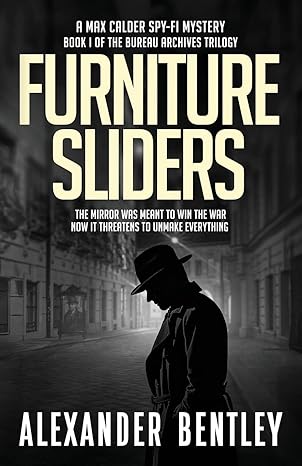
Furniture Sliders is a post-war spy-fi romp that kicks off The Bureau Archives Trilogy with a smoky, rain-slicked bang. Set in 1947, it follows Max Calder, a former intelligence officer with holes in his memory, who is pulled back into the shadows by a mysterious woman named Artemis. A cryptic file, a vanished scientist, and a strange device known only as “the Mirror” set the stage for a chase that spans seedy New York bars, crowded transatlantic ships, and the broken glamour of Vienna. The novel threads together espionage, noir atmosphere, and science-fiction intrigue, with time manipulation simmering under its cloak-and-dagger surface.
I loved how this book felt. The writing drips with mood. Fog curling down city streets, cigarette smoke blurring the edges of a room, the distant hum of jazz over clinking glasses. The pacing dances between languid observation and sudden bursts of violence. Bentley’s style pulls you into Max’s fractured mind. We’re not just following a spy, we’re feeling the tug of his half-buried memories and the unease of not knowing which shadows to trust. Sometimes the dialogue leans into pulp, almost like a wink to the genre’s roots, and it works. It kept me grinning even when the stakes turned deadly.
The ideas themselves are a bold mix. The “Mirror” concept, which is a device that remembers rather than reflects, opens the door for paranoia, philosophical tangents, and deliciously weird possibilities. Bentley resists over-explaining it, letting the mystery breathe. The interplay between Artemis and Max is sharp, edged with mutual suspicion and unspoken history. There’s a lot of world-building baked into their exchanges, which I appreciated, though now and then I wanted the plot to lunge forward faster. Still, I was hooked. Even the side characters, like the poison-bead-wielding Bishop, feel like they’ve stepped out of their own fully formed novellas.
Furniture Sliders is a strong start to what promises to be a stylish, time-twisting spy trilogy. It’s a book for readers who love their thrillers with a noir heartbeat, for fans of John le Carré who won’t mind a dash of science fiction, and for anyone who likes peeling back the layers of a protagonist who isn’t even sure of himself. It’s atmospheric, it’s clever, and it leaves you wanting the next mission right away.
Pages: 314 | ASIN : B0FF6RD921


