Blog Archives
The “Right” Call

Rogue Vengeance is the third installment in the Colt Hawkins Series and follows a network of CIA and special forces operations figures as their personal lives collide with international violence. What draws you to the espionage thriller genre?
There’s a particular tension in espionage that you don’t find anywhere else in fiction- the collision between the personal and the geopolitical. A spy can’t have a normal conversation, can’t fully trust the person across the dinner table, can’t ever truly come home. That fascinates me. The genre lets me explore loyalty, deception, and sacrifice at their absolute extremes, where a single decision ripples across borders and lives.
With the Colt Hawkins Series, I wanted to write thrillers that move at full throttle but never lose the human heartbeat underneath. The CIA briefings and the firefights are the engine, but the fuel is always the story and the characters. Rogue Vengeance is where that combustion really ignites- the stakes feel global, but every chapter comes back to people you’ve grown to care about over three books.
Colt is repeatedly forced to choose between duty and personal happiness. Why was that conflict important to the story?
That conflict is Colt Hawkins. A man who’s exceptional at his job precisely because he’s willing to give up everything- and a man who’s slowly realizing that “everything” includes the people he loves most.
I built that tension into the story because I think it’s the truest thing about anyone who serves. The mission demands total commitment, but commitment has a cost, and someone always pays it. By the third book, Colt can no longer compartmentalize. The two halves of his life crash into each other, and watching him try to be both the operative the world needs and the man his loved ones deserve- and learning he may not get both- is the emotional core of Rogue Vengeance. Readers who’ve followed Colt from the beginning will feel that weight in a way that hits hard.
What does the novel say about the limits of patriotism?
This is the question that kept me up at night while writing. Patriotism is often portrayed as uncomplicated–love your country, serve without question. But real loyalty gets tested in the gray spaces, where the “right” call and the “being ordered” aren’t the same thing.
Rogue Vengeance asks what happens when serving your country means betraying your conscience, or when the institutions you’ve bled for stop deserving that blood. Colt and the network around him are forced to define where their loyalty actually lives- in a flag, in their orders, in each other, or in their own sense of right and wrong. I don’t hand the reader an easy answer, because there isn’t one. What I do offer is a story that makes you feel the cost of every choice and respect the people willing to make them.
What is the next book you are working on, and when will it be available?
We are going to release an Audio version of Rogue Vengeance that will be out around August. The sequel to Rogue Vengeance, Book 4, The Price of Freedom, picks up moments after Rogue finishes. And it is the centerpiece of the Colt Hawkins Series. It is completed and sitting on the shelf. We are going to wait a bit before its release. I have maybe a standalone WWII Historical Epic Fiction Novel, Ties That Bind (179K words), that just went through final edit. That I will seek representation for. And we have done the rough outline for Book 5 of the Colt Hawkins Series, Arch Angel.
Author Links: GoodReads | X (Twitter) | Facebook | Website | Amazon
Their own government outcasts Colt and his team, Task Force 24, as ruthless Chinese assassins brutally attack the woman he loves on their wedding day, leaving her severely wounded.
But Colt isn’t dead- Now, it’s personal, he won’t rest until he’s hunted down every last person responsible.
With a mole at the highest levels of power and a ruthless enemy leader pulling the strings, Colt finds himself a target of both the intelligence community that abandoned him and a vengeful Chinese death squad. Aided by his former teammates, Colt uncovers a conspiracy that goes deeper than he ever imagined. Now, his quest for revenge becomes a race against time to save his country from a devastating espionage plot.
The lines between loyalty and betrayal blur as Colt must decide if he can trust the very agency that cast him out. With a new CIA director at the helm and an elite operative watching over the woman he loves, Colt must navigate a deadly game of international espionage where the only rule is survival.
Neutrality Act


The Consulting Agent: Neutrality Act, by Jonathan M. Bryant, is a historical noir crime and espionage novel set in Atlanta in 1939, just before the world tips fully into war. The story follows Mark Morgan, a damaged former corporate fixer turned consulting agent, as he is hired to keep watch over German delegates attending the Baptist World Alliance meeting. What begins as a protective job quickly pulls him into Nazi politics, local corruption, murder, police violence, and the uneasy question of what neutrality means when evil is standing right in front of you.
What I appreciated most about this book is how lived-in it feels. Bryant gives Atlanta texture: the heat, the class divisions, the racial lines, the clubs, the trolleys, the old buildings, the stink of streets that have not recovered from hard times. The city is not just a backdrop. It presses on Mark from every side. The noir genre works well here because Mark is bruised in all the ways a noir lead should be, but he’s not a cartoon of cynicism. He’s weary, proud, scared, impulsive, and often slower to understand people than he thinks he is. That made him interesting to follow. I did not always admire him, but I believed him.
The author also makes a smart choice by tying the mystery to real historical tension rather than treating history like decoration. The Baptist World Alliance, Nazi delegates, American isolationism, antisemitism, segregation, and the coming war all sit under the plot like a low rumble. Sometimes the book is a detective story, sometimes an espionage tale, and sometimes a character study about a man trying to decide what kind of person he still is. I liked that the title keeps echoing through the story. Neutrality is not presented as clean or noble. It starts to feel like a thin coat of paint over fear, self-interest, and exhaustion. That is where the novel has its sharpest edge.
I would recommend The Consulting Agent: Neutrality Act to readers who enjoy historical fiction with crime, espionage, and moral tension woven together. Fans of noir mysteries, prewar spy fiction, and character-driven detective stories will get the most out of it, especially if they like books that care as much about atmosphere and history as they do about plot. It’s thoughtful, gritty, and grounded, with enough danger to keep the pages moving and enough unease to linger after the last chapter.
Pages: 275 | ASIN : B0GHVRDKHW

The Cuckoo Asset

The Cuckoo Asset is an ambitious spy thriller that moves between Belfast, Coventry, Luanda, Kinshasa, London, Zambia, and Langley without losing sight of its central question: what happens when a clever young man is pulled into a game he doesn’t understand until it’s far too late. David “Kenny” McKenna starts as a bruised, gifted electronics student from Belfast, someone who trusts circuits more than people. That makes him useful to men like Peter DeVries and the nameless Chief, who see intelligence, loneliness, and technical talent as tools to be picked up and used.
I think the book works best as a story about recruitment, manipulation, and consequence. Its Cold War world is full of taxis, hotel rooms, dead drops, oil installations, chess games, fake reports, and people who know just enough to be dangerous. Angola gives the novel its political weight, while McKenna gives it its emotional centre. Judith Morales and Joe Chilondo are especially interesting because they aren’t written as simple side players. They’re compromised, capable, and human, and their decisions keep pushing the story into murkier territory.
Mac Seáin’s style is patient and procedural, often building tension through logistics rather than spectacle. The details of travel papers, surveillance habits, smuggling routes, electronics, and chess strategy give the novel a grounded feel. There’s also a recurring chess metaphor that feels earned because McKenna’s whole life becomes a board controlled by stronger players. The final message in The Urusov Gambit, “A king can whisper, but a pawn stays silent still,” neatly captures the book’s sense of power, secrecy, and survival.
What I liked most is that the novel treats history as something lived through by frightened, practical people. The assassination plot, the oil sabotage, the shifting loyalties, and the later 1999 reckoning all connect back to personal choices made under pressure. The book has plenty of action, especially near the end, but it’s not just chasing thrills. It’s interested in how states hide crimes, how assets become liabilities, and how ordinary people carry the damage long after the operation is over.
By the end, The Cuckoo Asset feels like a historical espionage novel with the heart of a survivor’s story. It’s about Angola and Cold War interference, yes, but it’s also about Kenny McKenna learning that cleverness doesn’t protect you from being used. The closing line, “The game would never be over,” works because the novel has spent hundreds of pages showing exactly why that’s true. It’s a layered, serious, and quietly unsettling thriller that rewards readers who enjoy espionage built on character, tradecraft, and long consequences.
Pages: 349 | ASIN : B0GHPC8YHW
Bait – A Harper Jones Novel


Bait, by Jeffrey Butler, is a crime thriller with strong espionage and action-thriller elements, centered on Detective Harper Jones as a local car bombing in Wolf Hollow pulls him back into the violent shadow of his past. What begins as a police investigation soon opens into something larger, more personal, and far more dangerous, involving old missions, buried guilt, international crime, and people Harper thought he had lost forever.
I liked how the book starts fast and keeps widening its scope. At first, I thought I was settling into a coastal detective story, with local politics, old grudges, and Harper’s sharp, often sarcastic voice guiding the way. Then the novel shifts gears. The stakes stretch from Wolf Hollow to Washington and then overseas, and the story becomes less about solving one crime and more about confronting the kind of past that refuses to stay buried. It gives the thriller a sense of forward motion, but also an emotional undertow.
Butler’s writing is direct, energetic, and plot-driven. The action scenes have a hard, tactical feel, and Harper’s narration gives the book its personality. He can be funny, wounded, reckless, and stubborn, sometimes all in the same scene. The story leans into big reveals, violent confrontations, and high-stakes twists. I appreciated that the book doesn’t treat Harper as untouchable. His choices cost him. His past matters. The title, Bait, is fitting because nearly everyone in the story is being used to draw someone else into danger.
What stayed with me most was the tension between duty and personal loyalty. Harper isn’t just chasing villains. He’s trying to make sense of guilt, love, fatherhood, and the damage left behind by secret wars. That gives the book more weight than a standard action thriller. I would recommend Bait to readers who enjoy fast-paced crime thrillers with military and spy-fiction edges, especially fans of damaged protagonists, layered conspiracies, and stories where the personal stakes hit as hard as the explosions.
Pages: 519 | ISBN : 979-8995267300
The Possibilities Are Endless

Solitaire follows a journalist and a ghostlike operator as they dive headfirst into the murder investigation of the deputy mayor and uncover layers of city corruption. What was the inspiration for the setup of your story?
Having served as a New York City Police Officer for twenty years, and later as a New York City mayoral candidate in 2020, I’ve had a unique view from both sides of the system: the complex, often polarizing world of law enforcement in the nation’s largest city, and the backroom deals and money-driven machinery of big-city politics. In Solitaire, those two worlds collide, as they often do in real life. Our struggling cities are searching for someone who can rise above the corruption and chaos, and that’s where Solitaire comes in.
How close do you think fiction like this comes to real-world possibilities?
In the rapidly expanding world of AI, I think the possibilities are endless—and not all of them are good. The idea of a system that can not only predict outcomes, but potentially shape or control them, no longer feels far-fetched. That possibility was one of the driving forces behind Solitaire.
The story moves at a fast, cinematic pace—how do you maintain momentum without losing depth?
For me, every chapter has to move the story forward. Whether it’s an action sequence or a quiet conversation between two characters, the reader has to understand what is driving the people on the page. If the characters’ motivations stay clear, the momentum stays strong because the reader remains invested in what happens next.
Can we look forward to more work from you soon? What are you currently working on?
I’m currently working on the follow-up to Solitaire. Sloane’s story is far from over, and Book Two raises the stakes significantly. I’m targeting a 2027 release, and I think readers will be very excited about where the story goes next.
Author Links: GoodReads | Facebook | X (Twitter)

A private surveillance empire.
A ghost in the darkness.
When a Times Square shooting leaves a deputy mayor dead, the FBI investigation leads to KATSAI- an AI intelligence network that enhances public safety while also deciding outcomes, prosecutions and elections.
KATSAI decides who rises, and who disappears.
Once an investigative journalist becomes a target, Agents Devi and West are cut off by both New York City and Washington, DC political machines. Their only ally is a man who doesn’t exist- Solitaire, a covert operative
hunted across the globe with a personal stake in burning KATSAI to the ground.
If Solitaire fails and KATSAI survives, ballots are just theatre.
The flash drive decides.
Getting the Twist Right

Terminus centers around an aging intelligence officer tasked with impersonating another agent in order to trace a rogue numbers station. What was the inspiration for the setup of your story?
John Post, my protagonist, originally appeared in a short story I wrote for the Promptly Written Podcast. He was never meant to appear again, but he popped up in a couple more short stories despite this, and then I eventually had the compulsion to give him the full-length treatment. I wanted to do something pulpy, a story with some of the Ian Fleming tropes, but with John Le Carre’s cynicism. Something vintage like those old Signet paperbacks (as evoked by the Terminus cover art) that someone might read on a weekend excursion. I needed a plot, of course. I don’t recall why I chose to incorporate numbers stations, other than they intrigued me. But during WWII, Fleming was known for daring, unorthodox intelligence operations that he and his cohorts came up with, and so I brought him into chapter two of the story with an undercover cameo as “James Secretan” (an early, unused character name before Fleming landed on James Bond). Secretan’s risky plan to get Post to impersonate another agent whose likeness he shares seemed like just the sort of thing Fleming would’ve come up with. The Soviet parapsychology programs were real things at the time, and I thought their inclusion would add some really nice intrigue.
What is the most challenging aspect of writing a thriller? The most rewarding?
The most challenging aspect might be the research involved. Thrillers often hinge on technical knowledge of a particular craft or profession. For Terminus, I had to do a lot of reading about the Cold War in the 60’s, West Berlin, the early days of the CIA, etc. The time period and locations of the book are times and places I didn’t experience, and so I had to rely on others’ accounts. Fortunately, there is a lot of material documenting this era of history. I even went so far as to get menu items right, as taken from photographs of an old Cafe Schloss Marquardt menu, for example. There’s very little that I invented, aside from the plot, of course. And I mean very little. I endeavoured to accurately replicate the West Berlin clubs, architecture, and OSS/CIA details to the best of my ability. Any inaccuracies I made were not for lack of effort/intent.
The most rewarding aspect of a thriller is getting the twist right. Every thriller (at least conventional thrillers) needs to have a twist of some kind, and I think (hope!) I got it right with Terminus.
What were some themes that were important for you to explore in this book?
Part of John Post’s problems stem from the fact that he’s the old guard. I very much feel I’m the old guard in my personal life, especially at work. I kind of riffed on the feeling of pending obsolescence that one gets despite having been successful in the past, despite having a good track record. At some point, things begin to change quicker than you can adapt to them, and you wonder whether you’ve still got what it takes. You also tend to get more jaded the older you get, and I think Post is less than enchanted with the CIA and his role with them. Add to all of that Post’s fear of loss, particularly that of relational loss, and you’ve got an uneasy mix of negative emotion. But the main theme of the novel is one of trust. “Trust is a luxury” is a phrase that gets bandied about in the narrative, and it comes to represent the main idea of the novel. Even with what constitutes his strongest allies, Post wonders whether he isn’t ultimately expendable to them–and if not expendable, then at least his demise is worth risking.
Can we look forward to more work from you soon? What are you currently working on?
I recently started writing the fourth book in my Reeve series, titled The Reeve, the Veil, and the Rifle. I refer to it as a Gothic Western series, though I suppose it might be billed as Weird West. Essentially, it’s a Low Fantasy genre mashup of Batman, a Western, and Alternate History with some philosophical underpinnings. There will be five books when it’s all said and done.
Author Links: GoodReads | Facebook | Instagram | Website | Amazon
Solitaire
Solitaire is a political thriller with a strong espionage pulse, and it opens by dropping us straight into a public shooting in Times Square that turns a mayoral campaign into a conspiracy story about surveillance, synthetic identities, and power hiding behind official systems. At the center are Grace Delgado, a relentless New York journalist, and Michael Sloane, a ghostlike operator tied to the Ace of Spades and a trail of old secrets, as they circle the murder of Deputy Mayor Robert Caldwell and the shadow network called KATSAI. What starts as a city corruption story grows into something broader and darker, with fake donors, weaponized tech, and a private apparatus trying to bend politics into obedience.
I really enjoyed the book’s momentum. Author Bill Pepitone writes like someone who knows how institutions sound from the inside, and that gives the novel a kind of hard floor under its feet. The scenes in City Hall, the FBI office, and the street-level New York moments have a lived-in feel that kept me leaning forward. I also liked that the book doesn’t pretend its people are clean heroes. Grace is stubborn, emotional, and smart in a way that gets her into trouble. Sloane is built like myth, but the book keeps trying to press bruises under the myth, especially in the quieter moments when his control slips. The dialogue can sometimes feel like everyone has a comeback in the chamber, but even then, the energy carries it.
I found the author’s choices around KATSAI and the fake donor machinery especially interesting because the book isn’t just chasing thrills for their own sake. It’s clearly interested in what happens when surveillance stops being a tool and starts becoming a nervous system for power. That idea lands. The novel’s best move, for me, is that it keeps tying giant systems back to private fear: Caldwell hiding a drive behind a picture frame, Shaw collapsing under pressure, Grace realizing too late that information itself can act like a flare in the dark. There is a pulp sheen to some of it, sure, and Sloane sometimes feels almost too competent, but that is also part of the book’s genre DNA. This is an espionage thriller fiction that wants to be sleek, tense, and a little larger than life, while still keeping one foot in recognizable political rot.
I came away feeling that Solitaire knows exactly what shelf it wants to sit on. It’s the kind of book I would recommend to readers who like conspiracy-driven thrillers, cat-and-mouse espionage, and stories where modern tech and old-fashioned power games collide in the same room. If you enjoy fast, cinematic fiction with a political edge, a wounded central duo, and a hero who moves through the world like a rumor with a passport, this will be very much your thing.
Pages: 259 | ISBN : 9781105802713
The Trident Code
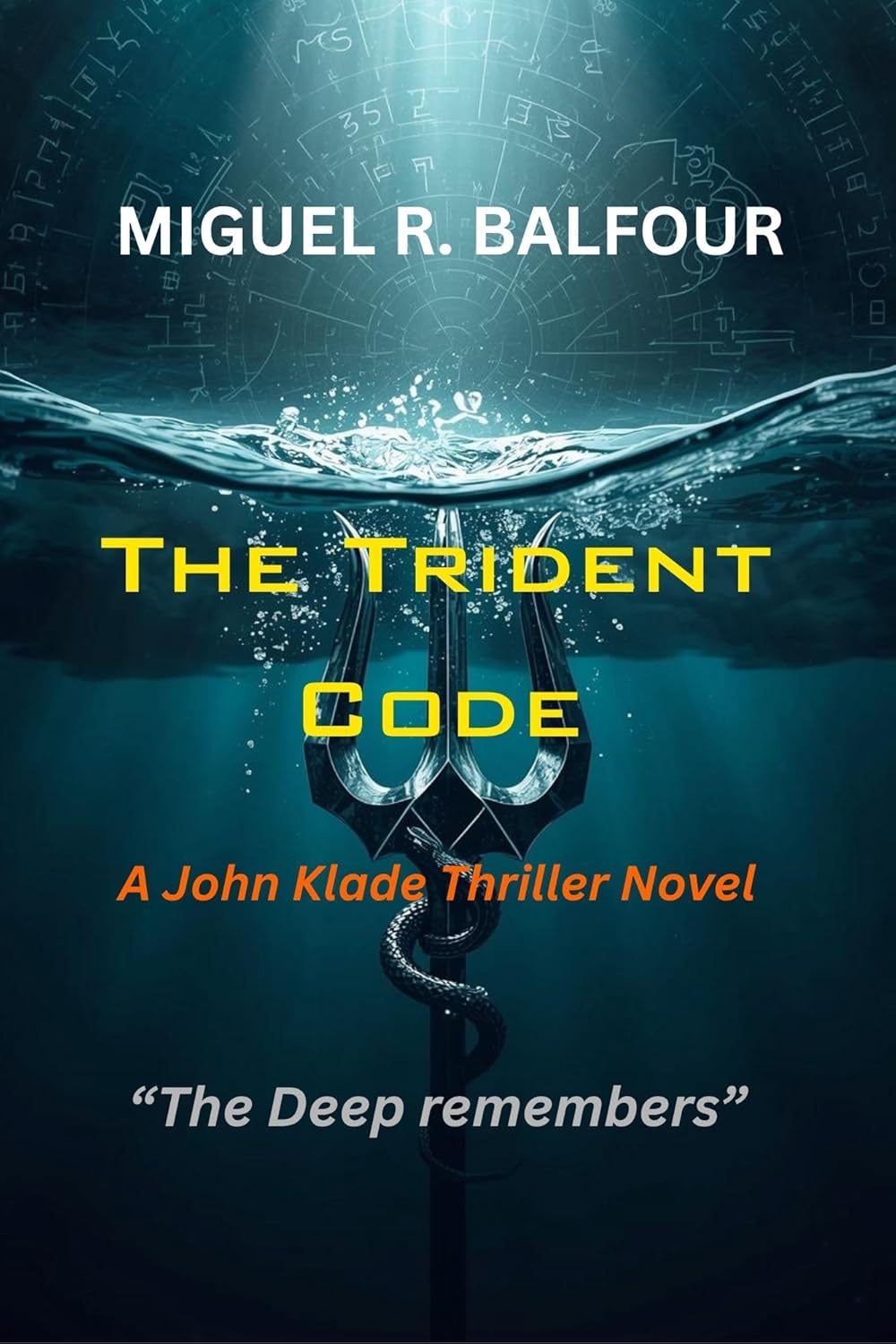
Miguel R. Balfour’s The Trident Code is a military conspiracy thriller (with a definite dark, myth-tinged edge) that kicks off the SEAL Cypher Series. It follows John Klade, a former SEAL turned private investigator, whose routine surveillance work in Los Angeles gets interrupted by a strange trident-and-serpent symbol that keeps showing up like a fingerprint you cannot wash off. When a former teammate is murdered and the same mark appears at the scene, Klade is pulled into a widening hunt that stretches from the streets to old operations, coded messages, and finally toward a looming offshore threat tied to something called “Leviathan.”
The opening chapters have that noir-ish, boots-on-asphalt feel, with details that land in a very physical way, like the city is sticky on your skin and every alley has a memory. Klade reads as competent without being invincible, and I liked that he’s not written as a walking slogan. He’s wary, tired, methodical. The story also knows how to escalate without rushing: a chalk mark becomes a pattern, the pattern becomes a warning, then suddenly it is personal in the worst possible way.
Balfour also makes an interesting author choice by blending modern special-ops paranoia with something older and stranger. Once Annabelle Johansson enters the story and the symbol starts pointing to maritime myths and long-buried operations, the book widens from “who’s stalking the team?” to “what did they wake up?” I was going back and forth on that shift, in a good way. Part of me wanted the clean logic of a pure spy thriller. Another part of me enjoyed the unease, because it fits the book’s central idea: some secrets are not just classified, they feel hungry. And when the plot pushes out onto the water and toward the Brotherhood’s ship, the Leviathan, the tension turns claustrophobic in a new setting. Steel decks, ritual vibes, and the sense that the ocean itself is keeping score.
By the end, I felt like I’d read the opening movement of a larger series story rather than a neatly tied bow, and I mean that as a heads-up more than a complaint. The last stretch leans into momentum and dread, and the closing image of heading into open water, with hope showing up like a fragile, stubborn light, really worked for me. I’d recommend The Trident Code most to readers who like fast, cinematic thrillers with military DNA, team history, and a conspiracy that turns almost mythic at the edges. If you’re happiest when a book feels like a cross between a covert-ops chase and a shadowy cult mystery, this one is written for you.
Pages: 386 | ASIN : B0G1L3JDYN



