Blog Archives
Rome’s Culture

In The Altar of Victory, you take readers on a journey into the days of the Western Roman Empire and the political fallout following the death of Emperor Valentinian I. Why was this an important book for you to write?
It was important to me for several reasons. My interest in this era began long ago, when I was a European History major in college and had taken a class on the period from Late Antiquity through Charlemagne (300-800 AD roughly). The period up to Constantine was well covered, as was the actual catastrophe of the sack of Rome in 410 AD and the subsequent barbarian invasion. However, the course jumped past the last half of the 4th Century, when the Roman empire was still intact and just before these catastrophes began to increase. The more I read in the intervening years, the more evident this gap appeared. Even Gibbon’s Decline and Fall of the Roman Empire tended to treat this critical period of European history in summary fashion.
I also decided that the question of how such a technologically advanced civilization like Rome, with the most organized army and engineering in the world, could fail to see the threat and fall so quickly to less organized enemies. Was there a point when the decline could have been arrested? Did it really come down in part to the deaths of perhaps three key emperors (Valentinian, Valens, and Gratian)? Was it cultural change and the loss of a Roman identity? What role did the advent of organized Christianity play? It was a host of puzzles that I wanted to understand, if not solve.
Can you share with us a little about the research that went into putting this book together?
Before I began writing, I spent several years accumulating various non-fiction sources- books by more contemporary historians like David Brown and Michael Grant; biographies of Ambrose of Milan, etc. I also went to the limited primary sources- Ammianus Marcellinus, of course, Zosimus, the letters of Symmachus, St. Jerome, Ausonius, the Notitia Dignitatum, and others; the military manual of Vegetius. Even as I began to outline the plot and write the first chapters, I continued to read and learn what I could, and still felt that so much was still missing from the historical record. Which was also good, because it enabled me to fill in with a plot of my own devising!
What were some themes that were important for you to explore in this book?
I wanted to explore what remained of Rome’s culture in the 4th Century, and how it had been eroded or replaced as the empire had grown and the city of Rome was no longer the center of the empire. I was also interested in the courts of the emperors, when the emperors no longer came from Rome or even visited very much. The idea that the key military and administrative figures had now become Gauls, Franks, and other nationalities/tribes who had only recently been enemies of Rome seemed to me to be critical in understanding how “Romanness” could have been disappearing for decades before a military transition occurred.
Another theme of importance to me was the figure of Gratian. By all accounts, he was a decent and brave military leader and tried to be a good emperor. He was also a fairly devout Christian and took an interest in the ecumenical issues of the day. And yet, he did not last, and after his reign, the Roman army did not do well in the west. I wanted to explore whether he was the last, best hope for Rome and what factors worked against his success.
Can we look forward to more work from you soon? What are you currently working on?
I am both researching and writing the sequel to The Altar of Victory, in which I intend to conclude Gratian’s story. I am also trying valiantly to finish a collection of short stories set in the 19th and early 20th centuries of Louisiana and Texas before year end.
Author Links: GoodReads | Facebook | Website | Amazon
The Altar of Victory
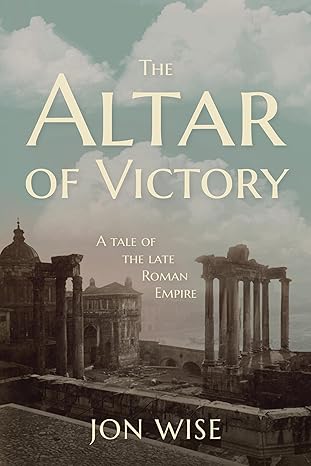

The Altar of Victory is a historical novel that plunges the reader into the waning days of the Western Roman Empire, centering around the death of Emperor Valentinian I and the political maneuvering that follows. Set in 375 A.D., it opens with Valentinian’s dealings with barbarian tribes and internal dissent, leading to his sudden death after a fit of imperial rage. The story then shifts into high-stakes political chess as the ambitious general Merobaudes races to install young Valentinian II on the throne before rivals can seize control. Along the way, the novel wrestles with themes of legacy, power, faith, loyalty, and the slow unraveling of an empire.
I found myself immediately immersed in its stark, lived-in world. The writing is richly atmospheric and historically informed, without ever feeling like a lecture. Every decision, every letter, and every small detail, like the crack in the aqueduct or the placement of a chair, feels purposeful. The prose is tight, clear, and evocative. What struck me most was how human the characters felt, especially Valentinian. He’s brutal, weary, proud, and oddly sympathetic. When he collapses mid-sentence, the emotional weight lands hard. The tension is just as strong in the quieter moments, furtive whispers in palace halls, long rides through uncertain terrain, as it is in battles and tribunals. I especially appreciated the balance between dialogue and action; the pacing kept me glued.
That said, what I really liked was the depth of the ideas. The book takes a hard look at power and how it mutates in uncertain times. The clash between the old gods and Christianity is not just window dressing; it’s a lens through which every character sees the world. Merobaudes, in particular, is a fascinating figure. He’s clever, opportunistic, not fully Roman yet entirely molded by Rome’s ideals. The women in the story, especially Justina and Mirjeta, are sharp and compelling, with agency that matters. There’s also an aching sense of decay in every corner of the empire, ruined towns, forgotten monuments, fading gods, that gives the story a haunting quality. I found myself thinking a lot about how empires die, not just politically, but spiritually.
I’d recommend The Altar of Victory to anyone who enjoys political intrigue, ancient history, or character-driven stories with bite. It’s a slow burn, but a rewarding one. If you like your historical fiction thoughtful, gritty, and emotionally textured, this one delivers. It’s not light reading, but it’s deeply satisfying, and in more than a few places, surprisingly moving.
Pages: 537 | ASIN : B0DCQ783YW




 LITERARY TITAN