Blog Archives
Genuine Horror, Not Just Scares

The Corpse War of 1793 follows a British soldier whose regiment is sent into Norfolk to confront rumors of walking corpses, only to find military discipline, courage, and conscience collapsing under the weight of an undead catastrophe. What was the inspiration for the setup of your story?
As both a military historian of the late 18th century and a big fan of horror and zombie media, it seemed like a pretty natural fit for my debut into fiction writing! While there are a few examples of broadly similar settings (“Pride and Prejudice and Zombies” comes to mind) these tend to read more as parodies and ‘over the top’ stories of cool characters doing ‘cool’, violent things to hordes of the undead. In fact, that seems to be what most zombie media is regardless of its setting! But, that has never been what interested me with the zombie genre. When you think about the what a zombie really is, then what we so often portray as mindless, gore-filled ‘fun’ ought to be an exceedingly tragic, disturbing, and serious affair! After all, the risen corpse that is trying to bite your head off isn’t just a faceless ‘other’, it is your former neighbour, friend, or loved one. Very little media delves into the psychological and social implications of such horrors, and, I wanted to write a story that would give zombies the gravitas and genuine horror, not just scares, they deserve.
In much the same way, while there stands no shortage of media exploring the horrors and privations of modern warfare, the early modern military world very rarely receives the same treatment. But just because the soldiers were wearing colourful uniforms and marching to drums didn’t make their service any easier! Just because early modern soldiers lacked our modern cultural and scientific framework for understanding trauma doesn’t mean they didn’t experience it. Indeed, looking at their writings, their trauma so often jumps off the page, if you know how to look for it. So, it seemed appropriate to combine these two passions of mine, to explore these themes in depth and create a piece of media that I had always wished existed. Ultimately, while the story is totally (blessedly!) fictional, it is intended to reflect a series of very real problems that faced early modern soldiers.
The novel uses period diction, illustrations, a glossary, and mock-historical framing. How did you balance authenticity with readability for modern readers?
Less balancing was needed than you may think! The memoirs, journals, and letters of soldiers from this time period are already fairly accessible, and enjoyable reads. Over the last ten years, I’ve also spent far more time reading those sorts of books than I have modern writing! Alongside just genuinely enjoying the style, I wrote my story in this somewhat archaic fashion to introduce more people to those primary sources. If you’ve enjoyed “The Corpse War”, I’ve little doubt you would also enjoy “The Recollections of Rifleman Harris” and similar works.
The military procedures and battlefield details feel central to the horror. How much research went into the regimental life, weaponry, and tactics of the period?
A great deal, and none at all! As a public historian and historical re-enactor, I’ve been working specifically with the history of the British army from 1764 to 1815 for a very long time. Consequently, a great deal of the information, from the basics of command structures and camp life to the flow of a battle, is all quite familiar to me. I was able to lean on this background when writing the book, regularly refreshing myself by glancing through the likes of Cuthbertson’s “Interior Oeconomy of a Battalion of Infantry” or Lewis Lochee’s “Elements of Field Fortification”. Ultimately, of course, the most important research was reading the memoirs and journals of soldiers and officers from this time period.
What drew you to portraying the undead not just as monsters, but as a crisis of empire, obedience, and conscience?
Like I’ve described above, I think that the zombie genre has so much more to offer than merely an excuse to bash in heads in gory excess. Their very nature, as with so many other classic monsters, has an extraordinary potential to explore meaningful themes. In this case, the undead forced the book’s inexperienced narrator to face the most grim and privative elements of military life, wherein he is not the hero of his story but merely a single piece of a much wider, and much crueller, tale. His suffering does not always have great personal meaning, but is at times necessarily imposed by the institutions around him in order to attain a greater goal. There is no sense to the terrors he witnesses, nor do the virtues of heroism and courage in the face of adversity always end happily. But, I don’t want to go into any more specifics, lest I spoil things!
Author Links: Goodreads | Website | YouTube
Here stands the authentic account of a soldier who bore the whole of The Corpse War witness. Bound by duty and compelled by guilt, he sets down in gruesome detail all that befell him, his comrades, and his regiment from the first devilish outbreak to the Great Battle between the Living and the Dead. His tale is one of woe and unwanted laurels, amidst a field where courage rots more quickly than flesh, and zeal burns hotter than black powder.
Fans of Sharpe and World War Z will devour this debut novel of visceral military horror, in which a common British redcoat confronts unimaginable terrors and bears witness to the Army’s desperate war against the risen dead.
The Corpse War of 1793
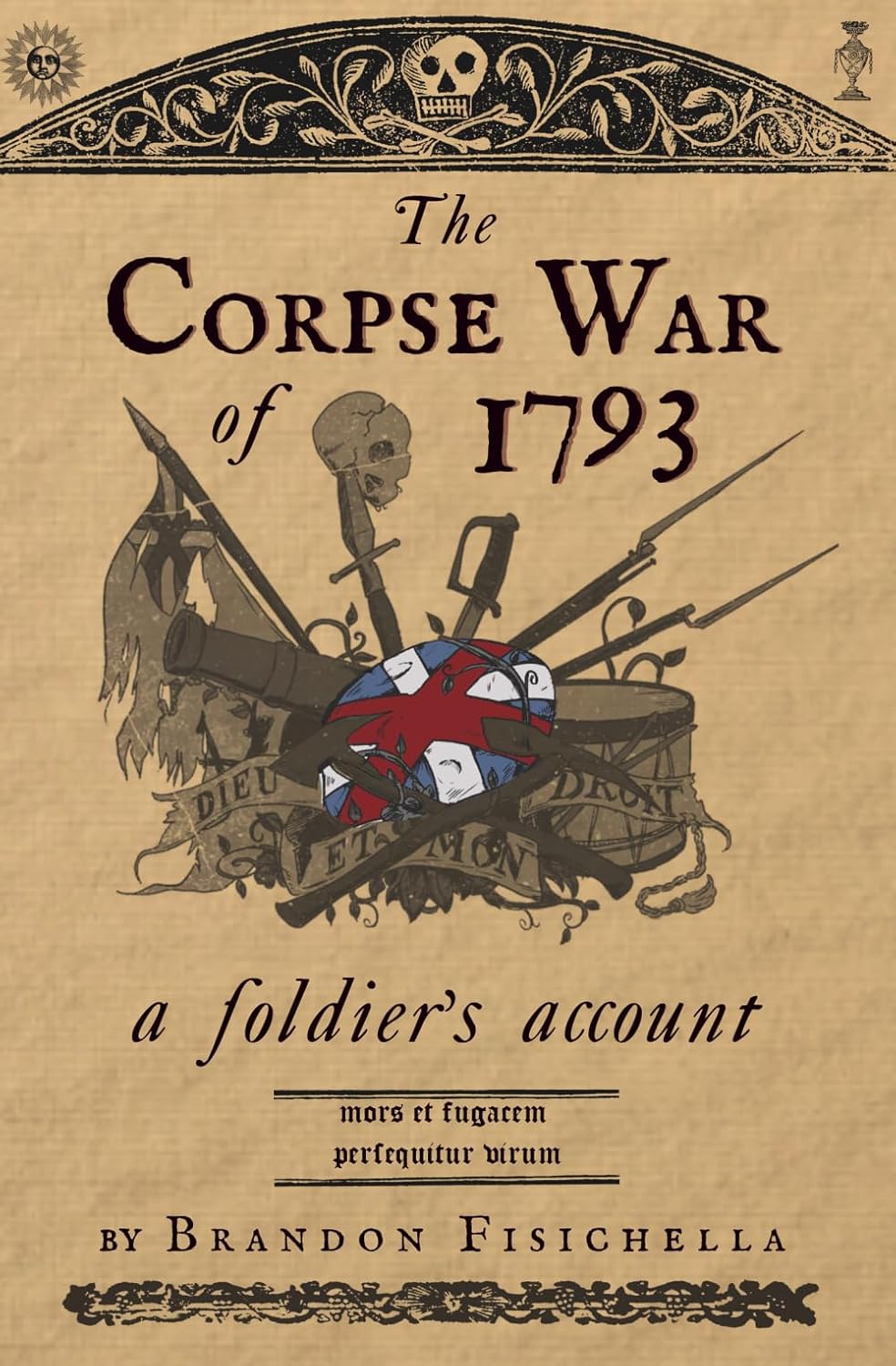

The Corpse War of 1793 is a grim and immersive work of historical horror presented as a British soldier’s account of an unnatural campaign in Norfolk, where rumors of walking corpses become a military catastrophe. What begins as barracks gossip about “Choleric Dead” soon carries the narrator and his comrades to Stowlham, a town gone quiet with dread, and then into a siege and battle where eighteenth-century discipline, muskets, artillery, and courage are tested against the dead. The book is not merely a zombie story in powdered wigs; it is a campaign narrative, a survivor’s confession, and a study of how quickly martial confidence can curdle into terror.
I was struck first by the book’s commitment to texture. The diction, illustrations, glossary, and mock-period apparatus could have become a gimmick, but instead they give the story a peculiar authority, as if some worm-eaten pamphlet had been pried from an archive and found still damp with fear. The military detail is especially strong. Marching orders, billet arrangements, sentry duty, weapon handling, regimental hierarchy, and battlefield formation all have weight. The horror works because the world around it feels so procedural. When the dead arrive, they don’t enter a vague gothic fog; they crash into a machine of rank, drill, punishment, and pride.
The novel understands that horror is not only what lunges from the dark, but what one must keep obeying after seeing it. The narrator’s guilt over John, Bennett, Richards, and the others gives the book its human pulse. I admired the way the story resists easy heroics. Men behave bravely, foolishly, cruelly, and tenderly, often in the same breath. The battle scenes are grisly and kinetic, but the quieter moments, the weeping in a tent, the empty streets of Stowlham, the postwar invalid limping away from the army, have the sharper blade.
The target audience is readers who enjoy historical horror, military fiction, alternate history, and survival horror with a serious appetite for atmosphere and period detail. Fans of Max Brooks’s World War Z will recognize the pleasure of a large-scale undead catastrophe treated with tactical sobriety, while readers of Bernard Cornwell may appreciate the mud, command structure, and hard-earned soldierly voice. The Corpse War of 1793 turns the undead into a matter of empire, drill, and conscience. It’s a musket-smoked nightmare that marches forward and bites like hell.
pages: 343 | ASIN: B0G5B1B3YZ



