Blog Archives
An Unshakable Force

The Glitch follows a grieving man and video game designer who creates a virtual reality world with a wealthy entrepreneur, and the two disagree on how the world should be governed. This is an intriguing setup for a novel that is high in social commentary. When creating Trevor, did you have a plan for development and character traits, or did it grow organically as you were writing the story?
Trevor’s character evolved organically as the story unfolded. I knew from the start that he would grapple with the grief of losing his beloved dog, which would serve as the inciting incident that pushed him toward a quest for immortality through virtual reality. His role as a video game and VR designer was essential, giving him an innate understanding of creating worlds and allowing me to explore the concept of simulations. I also realized that this moment of loss would become a catalyst for Trevor to grapple with the deeper meanings of life and death. In a sense, his dog became his greatest teacher, introducing him to the concept of mortality.
As Trevor plunged deeper into the metaphorical rabbit hole, the layers of reality peeled away, revealing the intricate tapestry of existence. This journey led him not only to explore new worlds but also to confront his own humanity. With the guidance of an old man, who is essentially a reflection of himself, Trevor embarks on an inner journey far beyond the physical world he once knew. The clash of ideals between Trevor and Sam Malone added depth to this journey. Trevor’s vision for Utopia Zed was rooted in compassion and love, a manifestation of unity, grounded in his belief that the source of all life lies in love. He saw technology as a tool to enhance the human experience and to cultivate meaningful connections. In stark contrast, Malone’s utopia was a dark reflection of unchecked power, greed, and control. He sought to “play God,” manipulating and enslaving individuals within the confines of his simulation. Trevor’s journey then shifts toward finding spiritual enlightenment, moving beyond the mere physical creation of worlds and seeking balance within the fabric of existence itself.
What were some themes that were important for you to explore in this book?
The Glitch delves into deep themes of spirituality, technology, and the perpetual search for enlightenment. It underscores the fundamental interconnectedness of all life and highlights how love—an unshakable force—has the ability to shape destinies, transcending both time and space. The story reminds us that love is not just a pursuit but the very essence of wholeness, possessing the ability to heal and transform both individuals and entire worlds.
In this story, reality and simulation extend beyond mere technical constructs; they become a canvas for examining life, death, friendship, and the lasting influence of love. This novel ultimately stands as a testament to the boundless human capacity for exploration and growth, even when confronted with extraordinary technological feats and metaphysical mysteries.
What is the next book that you are working on, and when will it be available?
I am currently finishing the manuscript for my second novel, Watchers: The Angel Eyes, which is the first book in a trilogy. I plan to release it in early 2025. It’s a sci-fi adventure suitable for all ages, and I like to describe it as ‘Harry Potter in space.’
“In The Angel Eyes, Osiris and Natasha discover they are Earth’s last hope as they unravel the secrets of celestial fragments and face cosmic foes. With newfound powers, they must protect humanity from ancient evils, but their journey through time and space reveals a truth that could change everything.”
Author Links: GoodReads | Amazon
Trevor’s serendipitous encounter with a cryptic old man, who possesses the ability to read the very essence of life in Trevor’s palm, marks the beginning of his extraordinary odyssey. Under the old man’s guidance, Trevor delves into a world of profound metaphysical possibilities, where he learns to traverse portals and manipulate reality as a glitch in the grand system of existence. This mentorship ignites Trevor’s curiosity and provides him with the tools to traverse different times and dimensions.
The narrative takes an intriguing turn when Trevor’s unique talents draw the attention of Sam Malone, a wealthy entrepreneur and scientist. Malone envisions a utopian world of his own, distinct from Trevor’s ideals, and seeks Trevor’s design expertise to bring this vision to life. In a pivotal decision, Trevor leaves his career as a video game designer and collaborates with Malone to build Utopia Zed, a state-of-the-art virtual realm.
But soon enough, the clash of ideals between Trevor and Sam Malone stands as a stark juxtaposition of two divergent world views. Trevor’s vision for Utopia Zed is rooted in compassion, love, and the liberation of human minds from the confines of their perceptions. His utopia is a manifestation of unity, driven by the belief that the source of all life lies in love, be it in the form of familial bonds, friendship, or the collective unity of humanity. For Trevor, technology should serve as a means to enhance the human experience and foster genuine connections among people.
In contrast, Malone’s vision for Utopia Zed is a chilling reflection of unchecked power, greed, and control. He aspires to “play God,” manipulating and enslaving individuals within the confines of his simulation. In this dystopian world, the pursuit of pleasures and the constant stimulation of dopamine receptors are prioritized above all else. Malone’s vision disregards the circumstances of those ensnared within his virtual realm, fueling a form of technological eugenics. The consequences of his actions are inconsequential to him, as he seeks to amass power and maintain dominance at any cost. The clash between Trevor’s altruistic values and Malone’s ruthless pursuit of control creates a powerful narrative tension that drives the heart of “The Glitch.”
Trevor, our protagonist, then embarks on a quest to find spiritual enlightenment. Leaving behind his life on Earth, he ventures to Tibet, where he undergoes a profound spiritual retreat. Guided by the same old man, Trevor combines technology with spirituality, diving deep into a new VR world to expand his consciousness. The goal is to liberate humanity from mental slavery and guide them toward spiritual awakening.
In this sweeping tale, “The Glitch” explores profound themes of spirituality, technology, and the eternal quest for enlightenment. It emphasizes the interconnectedness of all beings and the enduring power of love to shape destinies, even across the vastness of time and space. It serves as a reminder that the pursuit of the whole is called love, and that, ultimately, love has the power to heal and transform both individuals and worlds.
Thus, reality and simulation are not just technical concepts; but a canvas for exploring profound themes of life, death, friendship, and the enduring power of love. The story serves as a testament to the limitless human capacity for curiosity and growth, even in the face of technological marvels and metaphysical mysteries.
The Glitch
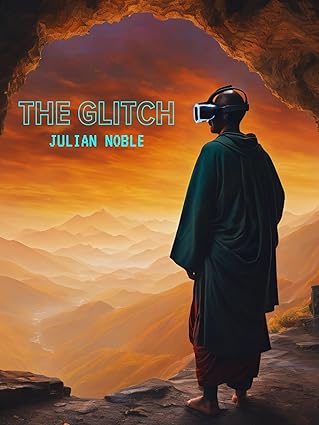

The Glitch by Julian Noble is an engaging sci-fi novel that delves into the mind of Trevor, a video game designer whose life straddles the line between reality and the virtual worlds he creates. After the devastating loss of his dog, Trevor throws himself deeper into his work, blurring that boundary even further. When his extraordinary talents attract the interest of Sam Malone, a wealthy entrepreneur, Trevor is given the freedom to fully immerse himself in his passion—building the virtual world of Utopia Zed. But with this new power comes a daunting choice: should he lead with wisdom and compassion or indulge in the darker allure of godlike control? His decision has the potential to shape not just the future of Utopia Zed, but the future of humanity itself.
Noble’s novel offers a well-crafted exploration of Trevor’s journey, as he navigates the complexities of both the digital universe and his own personal evolution. The plot is rich with twists and surprises, keeping readers engaged from start to finish. Trevor’s development as a character, both inside and outside of his utopia, is fascinating, though at times his portrayal feels somewhat lacking in depth. There are moments when I wanted more from his character, as his internal struggles sometimes fell flat. Noble’s ability to use virtual reality as a vehicle for exploring diverse and vibrant settings is exceptional. The novel deftly questions the limits of what is real, challenging our perceptions of both physical and virtual worlds. Themes of enlightenment, the fusion of technology and spirituality, and the nature of power are woven throughout the narrative, adding layers of meaning that resonate deeply with the sci-fi genre.
I would highly recommend The Glitch to sci-fi enthusiasts, particularly those with a passion for video games and virtual reality. While Trevor’s character could have been fleshed out more, the novel’s compelling themes and imaginative settings make it an enjoyable and thought-provoking read. I’m excited to see what Julian Noble has in store for readers in the future.
Pages: 165 | ASIN : B0CW1C6W56




 LITERARY TITAN