Blog Archives
When Do the Ends Justify the Means?

The Loss of What Is Past continues the journey of a physicist and time traveler, trapped decades in the future, who is torn between a lost love from the 2050s and the new life he has built in the future. What was the inspiration for the setup of your story?
My debut novel, The Lightning in the Collied Night, explored the power of love and forgiveness to transform a person, or perhaps a world. I thought it would be interesting in the sequel to introduce a different, darker aspect of love: what happens when love becomes obsessive, such that it clouds judgment? I also delved into what can happen when brilliant, well-intentioned people overestimate their abilities to the point of overconfidence, or even arrogance. Also, I wanted to answer questions that readers of Lightning may have had about events that were mentioned there but not covered in detail.
Your characters go on a deeply emotional and transformative journey in your novel. Is this intentional or incidental to the story you want to tell?
The transformative aspects of the characters’ journeys were intentional. As for the emotional impacts, I strove to have those flow naturally out of the situations the characters were faced with. Some of those were extremely difficult for the characters involved–and also very hard for me to write–as they dealt with acute, even heartbreaking, trauma and loss. We see how, with help and love from family and friends, the characters cope with such deep loss, carry on, and grow.
I find that, while writing, you sometimes ask questions and have the characters answer them. Do you find that to be true? What questions did you ask yourself while writing this story?
I guess that is true! I didn’t set out to do a “Q&A” with the characters; the questions (and answers) arose organically with the story. Some of the questions that were posed in the story are, are some actions unforgivable? What should be the role of AI in the future? When do the ends justify the means? At what point do we need to let go of the past and live in, and for, the present? And, as mentioned earlier, when is too much love not a good thing?
Where does the next book in the series take the characters?
As I mention in the Acknowledgements in the back of the book, there won’t be a trilogy. (There wasn’t supposed to even be a sequel!) Thus, except for some additional flash fiction stories–one of which will be an alternate ending to the sequel–that I’m planning to publish on my blog in coming months, I must say goodbye to these characters from my imaginary world of the near future, and beyond. I’m going to miss them.
Author Links: GoodReads | Website
The Loss of What Is Past
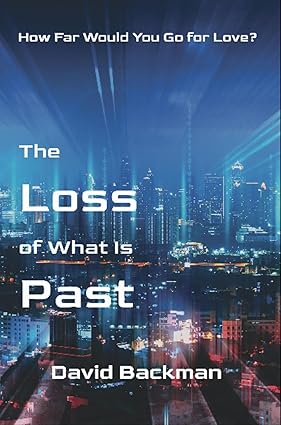

The Loss of What Is Past is a sweeping science fiction epic that picks up where The Lightning in the Collied Night left off, continuing the journey of physicist and time traveler Kapono Ailana. Set largely in the 22nd century, the story blends time travel, futuristic science, and human emotion into a tale of exploration, both personal and cosmic. Kapono, torn between a lost love from the 2050s and the new life he’s built decades into the future, collaborates with brilliant scientist Aroha Whakatane on antimatter research that unexpectedly leads to a way to send matter—and potentially people—back in time. What begins as a scientific endeavor quickly becomes a deeply emotional struggle about love, loss, ethics, and what it means to let go.
Reading this book felt like watching an aurora borealis—beautiful, mysterious, and just a little haunting. Backman’s writing is richly detailed and deeply empathetic. He has a knack for writing smart characters who talk like real people, with warmth, curiosity, and humor. The pacing takes its time in places, but I didn’t mind. I appreciated the way he slowed down for emotional beats and gave space for characters to breathe. The best parts weren’t the high-tech experiments or the theoretical breakthroughs, they were the tender moments. Kapono’s conversations with his daughter, with Aroha, and the memories of Lai, those were the heartbeat of the story. And while the time travel mechanics were rooted in scientific language, they never drowned the narrative in jargon. Backman managed to make theoretical physics feel surprisingly personal.
The book explores the risks of altering the past with thoughtful care, which I appreciated. At the same time, it sometimes leans toward the idea that grief is best resolved by simply letting go. I found myself wanting a bit more complexity, some gray areas, I think, could’ve added extra depth. A few of the plot developments, while emotionally satisfying, tied up a bit more neatly than I expected. I also would’ve loved to see more of Aroha’s world outside of her work and her connection to Kapono. She’s a compelling character, and there were glimpses of something richer beneath the surface.
The Loss of What Is Past is not just a sci-fi novel; it’s a meditation on time, memory, and the fragile hope of second chances. I’d recommend this book to anyone who loves character-driven science fiction with a beating heart. If you’ve ever wondered what you’d do if you could go back, or if you’ve ever struggled to move on from a love that shaped you, this story will speak to you.
Pages: 315 | ASIN : B0F6VTYMD9




 LITERARY TITAN