Blog Archives
People Like You and Me

Waves Toward the Pebbled Shore follows a physicist and her husband as they face a planetary crisis that becomes something personal and morally complicated. What was the inspiration for the setup of your story?
The protagonist of Waves Toward the Pebbled Shore, Māori physicist Aroha Whakatane, was a character in the second book of my trilogy, The Loss of What Is Past. In that story, Aroha works with its protagonist, Kapono Ailana, on some clandestine experiments involving antimatter and tachyons. When Kapono decides to use those technologies for an ethically and legally dubious personal project, Aroha calls him out on his arrogance and irrational behavior. I thought it would be interesting to weave a story in which the proverbial shoe is on the other foot—where Aroha is tempted to use the same technologies for what she believes is a very good reason, even though her actions would be not only a felony but would also violate the most sacred beliefs of the Māori. As the story unfolds and the planetary crisis looms, Aroha must decide between her deeply held beliefs—and fervent objections from her husband and father-in-law—and her responsibilities as a mother and Earth’s chief physicist.
How important was it to portray a scientist whose cultural identity and family relationships are just as important as her intellect?
It was crucial. I strive to pen characters who, although they may be brilliant scientists, are vulnerable and relatable … people like you and me, and far from perfect. Aroha and her husband Rangi Ngata are two of Earth’s leading physicists. But they’re also lovers, spouses, parents, someone’s daughter or son, and friends to many. Their values and behavior are largely shaped by Māoritanga—the traditional culture, way of life, and belief system of the Māori. Thus, I knew that their cultural identities, and those of the other Māori characters in the novel, would have to be integral to the story. Fortunately, I had invaluable help from two consulting editors from New Zealand on the Māori and Kiwi aspects of my book, and I researched the novel in New Zealand in early 2026.
The novel explores antimatter, tachyons, artificial intelligence, and time travel with considerable technical detail. How much scientific research went into building the world?
Quite a bit, although I was able to borrow significantly from the universe I’d created for the first two books in my trilogy. I want the science fiction in my stories to be science-based as much as possible and seem plausible to readers—at least to the point they may think, “Yeah, I can see how that could happen.” I include my references in the back of each novel, so readers can see that, for example, there really is such a thing as Quantum Drive. But I don’t want the science to get in the way of the story such that readers are overwhelmed by technobabble. I try to make my novels approachable to people who may not have a scientific background and may not even particularly like sci-fi stories. Now, since this story begins in the mid-22nd century and ends at the dawn of the 23rd century, I had to make a few guesses as to what technologies like AI and antimatter would look like then. And, as for the time travel … as the frosh roommate of the protagonist of the first novel of this trilogy told her once, “There are some things in science-fiction stories we just need to accept.”
Do you see Waves Toward the Pebbled Shore as a standalone story, or do you imagine returning to this world?
Waves is the conclusion to the trilogy I began with The Lightning in the Collied Night. But I wrote Waves to stand alone, so that readers who haven’t yet read the first two books of the trilogy can start with Waves, then loop back to the other books if they wish. As for returning to this world … I hadn’t planned on it. But then, I didn’t plan on a sequel to Lightning, nor a trilogy! If I do return to this universe I created, it would be with a new story set in the 23rd century and (almost all) new characters. I hinted at who the protagonist for such a story could be in the last entry of the Timeline of Events in the back of Waves. I don’t have a story flushed out yet, but I do know that this protagonist would find that, as Bob Dylan sang, the times they are a-changin’ … and not always for the better.
Author Links: GoodReads | Facebook | Website | Amazon
Although this novel is the conclusion to a trilogy, it was written to stand alone and thus can be read independently of the other two books.
The five main characters and some secondary characters are Māori, the indigenous people of New Zealand-very rare for a sci-fi novel. This novel explores the culture, religion, and language of the Māori in a futuristic sci-fi setting.
Waves Toward the Pebbled Shore


Waves Toward the Pebbled Shore, by David Backman, is a science fiction novel about time, family, grief, and the frightening weight of scientific power. Set mostly in the 22nd century, the story follows Aroha Whakatane, a brilliant Māori physicist, and her husband Rangi Ngata as they face a comet that could end all life on Earth. What begins as a planetary crisis becomes something more personal and morally complicated, especially as antimatter, tachyons, time travel, and heartbreaking loss force the characters to ask what should be saved, what can be changed, and what the cost of survival really is.
I was taken by how grounded the book feels even when the science fiction ideas get huge. Backman is dealing with extinction-level danger, advanced technology, artificial intelligence, and time loops, but the emotional center stays close to home. Aroha is not just a scientist solving a problem. She is a daughter, wife, mother, and Māori woman carrying her values into rooms where cold logic could easily take over. I appreciated that. The novel spends real time with grief, humility, responsibility, and cultural identity, which gives the science fiction genre a warmer and more human shape. The technical detail is heavy, but it also makes the world feel carefully built rather than casually imagined.
I also found myself thinking about the author’s choices long after certain scenes ended. Backman does not treat time travel like a clever trick. He treats it like a wound that might heal one thing while opening another. That made the book more interesting to me. The story asks whether doing the right thing is still right when the outcome is uncertain, and whether saving the world can excuse choices that damage the soul. Some parts move with the steady patience of a family saga, while others tighten into disaster-thriller territory. That mix will not be for every reader, especially those who want nonstop speed, but I liked the room it gave the characters to breathe.
I would recommend Waves Toward the Pebbled Shore to readers who enjoy thoughtful science fiction more than flashy spectacle. Fans of time-travel stories, near-utopian future settings, ethical dilemmas, and character-driven speculative fiction will likely find a lot to appreciate here. It’s best for readers who do not mind science, politics, and family drama sharing the same table, because that is where this novel is at its strongest.
Pages: 230 | ASIN : B0GX36QXXM

When Do the Ends Justify the Means?
The Loss of What Is Past continues the journey of a physicist and time traveler, trapped decades in the future, who is torn between a lost love from the 2050s and the new life he has built in the future. What was the inspiration for the setup of your story?
My debut novel, The Lightning in the Collied Night, explored the power of love and forgiveness to transform a person, or perhaps a world. I thought it would be interesting in the sequel to introduce a different, darker aspect of love: what happens when love becomes obsessive, such that it clouds judgment? I also delved into what can happen when brilliant, well-intentioned people overestimate their abilities to the point of overconfidence, or even arrogance. Also, I wanted to answer questions that readers of Lightning may have had about events that were mentioned there but not covered in detail.
Your characters go on a deeply emotional and transformative journey in your novel. Is this intentional or incidental to the story you want to tell?
The transformative aspects of the characters’ journeys were intentional. As for the emotional impacts, I strove to have those flow naturally out of the situations the characters were faced with. Some of those were extremely difficult for the characters involved–and also very hard for me to write–as they dealt with acute, even heartbreaking, trauma and loss. We see how, with help and love from family and friends, the characters cope with such deep loss, carry on, and grow.
I find that, while writing, you sometimes ask questions and have the characters answer them. Do you find that to be true? What questions did you ask yourself while writing this story?
I guess that is true! I didn’t set out to do a “Q&A” with the characters; the questions (and answers) arose organically with the story. Some of the questions that were posed in the story are, are some actions unforgivable? What should be the role of AI in the future? When do the ends justify the means? At what point do we need to let go of the past and live in, and for, the present? And, as mentioned earlier, when is too much love not a good thing?
Where does the next book in the series take the characters?
As I mention in the Acknowledgements in the back of the book, there won’t be a trilogy. (There wasn’t supposed to even be a sequel!) Thus, except for some additional flash fiction stories–one of which will be an alternate ending to the sequel–that I’m planning to publish on my blog in coming months, I must say goodbye to these characters from my imaginary world of the near future, and beyond. I’m going to miss them.
Author Links: GoodReads | Website
The Loss of What Is Past
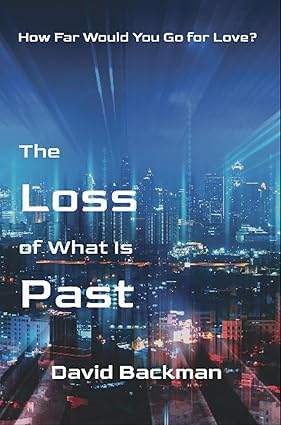

The Loss of What Is Past is a sweeping science fiction epic that picks up where The Lightning in the Collied Night left off, continuing the journey of physicist and time traveler Kapono Ailana. Set largely in the 22nd century, the story blends time travel, futuristic science, and human emotion into a tale of exploration, both personal and cosmic. Kapono, torn between a lost love from the 2050s and the new life he’s built decades into the future, collaborates with brilliant scientist Aroha Whakatane on antimatter research that unexpectedly leads to a way to send matter—and potentially people—back in time. What begins as a scientific endeavor quickly becomes a deeply emotional struggle about love, loss, ethics, and what it means to let go.
Reading this book felt like watching an aurora borealis—beautiful, mysterious, and just a little haunting. Backman’s writing is richly detailed and deeply empathetic. He has a knack for writing smart characters who talk like real people, with warmth, curiosity, and humor. The pacing takes its time in places, but I didn’t mind. I appreciated the way he slowed down for emotional beats and gave space for characters to breathe. The best parts weren’t the high-tech experiments or the theoretical breakthroughs, they were the tender moments. Kapono’s conversations with his daughter, with Aroha, and the memories of Lai, those were the heartbeat of the story. And while the time travel mechanics were rooted in scientific language, they never drowned the narrative in jargon. Backman managed to make theoretical physics feel surprisingly personal.
The book explores the risks of altering the past with thoughtful care, which I appreciated. At the same time, it sometimes leans toward the idea that grief is best resolved by simply letting go. I found myself wanting a bit more complexity, some gray areas, I think, could’ve added extra depth. A few of the plot developments, while emotionally satisfying, tied up a bit more neatly than I expected. I also would’ve loved to see more of Aroha’s world outside of her work and her connection to Kapono. She’s a compelling character, and there were glimpses of something richer beneath the surface.
The Loss of What Is Past is not just a sci-fi novel; it’s a meditation on time, memory, and the fragile hope of second chances. I’d recommend this book to anyone who loves character-driven science fiction with a beating heart. If you’ve ever wondered what you’d do if you could go back, or if you’ve ever struggled to move on from a love that shaped you, this story will speak to you.
Pages: 315 | ASIN : B0F6VTYMD9

Love and Forgiveness
Lightning in the Collied Night follows a group of scientists who embark on a bold mission to harness the power of a newly discovered wormhole in a desperate bid to secure the survival of the human race. What was the inspiration for the setup of your story?
The original story idea came to me several years ago. Back then, it was a simple story about a young physicist who overcomes personal and external challenges to travel to the future through a wormhole and discovers… well, I can’t get into that as it’s the crux of the story! I can say that there were multiple inspirations for the story, from literary and sci-fi sources; those are brought out in the novel. Over time, I added twists, layers, and characters to my story until I thought it might be suitable for a novel. When I retired in 2023 and had time to learn how to write fiction, I decided to share my story.
A lot of time was spent crafting the character traits in this novel. What was the most important factor for you to get right in your characters?
Probably the most important factor was that I wanted the characters to be relatable to readers. The story is set (mostly) about 30 years from now. I wanted readers to be able to understand and feel what these characters were going through as they overcame many challenges, both from within themselves and the outside world. One of the ways I did that was to try to make the dialogue seem “natural,” like people actually talk, and liberally use interior monologue to let readers get “into the heads” of the main characters.
What were some themes that were important for you to explore in this book?
Probably the most important theme was the power of love and forgiveness to transform a person… or perhaps a world. Another theme is that AI can be an extremely powerful and useful tool when used appropriately, but it’s not the best solution for every problem. There’s a difference I think between what AI could do for humankind, and what we should allow it to do. Finally, I wanted my novel to reflect our wonderfully diverse world, and thus I strove to have the characters be representative of that diversity.
Will there be a follow-up novel to this story? If so, what aspects of the story will the next book cover?
I hadn’t planned on a sequel. But I’ve fallen in love with the characters (most of them, anyway!) and believe there’s much more of their story to tell. Thus I’ve started outlining a sequel, with a planned release of Summer 2025. I don’t want to give any spoilers, but I will share that the draft tagline is, “How far would you go for love?” The sequel will be more of a traditional sci-fi story than Lightning, but still approachable by people who aren’t quantum physicists. Like Lightning, it will be focused on the characters, their relationships, and their struggles. I think it will be entirely based on Earth of the future–no trips to wormholes, this time. And, like Lightning, the title will be from Shakespeare. 😉
Author Links: GoodReads | Amazon
In the mid-21st century, a brilliant American physicist joins a secret mission to travel through the galaxy’s lone stable wormhole. When a series of challenges threaten the project, she must find another way to accomplish its objective: save the human race. With help from an unexpected ally, the young scientist races to harness the universe’s mightiest force and preserve humanity’s future.
The Lightning in the Collied Night

David Backman’s Lightning in the Collied Night plunges readers into a near-future world on the brink of collapse. Humanity faces mounting crises brought on by climate change and geopolitical instability, and a group of scientists embarks on a bold mission to harness the power of a newly discovered wormhole, in a desperate bid to secure the survival of the human race.
The novel introduces a diverse ensemble of characters, each wrestling with both the harsh realities of their world and their personal demons. Their stories unfold against the backdrop of advanced physics and space exploration, interwoven with the Hawaiian tradition of ho’oponopono, a spiritual practice offering reconciliation and healing. This unexpected cultural element provides a counterbalance to the cold, scientific ambition driving much of the narrative, creating a unique blend of hope amid the chaos. Backman crafts a vivid and unsettling vision of the future, where the consequences of humanity’s environmental neglect are laid bare in deeply personal ways. His characters are complex and carefully developed, their emotional arcs both moving and relatable as they navigate a world on the edge of ruin. These individuals are the heart of the story, elevating it beyond its dystopian setting into something deeply human. While the novel’s scope is vast and its themes are layered with philosophical depth, it may challenge readers unfamiliar with speculative fiction. Yet, Backman’s talent for intricate character development and his ability to pose profound ethical questions make the story captivating and thought-provoking.
Lightning in the Collied Night transcends its speculative science fiction roots. It offers a powerful meditation on environmental destruction and personal responsibility, with its strongest appeal found in the emotional journeys of its characters. Backman’s ability to weave together complex narrative threads makes this novel an essential read for fans of speculative fiction and those who appreciate thought-provoking storytelling.
Pages: 310 | ASIN : B0DDDYHGJY


