Blog Archives
The Turning Point

Free Carbon Free Electricity is a practical and passionate guide to residential solar that shows homeowners how sunlight can lower costs, increase independence, and transform the way we think about energy. Why was this an important book for you to write?
In my research on the conversion from fossil fuels to renewable energy, I found that there is much misunderstanding about the benefits of solar energy and why people should be converting to this technology. Most importantly, they can save a lot of money. Due to the unique and very efficient way that solar equipment converts sunlight directly to electricity there will be significant changes in the electric utility industry, which should be noted my management in the industry.
What first convinced you that residential solar was not just an environmental issue, but a cultural and economic turning point?
While some people will be motivated to convert to renewable energy for environmental reasons all people will be motivated by the ability to save money. While there is disagreement above the issues around global warming all people want to save money. The turning point occurred when solar energy became cheaper and more reliable than energy from a utility.
What is the biggest misconception homeowners have when they first begin considering solar panels or battery storage?
The biggest misconception is that they can only get some of their electricity from solar and they will have to rely on the public utility for the balance of their needs. Also, since solar was so much more expense than energy from a utility a few years ago they are not aware how of the size of the saving they can now enjoy with solar.
How do you think electric vehicles will change the way families think about home energy systems over the next decade?
All vehicles must be “refueled” on a regular basis. Thus, convenience is an important factor in this process. A solar system with battery storage will allow drivers to refuel their vehicles anytime the car is in the garage. And it will be less expensive than gasoline.
…a practical and urgent argument for residential solar — Literary Titan 5/11/26
Today the average homeowner with a solar system can generate electricity for six cents a kWh, which is about half of what many utilities charge for generation services. The public utility will charge an extra $0.06 Per kWh for poles, transformers etc. plus admin. costs and profits.
With the latest battery systems, a homeowner can save excess energy generated during peak sunshine hours that can be used to support the households electrical requirements while the sun is not shining in other words 24/7 The battery system can be used to provide coverage during outages from the public utility. Thus, eliminating the need for gas or gasoline powered generators.
Equipment accounts for almost all the costs of generating electricity in a solar system, once the system is paid off in 5 to 7 years with savings on electric charges the homeowner can enjoy free electricity for the remaining useful life of the equipment, which is about 25 years.
The author draws on more than 40 years of experience analyzing new technology and its practical impact on new products and services. Start today saving thousands of dollar a year.
Free Carbon Free Electricity
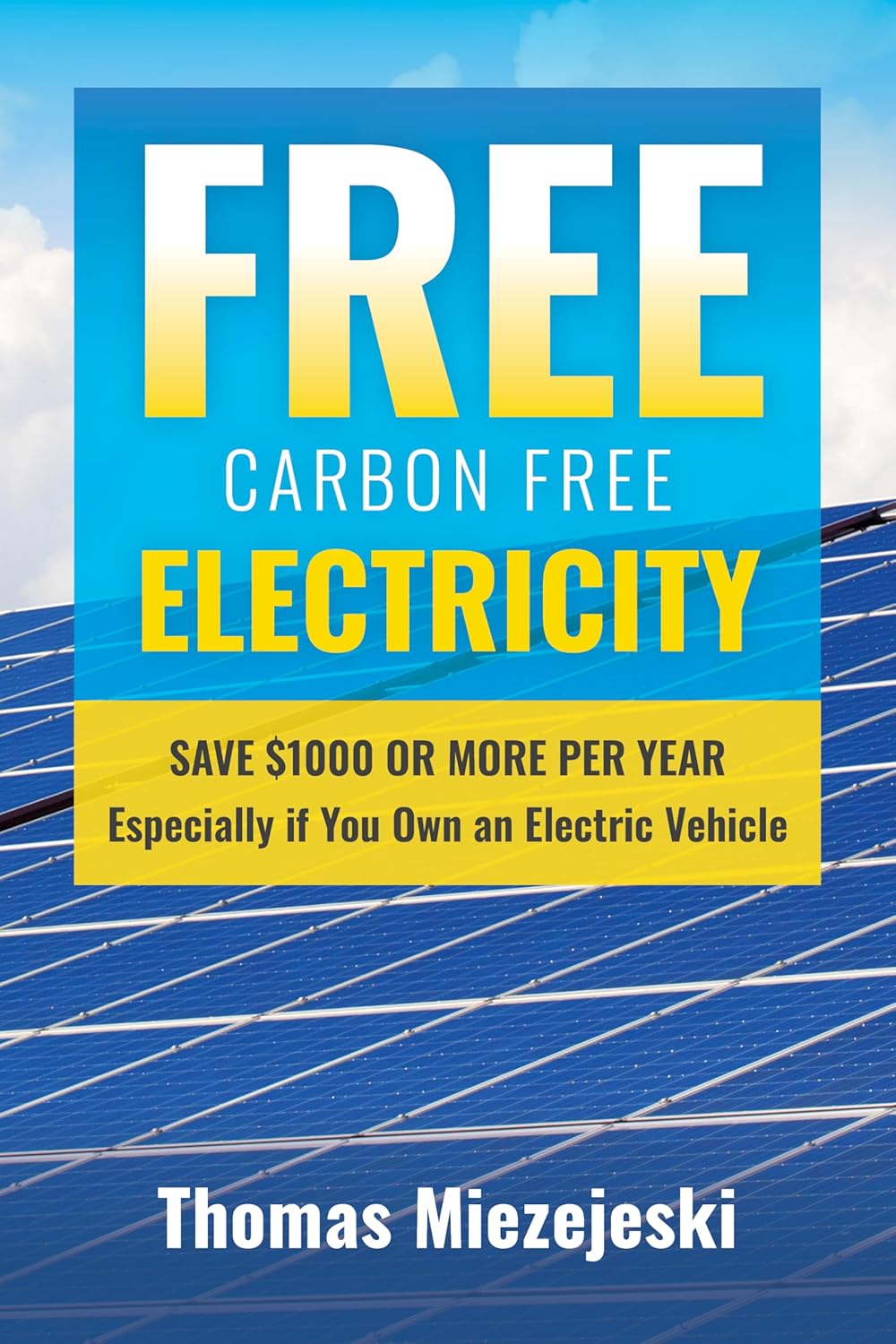

Free Carbon Free Electricity is a practical and urgent argument for residential solar as both an economic opportunity and a cultural turning point. Author Thomas Miezejeski frames solar not merely as green technology, but as a shift in power itself, away from centralized utilities and fossil-fuel dependence and toward homeowners producing, storing, and even driving on their own electricity. The book moves from Edison’s centralized power model to China’s solar dominance, then into storage systems, billing structures, tax credits, renewable energy credits, EV savings, and the author’s larger conviction that sunlight may change daily life as profoundly as agriculture once did.
What I appreciated most was the book’s plainspoken sense of possibility. Miezejeski writes with the enthusiasm of someone who genuinely wants readers to look at their roof, their electric bill, and their assumptions in a new way. His comparison between a well that makes water feel “free” and a solar system that can make electricity feel similarly liberated stayed with me, because it gives the book’s core idea a familiar, almost domestic warmth. I also found the sections on battery storage and electric vehicles especially persuasive, since they connect solar to everyday anxieties: outages, rising rates, fuel costs, and the small helplessness people feel when the grid fails. The Superstorm Sandy example gives that argument emotional weight without needing to overdramatize it.
The writing has an almost conversational feel. The ideas are strongest when Miezejeski is explaining a paradigm shift, such as the difference between generating electricity through motion and harvesting it directly from sunlight, or when he warns readers not to rely too heavily on subsidies that can vanish with political change. I liked that the book doesn’t hide its passion. Its certainty gives it momentum, and even when I wanted more nuance or sourcing, I felt the author’s sincerity pushing through the page.
I liked the book’s willingness to connect solar energy to larger patterns of technological change. The comparisons to Apple computers, cell phones, and the shift from centralized systems to decentralized personal tools made the argument feel broader than just “solar can save you money.” It gave the book a sense of historical movement, as if residential solar isn’t just a home upgrade, but part of a bigger reordering of how people live with technology and infrastructure.
I found Free Carbon Free Electricity to be an engaging and useful introduction to the economic case for solar power. It’s not a detached academic treatment. It’s a call to pay attention, ask better questions, negotiate with installers, understand the bill, and imagine a home that is less dependent on old systems. I’d recommend it to homeowners, EV owners, and curious readers who want a clear, accessible argument for why solar energy matters financially as well as environmentally.
Pages: 82 | ASIN: B0GZ5F52Q3

An Existential Issue

Solving Global Warming Will Kill the Fossil Fuel Industry is an urgent and thorough exploration of what happens when one of the world’s most powerful industries meets its inevitable decline. Why was this an important book for you to write?
I spent most of my working career researching developments in new technology and reporting this to corporate executives for them to establish marketing strategies. Climate change is not only the most important issue of our lifetime but the most important issue for our species. I view addressing climate change as simply transitioning from fossil fuels to renewable energy. Since I have a great deal of experience analyzing major technological changes, I thought I could add that perspective to the discussion on climate change.
How much research did you undertake for this book and how much time did it take to put it all together?
I spent about two months gathering the economic data for the book. Fortunately, with Google Search and ChatGPT, the information-gathering phase was much shorter than it would be before these resources were available. In the past, I had to spend a great deal of time in libraries of major institutions such as Princeton University and even more time interviewing corporate executives, government agencies, and major players in an industry. I worked in the computer and telecommunications industry when they were transitioning to personal computer and cell phone technology. Thus, I could use this lifetime experience with these transitions to support the major points I discussed in the book. This part of the book was simply a data download rather than a research effort.
What were some ideas that were important for you to share in this book?
It is now time to shift the discussion from policy issues to the economic justification for the transition to renewable energy. This is possible because all forms of renewable energy wind, solar, and hydropower can be generated at a lower cost than energy generated with fossil fuels.
The fossil fuel industry is so huge, more than $7 trillion, and is so integrated into our economy that there will be significant costs to transition from fossil fuels to renewable energy. Climate change is an existential issue so we must make the change. The cost of the demise of the fossil fuel industry can be somewhat mitigated by recognizing this issue and planning for it.
What is one thing that you hope readers take away from Solving Global Warming Will Kill the Fossil Fuel Industry?
We are solving global warming and it’s going to happen much faster than almost anyone thinks.
Author Links: GoodReads | Facebook | Amazon
We cannot stop global warming and still have a fossil fuel industry. 5 star Review by Literary Titans
The demise of the fossil fuel industry will affect everyone and will have impacts worldwide. The industry had revenues of approximately of $7 trillion If it was a country, it would be the third largest country in the world exceeded only by the United States and China. Or it is larger than the economies of Germany and Italy combined. In May 2024, institutional investors held $4.3 trillion in bonds and shares of fossil fuel companies, because the industry had record profits. But everyone who has a pension or is invested in a mutual fund will be affected when these profits disappear.
Solving global warming requires a transition from energy generated from fossil fuels to renewable energy. This transition will follow the transition of any other technological change. The change starts out slowly, then reaches an inflection point after which growth is exponential. We are now at that transition point. The exploration and refining sectors of the industry currently operate at a break-even point of about $45 per barrel of crude. Crude oil is now in the low $70s per barrel and will fall rapidly..
The economies of Oklahoma, Texas, Louisiana, Saudi Arabia, Russia, and Nigeria, to mention a few, will be affected more than other places. The governments in these locations will lose tax revenue to provide even basic services. International trade and geopolitics will change.
The cost of energy produced by hydroelectric and wind is lower than the cost of energy produced with fossil fuels. The cost of operating an electric vehicle is about $1500 per year less than the cost to operate a gasoline powered vehicle. While the price of petroleum products is controlled by organizations such as OPEC free market pricing will eventually prevail.
The writing about this change is already on the wall!
The impacts of these changes can be mitigated to some extent by an awareness of the key driving factors in the fossil fuel and renewable energy industries and by cooperation between business and government. This book provides an analysis of one of the largest changes in human history.
Solving Global Warming Will Kill the Fossil Fuel Industry

Thomas Miezejeski’s Solving Global Warming Will Kill the Fossil Fuel Industry is an urgent and thorough exploration of what happens when one of the world’s most powerful industries meets its inevitable decline. The book isn’t just about climate change; it’s about the economic, social, and geopolitical tremors that will follow the fall of fossil fuels. Miezejeski takes readers through the science of energy, the history of industrialization, and the strategies that oil and gas companies are using to cling to relevance. This is more than just a warning; it’s a deep dive into a global transformation already in motion.
One of the strongest aspects of this book is its blunt honesty. Miezejeski doesn’t waste time trying to convince skeptics that climate change is real; instead, he assumes his audience is already past that debate. Instead, he focuses on the massive fallout that will occur as the world transitions away from fossil fuels. The opening chapter sets the tone with a stark analogy: global warming is a storm that we can’t stop, but we can prepare for. This sense of urgency keeps the book engaging, making it clear that the demise of the fossil fuel industry won’t be neat or painless. When he details the economic impact on countries like Saudi Arabia, Russia, and Venezuela, it’s hard not to feel a little anxious about the future.
Miezejeski also does a fantastic job of connecting technological change to economic collapse. His comparison of the fall of the fossil fuel industry to the obsolescence of typewriters is one of the most effective parts of the book. Companies like Smith Corona, once giants in their field, failed to adapt when computers took over, and they disappeared almost overnight. The fossil fuel industry, he argues, is on the same trajectory, and history suggests they won’t go down without a fight. The book describes how energy companies are scrambling to diversify into renewables, invest in carbon capture, and rebrand themselves as environmentally friendly. It’s fascinating but also a little depressing; these efforts seem more like delaying tactics than genuine solutions.
Miezejeski does acknowledge the positive impact that fossil fuels have had on society. He credits them with powering the Industrial Revolution and enabling modern civilization. But he doesn’t let nostalgia cloud his judgment. He’s clear that the future belongs to renewable energy, and the longer we delay the transition, the worse the economic and environmental damage will be. His chapter on the costs of global warming over the next 25 years is particularly sobering, breaking down losses in agriculture, health, biodiversity, and even tourism. The numbers are staggering, and they drive home the point that inaction is not an option.
Solving Global Warming Will Kill the Fossil Fuel Industry is a must-read for those who want to go beyond the basics of climate change and understand the larger, messier, and more politically charged reality of the energy transition. Policymakers, business leaders, and anyone curious about the future of energy will find this book an eye-opener. Miezejeski’s thorough research and compelling historical comparisons make this a worthwhile and thought-provoking read.
Pages: 241 | ASIN : B0DMQFG4LS


