Blog Archives
Soul-Based Leadership

SOLAR COASTER is part business memoir, part history of the modern American solar industry, and part reflection on faith, purpose, and leadership. When did you first hear the phrase “solar coaster,” and why did it feel like the right title for the book?
I don’t remember the exact first time I heard the phrase, but if you spend enough time in the solar industry, you hear it. “Solar coaster” is how those of us who have lived through the industry’s ups and downs describe the ride. Policy changes, interest rates, financing, technology, commodity prices, and politics can completely change the economics of a project or the direction of the industry. You can have a plan, and then suddenly everything changes. To survive, you have to constantly adapt.
It felt like the perfect title because that has been my professional life for nearly two decades. But the title also took on a second meaning for me. My career has had its own tremendous highs and lows, and through all of those experiences I came to understand how much my faith and my soul were guiding the journey. That is why I play with the word in Part III of the book as my “SO(U)LARCOASTER.” The book is about the solar industry, but it is also about the much bigger ride of figuring out who you are, what your purpose is, and how to live your best life with the life you have been given.
You emphasize surrounding yourself with “A+ players.” What qualities make someone an A+ player in your view?
An A+ player is someone who is exceptionally good at what they do, but it goes beyond talent. They are driven. They want to win. They work hard because they genuinely care about the work; they are constantly learning, and they are always thinking several moves ahead. They understand their industry deeply and are never really satisfied with just being good enough.
I also think the best teams are built when those people share values, trust one another, and are committed to the same mission. At TurningPoint Energy, we made a conscious decision to hire the best people we could and then get out of their way. Give A+ players the resources they need, help them with the hard decisions, and make sure they have some balance in their lives. You don’t need to micromanage great people.
One of the lessons I learned, though, is that even A+ players can burn out. Growth for the sake of growth can destroy a great culture. Part of leadership is knowing when your team has too much on its plate, pulling back and giving people the time and space they need to continue doing great work.
Faith runs throughout your memoir. How has your spiritual life influenced the way you make business decisions?
My spiritual life has become my compass for making decisions. I grew up Catholic, went to a Jesuit university, and over the years, prayer and spiritual reflection became increasingly central to the way I approached both my personal life and my business life. I came to believe that you really can’t separate the two.
For me, soul-based leadership means strengthening your soul so that it becomes your moral compass, then having the courage to listen to it when you face difficult decisions. Some of the biggest decisions of my career were very prayerful ones, including decisions about the future of TurningPoint Energy and eventually my own exit from day-to-day leadership. I would ask: Is this the right thing for me? Is it the right thing for my partners, our employees, and their families? What am I being called to do?
That doesn’t mean I ignore financial analysis or business strategy. Those things are essential. But the most important decisions in life are rarely made by a spreadsheet alone. Faith has helped me think about success differently, not simply as what I can build or earn, but what I can contribute, whom I can help, and whether I am using what I have been given for something larger than myself.
SOLAR COASTER ultimately asks what we should do with the opportunities, talents, and time we’re given. How would you answer that question today?
We are all stewards of the gifts we’ve been given. Use them to help others. That is probably the simplest answer I can give.
I believe the best life is one where you connect your individual talents and abilities with causes you genuinely believe in. We all need to make money and support ourselves and our families, but money is a tool, not the purpose. The deeper purpose is figuring out how the particular gifts you have been given can create value for other people and for the world around you.
And giving back is not just about writing a check. I talk in the book about giving your “treasure, time, and talent.” You might begin by donating money, then give your time, and eventually realize that your professional skills and experience can be even more valuable to an organization or cause you care about.
That is really why I wrote SOLAR COASTER. After decades in business, I felt called to take what I had learned, including the successes, failures and mistakes, and pay it forward. I don’t think we’re given opportunities simply to accumulate more for ourselves. With success comes a greater responsibility to give back, help others, and leave things a little better than we found them.
Author Links: GoodReads | Website | Amazon
SOLAR COASTER is the untold story of the US solar industry—told through the eyes of a leader who rode its wild highs and crushing lows for nearly two decades. From boardrooms to backroads, Jared Schoch reveals the inside battles over clean energy, the political storms that shaped an industry, and the personal journey that transformed his life.
This is more than a business memoir; it’s a story of soul, fortitude, and purpose—how spiritual clarity guided bold decisions and sustained hope through chaos. Whether you’re an entrepreneur, a believer, or simply curious about the future of energy, Solar Coaster will inspire you to find light in the darkest turns.
SOLAR COASTER: The Untold Story of the Solar Industry and One Man’s Journey Leading with Soul


SOLAR COASTER by Jared Schoch is part business memoir, part history of the modern American solar industry, and part reflection on faith, purpose, and leadership. Schoch traces his path from an ambitious young professional in high tech and corporate energy to an early leader in solar, eventually helping build TurningPoint Energy. Along the way, he explains why the phrase “solar coaster” fits an industry shaped by changing tax credits, politics, utility rules, interest rates, supply chains, technology, and public opinion. What gives the book its personality, though, is that Schoch treats all of those professional twists as part of a larger personal journey. From the beginning, he connects business decisions with the question of what makes work meaningful and argues that purpose should sit at the center of a career.
Some of the most engaging sections for me come from Schoch’s years at SunEdison, where the young solar industry feels unpredictable, competitive, and full of possibility. He describes losing major deals, learning how utilities actually make decisions, developing relationships in rural communities, and eventually winning projects that changed his career. His stories give the reader a useful insider’s view of how solar projects come together through a complicated mix of finance, land, regulation, politics, community support, and persistence. His account of SunEdison’s later collapse also becomes one of the book’s strongest business lessons. After watching rapid expansion, excessive spending, and executive pride undermine the company, Schoch sums up what he took from the experience in five words: “Ego kills great companies.” That line captures Schoch’s larger belief that character and judgment matter just as much as strategy.
The story becomes more personal as Schoch moves through the difficult SOLON years and eventually starts TurningPoint Energy. Building the company becomes the clearest example of his ideas about resilience, disciplined risk, teamwork, and what he calls soul-driven leadership. He recounts putting his own money into projects, enduring years-long development processes, abandoning projects that no longer made sense, and learning how to build a company around talented people who could eventually operate without him. He’s also unusually open about how demanding that kind of life became. The pandemic and his midlife struggles force him to reconsider his health, family life, work habits, and priorities. Those chapters make the business successes feel more complete because Schoch is willing to examine what all that striving required from him personally.
Faith is the thread connecting nearly every part of SOLAR COASTER. Schoch talks openly about prayer, discernment, Jesuit spirituality, generosity, and his belief that God has guided the major turns in his life. His recurring prayer, “Give me the wisdom to see the path, and the courage to walk it,” works almost like a summary of the book’s philosophy. Schoch doesn’t keep spirituality in a separate compartment from business. He presents it as the moral framework behind decisions about employees, partners, money, philanthropy, risk, and eventually his own exit from TurningPoint Energy. The later chapters make that framework even more explicit, with discussions of strengthening the soul, surrounding yourself with “A+ players,” recognizing the importance of timing, and developing a company culture that can survive beyond its founder. His decision to step away at forty-eight, after years of succession planning, gives those ideas a practical conclusion.
What I liked most after reading SOLAR COASTER is how closely Schoch connects the growth of an industry with the growth of a person. The book covers more than two decades of solar development, from an emerging technology struggling for credibility to a major part of America’s energy system, while showing a career changing alongside it. Schoch clearly loves the solar business, including its maddening uncertainty, and his firsthand experience gives the industry sections energy and authority. At the same time, his final measure of success has less to do with megawatts, money, or titles than with whether his work helped other people and whether he followed the purpose he believed he was given. By the end, his exit from daily management, his renewed attention to family and spiritual life, and his continued concern about climate change all feel like natural extensions of the same question that drives the entire book: what should we do with the opportunities, talents, and time we’re given? SOLAR COASTER answers that question through the story of one career, but its real subject is how a person builds a life around work that feels worth doing.
Pages: 272 | ASIN : B0H8DYN9MB

An Existential Issue

Solving Global Warming Will Kill the Fossil Fuel Industry is an urgent and thorough exploration of what happens when one of the world’s most powerful industries meets its inevitable decline. Why was this an important book for you to write?
I spent most of my working career researching developments in new technology and reporting this to corporate executives for them to establish marketing strategies. Climate change is not only the most important issue of our lifetime but the most important issue for our species. I view addressing climate change as simply transitioning from fossil fuels to renewable energy. Since I have a great deal of experience analyzing major technological changes, I thought I could add that perspective to the discussion on climate change.
How much research did you undertake for this book and how much time did it take to put it all together?
I spent about two months gathering the economic data for the book. Fortunately, with Google Search and ChatGPT, the information-gathering phase was much shorter than it would be before these resources were available. In the past, I had to spend a great deal of time in libraries of major institutions such as Princeton University and even more time interviewing corporate executives, government agencies, and major players in an industry. I worked in the computer and telecommunications industry when they were transitioning to personal computer and cell phone technology. Thus, I could use this lifetime experience with these transitions to support the major points I discussed in the book. This part of the book was simply a data download rather than a research effort.
What were some ideas that were important for you to share in this book?
It is now time to shift the discussion from policy issues to the economic justification for the transition to renewable energy. This is possible because all forms of renewable energy wind, solar, and hydropower can be generated at a lower cost than energy generated with fossil fuels.
The fossil fuel industry is so huge, more than $7 trillion, and is so integrated into our economy that there will be significant costs to transition from fossil fuels to renewable energy. Climate change is an existential issue so we must make the change. The cost of the demise of the fossil fuel industry can be somewhat mitigated by recognizing this issue and planning for it.
What is one thing that you hope readers take away from Solving Global Warming Will Kill the Fossil Fuel Industry?
We are solving global warming and it’s going to happen much faster than almost anyone thinks.
Author Links: GoodReads | Facebook | Amazon
We cannot stop global warming and still have a fossil fuel industry. 5 star Review by Literary Titans
The demise of the fossil fuel industry will affect everyone and will have impacts worldwide. The industry had revenues of approximately of $7 trillion If it was a country, it would be the third largest country in the world exceeded only by the United States and China. Or it is larger than the economies of Germany and Italy combined. In May 2024, institutional investors held $4.3 trillion in bonds and shares of fossil fuel companies, because the industry had record profits. But everyone who has a pension or is invested in a mutual fund will be affected when these profits disappear.
Solving global warming requires a transition from energy generated from fossil fuels to renewable energy. This transition will follow the transition of any other technological change. The change starts out slowly, then reaches an inflection point after which growth is exponential. We are now at that transition point. The exploration and refining sectors of the industry currently operate at a break-even point of about $45 per barrel of crude. Crude oil is now in the low $70s per barrel and will fall rapidly..
The economies of Oklahoma, Texas, Louisiana, Saudi Arabia, Russia, and Nigeria, to mention a few, will be affected more than other places. The governments in these locations will lose tax revenue to provide even basic services. International trade and geopolitics will change.
The cost of energy produced by hydroelectric and wind is lower than the cost of energy produced with fossil fuels. The cost of operating an electric vehicle is about $1500 per year less than the cost to operate a gasoline powered vehicle. While the price of petroleum products is controlled by organizations such as OPEC free market pricing will eventually prevail.
The writing about this change is already on the wall!
The impacts of these changes can be mitigated to some extent by an awareness of the key driving factors in the fossil fuel and renewable energy industries and by cooperation between business and government. This book provides an analysis of one of the largest changes in human history.
Solving Global Warming Will Kill the Fossil Fuel Industry
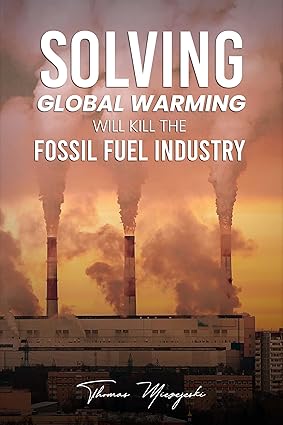

Thomas Miezejeski’s Solving Global Warming Will Kill the Fossil Fuel Industry is an urgent and thorough exploration of what happens when one of the world’s most powerful industries meets its inevitable decline. The book isn’t just about climate change; it’s about the economic, social, and geopolitical tremors that will follow the fall of fossil fuels. Miezejeski takes readers through the science of energy, the history of industrialization, and the strategies that oil and gas companies are using to cling to relevance. This is more than just a warning; it’s a deep dive into a global transformation already in motion.
One of the strongest aspects of this book is its blunt honesty. Miezejeski doesn’t waste time trying to convince skeptics that climate change is real; instead, he assumes his audience is already past that debate. Instead, he focuses on the massive fallout that will occur as the world transitions away from fossil fuels. The opening chapter sets the tone with a stark analogy: global warming is a storm that we can’t stop, but we can prepare for. This sense of urgency keeps the book engaging, making it clear that the demise of the fossil fuel industry won’t be neat or painless. When he details the economic impact on countries like Saudi Arabia, Russia, and Venezuela, it’s hard not to feel a little anxious about the future.
Miezejeski also does a fantastic job of connecting technological change to economic collapse. His comparison of the fall of the fossil fuel industry to the obsolescence of typewriters is one of the most effective parts of the book. Companies like Smith Corona, once giants in their field, failed to adapt when computers took over, and they disappeared almost overnight. The fossil fuel industry, he argues, is on the same trajectory, and history suggests they won’t go down without a fight. The book describes how energy companies are scrambling to diversify into renewables, invest in carbon capture, and rebrand themselves as environmentally friendly. It’s fascinating but also a little depressing; these efforts seem more like delaying tactics than genuine solutions.
Miezejeski does acknowledge the positive impact that fossil fuels have had on society. He credits them with powering the Industrial Revolution and enabling modern civilization. But he doesn’t let nostalgia cloud his judgment. He’s clear that the future belongs to renewable energy, and the longer we delay the transition, the worse the economic and environmental damage will be. His chapter on the costs of global warming over the next 25 years is particularly sobering, breaking down losses in agriculture, health, biodiversity, and even tourism. The numbers are staggering, and they drive home the point that inaction is not an option.
Solving Global Warming Will Kill the Fossil Fuel Industry is a must-read for those who want to go beyond the basics of climate change and understand the larger, messier, and more politically charged reality of the energy transition. Policymakers, business leaders, and anyone curious about the future of energy will find this book an eye-opener. Miezejeski’s thorough research and compelling historical comparisons make this a worthwhile and thought-provoking read.
Pages: 241 | ASIN : B0DMQFG4LS


