Blog Archives
The Narrative Arc of a Life

Universally Adored and Other One Dollar Stories is a sharp and emotionally rich collection of flash fiction that uses the humble dollar bill as a lens to explore love, loss, class, and quiet resilience in everyday lives. What was the inspiration for the setup of your stories?
I’ve been graced in life to be surrounded by hard-working people for whom money is a real thing. Something that determines fortune or misfortune, and all the complications that accompany them. And being an American, the “universally adored” American dollar perfectly captures the power money has over the narrative arc of a life.
I did not, however, set out to write a collection of “one dollar” stories. I wrote one—“Ricky Steiner Was Supposed To Die in Prison”—during a writing workshop series that I co-led for years, and it was well received. So, I riffed on the opening line again, then again, and soon it became like the “Pass the Object” theatre game in which each person in a circle must differently animate the same everyday object, like a bowl, without using words. The bowl becomes a hat, a knee brace, steering wheel, etc. The opening line, “One dollar,” became my “Pass the Object” game.
If you could expand just one of these flash pieces into a full-length novel, which would it be and why?
Well, interestingly enough, I’ve done just that! As you noted, a lot of my characters are pretty lonely, and I was worried about them, so I’ve taken 10 major characters (and a few minor characters) and plopped them down together in a fictitious diner in the Gulf Coast petrochemical town of Texas City in 1980 (which is next to my hometown). You’ll be glad to know that Paulina—the woman in the low-rent motel with the mechanical bed shaker who’s on the run from her abusive ex—is one of them!
The deep back story of this novel-in-progress (which is entitled I Will Read Ashes for You from the Carl Sandburg poem “Fire Pages”) is the 1947 Texas City Disaster, which is still the deadliest industrial accident in US history and, until 9/11, the deadliest loss of firefighter lives as well.
The most central character is Ballard, the older brother in “The Tuesday Theory” story who is the guardian of his younger, autistic brother Willis. The novel is set in the same diner as that story, and the brothers’ absentee “deadbeat” dad, Keller—who is a traumatized Pearl Harbor and industrial accident veteran haunted by the dead—is the unreliable narrator. At the age of 22, Ballard has shelved the pleasures and aspirations of his young man’s life and assumed the responsibility of caring for his neurodivergent younger brother. An everyday hero for sure.
Were there any stories in this collection that you struggled to finish or almost left out?
Great question! I struggled with “Boiling the Buggers”—the story about a recovering germaphobe bartender who is laid off and otherwise undone by the Covid pandemic—in trying to get the interiority of her unraveling right. Certainly, the most bizarre and profane of the stories is “Amygda-la-la-la,” set in a dystopian future time in which two ground-down women friends find meaning in their collection of worthless paper dollars. I debated whether to include that or not—as it is way out there—and I knew it would probably confuse or offend some readers. But I loved the premise that the dollar bill is so foundational to modern human existence that our amygdala—the “lizard brain”—has been hardwired to spot it even among the rubble. The “Mouse Socks” story, told in the POV of a young girl who’s lost her father, wasn’t in the original collection, but after it was published in the South Korean Samjoko Magazine, I gave it another look and decided it was worth including. I had worried its narrative voice was too gentle for contemporary readers.
What is the next book that you are working on, and when will it be available?
My novel-in-progress that I mentioned, I Will Read Ashes for You, is approaching a finished first draft, though I’m still working through a lot of structural edits. It’s a “polyphonic” (multiple POVs), “discontinuous narrative” (meaning there are multiple, interwoven plot lines) novel that has a lot of characters and key backstory about the lingering effects of the 1947 Texas City Disaster and the cancer that riddles that part of the world. However, it is not—emphatically not—historical fiction. While I’ve done a lot of research and indeed, several characters revisit the horror of the Texas City Disaster (plus, there’s a Prologue of the real post-disaster Procession for the Unrecognizable Dead), the narrative arcs of the novel are in 1980, not 1947. There are, though, thematic throughlines about the human cost of war and prosperity, and the work-a-day valor of moving forward.
For any of your readers who have read my recent collection, Universally Adored & Other -One Dollar Stories (published by Vine Leaves Press), the other recurring characters include the diner waitress Eileen, Manny the cook, and Officer Palacios from “The Tuesday Theory;” Theo, the extreme bibliophile from “All Knowledge;” and the alcoholic grandfather Fred, grandson Ben, and Ben’s mom Colleen from “Flounder” (Chester the Bait Man also makes a cameo appearance). Paulina, the domestic violence survivor in “Magic Fingers,” reappears as the waitress Eileen’s daughter, and Paulina’s abusive ex shows up as well. Willa Rae, the Depression-era migrant farmworker girl in “Evening in Paris,” is there as the owner of the used bookstore next to the diner.
Happily, an excerpt from I Will Read Ashes for You will be published in June 2025 in the bilingual (English/Hindi) literary/scholarly online journal Setu Bilingual. The finished book, however, is probably a year or two away from publication.
Currently, project-wise, I’m also collaborating with a longtime visual artist friend, Kevin Oehler, on a chapbook of short fictions that resonate with his artworks. And, with my husband and creative partner, Robert Michael Oliver, I co-produce a weekly podcast, Creativists in Dialogue: A Podcast Embracing the Creative Life, which is supported in part by the DC Commission on the Arts & Humanities. As a former character actor, I’m also keen to produce an author-read audiobook of Universally, much like I did for my debut novel, And Silent Left the Place.
Author Links: GoodReads | X (Twitter) | Facebook | Website | Amazon
In “Universally Adored,” a color-obsessed artist draws a facsimile of a dollar—a masterpiece universally adored—to win her girlfriend back. While checking for spare change in the laundry, in “Bald Tires” a Tennessee housewife with a malcontent husband finds an unused condom in his Sunday trousers. In “The Forgiveness Man,” a runaway teen with a newborn follows a vagabond healer absolving the bedraggled godless through hugs of forgiveness. And in “Magic Fingers, a ladies’ room attendant tracked down by her abusive ex finds refuge in a cheap motel with a 1970s era bed massager.
Riffing on the intimate object of a dollar, Bruce’s humane short fictions—from a great mashed potato war to the grass Jesus walked on—ring with the exquisite voices of characters in analog worlds.
Universally Adored and Other One Dollar Stories
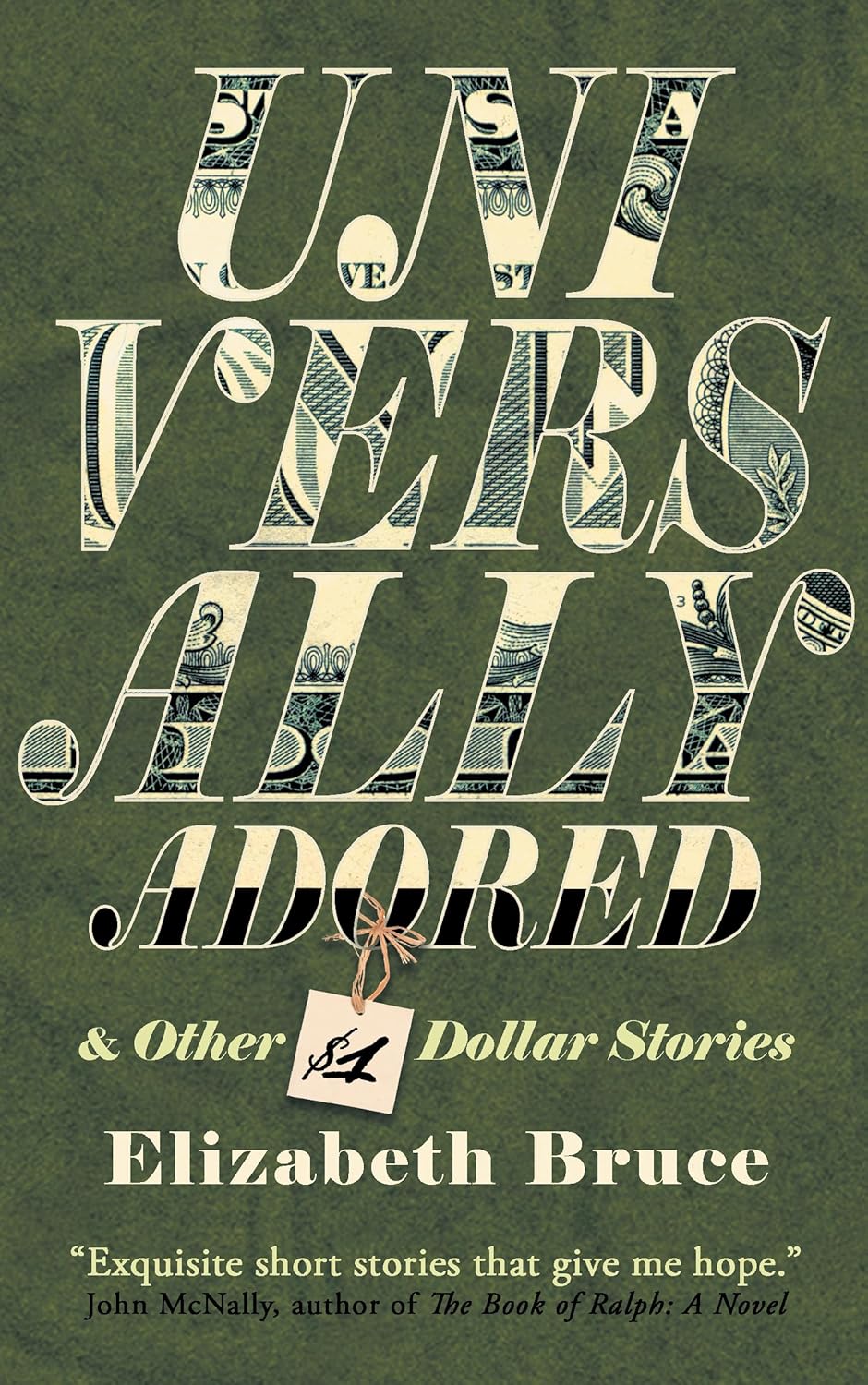

Elizabeth Bruce’s Universally Adored and Other One Dollar Stories is a sharp, tender, and often bittersweet collection of flash fiction and short stories, each orbiting around a simple but rich motif: a single dollar bill. Organized into sections like “Couples,” “Parents and Children,” and “Known Associates,” Bruce sketches lives touched by longing, disappointment, love, and small acts of rebellion. These are slice-of-life portraits told with an economy of words that somehow still manage to feel lush and textured, like she’s captured a thousand messy human emotions in just a few brushstrokes.
Bruce’s writing absolutely floored me from the start. She has this uncanny way of wrapping heartbreak and humor into the same breath. Like in “Universally Adored,” when Fran clutches a Christmas card from her ex and spirals into memories of their love, Bruce paints their collapse with such tender vividness that I almost felt like I’d lived it myself. The scene where Fran stands over her art supplies, caught between choosing color or stability, just broke me a little. Bruce doesn’t overdo anything; she just nudges your heart until it cracks open on its own. The way she captured that ache of holding on too long? Masterful.
That said, sometimes the super short pieces felt almost too fleeting. “Grocery List,” for example, is this hilarious, chaotic monologue from a tired mom scheming with coupons, but it’s over in a blink. I loved it (laughed out loud, actually), but it left me wanting just a little more meat on the bone. Same with “Magic Fingers,” a one-dollar vibrating bed becomes this strange little portal to hope and survival, and I swear I could have read a whole novel about Paulina. But that’s part of Bruce’s style: she trusts her readers to fill in the silences, even if sometimes you wish she’d linger a minute longer.
One thing I kept noticing was how cleverly Bruce uses ordinary objects to tell bigger stories about class, love, and loss. A crumpled dollar in “Bald Tires” becomes a stand-in for betrayal. A misplaced dollar in “Cargo Pants” turns into a lifeline for a lost kid. These little everyday dramas are told without any fancy footwork or pretension, and that’s what makes them hit so hard. Her characters are folks you know or maybe even are. Flawed, hopeful, desperate, trying to make a life out of less than enough.
If you’re the kind of reader who loves authors like Raymond Carver, Lucia Berlin, or even early Ann Beattie, then Universally Adored and Other One Dollar Stories will absolutely be your jam. I’d recommend this book to anyone who has a soft spot for scrappy, gutsy storytelling about real people in all their complicated glory. Just be warned: these stories might be short, but they’ll stay with you way, way longer than you expect.
Pages: 162 | ASIN: B0CKXK5X5T




 LITERARY TITAN