Blog Archives
The Ripple Effect

Born of Dirt & Dust is a collection of short fiction stories ranging from social horror to feral love and tales of survival in a broken world. What draws you to write speculative flash fiction?
Writing speculative flash fiction ignited for me when I sat inside a tattoo studio in Lahaina, along the west coast of Maui, in May 2023, a few months before the horrific wildfire scarred the land and the many, many families affected by the tragedy. At the time of having a beautiful sea turtle tatted on my arm, I learned about the artist working on me. A young woman, approximately in her late twenties, who came to Maui to escape years of marriage with an abusive husband. I could see in her shadowed eyes, her flinching body language, the deep bruised color of her dyed hair, and the violent tattoos inked on her body, the degradation she felt. I could see her need for a portal, an escape, to a very different existence—a world beyond the pain and suffering inflicted upon her. She found that temporary reprieve in the warmth, beauty, and embracing culture of Lahaina. Yet, after only a few months, Hell broke loose, and she lost herself again. This time, in the fire that raged upon her world. It was that moment, seeing the devastation broadcast on the news, feeling the heartache, thinking about her, that I knew I had to write about bending space and time, about churning our world differently in order to find a place where we belonged, where we could—and would—survive, no matter how broken we felt inside. No matter how threatening or violent our environment. In writing speculative fiction, I wanted to capture the worst of what we faced, illustrate the blood we shed, and explore the rising of our spirit to become more than the shrinking ways our world defines us. I wanted to prove that human kindness and resilience win in the end.
Were there any personal experiences or observations that influenced the themes in this collection, and how did they shape the characters or stories?
Two stories in the collection specifically focus on the young life of a boy. “Henry Didn’t Have A Chance,” and “Stuck At A Dead End.” The premise behind the stories came to me from articles I heard on PBS NewsHour while driving to work. The first is about a toddler boy who died at a very young age. Local authorities arrested his mother and her boyfriend on suspicion of murder. The other story aired as a documentary about children of parents who served in the military and returned home with PTSD—how the traumatic affliction affected their children. I knew at this point in writing the stories for Born of Dirt & Dust that I wanted to open a lens for readers to fully experience the character’s world, how trapped they felt, how they chose to move forward, and the ripple effect of those choices. As human beings, we are connected in so many ways. I truly believe that every action and every reaction triggers a ripple effect that touches each of us. Most often in a very minuscule, microcosmic way. Yet it breathes upon us. A tiny molecule. It hits us. No matter how quickly we forget.
Which character in the collection was the most challenging or rewarding to write, and why?
I’m one of those writers who thinks the last story or chapter I’ve written is the best yet. The one that counts. The most brilliant of all. Of course, it’s wishful thinking that comes to light when I re-read what I’ve written a week later and spot the obvious corrections needed. In the case of Born of Dirt & Dust, I favor the story, “Hands That Make A Man.” I have a weak spot for wanting to see the best circumstances for young children in which they grow up to feel loved, secure, and happy. Although my stories tend to lean towards horror, sci-fi, and fantasy, I want the best for my characters. A type of freedom they never thought they would experience. No matter the deepest cuts to their heart and soul. The young boy in “Hands That Make A Man” adores his father, and when Dad is no longer alive, the boy takes something—stitches it to his own young body—and knows full well his life without his father will turn out all right. No matter the loneliness he may feel or the environment where he resides. He gains confidence and feels that he will do right in life.
What is the next book that you are working on, and when will it be available?
There are three books in which I’ve completed first and second drafts—a middle grade book about a young girl who adores space travel and yearns to be a scientist when she grows up; a young adult book about an otherworldly character who hides and survives in the bodies of the recently dead; and an adult thriller about a teenager gaslit by her parents who continue to bury the truth about a family member’s suspicious death. All three books still need another round of editing. The goal (fingers-crossed) is to have them published in the coming year.
Author Links: GoodReads | Facebook | Website | Amazon
Born of Dirt & Dust
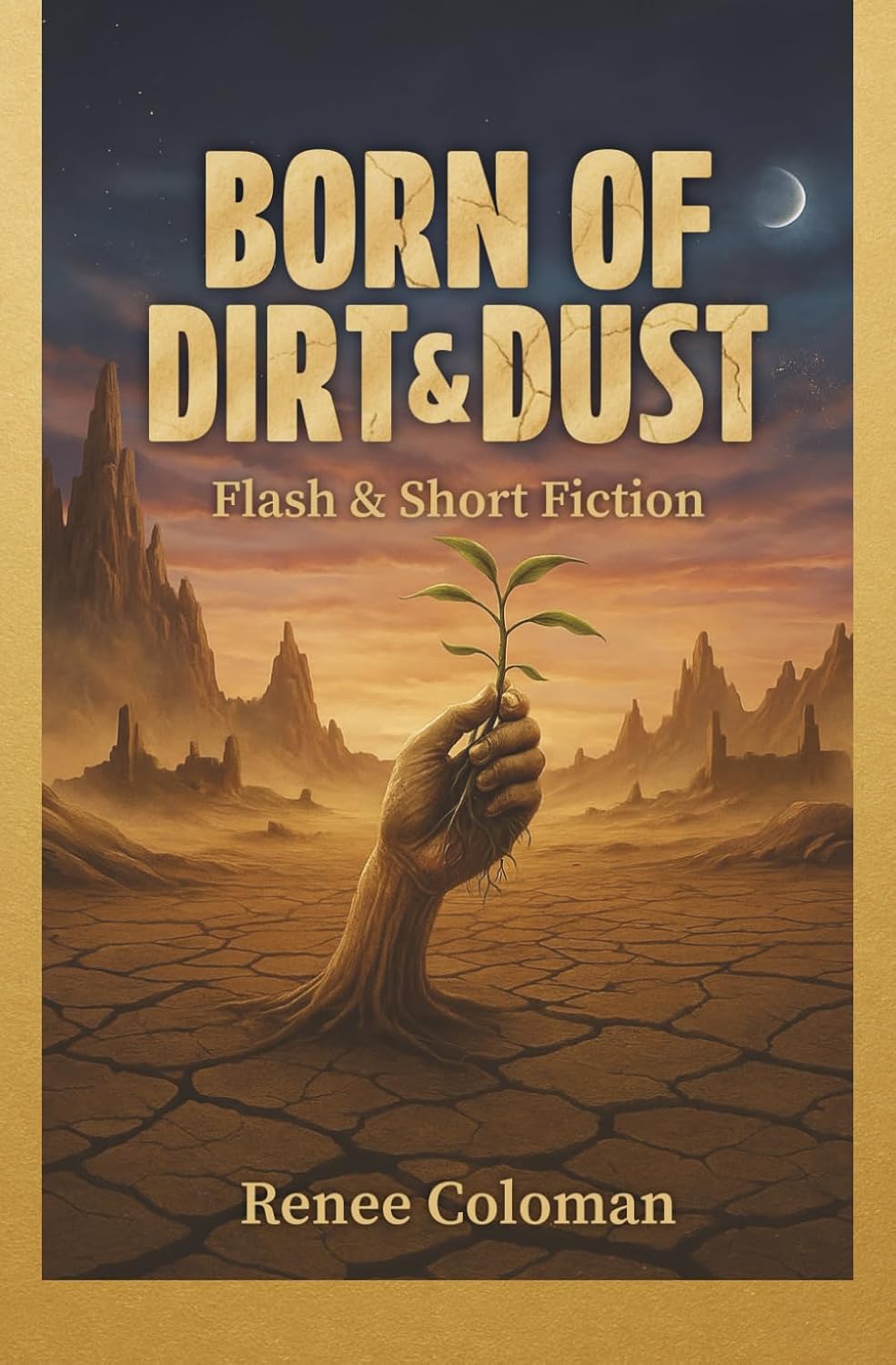

Born of Dirt & Dust is a sharp-edged collection of speculative flash & short fiction that keeps changing masks from urban dread, grief-myth, social horror, bruised fairy tale, while staying faithful to one obsession: what people do to survive when the world won’t stop chewing. Across stories like “Smokin’ with Death,” “Pretending,” “The Last of Our Kind,” and the title piece, Renee Coloman drops me into intimate, first-person rooms where love is feral, hope is conditional, and the aftertaste is usually smoke.
What hit me first was the voice: immediate, unvarnished, and weirdly tender even when it’s being crude. In “Smokin’ with Death,” the narrator sizes up Katelyn, pink hair, tattoos like warnings, a body already half-ghosted by addiction, and the dialogue snaps like a lighter: transactional, defensive, heartbreakingly ordinary. The story doesn’t ask me to approve of anyone; it asks me to recognize them, which is harder and more bracing.
As I kept reading, the book’s recurring textures started to feel intentional rather than merely intense: cigarettes as countdowns, bodies as battlegrounds, love as a dare. “The Last of Our Kind” is a brutal little poem of devotion, an oxygen tank, a warning label, and a woman who can’t stop reaching for flame anyway, as if self-destruction is the last language she and her husband share. And in “Born of Dirt & Dust,” Coloman leans into mythic framing, Adam’s rib, inherited venom, a woman trying to outgrow the “dirt and dust” she’s been assigned, turning family damage into something almost ritualistic. Sometimes the prose repeats or swells on purpose, like a chant you can’t quite step out of; for me, that worked more often than it wobbled.
Coloman’s collection is for readers who want speculative fiction, flash fiction, horror, dark fantasy, magical realism, stories that move fast but leave residue, stories willing to be ugly in the service of truth. If you’ve loved the bite-sized dread and emotional torque of Carmen Maria Machado, you’ll recognize the same appetite for turning private pain into a blade with a shine on it. Born of Dirt & Dust is a small book of big hauntings, each story a matchstrike in the dark.
Pages: 215 | ASIN : B0FZLMZR77

Mood and Mystique
Midnights in October is a collection of thirty-one fifty-five-word tales offering glimpses into the supernatural, giving readers an eerie story to cherish each night in October. What was the inspiration for this unique collection?
October is my favorite month of the year. I love the changing light, the temperature cooling, and the overall anticipation of All Hallows Eve. It occurred to me that having a nightly morsel to read would be a great way to add to the mood and mystique of such a month while enticing us, every night, to spend an hour or two by candlelight making up our own fables on the spot.
What was the biggest challenge you faced in putting together this book?
As Angel Numbers go, five is an intriguing one, and so are double fives. Infected by the notion of combining powerful numbers and words into a spellcasting fest, I committed to keeping my micro-fictions within a 55-word limit. I won’t lie, the revisions were numerous, at least five for each one, and word placement was maddening, but after extensive beta-reading, editing, and proofing, each micro fiction felt just right. It helped that there are specific observances in the month of October, which gave me a ready topic to explore. The other 13 days became a mixture of supernatural slices, wishful thinking, or expressed views.
Do you have a favorite selection from Midnights in October? One that was especially fun to write.
My favorite is October 31, “Halloween.” Every time I read it, I pat myself on the back because it paints such a dreamlike picture. As far as fun ones to write, I’d have to say October 2nd, “The Sky is Falling,” and October 17th, “¡Salud!”
What is the next book you are working on, and when will it be available?
My Faerie Legacy series, chronicling the lives of 3 matriarchs in hybrid faery-human family, is currently a trilogy (now available in Spanish), and I’m contemplating writing a 4th book. I’ve barely started the outline process, so it won’t be a 2026 publication— 2027 might be more on the mark.
Author Links: GoodReads | BlueSky | Facebook | Website | Amazon
But words said in October will inevitably conjure a spellcasting fest.
‘Tis the season for lit-tricky-treats, so dive in, make a ritual of it and, on the fly, compose your own nightly fable in fifty-five words or less.
Why fifty-five?
It’s all about the energy double fives lend to the moment or task.
When casting in October, let your words, or the components of your spell, be 55 in number. Its power will infuse your intention with signature energies like adventure, change, development, opportunity, and transformation, all vital when seeking to begin afresh.
Midnights in October – eerie nightly escapes


Midnights in October is a collection of 31 tiny tales, each just fifty-five words, crafted to match the eerie, mystical mood of every October night. Each story aligns with a calendar day in October, some rooted in real-world observances and others purely imagined. The book doesn’t follow a linear plot but rather unfolds like a haunted advent calendar, with each entry offering a flash of the supernatural, a flicker of fear, or a jolt of dark whimsy. Ghosts, witches, misfits, rebels, and spirits lurk behind every page, waiting to whisper their fifty-five-word truths into the reader’s ear.
I wasn’t sure what to expect at first. I’ve seen microfiction before, but never quite like this. The tight word limit could’ve been a creative straitjacket, but Bossano wears it like armor. Each story punches harder because there’s no room to soften the blow. The writing is sharp, vivid, and almost lyrical. It dances between poetic and unsettling without getting bogged down in over-explanation. I found myself rereading many entries just to let the mood sink in again. One second, you’re smirking at a sly jab; the next, you’re genuinely creeped out. It was like sipping thirty-one shots of moonlight and ink, each with a different burn going down.
What I liked most, though, were the ideas hidden behind the shadows. There’s anger here. Power. Longing. Justice. Loss. Bossano doesn’t just want to scare or amuse you, she wants you to see something. Sometimes it’s political, sometimes it’s personal, sometimes it’s just raw. Stories like “¡Salud!” and “Uprising” stirred something deep and real. Others, like “It’s My Party Day” or “National Cat Day”, brought a strange tenderness to the eerie. It’s rare that something so short can carry so much weight, but these stories do. They sneak up on you. You’ll feel a little haunted afterward.
Midnights in October is a perfect companion for dark, quiet nights when the wind starts to rattle the windows and you want something strange to keep you company. I’d recommend it to fans of flash fiction, lovers of all things spooky, and anyone who craves clever, offbeat storytelling that doesn’t overstay its welcome. If you enjoy Halloween vibes with a side of soul-searching, this is for you.
Pages: 39 | ASIN: B0FJMVJF85
The Narrative Arc of a Life

Universally Adored and Other One Dollar Stories is a sharp and emotionally rich collection of flash fiction that uses the humble dollar bill as a lens to explore love, loss, class, and quiet resilience in everyday lives. What was the inspiration for the setup of your stories?
I’ve been graced in life to be surrounded by hard-working people for whom money is a real thing. Something that determines fortune or misfortune, and all the complications that accompany them. And being an American, the “universally adored” American dollar perfectly captures the power money has over the narrative arc of a life.
I did not, however, set out to write a collection of “one dollar” stories. I wrote one—“Ricky Steiner Was Supposed To Die in Prison”—during a writing workshop series that I co-led for years, and it was well received. So, I riffed on the opening line again, then again, and soon it became like the “Pass the Object” theatre game in which each person in a circle must differently animate the same everyday object, like a bowl, without using words. The bowl becomes a hat, a knee brace, steering wheel, etc. The opening line, “One dollar,” became my “Pass the Object” game.
If you could expand just one of these flash pieces into a full-length novel, which would it be and why?
Well, interestingly enough, I’ve done just that! As you noted, a lot of my characters are pretty lonely, and I was worried about them, so I’ve taken 10 major characters (and a few minor characters) and plopped them down together in a fictitious diner in the Gulf Coast petrochemical town of Texas City in 1980 (which is next to my hometown). You’ll be glad to know that Paulina—the woman in the low-rent motel with the mechanical bed shaker who’s on the run from her abusive ex—is one of them!
The deep back story of this novel-in-progress (which is entitled I Will Read Ashes for You from the Carl Sandburg poem “Fire Pages”) is the 1947 Texas City Disaster, which is still the deadliest industrial accident in US history and, until 9/11, the deadliest loss of firefighter lives as well.
The most central character is Ballard, the older brother in “The Tuesday Theory” story who is the guardian of his younger, autistic brother Willis. The novel is set in the same diner as that story, and the brothers’ absentee “deadbeat” dad, Keller—who is a traumatized Pearl Harbor and industrial accident veteran haunted by the dead—is the unreliable narrator. At the age of 22, Ballard has shelved the pleasures and aspirations of his young man’s life and assumed the responsibility of caring for his neurodivergent younger brother. An everyday hero for sure.
Were there any stories in this collection that you struggled to finish or almost left out?
Great question! I struggled with “Boiling the Buggers”—the story about a recovering germaphobe bartender who is laid off and otherwise undone by the Covid pandemic—in trying to get the interiority of her unraveling right. Certainly, the most bizarre and profane of the stories is “Amygda-la-la-la,” set in a dystopian future time in which two ground-down women friends find meaning in their collection of worthless paper dollars. I debated whether to include that or not—as it is way out there—and I knew it would probably confuse or offend some readers. But I loved the premise that the dollar bill is so foundational to modern human existence that our amygdala—the “lizard brain”—has been hardwired to spot it even among the rubble. The “Mouse Socks” story, told in the POV of a young girl who’s lost her father, wasn’t in the original collection, but after it was published in the South Korean Samjoko Magazine, I gave it another look and decided it was worth including. I had worried its narrative voice was too gentle for contemporary readers.
What is the next book that you are working on, and when will it be available?
My novel-in-progress that I mentioned, I Will Read Ashes for You, is approaching a finished first draft, though I’m still working through a lot of structural edits. It’s a “polyphonic” (multiple POVs), “discontinuous narrative” (meaning there are multiple, interwoven plot lines) novel that has a lot of characters and key backstory about the lingering effects of the 1947 Texas City Disaster and the cancer that riddles that part of the world. However, it is not—emphatically not—historical fiction. While I’ve done a lot of research and indeed, several characters revisit the horror of the Texas City Disaster (plus, there’s a Prologue of the real post-disaster Procession for the Unrecognizable Dead), the narrative arcs of the novel are in 1980, not 1947. There are, though, thematic throughlines about the human cost of war and prosperity, and the work-a-day valor of moving forward.
For any of your readers who have read my recent collection, Universally Adored & Other -One Dollar Stories (published by Vine Leaves Press), the other recurring characters include the diner waitress Eileen, Manny the cook, and Officer Palacios from “The Tuesday Theory;” Theo, the extreme bibliophile from “All Knowledge;” and the alcoholic grandfather Fred, grandson Ben, and Ben’s mom Colleen from “Flounder” (Chester the Bait Man also makes a cameo appearance). Paulina, the domestic violence survivor in “Magic Fingers,” reappears as the waitress Eileen’s daughter, and Paulina’s abusive ex shows up as well. Willa Rae, the Depression-era migrant farmworker girl in “Evening in Paris,” is there as the owner of the used bookstore next to the diner.
Happily, an excerpt from I Will Read Ashes for You will be published in June 2025 in the bilingual (English/Hindi) literary/scholarly online journal Setu Bilingual. The finished book, however, is probably a year or two away from publication.
Currently, project-wise, I’m also collaborating with a longtime visual artist friend, Kevin Oehler, on a chapbook of short fictions that resonate with his artworks. And, with my husband and creative partner, Robert Michael Oliver, I co-produce a weekly podcast, Creativists in Dialogue: A Podcast Embracing the Creative Life, which is supported in part by the DC Commission on the Arts & Humanities. As a former character actor, I’m also keen to produce an author-read audiobook of Universally, much like I did for my debut novel, And Silent Left the Place.
Author Links: GoodReads | X (Twitter) | Facebook | Website | Amazon
In “Universally Adored,” a color-obsessed artist draws a facsimile of a dollar—a masterpiece universally adored—to win her girlfriend back. While checking for spare change in the laundry, in “Bald Tires” a Tennessee housewife with a malcontent husband finds an unused condom in his Sunday trousers. In “The Forgiveness Man,” a runaway teen with a newborn follows a vagabond healer absolving the bedraggled godless through hugs of forgiveness. And in “Magic Fingers, a ladies’ room attendant tracked down by her abusive ex finds refuge in a cheap motel with a 1970s era bed massager.
Riffing on the intimate object of a dollar, Bruce’s humane short fictions—from a great mashed potato war to the grass Jesus walked on—ring with the exquisite voices of characters in analog worlds.
Busted Flat

Busted Flat follows the harrowing journey of Hap, an orphaned teenager with no home or family, and Shriner, a troubled Afghanistan war veteran. Together, they traverse the United States, surviving through petty crime and theft, their lives steeped in chaos and uncertainty. Shriner, haunted by the scars of Post-Traumatic Stress Disorder, spirals into deeper turmoil, dragging Hap into an endless cycle of desperation and danger.
This is not just a story of survival but one of profound struggle. Busted Flat vividly portrays the bleak realities faced by Hap and Shriner, shedding light on homelessness, mental health, and the heavy toll of life on the fringes of society. The story’s raw intensity resonated deeply with me, particularly as someone familiar with the immense challenges of homelessness. The psychological burden, the loss of direction, and the constant fight to persevere felt strikingly authentic.
Hap’s character stood out as the emotional anchor of the story. His innocence and vulnerability were palpable, a stark contrast to the hardened circumstances he endures. His naivety and lack of purpose manifested through his descent into cellphone theft paint a poignant picture of the struggles faced by runaway, orphaned teens. Hap’s portrayal is not just genuine but heart-wrenching, offering an unflinching look at the emotional scars of abandonment and aimlessness.
Gray’s storytelling excels in capturing the bleakness of homelessness in America. The characters are painted with depth and nuance, making their pain and hardships achingly real. The depiction of Shriner’s PTSD adds a layer of complexity to the narrative. It showcases how trauma compounds the already immense challenges of survival.
For readers seeking an intense and thought-provoking crime thriller, Busted Flat delivers. It is a gripping, page-turning exploration of broken lives, raw emotions, and the relentless fight for survival. Highly recommended for those who crave a story that is as heart-pounding as it is deeply moving.
Pages: 92 | ASIN : B0DG9Z879R
Chimaera and Other Stories


Horror can come in many forms; sometimes, it’s visceral and gory, and other times, it digs deep into the mind. Chimaera and Other Stories by Steven Bruce gives readers a mix of both. In the titular story “Chimaera,” a woman trapped in a crumbling relationship is haunted by terrifying hallucinations. Elsewhere, a teenager’s life unravels after encountering a mysterious creature, while a pair of kidnappers find themselves battling a monstrous force in a secluded cabin. In another unsettling tale, a restaurant owner prepares a meal for an engaged couple who aren’t at all what they seem. Each story is a doorway to sleepless nights, and Bruce doesn’t hold back in making sure you regret opening them.
This collection of Flash Fiction reminds me of the dark genius of Stephen King or Clive Barker, particularly the latter’s Books of Blood series. Bruce has a sharp eye for detail and doesn’t shy away from taking his readers to some truly gruesome places. If you’re easily disturbed, be warned—stories like “Voila” and “Gristle,” both centering on the horrors of food gone wrong, will churn your stomach in the best possible way. Just when you think you know where a tale might lead, Bruce twists it, often to the grisliest extremes, relishing the macabre journey. But it’s not all blood and guts. The title story, “Chimaera,” stands out for its psychological horror, which makes it even more unnerving. Unlike some of the other entries, this one sneaks up on you with its subtler approach. Anyone who’s been in a doomed relationship will recognize the protagonist’s growing paranoia and doubt, making it a truly relatable nightmare. It’s this slow descent into madness, rather than overt terror, that leaves the most lasting impression.
This collection offers plenty to devour for readers who enjoy exploring the darkest corners of the mind and are unfazed by a bit of bloodshed. Steven Bruce dives fearlessly into horror’s most unsettling depths, and the results are nothing short of chilling. Chimera and Other Stories should be at the top of your reading list if you’re a fan of psychological horror with a sharp, bloody edge.
Pages: 40
Create From the Inside Out

Little Fortified Stories is an entrancing collection of flash fiction that plunges readers into a series of surreal, evocative realms. What was the inspiration for the original and fascinating idea at the center of the collection?
A few years ago I was introduced to what was then called short-short fiction, essentially micro or flash fiction. I won a scholarship to attend the Disquiet International Literary Program in Lisbon, a city steeped in the past but roaring into the future, with an arts culture that fascinated me, whether it was Paula Rego’s startling, fairy-tale inspired artworks, Pessoa’s idiosyncratic, modernist writing, or the gut-wrenching emotion of Portugal’s native fado music. It all poured into me and influenced my first faltering efforts at writing flash fiction, efforts that took place in Lisbon’s Port Institute after my short-short fiction classes. It was here that I sat in the dimly lit room and sampled the national drink (port) and in my own “act of distillation,” produced compact, weird, touching, unsettling stories which would grow to become Little Fortified Stories. I immediately knew this was my genre.
Was it important for you to deliver a moral to readers, or was it circumstantial to delivering entertaining stories?
My interaction with the reader starts with my interaction with the deep material lurking inside my subconscious. Writing, for me, is more about “translating” voices or lived experiences than educating readers. That being said, in my writing I operate in an empathic sphere, trying to illustrate a range of human emotions and situational states that move characters toward some kind of change, however small. Like the great master, Chekhov, whose work I cherish, I don’t operate on a moral basis. Fiction’s purpose, in my take on it, is to share human experience, allowing the reader to reach their own conclusions.
The cover for this book is interesting. How did you create the cover for Little Fortified Stories?
I’ve always been drawn to theatre. My first two years in university were in theatre. I had a knack and maybe even a yearning to inhabit the characters of other people, to “occupy” someone’s physicality and inner world. Little Fortified Stories is an outcome of this desire. Although I didn’t continue pursuing theatre as a career, I turned instead to studying English and writing and my approach to writing is, rather than artificially planning a story structure, to create from the inside out. As Ray Bradbury said, “Your subconscious is smarter than you are.” In the Ancestral Fabrications section of Little Fortified Stories, I reach into both the factual and mythic elements of my ancestry. The story, “The Jaeger Family Theatre,” depicted on the cover is based on my maternal Swedish heritage but steeped in a wildly imagined past when people interacted with pagan gods and occupied their native landscapes as if they were an integral part of it. In this world, the narrator’s mother dies and as a jaeger bird, flies back to her avian origins in Sweden’s north. The narrator, in her mourning, remembers her childhood as a kind of family “theatre” where all members of her family acted out their lives. I thought this story was an ideal illustration of what I’m doing overall in the collection, and so I chose to collage it for the cover, showing the narrator as a young girl performing her role as the fifth born of the Jaeger clan—in both human and bird form. In a way, many of the stories in Little Fortified Stories are fragments of my own inner or remembered life, steeped in a dreamlike other-place. Many other stories, however, are sheer fiction!
Will there be a follow-up book for this collection? If so, what can readers expect in the next book?
Little Fortified Stories is a collection of loosely linked stories, tethered to broad themes. My next work, possibly a novella in flash, will, although told in flash chapters, have an overarching connection, be anchored in a timeframe from the early 1800s to 1980s and set in a partly imagined community on Canada’s west coast. Considering the unusual characters already hanging out in my brain, I predict it won’t be a traditional narrative and it will likely feature my oft-cited “poetic prose.” Of course, the muse might have other ideas.
Author Links: Book’s GoodRead | Author GoodReads | X | Facebook | Website | Instagram | Book Review


