Blog Archives
The Victorian Era: History for Kids Who Hate History Book 1
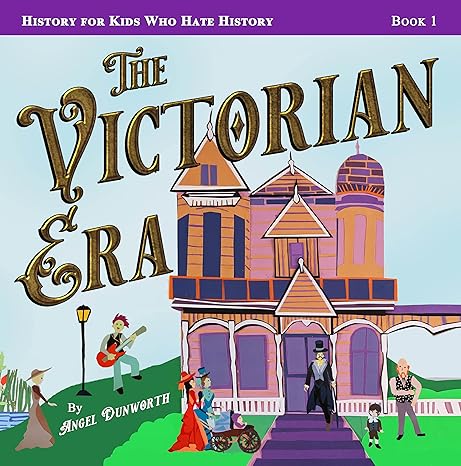

Angel Dunworth’s The Victorian Era: History for Kids Who Hate History is a lively and whimsical dive into the fascinating time of Queen Victoria’s reign, as told through the eyes of Punxy, a playful character with a magic guitar that whisks them back in time. The book is a blend of storytelling, history, and imaginative engagement aimed at young readers. It makes the past approachable by weaving historical facts with vibrant illustrations and a touch of humor.
One of the standout qualities of this book is how it distills complex historical ideas into digestible bits without ever feeling dry. The story of Alice explaining how Lewis Carroll invented Alice in Wonderland is both charming and informative. Carroll’s whimsical storytelling origins, as recounted on a boat ride for Alice Liddell, capture the spirit of creativity that defines this era. I found myself smiling at how cleverly Dunworth uses rhymes to make details stick. This technique makes learning feel like a game.
Another highlight is how the book juxtaposes modern life with Victorian innovations, helping kids connect with the past. Punxy’s excitement over seeing an old-fashioned phonograph and realizing it’s now combined into our smartphones is pure joy. The playful “dance of joy” Punxy shares adds a layer of fun and relatability to what might otherwise feel like a dull history lesson. The book also touches on cultural aspects, like poetry and literature, with anecdotes about Mary Shelley’s Frankenstein. This section shows how creativity in the Victorian era shaped modern storytelling.
The Victorian Era, by Angel Dunworth, is a delightful read that excels in making history fun for kids. Its mix of colorful illustrations, engaging dialogue, and clever rhymes makes it perfect for young readers who might typically shy away from traditional history books. I’d recommend it to children between ages 7 and 12, parents looking for interactive learning tools, or even teachers wanting to add a splash of fun to their curriculum. This book truly rocks and not just because of Punxy’s magic guitar!
Pages: 45 | ASIN : B0DK9PHSH5

A Sentient House

A Madness Unmade follows the last guardian of a crumbling sanctuary for restless spirits, who must navigate a world of necromantic power and unravel the haunting mysteries of her father’s death. What was the inspiration for the setup of your story?
A whole slew of inspiration hit me at once: within a matter of days, I consumed S.L. Prater’s Street Witch trilogy, followed by Charlie N. Holmberg’s Spellbreaker duology, both of which made me want to write Victorian-inspired fantasy and then, while watching an old episode of Survivor, I got hung up on the word “soliloquy” and began dreaming up a character who talked to herself all the time — no, wait, she wasn’t talking to herself, but to ghosts! Then I decided we needed more friendly ghosts in literature, saw an opportunity to incorporate a sentient house (something I’ve always wanted to do), and it snowballed wonderfully from there.
Laurel Rumbroom is a complex character shaped by grief and burdened with responsibility. How did you approach developing her character arc, and what were the biggest challenges in writing her journey?
There is a lot of myself in Laurel; though I didn’t realize it, in writing her character I was exploring the way my own mind worked, both in the sort of shunting-aside of grief, the almost aggressive forgetting of it, as well as in the struggling to make sense of how the world works and the difficulties faced in learning when you have any sort of attention or information-processing disorder. Sometimes the simplest tasks are the hardest, and I wanted to see that reflected in a character, but without slipping into the clichés or misconceptions about attention disorders — that was the most challenging part, especially since I’m still learning about neurodivergence and all its nuanced forms.
The Underhallow is a beautifully haunting setting with rich gothic elements. Can you share your creative process behind building this unique sanctuary for spirits?
Really, the setting came to life on its own! When starting the story, I was reading a lot of Victorian/gaslamp fantasy, and knew I needed a sprawling old manor. I also knew my main character, Laurel, was mildly agoraphobic and would not be leaving the manor — thus, the idea of a “sanctum” was twofold, as it’s not just a sanctuary for ghosts, but for her as well! It needed to be as cozy as it was gothic, which was a fun dichotomy to experiment with.
In the Victorian era, a large manor such as the Underhallow would typically require a dedicated team of people to maintain its upkeep, but in this case, we have a lone young woman who has no idea how to run a household (nor does she have the desire to), and that was another fun element to incorporate. I did a lot of research on how they did these mundane but necessary things in the eighteenth century. Super intense stuff.
When and where will your book be available?
A Madness Unmade will be released on March 3, 2025, in both print and digital formats, and will be available from most online book retailers!
Author Links: GoodReads | Website | Instagram | Amazon
Since the institution of the Revenant Accords, which prohibits ghosts from freely haunting the country, the Rumbrooms have acted as Guardians to the ghosts seeking refuge at their sanctuary. But when Laurel’s father suddenly passes, leaving her orphaned, the Underhallow falls in danger of losing its sanctions.
Bewildered by the mysterious deliveries of dead moths, starting to question her grip on reality, and gradually realizing the precarious position of her home and the questionable circumstances surrounding her father’s death, Laurel begs the help of the Underhallow ghosts animated by her powers, struggling to come into her own and unmake her madness.
With humor, whimsy, and elements of gothic mystery, A Madness Unmade is the first book in the Victorian-inspired Deathly Inheritance Duology, perfect for fans of Charlie N. Holmberg and S.L. Prater.



 LITERARY TITAN