Blog Archives
I Am; Therefore I Think: Consciousness and Humanity in the Age of AI


JP Pulcini’s I Am; Therefore I Think is a reflective and wide-ranging meditation on consciousness, identity, memory, mortality, and artificial intelligence, written less as a rigid thesis than as a guided walk through the author’s own questions. The book begins in the intimate territory of early memory and wonder, then moves through Descartes, Nagel, Chalmers, neuroscience, science fiction, simulation theory, transhumanism, and the ethics of AI, always returning to one central conviction: whatever machines may eventually imitate, human consciousness still seems bound up with lived experience, meaning, and the stubborn inwardness of a self. What gives the book its shape is that recurring movement from abstraction back to life itself, from Lascaux cave paintings to Blade Runner, from memory as data to memory as felt history, and finally to mortality as the force that gives existence its urgency.
Pulcini is at his best when he stops trying to sound like a referee in a philosophical debate and instead sounds like a person genuinely wrestling with what it means to be here at all. The early pages about childhood warmth and wonder have a quiet grace to them, and later, when he argues that AI can simulate intelligence but cannot inhabit it, the book finds its emotional center. I found myself especially taken by his insistence that memory isn’t just stored content but something saturated with feeling, authorship, and private texture. His beach-sand comparison, modest as it is, works because it makes the larger claim tangible. That same gift shows up in his reading of Blade Runner against The Matrix, where he argues that consciousness is not just perception manipulated from the outside, but meaning shaped from within. Those are the moments when the book stops being merely thoughtful and becomes affecting.
There are stretches where the synthesis of philosophy, pop culture, theology, futurism, and personal reflection feels genuinely rich. This isn’t a cold, academic book. It wants to keep the mystery intact while still thinking hard around its edges. The writing is often plainspoken rather than dazzling, yet it has a steadiness that suits the material, and when Pulcini turns to mortality, grief, and the danger of pursuing technological perfection at the cost of human presence, the book gathers real moral weight.
This is a thoughtful and deeply felt book. It reminds me that our most urgent questions about AI are still, underneath it all, questions about the soul of human life: what we remember, what we love, what we lose, what we fear, and why any of it matters. Its final mood is not triumphalist or apocalyptic, but tenderly cautionary, asking us to carry our tools forward without surrendering the fragile, mortal selves that made those tools in the first place. I’d recommend it to readers who enjoy philosophy written for thoughtful generalists, especially people drawn to books that live somewhere between cultural criticism, existential reflection, and accessible writing about AI.
Pages: 313 | ASIN : B0GRMQ945F

Unchained: Your AI Blueprint for Liberation

Unchained: Your AI Blueprint for Liberation by Mark Mueller walks through three big moves at once. First, it argues that the modern economy is deliberately rigged, tracing how policy choices, corporate power, and debt have boxed ordinary people into a kind of financial servitude. Then it shifts into how schools and corporate culture have trained us to think like factory workers instead of free agents. Finally, it offers AI, mindset shifts, and some unconventional tools as a way to reclaim control over money, work, and personal purpose, wrapping all of that in the author’s own story of layoffs, illness, burnout, and slow rebuilding.
The sections on housing, healthcare, food stamps, and debt resonated with me personally. The personal scenes, like sneaking into a friend’s condo to have a place to sleep or waiting hours with a painful infection because treatment was unaffordable, land with real emotional weight. The writing there is emotional and almost messy on purpose. It feels like someone talking late at night after a long day. I liked that. The numbers and historical context around tax law, CEO pay, and wealth gaps are presented in plain language, with enough detail to feel grounded. The rhetoric can get heated, yet that intensity matches the point of the book.
The chapters that explain AI as pattern recognition and prediction, along with the “Trash Bot” story and the breakdown of how jobs may shift instead of simply vanish, are clear and practical. I found those parts useful, and I appreciated how the author keeps saying, in different ways, that AI is a tool, not a god, and not a monster. As someone who values numerology, I really enjoyed the numerology chapter and the more cosmic language about destiny and unseen threads. I like how he mixes intuition, meaning-making, and data. It feels like he is inviting the reader to see life as both pattern and mystery at the same time. That blend makes the practical advice feel deeper and more personal. The book uses bold images and wild metaphors like Galactus eating worlds or workers as nutrients, and I found that style fun and memorable. It kept the ideas from feeling dry and made the whole thing feel more like a graphic novel for the soul.
Unchained is heartfelt, sincere, and useful. I would recommend Unchained to readers who feel stuck in their jobs, anxious about money, or scared of what AI means for their future, and who prefer a human, story-driven approach instead of a dry manual. It’s a good fit for people who like a mix of social critique, personal confession, and step-by-step encouragement, and who do not mind a passionate, sometimes fiery tone. If you want someone to sit next to you, point at the system, and say, “Here is how it broke you and here is how we might break free,” then this book delivers.
Pages: 125 | ASIN : B0GHZX358D

Advancing the World

Research, Invent, and Create Wealth is a passionate, full-throttle manifesto urging individuals to harness the power of research and invention to achieve prosperity and elevate humanity. Why was this an important book for you to write?
It was most important for Peter James Kpolovie, the Scientist of the Year 2021 and the Name in Science, to write the book Research, Invent, and Create Wealth because what best improves people, sustains, and advances society and the world are research, invention, and the Wealth in circulation. Without research, inventions, discoveries, and innovations, the world will not only stagnate but also degenerate continuously into nothingness over the years.
It was extremely important for P. J. Kpolovie to write the book because individuals and nations desperately need to attain greater Wealth. The achievement of peak wealth is dependent on research and inventions. Research and inventions determine the Wealth and advancement of people, society, nations, continents, and the world.
For instance, gross national income (GNI), which is the total dollar value of everything produced by a country and the income its residents receive both at home and abroad, depends on research and inventions. Only with research and invention are goods and services that determine a nation’s Wealth produced and disseminated. Gross domestic product (GDP) per capita, which is the total annual monetary value of all goods and services a country produces and sells within its borders, is directly determined by the research, inventions, discoveries, and innovations in the nation. No nation can exist for just thirty years without goods and services produced and sold via research and invention. The nations with more inventions, products, and better services are incomparably wealthier than countries with far fewer inventions, products, and services.
Research, Invent, and Create Wealth was necessarily written by Peter James Kpolovie as an excellent guide for us to research, invent, create value, generate Wealth, and advance the world, individually and sometimes collaboratively. No person invents products by doing things the same way others do. A person does not create, invent, or innovate something by doing it the exact way people expect him to.
Research is best defined as “making impossibility possible” (Peter James Kpolovie, 2023, 1). The answer to “What is Research?” is simply three words – “Making impossibility possible.”
Research makes the impossible possible and solves unsolvable problems through invention, discovery, creation, or innovation. Only when a person empirically makes an invention, discovery, creation, or innovation that he has done research.
In the book, P. J. Kpolovie has emphasized that: “Without making an invention, discovery, creation, or innovation, a person has not done research. A person can only be said to have executed research when he made an invention, creation, discovery or innovation. The invention, discovery, creation, or innovation made must be of immense value to humankind. “
People worldwide queue to pay electronically to benefit from or purchase an invented product, service, idea, knowledge, truth, or device of essential worth.
The international market determines the value of an invention by how much people are willing to pay for it.
A person who has not yet developed a product that people worldwide are willing to pay for has not done any research. Every renowned researcher in the world has made useful inventions, discoveries, creations, or innovations that automatically attract dollars.
Research is done for the creation of Wealth and improvement of people’s lot. Research is conducted for the enrichment of the people and the inventor. The impoverishment of the investigator and the people is never the purpose of research.
In the book, Peter James Kpolovie thoroughly presents how the world’s preeminent researchers and prolific inventors think and act. Surely, every person who studies, practices, and masters the book and emulates the way prolific inventors think and act will eventually conduct research and create a very useful invention, discovery, creation, or innovation to better people’s lives, improve society, and advance the world.
Research is the quest for new possibilities. It deals with the invention or discovery of replicable solutions to unsolved and seemingly unsolvable problems.
Invention is the process or act of bringing into existence something that has never been made before. It is the bringing of ideas or objects together to create a novel device, process, or something useful.
Discovery is the act of finding something that has not been known before. It is finding a functional solution for the first time. It is finding what no one has known previously.
Each invention is equal to an impossibility made possible. When you invent, create, discover, or innovate something of tremendous value to people, research has been done. Something of great value to humankind is invented through research. Something that truly meets the great needs of man is invented through research.
Invention, creation, or discovery is evidence of surmounting the insurmountable and solving the unsolvable problems. The audience and users gladly pay to get and benefit from what you have done – the invention made and the value created.
Ask yourself these questions:
1. Do I want to be paid for the outcome of my research?
2. What if I receive an automated payment for the results of my research?
3. What if the products of my research keep working for me, magnetizing dollars all through my lifetime?
4. Am I craving getting paid automatically for what I know?
5. Would I love to have some research products that people rush and pay for?
6. Would I like a major company to mass-produce the outcome of my research for the world?
7. What if the products of my research are massively commercialized on a large scale?
8. What if my research products inexhaustibly pervade and dominate the global market?
9. Will I be self-fulfilled when I become renowned as the inventor who remarkably advanced the world?
Suppose the answers to these and similar questions are affirmative. In that case, you can achieve such cravings by researching or funding others to research and make valuable inventions.
How to research, invent, make impossibilities possible and turn unsolvable problems into solvable ones, and consequently attain Wealth and prosperity are excellently presented by Peter James Kpolovie in the book – Research, Invent, and Create Wealth. Get a copy of the book, study and apply it to achieve all you seriously aspire to.
A key point you make in your book is that invention is not only the most direct path to personal Wealth but also the highest moral duty we owe to future generations. Could you elaborate on this theory and explain how you envision it in action with the upcoming generations?
We can create a better tomorrow. It is our duty, responsibility, obligation, and utmost fundamental human right to invent and create a blissful tomorrow for humankind.
Peter James Kpolovie, in his book Research, Invent, and Create Wealth, has passionately called on each of us to answer these questions and take all the necessary practical steps to guarantee an exceptionally better future for humanity. Have you ever visualized a better tomorrow for the majority of people on the planet? Have you ever wished to invent, discover, or create something to materialize the blissful tomorrow?
From today, embark on the journey to make the inventions that a better tomorrow depends on. Execute research and invent the ideal future people crave. We must set out with our research and make the inventions upon which the blissful tomorrow we crave depends.
We must pay the great debt we owe the future. Everything we could have and use today was invented, discovered, or created by people’s research yesterday.
What have we individually created, invented, or discovered to guarantee a much better tomorrow for humankind?
The debt we owe, the greatest debt we owe, the only real debt we owe, is the creation of an exceptionally better future for all. We owe the future the making of inventions, discoveries, creations, and innovations that will bring about an incomparably better future than today. We must go all out with our research today to fully pay that debt.
We must individually self-sacrifice for the good of all. Research demands complete selfless sacrifice and investment for the best good of humankind. Only a person who develops herself to the level of selfless investment in and sacrifices for the best good of all can execute research.
Research can only be done by a person who has developed herself for this purpose. Invest heavily in your self-development to execute or fund research, make inventions, create value, generate Wealth, and advance the world.
A person must self-develop for research. Only a self-developed person for research can utterly seek:
1. Meeting man’s needs.
2. Provision of solutions to unsolved problems.
3. Unravelling the truth and adding to knowledge.
4. Identification and resolution of unsolvable problems.
5. Discovery of novel cause-and-effect relationships.
6. Accomplishment of new possibilities.
7. Working in her alarm zone to make inventions.
8. Valuing the making of discoveries and inventions more than everything else, even her life.
9. Creating value with her inventions and achieving uncommon Wealth, greatness, glory, and prosperity.
10. Advancement of the world by making the necessary inventions.
What is one piece of advice you wish someone had given you when you were younger?
Peter James Kpolovie wished he had been advised, when he was younger, to enthusiastically dedicate himself to research, invention, and the creation of Wealth. To ensure that other people timely get the advice and motivation he would have loved to get, P. J. Kpolovie has extensively researched for three decades and painstakingly written the book, Research, Invent, and Create Wealth, to best guide people on what they mostly need to do to achieve uncommon Wealth, better people, improve society, and advance the world.
What is one thing that you hope readers take away from Research, Invent, and Create Wealth?
Readers should be motivated to research, invent, and create Wealth enthusiastically. With enormous data-based information, P. J. Kpolovie is absolutely certain that every person who reads the book voraciously with undying passion to know, resolute determination to apply, and complete commitment to execute research will surely make inventions, create Wealth, and achieve whatever he seriously aspires to for the betterment of people and advancement of society and the world. Please acquire a copy now, study it, conduct research, make indispensable inventions, and achieve outstanding Wealth over the years.
Author Links: GoodReads | X | Facebook
The blissful future we all yearn for, we can surely achieve when we make all the necessary inventions. The time to act is now, and it is our individual and collective responsibility to ensure a better future.
The worst security risk and the greatest threat to national and global sustainability and advancement is the refusal or failure to make essential inventions with our research today.
Human Again: In the AI Age

Author J.D. Macpherson’s Human Again: In the AI Age is a brisk, kitchen-table-to-big-picture tour of what happens when a normal person falls hard for a not-normal tool and then refuses to let it steal her mind. She starts with the seductive convenience of “Ask Chat” and quickly widens the lens: AI isn’t “magic,” it’s leverage, and the real danger isn’t job loss so much as the quiet outsourcing of thought. From there, the book moves through practical ways to work with LLMs (better questions, stronger prompts, treating AI as a first draft) while repeatedly circling one thesis: keep the human parts fiercely yours, like taste, judgment, lived context, and meaning.
I enjoyed the author’s tone. It’s a little mischievous and allergic to corporate beige. Macpherson writes about AI like it’s something you can hold in your hand. Something useful, unstable, and thrilling. When she describes the “AI-ICK” of lazy-generated writing, or the strange intimacy people build with models, I can tell she really understands how people use AI. Even the craft advice is fantastic because it’s anchored in something tactile. You don’t just “use” AI, you spar with it, you prune it, you train it, you insist on the line where a machine’s polished empathy turns hollow.
So many sharp ideas are delivered in quick succession that I felt like a few of them deserved more time to be drawn out and explored. But I’d rather have a book that risks velocity than one that embalms itself in caution tape. And to the author’s credit, she doesn’t ignore the rot, she calls out hallucinations plainly (the model “confidently” inventing reality, even getting basic political facts wrong) and treats that confidence as part of the hazard. The sections on dependency and the “second self” illusion also resonated with me as less techno-panic and more of a psychological weather report.
I think Human Again is for curious professionals, creators, students, and cognitively-overbooked humans who feel the shift and want to benefit from AI without becoming beige in the process. Especially readers who don’t need a technical manual, but do want a usable philosophy and a few tactics. Human Again is more like a streetlight giving practical illumination, with a warning about what’s prowling just outside the light. I think J.D. Macpherson would say, let the machine draft, let the human decide what’s worth saying.
Pages: 221 | ASIN : B0DCWJP2BZ
The Paradox of Progress: Book 2: The Roses and Thorns of Artificial Intelligence

Michael M. Karch’s The Paradox of Progress is a thoughtful and personal exploration of artificial intelligence and the tangled web of benefits and risks it brings to modern life. The book is framed around the central idea that progress never comes without a price. Each chapter highlights a paradox, such as self-driving cars that promise safety yet pose new dangers, batteries that drive clean energy but scar the environment, and AI in war that might save lives but could also escalate conflicts. Karch skillfully balances the roses with the thorns, using vivid historical parallels, personal anecdotes, and contemporary case studies to show how every leap forward reshapes society in both hopeful and unsettling ways.
Karch’s writing feels conversational, even playful at times, yet it never loses sight of weighty ethical questions. I especially liked how he wove his own experiences into the narrative. The self-checkout story, his Ironman accident, and his work as a surgeon with AI-driven tools. These moments gave the book texture and heart, reminding me that discussions about AI are not just technical but deeply human. The prose is clear, free of jargon, and sprinkled with humor, which makes even the most complex topics easier to digest.
What I liked most was the author’s mix of optimism and unease. His fascination with AI’s potential is genuine, but so is his fear of its misuse. I shared his awe at the possibilities. Medical breakthroughs, global problem-solving, and smarter systems that could ease human suffering. And I shared his anxiety about the darker flipside. Bias in algorithms, surveillance, widening inequality, war machines that act faster than human conscience. The book stirred both excitement and caution in me, sometimes within the same page. It left me reflecting not just on AI, but on human nature, since at its core, this isn’t a book about machines. It’s about us, our flaws, our hopes, and our choices.
I think The Paradox of Progress is a book best suited for readers who are curious about AI but not looking for a technical manual. It’s written for people who want to think, not just learn facts. I’d recommend it to policymakers, students, teachers, and anyone who has felt both wonder and dread at the pace of change around us. It’s not a book that will tell you what to believe about AI. Instead, it invites you into a bigger conversation, one that we all need to be having before the thorns outgrow the roses.
Pages: 236 | ASIN : B0FNDN4FYY
Reimagining Government: Achieving the Promise of AI

Reimagining Government: Achieving the Promise of AI is a comprehensive examination of how artificial intelligence can transform government from the inside out. It mixes history, technical detail, and practical advice in a way that feels both ambitious and grounded. The authors walk through the basics of AI, explain different models and their strengths, and then shift into how these tools can be applied in real government settings. They discuss frameworks such as OPEN and CARE, portfolio approaches to project management, and the importance of leadership and culture. The book argues that AI is not just about technology, but also about people, values, and institutions, and that governments must rethink themselves to keep pace with the changes AI brings.
The writing is clear and avoids the usual hype that surrounds AI, which was refreshing. Instead of promising magic, the book insists on responsibility and balance. I appreciated how it didn’t gloss over risks like bias, hallucinations, or policy drift. The authors don’t just flag these issues; they provide ideas for handling them. That gave the whole thing a sense of credibility. The frameworks felt a bit rigid at times, but I understood why they were there. They give structure to a messy and fast-moving space, and in a government context, structure is probably what’s needed.
What struck me most was the way the book spoke about leadership and culture. I could feel the urgency in their words, almost like a call to action. It reminded me that technology alone doesn’t fix anything. It’s people who make the choices, who decide how much to embrace risk, and who shape whether AI becomes a tool for service or just another layer of bureaucracy. I liked that tension. It made the book feel real rather than utopian. I wished for more stories or case studies of where this has worked well already. I think that would have given it more life and less of a playbook vibe.
I would recommend this book to policymakers, civic leaders, and even curious citizens who want to understand where government and AI are heading. It’s approachable and avoids drowning in jargon. If you’re looking for a thoughtful and practical guide that treats AI as both a promise and a problem, this is a book worth your time.
Pages: 288 | ASIN : B0FLDZHCR5
The Doctor’s Future


Dr. Pietro Garbelli’s The Doctor’s Future is a deep dive into the fast-approaching world of AI and robotics in medicine. The book blends practical guidance, cautionary tales, and a rallying cry for doctors to take charge of the transformation ahead. Garbelli covers everything from the current state of AI adoption in healthcare to predictions of where technology could lead us, both in best-case and worst-case scenarios. He introduces the “Healthcare Convergence Framework” as a blueprint for ensuring AI serves the profession without eroding its core values of empathy, ethics, and patient-centered care. Along the way, he doesn’t shy away from discussing threats, like loss of professional autonomy or the risk of over-reliance on black-box algorithms, and he offers concrete strategies to navigate them.
Garbelli’s writing is straightforward, peppered with vivid metaphors, and there’s a clear emotional undercurrent. He’s worried about what’s coming, but he’s also hopeful. I appreciated his honesty about the profession’s blind spots, such as resistance to change and discomfort with having decisions second-guessed by machines. Some parts hit hard, especially his reflections on burnout and the fragile trust between doctors and patients. It’s not just theory; he folds in surveys, examples from different specialties, and even patient reactions to AI, which makes the book feel grounded and real.
I found myself alternately nodding along and pausing to think. The “doomsday” scenarios were unsettling, yet they didn’t feel like fear-mongering. Instead, they made the stakes clear. Garbelli’s insistence that doctors must lead, rather than follow, in this transformation stuck with me. He clearly loves medicine and wants to protect it, and that passion comes through in every chapter. There’s also an undercurrent of empowerment here: he’s not telling us to survive the AI revolution, but to shape it. That’s a refreshing change from the usual doom-and-gloom takes.
The Doctor’s Future is more than a technology primer. It’s a call to action for medical professionals, policy makers, and even patients who care about the integrity of healthcare. I’d recommend it to any doctor who’s curious, worried, or skeptical about AI, as well as to healthcare leaders responsible for steering their organizations into the next era. It’s also valuable for medical students because the sooner they understand what’s ahead, the better prepared they’ll be. If you want a book that challenges you to think critically while giving you practical tools to safeguard your profession, this one’s worth your time.
Pages: 252 | ASIN : B0FGCNY5HH

Research, Invent, and Create Wealth
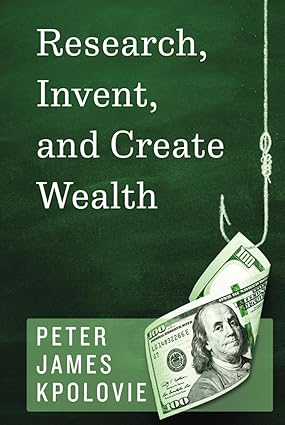

Peter James Kpolovie’s Research, Invent, and Create Wealth is a passionate, full-throttle manifesto urging individuals to harness the power of research and invention to achieve prosperity and elevate humanity. The book’s central claim is crystal clear and relentlessly repeated: invention is not only the most direct path to personal wealth but also the highest moral duty we owe to future generations. Across its 19 chapters, Kpolovie blends motivational prose with anecdotes, directives, and a firm belief in the transformative power of human creativity. He outlines the mindset, actions, and sacrifices required to make valuable discoveries and products that, once mass-produced, can improve lives and generate endless wealth.
Kpolovie’s writing is energetic. It’s repetitive, intense, and charged with ambition. The tone rarely wavers; it pushes and urges, page after page. But underneath lies a sincere and powerful idea: the future belongs to the creators. I admired the belief in human potential, the sense that we are all just one invention away from changing everything. His enthusiasm is contagious.
The book shines brightest when it spotlights the stories of famous inventors or urges the reader to dig deep, take risks, and endure hardship in pursuit of a breakthrough. It inspired me to reevaluate how I approach problem-solving and reminded me that most conveniences in our lives once seemed impossible. The book is like a motivational seminar. I craved more real-world examples, a few cautionary tales, or even contrasting voices.
I think Research, Invent, and Create Wealth is best suited for ambitious dreamers, especially young entrepreneurs, inventors, or students looking for a spark. If you’re feeling stuck or uninspired, this book might just kick you into motion. If you can embrace its volume and intensity, you’ll walk away energized and ready to build the future.
Pages: 285 | ASIN : B0D7GL18QZ


