Blog Archives
Advancing the World

Research, Invent, and Create Wealth is a passionate, full-throttle manifesto urging individuals to harness the power of research and invention to achieve prosperity and elevate humanity. Why was this an important book for you to write?
It was most important for Peter James Kpolovie, the Scientist of the Year 2021 and the Name in Science, to write the book Research, Invent, and Create Wealth because what best improves people, sustains, and advances society and the world are research, invention, and the Wealth in circulation. Without research, inventions, discoveries, and innovations, the world will not only stagnate but also degenerate continuously into nothingness over the years.
It was extremely important for P. J. Kpolovie to write the book because individuals and nations desperately need to attain greater Wealth. The achievement of peak wealth is dependent on research and inventions. Research and inventions determine the Wealth and advancement of people, society, nations, continents, and the world.
For instance, gross national income (GNI), which is the total dollar value of everything produced by a country and the income its residents receive both at home and abroad, depends on research and inventions. Only with research and invention are goods and services that determine a nation’s Wealth produced and disseminated. Gross domestic product (GDP) per capita, which is the total annual monetary value of all goods and services a country produces and sells within its borders, is directly determined by the research, inventions, discoveries, and innovations in the nation. No nation can exist for just thirty years without goods and services produced and sold via research and invention. The nations with more inventions, products, and better services are incomparably wealthier than countries with far fewer inventions, products, and services.
Research, Invent, and Create Wealth was necessarily written by Peter James Kpolovie as an excellent guide for us to research, invent, create value, generate Wealth, and advance the world, individually and sometimes collaboratively. No person invents products by doing things the same way others do. A person does not create, invent, or innovate something by doing it the exact way people expect him to.
Research is best defined as “making impossibility possible” (Peter James Kpolovie, 2023, 1). The answer to “What is Research?” is simply three words – “Making impossibility possible.”
Research makes the impossible possible and solves unsolvable problems through invention, discovery, creation, or innovation. Only when a person empirically makes an invention, discovery, creation, or innovation that he has done research.
In the book, P. J. Kpolovie has emphasized that: “Without making an invention, discovery, creation, or innovation, a person has not done research. A person can only be said to have executed research when he made an invention, creation, discovery or innovation. The invention, discovery, creation, or innovation made must be of immense value to humankind. “
People worldwide queue to pay electronically to benefit from or purchase an invented product, service, idea, knowledge, truth, or device of essential worth.
The international market determines the value of an invention by how much people are willing to pay for it.
A person who has not yet developed a product that people worldwide are willing to pay for has not done any research. Every renowned researcher in the world has made useful inventions, discoveries, creations, or innovations that automatically attract dollars.
Research is done for the creation of Wealth and improvement of people’s lot. Research is conducted for the enrichment of the people and the inventor. The impoverishment of the investigator and the people is never the purpose of research.
In the book, Peter James Kpolovie thoroughly presents how the world’s preeminent researchers and prolific inventors think and act. Surely, every person who studies, practices, and masters the book and emulates the way prolific inventors think and act will eventually conduct research and create a very useful invention, discovery, creation, or innovation to better people’s lives, improve society, and advance the world.
Research is the quest for new possibilities. It deals with the invention or discovery of replicable solutions to unsolved and seemingly unsolvable problems.
Invention is the process or act of bringing into existence something that has never been made before. It is the bringing of ideas or objects together to create a novel device, process, or something useful.
Discovery is the act of finding something that has not been known before. It is finding a functional solution for the first time. It is finding what no one has known previously.
Each invention is equal to an impossibility made possible. When you invent, create, discover, or innovate something of tremendous value to people, research has been done. Something of great value to humankind is invented through research. Something that truly meets the great needs of man is invented through research.
Invention, creation, or discovery is evidence of surmounting the insurmountable and solving the unsolvable problems. The audience and users gladly pay to get and benefit from what you have done – the invention made and the value created.
Ask yourself these questions:
1. Do I want to be paid for the outcome of my research?
2. What if I receive an automated payment for the results of my research?
3. What if the products of my research keep working for me, magnetizing dollars all through my lifetime?
4. Am I craving getting paid automatically for what I know?
5. Would I love to have some research products that people rush and pay for?
6. Would I like a major company to mass-produce the outcome of my research for the world?
7. What if the products of my research are massively commercialized on a large scale?
8. What if my research products inexhaustibly pervade and dominate the global market?
9. Will I be self-fulfilled when I become renowned as the inventor who remarkably advanced the world?
Suppose the answers to these and similar questions are affirmative. In that case, you can achieve such cravings by researching or funding others to research and make valuable inventions.
How to research, invent, make impossibilities possible and turn unsolvable problems into solvable ones, and consequently attain Wealth and prosperity are excellently presented by Peter James Kpolovie in the book – Research, Invent, and Create Wealth. Get a copy of the book, study and apply it to achieve all you seriously aspire to.
A key point you make in your book is that invention is not only the most direct path to personal Wealth but also the highest moral duty we owe to future generations. Could you elaborate on this theory and explain how you envision it in action with the upcoming generations?
We can create a better tomorrow. It is our duty, responsibility, obligation, and utmost fundamental human right to invent and create a blissful tomorrow for humankind.
Peter James Kpolovie, in his book Research, Invent, and Create Wealth, has passionately called on each of us to answer these questions and take all the necessary practical steps to guarantee an exceptionally better future for humanity. Have you ever visualized a better tomorrow for the majority of people on the planet? Have you ever wished to invent, discover, or create something to materialize the blissful tomorrow?
From today, embark on the journey to make the inventions that a better tomorrow depends on. Execute research and invent the ideal future people crave. We must set out with our research and make the inventions upon which the blissful tomorrow we crave depends.
We must pay the great debt we owe the future. Everything we could have and use today was invented, discovered, or created by people’s research yesterday.
What have we individually created, invented, or discovered to guarantee a much better tomorrow for humankind?
The debt we owe, the greatest debt we owe, the only real debt we owe, is the creation of an exceptionally better future for all. We owe the future the making of inventions, discoveries, creations, and innovations that will bring about an incomparably better future than today. We must go all out with our research today to fully pay that debt.
We must individually self-sacrifice for the good of all. Research demands complete selfless sacrifice and investment for the best good of humankind. Only a person who develops herself to the level of selfless investment in and sacrifices for the best good of all can execute research.
Research can only be done by a person who has developed herself for this purpose. Invest heavily in your self-development to execute or fund research, make inventions, create value, generate Wealth, and advance the world.
A person must self-develop for research. Only a self-developed person for research can utterly seek:
1. Meeting man’s needs.
2. Provision of solutions to unsolved problems.
3. Unravelling the truth and adding to knowledge.
4. Identification and resolution of unsolvable problems.
5. Discovery of novel cause-and-effect relationships.
6. Accomplishment of new possibilities.
7. Working in her alarm zone to make inventions.
8. Valuing the making of discoveries and inventions more than everything else, even her life.
9. Creating value with her inventions and achieving uncommon Wealth, greatness, glory, and prosperity.
10. Advancement of the world by making the necessary inventions.
What is one piece of advice you wish someone had given you when you were younger?
Peter James Kpolovie wished he had been advised, when he was younger, to enthusiastically dedicate himself to research, invention, and the creation of Wealth. To ensure that other people timely get the advice and motivation he would have loved to get, P. J. Kpolovie has extensively researched for three decades and painstakingly written the book, Research, Invent, and Create Wealth, to best guide people on what they mostly need to do to achieve uncommon Wealth, better people, improve society, and advance the world.
What is one thing that you hope readers take away from Research, Invent, and Create Wealth?
Readers should be motivated to research, invent, and create Wealth enthusiastically. With enormous data-based information, P. J. Kpolovie is absolutely certain that every person who reads the book voraciously with undying passion to know, resolute determination to apply, and complete commitment to execute research will surely make inventions, create Wealth, and achieve whatever he seriously aspires to for the betterment of people and advancement of society and the world. Please acquire a copy now, study it, conduct research, make indispensable inventions, and achieve outstanding Wealth over the years.
Author Links: GoodReads | X | Facebook
The blissful future we all yearn for, we can surely achieve when we make all the necessary inventions. The time to act is now, and it is our individual and collective responsibility to ensure a better future.
The worst security risk and the greatest threat to national and global sustainability and advancement is the refusal or failure to make essential inventions with our research today.
From a hod to an odd EM wave


From a Hod to an Odd EM Wave follows D. A. Weston’s life from a rough start in postwar Britain to a long, winding career in engineering and research. The book moves through building sites, radio repair shops, mental-health research labs, nuclear facilities, and international consulting work. Along the way, Weston meets people who are brilliant, kind, petty, tragic, and sometimes heroic. His memoir mixes personal anecdotes with technical curiosities, plus emotional reflections on war, ethics, science, and the strange places a career can lead. It feels like a tour through the human side of engineering, full of sharp memories and surprising turns.
I found myself pulled in by the plainspoken honesty in his stories. He writes in a way that feels like the reader is sitting across from someone who has lived five lifetimes and is finally ready to talk. Some scenes hit hard. The thalidomide children, the chaotic fights in the lab, the grim humor around radiation work, and the quiet sadness of patients stuck in outdated psychiatric systems. Other parts feel warm and almost nostalgic. His delight in radios and tape recorders, his pride in small technical victories, his awe at mentors who believed in him. At times I laughed, then suddenly felt my stomach drop. The emotional swing made the book feel alive, even when the writing wandered.
The parts that lingered most for me were the stories that touched on moral courage. Rudy’s escape from Auschwitz and his fight to warn the world. The reminders that science is done by flawed people who can steal credit, cut corners, or act with unexpected kindness. Weston never hides his own missteps either. That humility made me trust him more. Sometimes the prose felt abrupt, but I didn’t mind. It matched the way memories surface in real life. The mix of technical curiosity and human vulnerability kept me hooked.
From a hod to an odd EM wave is ideal for readers who enjoy memoirs with grit and candor, especially those curious about science and engineering from the inside. It is raw, personal, and full of feeling. I recommend it to anyone who likes hearing about life told straight from the heart and who does not mind a ride that goes from light to heavy and back again.
Pages: 223 | ASIN : B0G9C9R31N

The Magnet, The Method and The Machine


When I closed this book, I felt like I had just stepped out of a tough but eye-opening workshop. Author Rodric Lenhart sets out a clear roadmap for builders who want to escape the trap of being tied to every phone call, every client, every crisis. He calls it the three laws and nine levers, and it’s all about moving from an operator who scrambles to put out fires into a real owner who builds a company that runs on systems, structure, and strategy. The framework weaves through marketing, leadership, culture, and execution. Along the way, he shares blunt stories of burnout, chaos, and finally breaking free into a business that grows without devouring your life.
I found the author’s writing to be sharp, direct, and very down-to-earth. He makes his points with a mix of personal confession and practical advice, which makes the lessons stick. The metaphors, like being a lighthouse instead of a flashlight, or running a prison instead of a business, landed hard. At times, I felt like he was in the room, calling out excuses I’ve made myself. I was surprised by how blunt he could be, but then I’d stop and realize he was right. The book cuts through fluff, and that’s refreshing in a genre where too many authors hide behind buzzwords and theory.
Emotionally, I kept bouncing between frustration and relief. Frustration, because I recognized myself in the builder stuck in the mud, doing too much, chasing every lead, and losing freedom in the process. Relief, because Lenhart shows that it doesn’t have to stay that way. He gives real steps to take, like filtering clients, building a lead engine, and letting go of control so others can step up. His stories of transformation from other builders felt genuine and gave me hope. More than once, I thought, “I could actually do this.” That spark of possibility is rare in business books, and it’s what kept me hooked.
I’d recommend this book to custom homebuilders who feel trapped in their own success. It’s not for someone looking for motivational fluff or a quick fix. It’s for the owner who knows they’re carrying too much and wants a way out. If you’ve ever felt like your company owns you instead of the other way around, this book will hit close to home. And if you’re ready to make changes, it will give you a straight path forward.
Pages: 145 | ASIN : B0FPPYLY1D

Ten Years of Research

Tesla’s Cottage is a beautifully woven mix of memoir, historical detective story, and tribute to Nikola Tesla’s human spirit, exploring his lesser-known years in Shoreham, Long Island, where he sought refuge and inspiration during the critical period of the Wardenclyffe project. What inspired you to share his story and its connection to you?
Too often, Nikola Tesla is seen as a strange individual who lacked human emotions. He is regarded to be a kook or even seen as an alien by some. My book focuses on Nikola Tesla as a human being: the motivations behind his work, his struggles, his warmth, his joys and happiness. It speaks to his daily life at Wardenclyffe the village where he had a lab and built his tower. Since I live in his former home there, I have a specific insight into what his life was like. I breathe the same air, see the same horizon, swim in the same water; I literally walk in his footsteps. I also have access to village lore as well as unpublished accounts written by residents who knew Tesla while he was here.
What were some ideas that were important for you to share in this book?
Tesla’s primary goal was the advancement of the human race. To this end, he invented the polyphase AC motor, wireless technology, remote control, electrotherapy applications and so, so much more. The purpose of his inventions was to achieve world peace, universal education, increased productivity, environmental sustainability, and provide abundant food to the world. Because he believed he could improve the human race in this way, he gave up everything that might be a distraction: a wife, a family, a home of his own, and personal profit.
What was the most challenging part of telling this story, and what was the most rewarding?
The most challenging aspect was probably the ten years of research that went into proving that Tesla did live in my house, discovering what his life was like, and discovering who his local friends (and enemies) were, etc. The most rewarding was coming face to face with the man, the human being behind the meme.
What is one thing that you hope readers take away from Tesla’s Cottage?
I hope that people come away with an accurate portrait of a very human person who dedicated his life for humanity. I also hope they come away with an idea that I believe Tesla would want to convey: technology is neutral. It can be used either for good or evil. Tesla believed that the only purpose of technology was to improve the human race. In today’s world, it is critical to ask if our vast technology is making us more intelligent, more compassionate, more open-minded, and safer; or, on the other hand, are we becoming intellectually lazy, more isolated, less tolerant, and more imperiled?
Author Links: GoodReads | YouTube | Website | X (Twitter) | Facebook | Amazon
Daddino set on a on a ten-year long search for answers. Was the cottage really his home? How long did he live there? What was his life like? Who were his friends, his enemies?
Daddino scours historical records and newspapers and reads Tesla’s own letters and those of his friends. Bit by bit, she pieces together the inside story of Tesla and his wonderful tower.
Alternating between past and present, the narrative wends its way through New York City during the Gilded Age, the humble beginnings of Wardenclyffe-on-Sound and the Shoreham of today to discover the man behind his inventions – his perseverance and heartbreaks, triumphs and regrets, and the quarrels and friendships history has long forgotten.
Part biography, part memoir, part detective story, Tesla’s Cottage: The Lost story of Wardenclyffe (and how it was recovered) brings Tesla to life and reveals the legacy he leaves for those of us living today.
Research, Invent, and Create Wealth
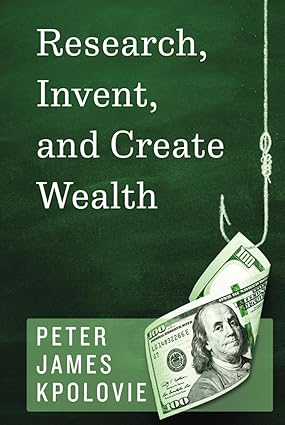
Peter James Kpolovie’s Research, Invent, and Create Wealth is a passionate, full-throttle manifesto urging individuals to harness the power of research and invention to achieve prosperity and elevate humanity. The book’s central claim is crystal clear and relentlessly repeated: invention is not only the most direct path to personal wealth but also the highest moral duty we owe to future generations. Across its 19 chapters, Kpolovie blends motivational prose with anecdotes, directives, and a firm belief in the transformative power of human creativity. He outlines the mindset, actions, and sacrifices required to make valuable discoveries and products that, once mass-produced, can improve lives and generate endless wealth.
Kpolovie’s writing is energetic. It’s repetitive, intense, and charged with ambition. The tone rarely wavers; it pushes and urges, page after page. But underneath lies a sincere and powerful idea: the future belongs to the creators. I admired the belief in human potential, the sense that we are all just one invention away from changing everything. His enthusiasm is contagious.
The book shines brightest when it spotlights the stories of famous inventors or urges the reader to dig deep, take risks, and endure hardship in pursuit of a breakthrough. It inspired me to reevaluate how I approach problem-solving and reminded me that most conveniences in our lives once seemed impossible. The book is like a motivational seminar. I craved more real-world examples, a few cautionary tales, or even contrasting voices.
I think Research, Invent, and Create Wealth is best suited for ambitious dreamers, especially young entrepreneurs, inventors, or students looking for a spark. If you’re feeling stuck or uninspired, this book might just kick you into motion. If you can embrace its volume and intensity, you’ll walk away energized and ready to build the future.
Pages: 285 | ASIN : B0D7GL18QZ
A View Through the Fog

Dive deep into the world of the iconic Golden Gate Bridge with an unprecedented perspective – through the eyes of someone who spent 12 riveting years working on its majestic span.
From the outset, the author captivatingly recounts the meticulous selection process he underwent, earning him a coveted position amongst a handful of fortunate individuals chosen to work on this architectural marvel during its formative years. His narrative style is immersive; he paints scenes so vividly that readers might feel they’re standing right beside him, absorbing the sights, sounds, and sensations of the bridge.
Every brush of the wind, the embrace of the morning fog, and the occasional warming touch of sunlight are rendered with such finesse that they transport you directly to those very moments. Beyond the physical experiences, the author delves into the intricate fabric of interpersonal relationships that evolved on the bridge – colleagues who transformed into family and bonds that transcended the boundaries of a mere workplace.
However, it’s not all sunlit tales. The narrative also courageously addresses the somber issue of suicides linked to the Golden Gate Bridge. The author’s first-hand accounts of such tragic events are heart-wrenching but equally informative as he sheds light on the preventive measures introduced over the years.
Readers will be treated to behind-the-scenes revelations – from hidden nooks where workers sought reprieve to the challenges and encounters that make this job far from ordinary. As he chronicles the evolution of working conditions on the bridge, there’s a palpable sense of nostalgia for the bygone days.
For those intrigued by the nexus of mental health and iconic architecture, A View Through the Fog offers a deep exploration. Prepare to see the Golden Gate Bridge in a light you’ve never imagined.
Pages: 182 | ASIN : B0C65ZDPP8
The Future of Disruptive Technologies
![The Future of Disruptive Technologies: Impacts on Business, Workforce, and Societies by [Dr. Srikanth Gaddam]](https://m.media-amazon.com/images/I/515wCikEzqL.jpg)
In The Future of Disruptive Technologies Dr. Srikanth Gaddam explores modern day problems, solutions and how technology affects each one of us. The book discusses tThe shapers of technology and how everyone should embrace the positives brought by technology while being cautious of the adverse effects. I enjoyed reading this thought-provoking book because the author used real stories and gave practical examples when explaining his points. Some of my favorite parts of the discussions were where he spoke about movers and shakers in the industry, and how their background did not necessarily shape their future and success.
In one chapter, the author goes into detail on how data privacy and the safety of internet users is paramount. I appreciate the author for giving facts and statistics as he expounded on this topic, as it enables the reader to get a clear picture of how things are in the world. Data and information are widely shared today thanks to swift online platforms. While this may appear as a blessing to many, the safety and privacy of any internet users may not be guaranteed given rogue characters and other malicious internet users online. While reading this chapter, I was made to understand why it is important to have at least the basic knowledge on formation security and how to protect the network that one uses.
A lot of things are made easy in the world thanks to technology. Reading Dr. Srikanth Gaddam illuminating book will open your eyes on big data, artificial intelligence and other things that have changed how the world operates today. I like Dr. Srikanth Gaddam’s writing because he explains every new term to readers who are not familiar with tech terminologies, before proceeding with the discussion. At no point does the user feel out of touch with the author’s text even when Dr. Gaddam uses heavy cyber jargon. The author made the book more interesting by including personal stories and experiences he has been through. I loved this about the author because the reader despite not relating with all, gets the impression that everyone goes through different challenges and learning stages in life.
The Future of Disruptive Technologies is a great read for both tech aficionados and people that are least bothered by digital trends and technology in general. The author gets one thinking about the different types of technology and how societies across the world work. The book is wonderfully written with a friendly tone and using an easily readable format. I recommend this book to all readers that want to learn more about technology, the impact it has in the world and how it affects small communities and individuals on a personal level. The content in the book is evergreen and educative. This book will enable readers to change their perspective on things and help them make better decisions in the respective industries that they work in.
Pages: 173 | ASIN: B08NXWHKF9

Damaged Beyond All Recognition
![Damaged Beyond All Recognition (Infinity's Trinity Book 1) by [Felyk, Alan]](https://i0.wp.com/images-na.ssl-images-amazon.com/images/I/51dypJY3iCL.jpg?resize=279%2C446&ssl=1)
No one has seen God’s library–or have they? According to Paul Tomenko, actress Katharine Ross is hanging out there. When he is chosen by God to visit his heavenly library and, in essence, save humankind, Paul obliges. Following his brush with death as a result of a car accident, Paul is matched by fate with the woman who almost killed him thus changing the entire course of his life. Author Alan Felyk’s Damaged Beyond All Recognition details the exceptional journey of Paul, the two true loves of his life, and their combined impact upon the universe.
Paul Tomenko is a truly fascinating character. From the trials and tribulations of his youth to his eventual discovery of his love for Maggie Mae and his work for the Creator himself, Paul is strangely relatable. I found myself cheering him on as his writing career reached extraordinary heights and grieving with him through his numerous losses.
Allie, Paul’s second first love as it were, is likely my favorite of the three main characters in Felyk’s work. It is virtually impossible to imagine a young woman so innocent and simultaneously capable of unknowingly holding the answers to the world’s most pressing dilemma. As Allie begins her writing career in earnest and essentially outwrites and outsells Paul, she maintains her selflessness and an unwavering loyalty to Paul. Her devotion to a man she isn’t sure she will ever have is stunning.
Not being a fan of science fiction, I fully expected to lose interest in the most detailed sections of text. Felyk, however, is a master at communicating the most intricate and advanced concepts. I found myself as engrossed in Paul’s visits to God’s library as I was in his relationship with Maggie Mae which he fought so hard to maintain through decades of trials.
I was rather amazed at Felyk’s take on God. The Creator is ultimately dependent upon others, and this mystified me as I read. The notion that Paul is able to help God was a difficult one to get used to. Once I let the idea settle in, I became increasingly fascinated with God’s helplessness. Felyk brings a certain level of vulnerability to God–something virtually unheard of in books addressing Christianity in any sense.
The overarching plot line that kept me coming back for more revolves around Paul and Maggie Mae. To say that readers will envy their dedication to one another is a huge understatement. As years and miles separate them, they do not waver in their loyalty to one another. Felyk proves he is adept at fantasy and equally as skilled at writing heartbreaking romance.
I am giving Damaged Beyond All Recognition 5 out of 5 stars. I can’t imagine readers will find anything lacking in Felyk’s work. His characters have it all: humor, an undying loyalty in each other, a drive to save the world, and an appreciation for all things science. Paul, Maggie Mae, and Allie can hold their own against any characters in recent books of the same genre.
Pages: 367 | ASIN: B077VJGJCD


