Blog Archives
Looking From Different Angles

Ischaemic follows a man blindsided by a DNA test revealing a twin brother he knew nothing about, who finds himself pulled into a dark web of identity, desire, and survival where the line between victim and monster blurs. What was the inspiration for the setup of your story?
My first book was a children’s book “The Visitors” with talking animals and aliens. It was fun to write, but I was also working on something much darker and more adult.
‘The Walking Wounded” is on a much grander scale and only recently released after 10 years. Ischaemic is middle ground and allowed me to try new ideas and concepts. Looking from different angles.
The novel explores queer identity in dark and complex ways. How did you balance representation with the story’s brutality?
As a queer writer I can use personal experiences and the stories of friends to balance things out, always remembering to draw the lines in the appropriate places.
Ischaemic explores identity, shame, and control. Which theme feels most central to you?
For Joshua, it is definitley about manipulation and control.
Do you plan to revisit this darker psychological territory in future work?
I have another book called “The Walking Wounded” that switches things up a notch. A second book with these characters is on the cards.
Author Links: Goodreads | X | Facebook | Website
As the narrative unfolds, sinister secrets emerge. A shocking revelation—Joshua’s twin, Antony Gordon—sets the stage for an intense psychological duel. The twins’ twisted connection spirals into obsession, culminating in Antony’s desperate struggle for survival. Layered with suspense and psychological complexity, the narrative builds toward a devastating climax, where identities blur and the darkest instincts are unleashed. This narrative promises a compelling exploration of trauma, sexuality, and the human capacity for both cruelty and survival.
Ischaemic


Ischaemic by Andrew Cahill-Lloyd is a dark, twisty thriller that jumps between a closeted truckie with a secret nightlife, a man blindsided by a DNA shock, and a homicide team chasing a string of killings. Joshua is introduced as a married interstate truck driver with “queer kink” and a taste for danger. Antony, meanwhile, gets DNA results that point to a same-age brother, and it flips his whole sense of self. As deaths stack up and detectives Webb and Tiernan work the case, pressure builds from every side. Then the personal hits the practical. Money goes missing through Antony’s own login, and later, he ends up donating a kidney to Joshua. The book barrels toward a final confrontation, a shooting, Joshua’s death, and Antony’s name being cleared.
The writing style is loud and visual. It often feels like a camera is parked in the corner of the room. I could see the lights, the sweat, the dread. I liked that pace. It kept me turning pages even when I wanted to mutter, “Mate, slow down.” The downside is that it can lean hard into big feelings and big setups. Sometimes it reads a bit stacked. One punch lands, then another, then another. Still, I respected the commitment. It swings for the fence. It does not do “subtle,” and that boldness can be a guilty pleasure.
What stuck with me was the mess of identity and control. Adoption. Shame. Desire. Family roles that rot from the inside. The kidney thread felt like the sharpest moral test in the whole book. Love versus obligation. Anger versus pity. It also goes into sexual harm and coercion, and that hit me in the gut. I had moments of real sympathy for characters, and then whiplash when the story shoved me somewhere darker. That push and pull felt intentional. It made the book feel mean at times, but also honest about how trauma can scramble people.
The wrap-up gives a sense of closure and a glimpse of healing later on, which I needed after all that intensity. I’d recommend this to readers who like gritty thrillers with family drama, queer themes, and a true-crime vibe. Bring a strong stomach. Expect explicit scenes and heavy topics. If you want a neat little mystery, nah. If you want a wild ride that punches hard and keeps punching, this one will do it.
Pages: 260 | ASIN : B0G94PTRGK

To Give the Victim a Voice

Dear Gosei: A young man confronting his past follows a young man who was sexually abused as a teenager as he goes on a journey of self-discovery and a search for answers from those who did nothing to protect him. What was the inspiration for the setup of your story?
The novel is based on a true fact that was revealed to me by accident, and I had to keep it a secret. I couldn’t comfort the victim, who was an acquaintance of mine so I grew a bit obsessed with the event. Also, it was during the worst part of Covid, and I spent many hours alone at home in isolation. I ended up writing about this to calm my anxiety. I wrote the story as a way to process my thoughts and feelings about the incident. It was my way of trying to make sense of what had happened and to give the victim a voice that they couldn’t give themselves. I hope my novel will be a source of comfort for those who have been through similar experiences.
Was there anything from your own life that you put into the characters in your novel?
There is no direct reference in my debut novel to anything that happened in my life but definitely, I share many points of view with the protagonist. Family dynamics, the college years away from home, the teenage dreams to become an independent, dependable person, the path to self-discovery are also aspects with which I identify myself. Some of the characters in the novel are composites of my past and present, and their stories come from my own life experiences.
What were some themes that were important for you to explore in this book?
In order to properly describe the harrowing experience of suffering sexual abuse I read a lot about it, trying always to understand why it happens and what are the consequences. I found, to my astonishment, that sexual abuse is not a thing of the past. On the contrary, it is an ever-present damage in modern societies, affecting all over the world. It is a heartbreaking reality that has serious consequences for those who suffer it. We must take urgent steps to prevent and combat it and to provide the necessary support to survivors. This is the only way to make our society a safer place for all. It is also a delicate issue, particularly when it happens among families, and there is no real magic solution to it. Many sexual abuse crimes go unreported precisely for that reason because it can destroy the future of the victim, the abuser, and the entire family.
I read a lot, too, about Asian immigration to the USA during the last century, particularly Japanese immigration. That is how I learned about WWII internment camps for Japanese families on the West Coast, such as Manzanar in California. It was so shocking to me that I decided to put it in the story. It was a powerful reminder of the racism and injustice that was faced by Japanese-Americans during the war, and of the strength and courage of those who survived the camps. I wanted to include it to show that even in the darkest of times, we can still find hope and resilience.
What is the next book you are working on, and when will it be available?
I am working on the prequel which will give a perspective on the traumatic events happening in DEAR GOSEI. It goes back four generations of the Forrester Hattori family. The prequel will explore the family’s history and how they came to be where they are today. It will also provide more insight into the characters and their motivations. Finally, it will provide the necessary context to understand DEAR GOSEI. It is at a very early stage, so I can’t say when it will be finished.
Author Links: GoodReads | Facebook | Instagram | Website | Amazon
After a tragic teenage trauma, a young man fights to respect himself and embarks on a journey of self-discovery, facing his family to get the answers he has been searching for for the last 12 years.
John, a good-looking, and athletic 14-year-old from an affluent family in the suburbs of Los Angeles, is a victim of sexual abuse at the hands of his uncle. Family interests will prevail above all else. The mother decides to keep the incident secret to avoid scandal and the bad reputation of the family. The boy’s life is forever changed by this tragic experience which destroys his hopes of becoming a competitive swimmer and leaves him feeling helpless and alone.
Over time, however, thanks to his resilient and tenacious spirit, he overcomes his obstacles and returns to his former academic and athletic success. John and his girlfriend Val, who seem to have a rock-solid relationship, become the most popular couple at school. In reality, he doesn’t live like his friends because of his tragic past, insecurity, sexual confusion, and toxic family. Although everything appears normal, neither the family behaves naturally nor does John shake off the weight of his past.
His uncle considers John his favorite nephew but ignores the harm inflicted on the boy. His mother wishes to keep the secret. His father and brother, devoutly religious, make him feel like an outsider at all times, dictating family life with an iron fist and a handful of obsolete rules.
To reclaim his self-respect, he will confront his past, demanding explanations from his uncle and mother, each guilty of having a great impact on his harrowing youth. In this journey of self-discovery, he will explore his priorities, career, friendships, and dysfunctional family. John knows that he must face the future head-on to be at peace with himself.
DEAR GOSEI is the debut novel of Jorge Bosch, born and educated in Barcelona, Spain, now a resident of Los Angeles, California. The book hopes to captivate the reader with its well-grounded and vividly portrayed characters, and participants in a story that will keep you interested until the end. The story takes place at two points in the protagonist’s life: firstly when John is molested as a young boy and then again when he finally decides to take charge of his life and confront his family 12 years later. Two central themes steer the narrative: sexual abuse, as real as life itself, and a controversial subject treated with sensitivity and empathy, and John’s personal development, as he seeks to deal with the truth about what happened to him. He struggles to find his place in the world by accepting his homosexuality and the person he loves. DEAR GOSEI, a romantic drama with touches of a psychological novel, fast-paced and minimalist, is set in the capital of Southern California and takes a critical view of the traditional and old-fashioned family it portrays.
The Long Journey To You
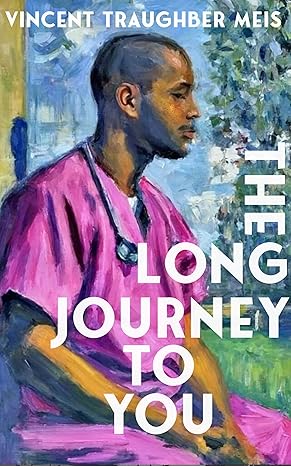
The Long Journey to You by Vincent Traughber Meis offers a delightful exploration of romance through the eyes of an aging protagonist living in the peaceful suburb of San Leandro, near San Francisco. The narrative gently unfolds as Nathan, feeling his prime years have slipped by, encounters Mateo, a strikingly handsome nurse from the local hospital. Their initial friendship blossoms into a deeper romantic connection. However, the plot thickens as we delve into Mateo’s personal challenges, particularly his commitment to caring for his mother, who suffers from dementia.
What stands out in this novel is the authenticity and relatability of the relationships. The romance is portrayed with a refreshing realism, steering clear of excessive sentimentality, while the intimate scenes are depicted with a commendable sense of taste and delicacy. The characters are crafted with depth, allowing readers to form a genuine connection with them. Mateo, in particular, is a character of substance, balancing the demands of a stressful job, the complexities of a new relationship, and his devotion to his ailing mother. Meis skillfully weaves Nathan’s past into the narrative, transporting readers to various global locations renowned in the LGBTQ community, from Barcelona to San Francisco. These flashbacks offer more than just scenic descriptions; they provide a poignant glimpse into the challenges of the LGBTQ community during the era of AIDS and less tolerant times. The story doesn’t shy away from addressing the harsher realities faced by the characters, including drug use and promiscuity, yet it does so in a way that emphasizes their human longing for genuine connection and stability.
The Long Journey to You is a well-crafted novel that balances romance, personal growth, and historical context. It’s a story that not only entertains but also enlightens, offering insights into the LGBTQ experience across different eras. The narrative’s journey across the globe, coupled with Nathan’s internal journey toward understanding and acceptance, makes for an engaging read. I am certainly looking forward to more works from Meis.
ASIN : B0CQFPYGWW



