Blog Archives
Messy and Unpredictable

The Last Revision follows a man reflecting on his life as he navigates present-day physical limitations while revisiting vivid memories of childhood, family, romance, art, work, Buddhist practice, and life in New York City. What inspired you to structure the story around these reflections?
The structure of the book came from an intersection of three things. First, I was approaching my sixtieth birthday and was having a hard time of it, unlike approaching my 50th, which I relished and celebrated. At sixty, I was asking myself, “What happened? What’s left?” and I was fearful of forgetting, as I entered my third act. So, I wanted to write everything down before I forgot. In fact, I didn’t set out to write a memoir at all. It was an exercise in documentation. Secondly, I had always said I wanted to live to be a hundred years old, to see a century — how amazing would that be?! And lastly, my sister, author Patience Bloom, encouraged me to join the NaNoWriMo challenge (i.e., write 50,000 words in the 30 days of November). With that deadline looming, an idea popped into my head: a “memoir hypothesis.” Tell my story from the end of my life, from 100 years old. So, everything to 60 years old is true. Or mostly, as memory is imperfect. The rest is speculation. The original idea was to have two timelines intersecting. Chapter 1 would be the end, at 100. Chapter 2 would be the very early years. Chapter 3 would be somewhere in the early 90s, and so on until the timelines intersected. But somewhere along the way, like memory does, my mind drifted here and there, to the “present” and backward and then sideways. The title, The Last Revision, is the main character’s (and my) attempt to concretize what Bill remembers.
The novel explores LGBTQ+ identity across different periods of social change. How did you approach portraying the fears, challenges, and freedoms that shaped Bill’s life?
Because this is partially a work of auto-fiction, many of the experiences are my own — I didn’t have to research them. From being bullied as a child to feeling society’s tacit (or not so tacit) disapproval of anyone across the LGBTQ+ spectrum, there is a wealth of material to draw from. Anyone who has felt “different” from an early age carries those feelings with them, and it is important to know them and grapple with them so that one can live freely in the world. I imagined that, based on Bill’s (my) own experiences as a young and subsequently middle-aged person, Bill wouldn’t become truly fearless and comfortable in his own skin until later in life, which he does. I’ll also add that writing this book further helped me in my own journey of living freely in the world. I mean, I’m an out gay man, but with the publishing of this book, I’m really out.
Bill’s relationship with Andres is one of the emotional anchors of the novel. What did you want to explore about love, vulnerability, and the process of allowing oneself to be fully seen?
I wanted to explore the ups and downs of a relationship, of a marriage. We see so many stories on TV and in films in which relationships are one thing, good or bad, or they are good, then bad, then amazing. But it’s not that simple. Relationships can be incredibly challenging, inspiring, infuriating, titillating, moving, comforting, scary, and beautiful — all at the same time. They are messy and unpredictable, and ultimately rewarding. I wanted to show that one can — one has to — be oneself in a relationship, in a marriage, and that good things come from actively working on this.
What message do you hope readers carry with them after spending time with Bill?
My hope is that readers will feel seen in some way. Bill goes through many, many ups and downs throughout his long life, but he never gives up. As a practitioner of Nichiren Buddhism with SGI for nearly 40 years, I embrace our motto to “never be defeated.” This doesn’t mean that we won’t have disappointments or that we will get everything we want. Rather, the goal is to never let one’s spirit be defeated, to never lose hope for the future, no matter what happens. If The Last Revision can instill an iota of this hope in a reader, I will be very, very happy.
Author Links: GoodReads | Threads | Website | Amazon
His journal.
And the memories begin.
The Last Revision moves through an entire life—from an Easter morning in upstate New York, through childhood moves across continents, a hard-won coming out, years of solitude in a New York City studio apartment, a late and lasting love, and a world that slowly, then all at once, changes beyond recognition. Bill has lived all of it. And on the eve of his hundredth birthday, he is finally willing to look.
Written from the imagined perspective of a man forty years older than the author, the novel blends lived memory with an invented future—reconstructing the past as it was, and imagining what might come after. The result is a life seen whole: remembered, revised, and, at last, understood.
At once intimate and expansive, The Last Revision is a novel about what it feels like to hold a life in your hands all at once—the losses and the luck, the curtain calls and the heartbreaks—and discover, with something close to astonishment, that it was a joy.
The Last Revision: A Novel


Patrick Smith’s The Last Revision is a reflective, deeply personal novel about memory, aging, love, grief, creativity, and the uncertain future waiting for humanity. The narrator, Bill, looks back over a century of life from a care residence, moving between his present-day physical limitations and vivid memories of childhood, family, romance, work, art, Buddhist practice, and life in New York City. Smith describes the book as a “memoir hypothesis,” and that’s an apt label. This book blends autobiographical fiction, LGBTQ+ fiction, and climate fiction into an intimate portrait of one person trying to understand what his life has added up to.
The novel unfolds through thirty-three themed chapters. A wheelchair, a photograph, a song, a visitor, or a physical sensation can send Bill into a memory spanning decades. His recollections include childhood accidents, boarding school, running the New York City Marathon, training as a massage therapist, returning to acting later in life, and building a marriage with Andres. These transitions give the story the loose, associative rhythm of an actual mind looking backward. Bill’s voice is conversational, opinionated, funny, and occasionally irritable, which keeps the book from becoming overly solemn.
The novel is at its strongest when Bill considers the people who encouraged him and the small decisions that gave his life meaning. Teachers, friends, family members, artistic mentors, and Buddhist leaders continue to shape him long after they’re gone. His relationship with Andres provides the emotional center, particularly as Bill remembers learning to express affection openly after years of fear and internalized shame. One sentence captures the philosophy running through the book: “Take care of the person right in front of you.” Smith returns repeatedly to the idea that a worthwhile life is built through attention, encouragement, dialogue, and the willingness to keep participating in the world.
Readers who enjoyed Mitch Albom’s Tuesdays with Morrie will recognize a similar interest in aging, mortality, relationships, and the lessons that become clearer near the end of life. Smith’s novel, however, covers a broader and more idiosyncratic landscape. It mixes personal recollection with an imagined future shaped by climate disaster, political instability, technological change, and war. The result feels like a memoir viewed through a speculative lens. Its ideal audience includes readers of character-driven literary fiction, autobiographical novels, LGBTQ+ historical fiction, Buddhist fiction, novels about aging, and near-future climate fiction. It will especially appeal to people who enjoy reflective storytelling more than fast-moving suspense.
The Last Revision is ultimately a warm, candid examination of what remains when careers end, bodies weaken, loved ones die, and memory begins rearranging the past. Smith finds meaning in creative work, hard conversations, enduring love, and moments of physical freedom, including the simple pleasure of swinging through the air on Bill’s hundredth birthday. The novel’s episodic structure asks readers to settle into Bill’s company and listen as one memory opens into another. By the final pages, his life feels neither polished nor reduced to a tidy lesson. It feels fully inhabited, filled with regret, humor, affection, conviction, and a stubborn readiness to greet one more day.
Pages: 210 | ASIN : B0GZJH4M7R

Creative Instinct

The Canvas We Share follows four lifelong friends who rediscover the value of friendship, honesty, and being seen when they reunite for an art exhibition two decades after attending art school together. What was the inspiration for the setup of your story?
The inspiration was really life. I’ve been a full-time artist for many years, and I’ve been part of the art world since graduating with a painting degree in 2002. Over that time, I’ve experienced many of the same challenges my characters face, and I’ve watched friends and fellow artists go through similar journeys. While the story is set in the art world, it’s really about something much bigger. It’s about life, how friendships evolve over time, the dreams we chase, the ones we let go of, and the people who are there to help us through it all. I think whether you’re an artist or not, those experiences are something everyone can relate to.”
How did you develop these four distinct voices and journeys?
“Once I had a clear picture of who each of the four characters was, their voices really began to develop naturally. Each one has their own personality, struggles, and way of seeing the world. As a writer, you inevitably draw from your own experiences, the people around you, and the life you’ve lived, but these characters are still very much their own people.
I’ve always loved creating. Whether it was writing poetry, making up lyrics to songs, painting, or now writing novels, I’ve always enjoyed imagining stories and asking, ‘What happens next?’ I remember as a kid I would make up my own words to songs because I could already picture where I thought the story should go before it got there. In many ways, writing The Canvas We Share felt like a natural extension of that same creative instinct.”
How important was it for readers to feel as though they were spending time with a real group of friends?
“Very important. I wanted readers to feel like they weren’t just reading about these characters; I wanted them to feel like they were spending time with friends. I wanted readers to laugh with Daniel, Claire, Marcus, and Julian, hurt when they hurt, celebrate their victories, and genuinely care about where life takes them.
By the end of the book, my hope is that readers aren’t just closing the final page…they’re wondering, ‘What happens next?’ That’s really what friendship is. Even when you’re not together, you continue to care about the people in your life and hope the best for them. I wanted readers to have that same feeling with these four characters.”
Do the four friends still have more stories to tell?
“Absolutely. I’m already working on the second book, which picks up a couple of years after the end of The Canvas We Share. We step right back into their world, but this time the question isn’t, ‘Can they find themselves again?’ It’s, ‘What happens after that?’ What happens after recovery? After finding love? After achieving success? Life doesn’t stop when one chapter ends; it keeps moving.
That’s what the second book explores. Daniel, Claire, Marcus, and Julian still have careers to build, relationships to navigate, dreams to chase, and new challenges to face. Their lives are still unfolding, and I think they have a lot more stories to share with us.”
Author Links: GoodReads | Instagram | Facebook | Website | Amazon
“The Canvas We Share is ultimately a story about friendship. The art world provides the setting, but the heart of the novel is four friends navigating life, love, loss, and the complicated relationships that connect us long after our paths diverge.”When an unexpected invitation reunites four former art-school friends, none of them realizes what they’ve agreed to.
The exhibition was supposed to be simple—a chance to reconnect, share their work, and revisit a friendship that once shaped their lives. But as opening night approaches, old dynamics resurface, unspoken tensions rise, and each of them is forced to confront the choices, sacrifices, successes, and regrets that have defined the years since they last stood together.
Daniel is learning how to rebuild after loss. Claire is quietly questioning the life she chose. Marcus is holding everything together with charm—and something much heavier just beneath it. Julian is creating like everything depends on it…because it might.
Through love and loss, marriage and ambition, grief and hope, The Canvas We Share explores the ways friendships evolve over time and how the people who know us best often hold a mirror to who we have become. As old wounds resurface and long-buried truths emerge, each friend begins to question not only the path they have taken, but the life they still hope to build.
What begins on the canvas doesn’t stay there.
And not all of them will walk away unchanged.
The Canvas We Share is a story about friendship, vulnerability, forgiveness, and the enduring connections that shape our lives. Set against the backdrop of the contemporary art world, it reminds us that while careers, passions, and circumstances may change, the most important masterpiece is often the life we create together.
The Canvas We Share

Bradley Carter’s The Canvas We Share is a warm, character-driven contemporary fiction novel about four longtime friends who reunite for a group art exhibition nearly two decades after attending art school together. Daniel, Claire, Marcus, and Julian each enter the project carrying unfinished emotional business. Daniel is rebuilding after divorce, Claire is trying to reclaim an artistic identity buried beneath family responsibilities, Marcus is caring for his seriously ill husband, and Julian is fighting addiction and creative self-doubt. The approaching exhibition gives the story a clear destination, but the real movement comes from watching these artists rediscover the value of friendship, honesty, and being seen.
The novel’s strongest feature is the way each person’s artwork reflects what’s happening in their private life. Daniel’s increasingly open abstractions reveal his growing relationship with critic Ellen. Claire’s slightly crooked domestic scenes express the tension between family life and creative ambition. Marcus hides fear beneath neon color and theatrical humor, while Julian’s forceful abstract expressionism becomes an outlet for pain he can no longer safely numb. Carter writes about art in accessible, visual language, so readers don’t need any background in painting to connect with the characters. The canvases become conversations, confessions, and sometimes lifelines.
At its heart, this is a friendship novel about people choosing to show up for one another. Some of the most affecting scenes are small ones, such as Daniel answering Julian’s tentative request for help with the simple message, “I got you. See you in 10.” That moment captures the book’s emotional center better than any speech could. The characters don’t solve one another’s problems, but they make those problems less lonely. Elliot’s illness, Julian’s recovery, Claire’s frustration, and Daniel’s guardedness all receive space within the larger group story, giving this art-world fiction novel a steady sense of compassion.
Readers who enjoyed the creative friendships and complicated adult ambitions of Gabrielle Zevin’s Tomorrow, and Tomorrow, and Tomorrow will find familiar emotional territory here. Both books explore how collaborative work can bind people together while exposing their insecurities, resentments, and need for recognition. Carter’s novel is gentler and more intimate, with an ensemble structure that often feels like spending time with a close circle of friends. Its target audience includes adult readers of contemporary fiction, uplifting literary fiction, LGBTQ+ fiction, addiction recovery stories, and novels about artists, marriage, friendship, and second chances.
The Canvas We Share ultimately offers an affectionate portrait of middle-aged artists learning that creative success and personal connection don’t have to compete. Its conversational dialogue, rotating viewpoints, romantic thread, and emotionally direct storytelling make it an approachable read. The final exhibition brings the characters’ separate struggles together without losing sight of the people behind the paintings. When Daniel observes, “When an artist falls in love with you, you will never die,” the line neatly expresses the book’s belief that art preserves not only individual feeling, but the relationships that make a life meaningful.
Pages: 188 | ASIN : B0H2YWJT6D
The Ripple Effect

Born of Dirt & Dust is a collection of short fiction stories ranging from social horror to feral love and tales of survival in a broken world. What draws you to write speculative flash fiction?
Writing speculative flash fiction ignited for me when I sat inside a tattoo studio in Lahaina, along the west coast of Maui, in May 2023, a few months before the horrific wildfire scarred the land and the many, many families affected by the tragedy. At the time of having a beautiful sea turtle tatted on my arm, I learned about the artist working on me. A young woman, approximately in her late twenties, who came to Maui to escape years of marriage with an abusive husband. I could see in her shadowed eyes, her flinching body language, the deep bruised color of her dyed hair, and the violent tattoos inked on her body, the degradation she felt. I could see her need for a portal, an escape, to a very different existence—a world beyond the pain and suffering inflicted upon her. She found that temporary reprieve in the warmth, beauty, and embracing culture of Lahaina. Yet, after only a few months, Hell broke loose, and she lost herself again. This time, in the fire that raged upon her world. It was that moment, seeing the devastation broadcast on the news, feeling the heartache, thinking about her, that I knew I had to write about bending space and time, about churning our world differently in order to find a place where we belonged, where we could—and would—survive, no matter how broken we felt inside. No matter how threatening or violent our environment. In writing speculative fiction, I wanted to capture the worst of what we faced, illustrate the blood we shed, and explore the rising of our spirit to become more than the shrinking ways our world defines us. I wanted to prove that human kindness and resilience win in the end.
Were there any personal experiences or observations that influenced the themes in this collection, and how did they shape the characters or stories?
Two stories in the collection specifically focus on the young life of a boy. “Henry Didn’t Have A Chance,” and “Stuck At A Dead End.” The premise behind the stories came to me from articles I heard on PBS NewsHour while driving to work. The first is about a toddler boy who died at a very young age. Local authorities arrested his mother and her boyfriend on suspicion of murder. The other story aired as a documentary about children of parents who served in the military and returned home with PTSD—how the traumatic affliction affected their children. I knew at this point in writing the stories for Born of Dirt & Dust that I wanted to open a lens for readers to fully experience the character’s world, how trapped they felt, how they chose to move forward, and the ripple effect of those choices. As human beings, we are connected in so many ways. I truly believe that every action and every reaction triggers a ripple effect that touches each of us. Most often in a very minuscule, microcosmic way. Yet it breathes upon us. A tiny molecule. It hits us. No matter how quickly we forget.
Which character in the collection was the most challenging or rewarding to write, and why?
I’m one of those writers who thinks the last story or chapter I’ve written is the best yet. The one that counts. The most brilliant of all. Of course, it’s wishful thinking that comes to light when I re-read what I’ve written a week later and spot the obvious corrections needed. In the case of Born of Dirt & Dust, I favor the story, “Hands That Make A Man.” I have a weak spot for wanting to see the best circumstances for young children in which they grow up to feel loved, secure, and happy. Although my stories tend to lean towards horror, sci-fi, and fantasy, I want the best for my characters. A type of freedom they never thought they would experience. No matter the deepest cuts to their heart and soul. The young boy in “Hands That Make A Man” adores his father, and when Dad is no longer alive, the boy takes something—stitches it to his own young body—and knows full well his life without his father will turn out all right. No matter the loneliness he may feel or the environment where he resides. He gains confidence and feels that he will do right in life.
What is the next book that you are working on, and when will it be available?
There are three books in which I’ve completed first and second drafts—a middle grade book about a young girl who adores space travel and yearns to be a scientist when she grows up; a young adult book about an otherworldly character who hides and survives in the bodies of the recently dead; and an adult thriller about a teenager gaslit by her parents who continue to bury the truth about a family member’s suspicious death. All three books still need another round of editing. The goal (fingers-crossed) is to have them published in the coming year.
Author Links: GoodReads | Facebook | Website | Amazon
Born of Dirt & Dust
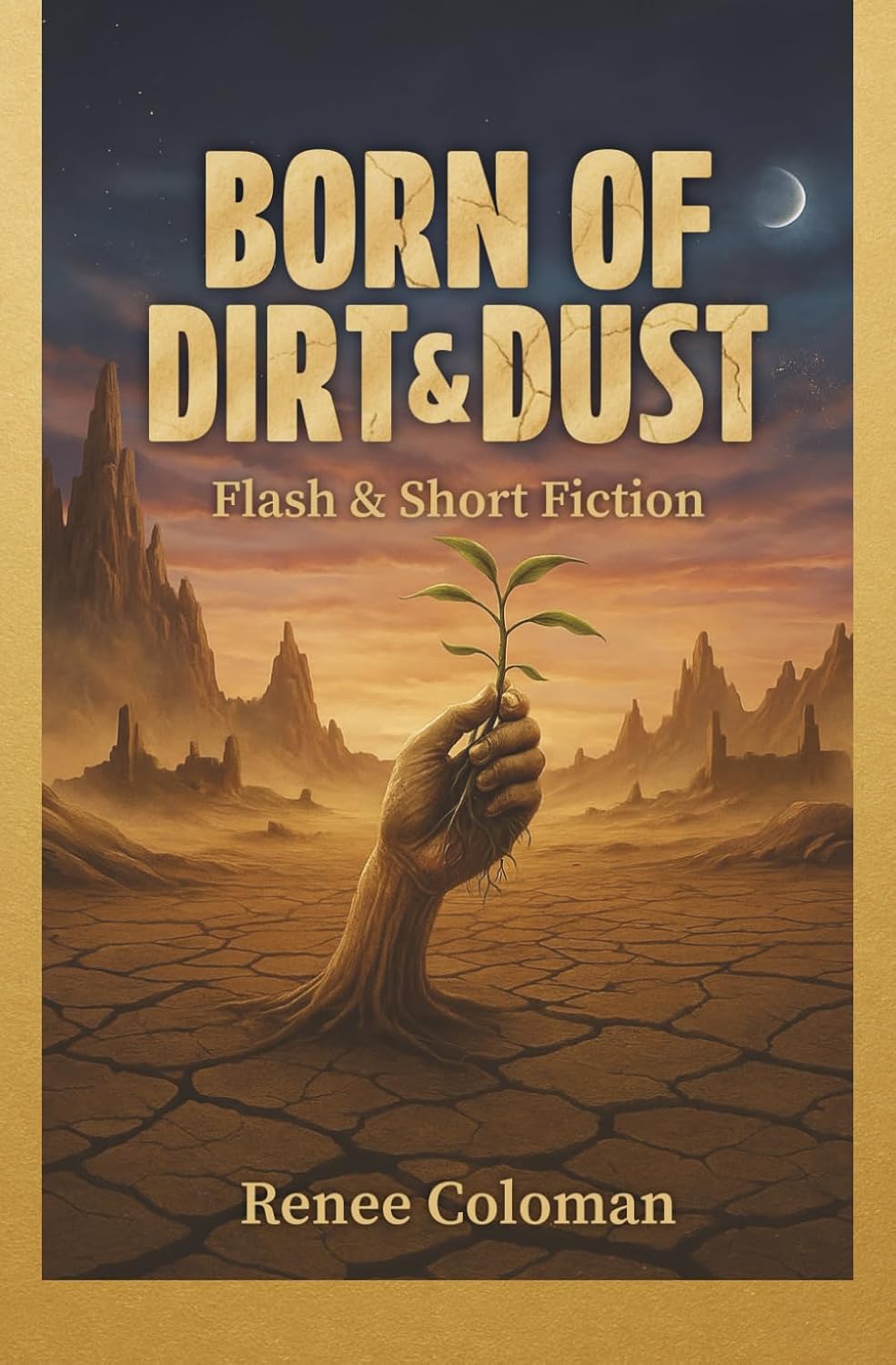

Born of Dirt & Dust is a sharp-edged collection of speculative flash & short fiction that keeps changing masks from urban dread, grief-myth, social horror, bruised fairy tale, while staying faithful to one obsession: what people do to survive when the world won’t stop chewing. Across stories like “Smokin’ with Death,” “Pretending,” “The Last of Our Kind,” and the title piece, Renee Coloman drops me into intimate, first-person rooms where love is feral, hope is conditional, and the aftertaste is usually smoke.
What hit me first was the voice: immediate, unvarnished, and weirdly tender even when it’s being crude. In “Smokin’ with Death,” the narrator sizes up Katelyn, pink hair, tattoos like warnings, a body already half-ghosted by addiction, and the dialogue snaps like a lighter: transactional, defensive, heartbreakingly ordinary. The story doesn’t ask me to approve of anyone; it asks me to recognize them, which is harder and more bracing.
As I kept reading, the book’s recurring textures started to feel intentional rather than merely intense: cigarettes as countdowns, bodies as battlegrounds, love as a dare. “The Last of Our Kind” is a brutal little poem of devotion, an oxygen tank, a warning label, and a woman who can’t stop reaching for flame anyway, as if self-destruction is the last language she and her husband share. And in “Born of Dirt & Dust,” Coloman leans into mythic framing, Adam’s rib, inherited venom, a woman trying to outgrow the “dirt and dust” she’s been assigned, turning family damage into something almost ritualistic. Sometimes the prose repeats or swells on purpose, like a chant you can’t quite step out of; for me, that worked more often than it wobbled.
Coloman’s collection is for readers who want speculative fiction, flash fiction, horror, dark fantasy, magical realism, stories that move fast but leave residue, stories willing to be ugly in the service of truth. If you’ve loved the bite-sized dread and emotional torque of Carmen Maria Machado, you’ll recognize the same appetite for turning private pain into a blade with a shine on it. Born of Dirt & Dust is a small book of big hauntings, each story a matchstrike in the dark.
Pages: 215 | ASIN : B0FZLMZR77
Breathe and Believe

Breathe and Believe, by Arthur Wiggins, drops readers into the messy, money-soaked world of American Midwest University athletics, where one bad week blows up an entire department. Bruce McDermott, a marketing specialist on the rise, watches his mentor quit, his secret relationship implode, and his football program slide toward NCAA sanctions and budget disaster. Interim athletic director Tara Gantt battles power-hungry basketball coach Ron Hill and his boosters over gender equity, football vs. basketball priorities, and the push to build a new multi-purpose facility, while a tragic road accident involving the women’s tennis team shows the very real cost of all these decisions. By the time Bruce walks into a legislative hearing with a giant check and a campus-wide vision, the book has turned a spreadsheet crisis into a story about ambition, grief, and what it really takes to keep a university sports machine alive.
The storytelling has a slow-burning style that works overall. The early chapters around the motel incident, the surprise resignation, and then the van crash hit hard and fast, and I caught myself thinking, “OK, this is not just a sports novel, this is a whole train wreck of a weekend.” The author writes meetings, press conferences, and budget talks with the same seriousness as big games, and that gave the book a grounded, insider feel. There are passages packed with numbers, acronyms, and institutional history where the tension dips. The dialogue often carries the weight, with characters stating the stakes rather than letting subtext do more of the work. Still, when the story leans into crisis scenes or personal confrontations, the pacing snaps back, and the pages move quickly.
What really hooked me were the ideas underneath the plot. The book digs into Title IX, gender equity, and the brutal math of “too many sports, not enough money” in a way that feels honest. We see how a 53 percent female student body sits next to only 39 percent female scholarship athletes, and you can feel how wrong that is without the author giving a lecture about it. Tara Gantt’s arc, as a veteran woman administrator who built a separate women’s program only to see it merged, trimmed, and constantly second-guessed, gave the book heart.
Bruce’s role as a marketing guy caught between ideals and survival felt believable to me; he is selling walk-a-thons, naming rights, and spring game hype so the department can pay back a 1.3 million dollar overspend, and the whole thing feels both clever and a little desperate. The tennis team crash is handled with a blunt, unsentimental style that hit me in the gut; it underlines that all the talk about TV contracts and conference moves sits on top of actual young people in vans on bad roads.
I also liked how Wiggins treats politics and media as part of the same ecosystem. The scenes with the local newspaper scrambling for a “thumper” front-page story and sniffing around the athletic budget felt very true to life, and there is a sly humor in how leaks, half-truths, and spin drive the narrative around AMU more than any scoreboard does. The boosters, legislators, and campus leaders come off as flawed rather than cartoonish villains, which I appreciated. There were moments when I wished for more time inside the student-athletes’ heads and a bit less time inside meeting minutes. Even so, I came away with the strong sense that the author has lived in this world, and that authenticity carries the book.
I would recommend Breathe and Believe to readers who enjoy behind-the-scenes sports stories, campus politics, and workplace dramas where the real action happens in boardrooms, press boxes, and budget spreadsheets more than on the field. If you want a thoughtful, occasionally heavy, very human look at what modern college athletics does to the people inside it, you’ll enjoy this book. Arthur Wiggins has written a grounded, slow-burning sports novel for readers who love college athletics stories packed with messy politics, money trouble, and real emotional fallout.
Pages: 309 | ASIN : B0DFCHCWND
Creation Unfolding

Nothing and Blank Save the World and Other Tiny Works follows a constellation of poems and stories that intertwine cosmic creation, human vulnerability, and the beauty of connection into a single, awe-filled tapestry. How do you balance scientific wonder with emotional truth in your writing process?
As the second-to-last poem, “A Scientist with an Arts Degree” hints—or, rather, outright states—I have both a science (Biology) and arts (English and Creative Writing) degree, obtained in that order. I think the order matters. For as long as I can remember, I have always been fascinated in the sciences; the theories and explanations of the unknown, and the possible answers to impossibilities. That curiosity, and perhaps a tiny bit of staring at and learning about the night sky, is what fueled many of the works in the collection. The physical world can be explained in complex terms that people read in textbooks or academic journals. Elements of the human experience, much like atoms, chemical compounds, and even space dust, are also tangible, universal (no pun intended), and can be explicated.
But what if, I thought, it was more than that?
As a person of faith, one of my favorite things in the world is things that are unseen. Faith is the evidence of it. Evidence of the unknown, the not yet, the maybe. How can we as humans answer unknown questions or give unknown answers? That, I believe, is the vehicle of this collection that the fuel powers. There is what we know, there is what we don’t know, and then there’s us, smack in the middle of the two. I wanted to write about both together—to form that ever-so-peculiar balance. I pick an idea or concept or person and just… think, and write down my thoughts. Take, for example, a star. We know it’s there. We know what it’s made of, we think. But… how did it get there? What is it, really? Can it think like we can? What if it could? How does it spend its life? What if, what if, what if? The exact same thing goes for people. Everything is a wonder, and, with the right words, they can be explained further or explored from different angles. I’ve, as someone I talked with recently put it, “allowed myself to feel” this sense of wonder and curiosity, and the very human emotions behind them. Writing them down was the next logical step. Somehow, it all fits into two hundred thirty-six pages. And curiosity fuels the cat.
The title story feels allegorical and foundational. What inspired the beings who created the world out of light and darkness?
The characters Nothing and Blank are probably the earliest concepts that have come from this book. Over a decade before the publishing of the book, I wrote a little bit about the two in a smaller version of the final poem. In the early stages of my fixation on space, I fashioned small beings in my brain made of stardust, just floating somewhere in the universe with nothing to do but play around. I came to the conclusion that the two were children, curious about the world around them. So curious, in fact, that they would want to participate in their surroundings after watching it all happen for some time. Nothing and Blank simply watched creation unfolding. At some points in life, that’s all we as humans can do. Watch beauty form. Watch things change and grow. And, when given the opportunity to make something of our own, we use what we have and what we know to mold something else. Nothing and Blank are the embodiment of cosmic inquisitiveness—in many ways, my cosmic inquisitiveness, and my own quest for creation from childhood to adulthood.
It’s not easy for me to describe what exactly the light and darkness are in the poem, and what connotations are connected to them. They are both powerful forces coexisting. But I think it was important that the two characters were not one-hundred percent light or dark, and that there was a little bit of each other within. Balance. Equilibrium. Order. A more neutral version of yin and yang. I think writing “the balance thereof is life” was the moment I reached an epiphany concerning the ideas of the poem. The two beings, with their light and darkness, worked together to make a world, to save a world.
The balance of light and darkness as a concept is present in many beliefs and symbols on Earth. Neither can exist without the other, so to speak. There is good in bad; there is bad in good. The balance thereof is life. Everything that was created, I think, is a result of that concept. In my own life, I’ve had to sort of come to terms with this, more especially the good in the bad. Maybe I longed for the balance when creating the poem, or I wanted to know where the balance came from, or what it felt like. Both light and darkness were used to create in the poem. It gives me assurance in a weird sort of way.
Your imagery is vivid and recurring. Are there particular symbols you return to intentionally, or do they emerge organically as you write?
Sometimes I look back at my own work and, while laughing, I notice quite a few recurring ideas: life, death, space, and the unknown human experience. All things I love writing and learning about. All things I have never fully understood or participated in myself, save for a few decades on Earth. I look at my surroundings, again with laughter, and find that I am bombarded by these ideas every single day. I know of life. I know of death. I read about space all the time. I hear stories from people I could never be doing things I could never do.
Sometimes, I come up with thoughts and scenarios about these ideas in hopes that I am close to an answer for them, or at least something that makes sense to me. I’ve never died or stepped outside of our galaxy. I’ve never gotten married (yet?) or been to Washington state. I’ve never seen a constellation up close or run away from home.
What would it be like?
It’s really convenient that these ideas are, in many ways, both constant and changing continually. I think they’ll stick with me for a very long time.
What part of this collection challenged you the most to share with the world?
Though most of the poems and short stories are fictional, there is a little piece of me laced in some of the letters. I was most afraid of… doing that. A good writer will place themselves somewhere in their work to make it more relatable, either through characters, plot, or other story elements. But me? The hardest thing to write about is myself. If I were to place myself in this book, what would happen? Would people understand? Would people get it? Would they paint a picture of me and pass some sort of judgment? I was afraid of writing about my experiences and thoughts in their raw form. I was afraid of revealing so much about me, even in subtle ways. I didn’t want people to know (the real) me. For months, I struggled with pouring out my heart into the pages as I typed and being honest and open about myself. But I realized that it was the only way to breathe life into the poetry and stories and make the language authentic. Short stories like “Coffee Stains” and poems like “6/8” or “Sussan’s Sonnet” became much easier to craft.
The review of my book called me “brave.” I think that’s the word for it. It took a lot for me to be as vulnerable as I was, allowing myself to be myself. Allowing myself to be. It was okay to be honest and expressive. I didn’t have to limit my emotions or interweave my diction with superficial statements or imaginary sentiments. I could be genuine. It sometimes feels, in real life, that I can’t. But on paper, I can.
Now that this book is out, readers can catch a glimpse of my mind, of me as a person. And, ultimately, it was a great decision to make.
Author Links: GoodReads | Website | Amazon


