Blog Archives
Earth’s Last Hope


Mary L. Schmidt’s Earth’s Last Hope is an apocalyptic survival novel that starts with a frighteningly simple problem: Yellowstone is about to erupt, and humanity has almost no time to prepare. When scientists realize the supervolcano is behaving far more aggressively than expected, President Joyce Zimmerman and government leaders move quickly to protect as many people as possible. Much of the story follows retired General James Tilson and his extended family as they take shelter in a massive underground complex beneath the Denver Federal Center. Schmidt spends a lot of time showing how bunker life actually functions, from hydroponic food production and medical care to schooling, security, recreation, and daily chores. That practical detail gives the novel the feel of both a disaster story and a survival manual, while the worsening eruption, ash-filled atmosphere, extreme cold, and collapse of normal society keep reminding everyone that the world above them is changing permanently.
What gives the book its personality, though, is its focus on family and community. James may be dealing with presidents, generals, secret facilities, riots, evacuations, and classified missions, but he’s also Grandpa James, a husband and the emotional center of a sprawling family. The quieter scenes matter just as much as the disaster scenes. People cook together, work in the hydroponic gardens, teach children, fall in love, get married, play games, paint, pray, deal with injuries, and eventually welcome new babies. Those moments create an unusual rhythm for an apocalypse novel because Schmidt is interested in more than simply surviving the next catastrophe. She’s interested in what people would do with ordinary life once ordinary life has been forced underground. Faith is also central to that vision. Prayer, gratitude, marriage, childbirth, and the belief that humanity has a future become recurring parts of the characters’ response to enormous loss.
About halfway through, Earth’s Last Hope expands from disaster fiction into science fiction when the Nyard, an advanced extraterrestrial race secretly connected to humanity since the Roswell era, become crucial to Earth’s survival. Their technology changes the scale of the novel dramatically. Instead of concentrating only on how long people can endure underground, the story begins asking whether the planet itself can be repaired. Yellowstone is permanently neutralized, new technology removes volcanic ash from the atmosphere, nanobots assist with cleanup, and a new source of clean energy helps humanity rebuild. In that sense, the book reminded me somewhat of Andy Weir’s The Martian. Both stories enjoy explaining solutions instead of simply announcing that a problem has been solved. Weir tends to build those solutions through tightly constrained engineering and scientific problem-solving, while Schmidt blends scientific explanation with speculative technology, government coordination, faith, and family life. Her canvas is also much larger. Instead of one person trying to stay alive, she follows an entire society trying to figure out what living should look like after almost losing the planet.
The result is a hopeful kind of apocalypse story. There’s tremendous destruction here, including mass death, ruined cities, toxic ash, starvation, psychological trauma, and the near extinction of humanity, but the novel keeps returning to rebuilding. By the final chapters, survivors are confronting what remains of Denver, salvaging materials, restoring communities, welcoming new life, and imagining a society built differently from the one that disappeared. The birth of Georgy near the end works especially well as a symbol of that direction, arriving just as the characters finally face the physical remains of their former homes. The epilogue carries that idea forward three years into reconstruction, with salvaged stone, granite, new infrastructure, and green energy becoming the foundations of another civilization. Earth’s Last Hope is ultimately a story about catastrophe as a test of cooperation. Its biggest interest is the question of what people preserve when nearly everything familiar is taken away, and its answer is remarkably consistent: family, knowledge, faith, useful work, community, and the determination to build something that can last.
Pages: 221 | ASIN : B0GX36GXN2

What Nature Teaches Us: A Book About Being the Light

What Nature Teaches Us by Clay Vilhauer and Amber Vilhauer is a reflective children’s book that turns familiar parts of the natural world into lessons about kindness, courage, patience, belonging, and growth. Each section focuses on one subject, such as the sun, moon, rain, birds, trees, rivers, or mountains, then describes what children might learn by paying closer attention to it. The authors invite readers to return to the book, talk about its ideas, and add their own thoughts, which makes it feel more like a shared conversation than a story meant to be read once and shelved.
The writing has a calm, poetic rhythm, with brief observations that are easy to read aloud but carry enough meaning to prompt a longer discussion. Some lessons are especially memorable, including the rainbow’s reminder that every color contributes, the tree’s example of rest and renewal, and the river’s ability to adjust its path while continuing toward the ocean. The book’s approach works well because it connects big emotional ideas to things children can actually see, touch, and observe.
Joni-Leigh Doran’s illustrations give the book much of its warmth. The small watercolor images are loose, gentle, and surrounded by plenty of white space, so every sun, cloud, bird, flower, wave, and mountain feels like an object being quietly noticed. Their hand-drawn quality fits the book’s invitation to slow down and look closely, while the limited splashes of yellow, blue, green, and purple keep the pages lively without crowding the words. The activity pages near the end also leave room for children to draw, attach found objects, or write down what nature has taught them.
This is a thoughtful book for families, classrooms, counseling spaces, or any setting where an adult and child can pause and talk together. Its strongest quality is the way it treats children as capable of reflection without making the language stiff or overly complicated. The final message, that the light has always been inside the reader and nature can help them remember it, gathers the individual lessons into a reassuring conclusion. It’s the sort of book that can grow alongside a child, since different pages are likely to feel meaningful at different moments.
Pages: 50 | ASIN : B0HBXHZ5NB
Arboreal Destiny: The Trees that Shaped the History and Culture of People
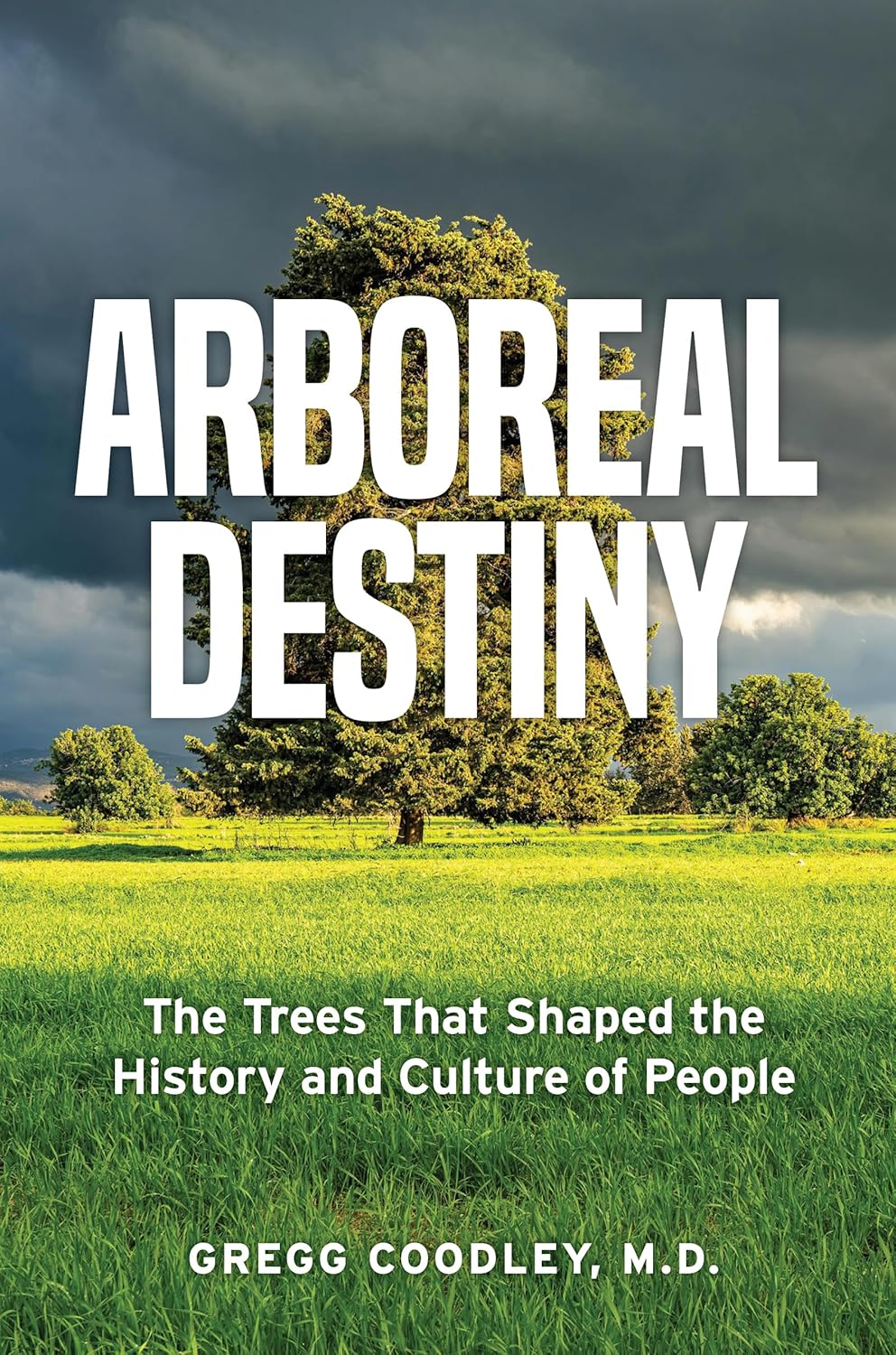
Arboreal Destiny: The Trees That Shaped the History and Culture of People takes twenty kinds of trees, from figs and olives to oaks, chestnuts, and rubber, and shows how they have steered human history, belief, trade, and even medicine. Each chapter starts with clear biology, then moves through myths, sacred stories, everyday uses, and modern science, before the final section widens out into a case for trees as key allies in facing climate change and ecological breakdown. The book argues that we literally grew up with trees, built our homes and ships from them, wrapped our gods and our empires around them, and that our future still rises or falls with their fate.
The writing is careful, researched, and very steady. The author piles up stories, laws, quotes, and footnotes, and the effect is that each tree feels huge and crowded with people. I loved the way the fig chapter moves from wasp pollinators to Egyptian coffins to Buddhist pilgrims under the Bodhi tree. The olive chapter does something similar with lamps, temple rituals, and long-lived groves tied to families. Those shifts kept my curiosity awake. The tone can sometimes feel textbook-like, and the book is very detailed. Still, the overall voice is calm, patient, and respectful of readers who want substance.
The book quietly insists that trees are not scenery. They are the main cast. When I read about chestnuts feeding mountain villages, or white pines driving imperial navies and colonial anger, I felt a little jolt of grief at how casually we cut these living systems down. The closing material, where trees become tools for restoring ruined land and drawing carbon out of the air, hit a different nerve. It felt hopeful, but also a bit desperate, like we are turning back to old companions after years of neglect and asking them to save us one more time. I appreciated that the author does not romanticize everything. Rubber and palm chapters, for example, face the violence and exploitation tied to those trees. I would have liked a stronger personal voice from the author, a short scene on the ground, a human face among the facts, because the subject is so alive that it almost begs for that touch.
This is not a quick nature coffee table read. It’s closer to a serious but accessible course in how trees and people grew into each other, with a side of quiet moral urgency about where we go next. I would recommend it to readers who enjoy narrative history, people who like to see religion, trade, science, and culture in one frame, and anyone involved in conservation, policy, or environmental education who wants stronger stories to tell. If you are ready to see forests and street trees as long-time partners with a real stake in our future, this book will be well worth your time and attention.
Pages: 414 | ASIN : B0GNNVSG69


