Blog Archives
For All Of Us To Contemplate

A Story follows an amateur paleo-archeologist who discovers an ancient tiger skin with mystical properties that imparts to him the story of two early hominids. What was the inspiration for the setup of your story?
The setup for the story reflect a life long fascination with ancient artifacts. Although I have spent a good deal of my life outdoors, I have only found two arrowheads. The one on the cover the book and another smaller one I lost many years ago. I don’t go out on arrowhead hunting trips, I found them purely by chance. I am a geologist by training and spend lot’s of time outdoors. Over the years, I developed a passion for our ancient world. As we have begun to unfold our genetic code, I see the powerful linkages in our species and the path of evolution as our planet evolved. It is remarkable to me how nature has charted our genetic path. I wanted to frame the story of something that was tangible. Human nature, being what it is, is more tangible than we realize. I wanted to frame the story to be something more real than fiction based on what we observe and what traces of humanity we can find. Ancient tools, dwellings, and paintings give us the roots of our ancestry. Hamster Dunnigan, the protagonist in the beginning of the story, is symbolic of our human curiosity and the powers of good and evil. I wanted to project him as an anti-Indiana Jones who find redemption by sharing the story he tells and the physical similarities he shares with the characters in the story. Finding ancient artifacts is both good and bad, depending on what you do with them. A good example of this is Dr. Lee Berger of the University of Witwatersrand in South Africa, Taylor McCoy of Eastern New Mexico University, Dr. Leaky, Dr. Jane Goodall, and so many other researchers that share their findings with the world and helped frame “A Story” for all of us to contemplate. We humans are more than the sum of our parts and awareness of this fact is important to understand. I am trying to make that connection. But…this is just “A Story” to reflect on.
With the early hominids having different cultures and communication skills it was interesting to see their interactions. What was your approach to writing the interactions between characters?
We all share common traits and abilities. In my mind, the evolving brain was capable of lots of things we no longer access. Just as we have physically changed through evolution the changes of course include our brains. I use the term evolution loosely. I think it is totally possible that we carried lots of abilities to communicated purely by intuitiveness and understanding survival in a world and environments today’s humans would find extreme. Using what assets we have (and still carry with us, such as being able to make vocal sounds and using parts of our bodies to communicate,) has been a trait we carried and used since early evolution in our species. It is the same with all of the animal phylum and plants phylum as well. We all use the assets we have. It is a matter of survival.
What were some themes that were important for you to explore in this book?
Racism was one theme. In my book, the fact that the reader will not have to acknowledge race, because it did not matter, should resonate behind the scenes. Just because I did not say it specifically, one should view the interactions of the characters with a sense of bonding. Each one of the characters should reflect an emotional and physical linkage we all share. The characters should reflect an awareness of self, others, and spirituality. That includes shamanism, our earliest adventures into our sub-conscience mind and religious awareness. The discovery of Homo Naledi and research on those remains will open doors to so many possibilities and question connection to our ancient ancestors. We are more alike than different. We always will be, so stop the stupidity of thinking we are different just because of our skin color.
Will there be a follow-up to this story? If so, what aspects of the story will the next book cover?
Yes. But in truth, it depends on how this book is received. I have several aspects of the story that dive deeper into our collective past and the manifestation of our self-awareness, and cultural similarity. For example, what made an early hominoid successful and how did that genetic mutation present itself in our earliest ancestors lineage? My belief is that it was based on spirituality and not necessarily the strongest or the fittest. There is a story around that and I think it generates a lot of questions ripe for creative thought. But don’t misunderstand me. We are all unique individuals and I totally respect our ability to think freely and become contributing members of our planetary community. We should embrace our subtle differences, and embrace our collective humanity.
Author Links: GoodReads | Twitter | Facebook | Website
As the story evolves Noolan and Caek are two competing species of early hominoids, but separated from their clans, they depend on one another and become emotionally attached. Journey with them through many harrowing events as they try to reunite with their families. Making their way through an unrelenting environment with determination and grit, they grow closer together and closer to their ultimate enemy, the Jakkar. It is only through an intuitive power, deeply honed survival skills and a bit of luck that these two craftly and cleverly overcome the odds. As you get to know Noolan, Caek and their clans, you’ll reconsider what you thought you knew about our early ancestors.
The genesis of problem-solving abilities and what may happen with earlier hominoid ancestors demonstrates they were a lot smarter than we give them credit for. It was a human who created the wheel, and prayer and relational understandings.
A Story
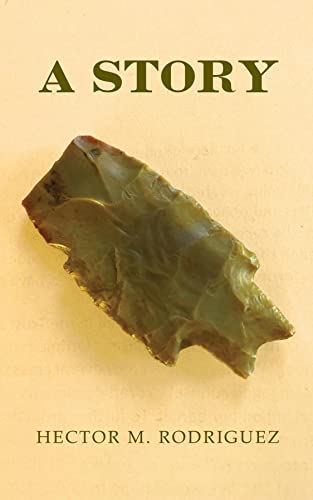

Hector M. Rodriguez’s A Story commences with the enthralling discovery of a time-capsule chamber, delving into the intriguing narrative of hominoids from the Pleistocene epoch. It provides an engaging exploration of the emergence of collective consciousness, emotional evolution, and the grappling with extreme climatic shifts.
This captivating novella chronicles the lives of several key figures: Voltek, a hominoid shaman, alongside Noolan and Caek, members of the Homo Naledi species. It artfully encapsulates their migration from the harsh northern realms to outpace their deteriorating environment. Amidst this mass movement, Caek finds herself detached from her tribe, a minor band of Naledis journeying southward to escape encroaching disasters.
While Caek’s group finds temporary solace amongst Voltek’s people in the volcanic mountains, she encounters Noolan, another strayed member of Voltek’s group. The pair embarks on a precarious quest to return to their newfound haven in the mountains. As they confront brutal climatic changes and the impending threat to hominoid existence, a striking parallel is drawn between the concerns of this prehistoric epoch and those prevalent in contemporary society.
Rodriguez’s deftly woven narrative stirs reader curiosity, effectively balancing the absence of dialogue with insightful, descriptive prose that fosters deep empathy for its characters. The author’s stark portrayal of character demises offers an exploration into the genesis of emotions such as grief and sorrow among the hominoids, contributing to the visceral realism of the narrative.
The narrative is a poignant, vivid, and somewhat melancholic journey into our past. It brilliantly captures the awe experienced when forming ties with the past and future, as well as the wider natural world, enhanced by the use of hallucinogenic mushrooms. The spectacles of massive beasts long extinct and the sheer immensity of our planet, presented in rudimentary cave paintings, are beautifully encapsulated in this compelling novella.
Pages: 189 | ASIN : B0C5KQCGHL




 LITERARY TITAN