Blog Archives
My Faith in God

The Last Expression follows a passionate, faith-driven journey of identity, heartbreak, purpose, and self-worth as you wrestle with pain and power while claiming your voice. Why was this an important book for you to write?
My book was important for me to write because I had an important message I needed to convey to my audience. I wanted to share my story with my audience that could deeply resonate with my words in poetic form. I wanted to leave a lasting impression, an imprint, and leave a legacy with my readers around the world. I didn’t want to leave the ending to my poetry series on a fall; I needed to return. Also, I wanted to correlate that return to the Return of Jesus. He will one day come back to rule and reign and be reconciled with His followers! I am a Christian, and I believe my writing influences people. Lastly, it was for my own therapy to have a release or outlet to cope with life.
The book often balances confidence with vulnerability. How do you navigate writing from a “kingly” posture while still revealing pain, doubt, and longing?
I truly believe I write with an open heart and want to be authentic in my writing approach. I believe we as humans deal with the duality of opposites, for example, happiness and sadness. You can feel two things simultaneously. You can be confident but may wrestle with some doubts or fears. I believe you can disarm people with your demeanor, but people need to feel like they can identify with you! Every king wasn’t always perfect, especially those who were kings in biblical times. They all faced challenges, battles, or opposition. We all have our moments, but I truly see myself as a king because God is a King of All Kings. I am made in His image. He has crowned me with favor in spite of my struggles.
Faith is central throughout the book. Were there particular life experiences that shaped the spiritual urgency behind these pieces?
Yes, absolutely!! When I went through rough seasons, I had to rely on my faith in God to get through them! I felt like people needed to hear my testimony so they could be inspired and know that God is with us, just like He has always been with me! I remember being in the military, and I was deployed to Iraq back in 2006 and 2007. We had a mortar attack that hit inside the compound I was working at. It was a very close call; my life literally flashed before my eyes. I had to go into combat mode and protect the detainees (the enemy) that I was guarding with my fellow troops. I knew God protected all of us that day from what could have been a disaster!
Which piece in the collection was the most difficult or healing for you to write, and why?
Hmmm, let me see there were a few that were a bit challenging to write like “Therapy,” “Stages,” “Sacrifice,” “Evolve,” and “Letter To My Dad.” There was just a lot to cover and very complex topics to speak about. Stages were very detailed and were quite a process going from start to finish. “Evolve” was scientific and just a different lane into unfamiliar territory than what I am used to writing.”Letter To My Dad” was difficult because you’re trying to embody a whole person and the relationship you have with them into one poem. I made a rough draft of it and recited it to my father. He asked me to rewrite the poem. I was kind of shocked, but he wanted me to elaborate more, and he is a studious kind of person anyway. So, when I wrote it a second time, I put more emphasis on giving the poem more meaning to satisfy his liking and also showcase what type of man and father he is! Overall, this last book has been my most challenging yet, but I enjoy taking on challenges, and it’s really helped me become more efficient in my writing!
Author Links: X (Twitter) | Facebook | Website | Instagram | Amazon

The Last Expression: Return of The King

The Last Expression: Return of the King by Aaron Woodson reads like a sprawling personal testimony, part poetry collection, part spiritual journal, part self-declaration. Across dozens of short pieces, Woodson moves through faith, masculinity, Black identity, romance, rejection, grief, ambition, family, and the hunger to be seen. The book opens with an almost defiant sense of arrival in “Set The Tone” and “Mission First,” then keeps widening its emotional field through pieces like “Allowed,” “Therapy,” “Renaissance Man,” “The Year of Goodbyes,” “God’s Face,” “Future King,” and “Pouring Out My Heart This Time Around.” What holds it all together is the author’s insistence that life, even when bruising or messy, is still charged with purpose and divine possibility.
Woodson writes with the energy of someone speaking from a stage, a pew, a text thread, and a private notebook all at once. There’s a looseness to the style that can be uneven, but it also gives the work its heartbeat. In “Therapy,” for instance, the speaker wrestles with rage, shame, spiritual warfare, and the ache of wanting love and protection, and the piece becomes less a polished poem than a release valve. I found that honesty moving. The best moments arrive when the bravado softens, and something tender slips through, as in “The Year of Goodbyes,” where loss lingers like residue, or “I Don’t Care, Nevermind I Do Care,” where emotional fatigue gives way to a real desire to keep showing up for people. Those passages have a bruised sincerity that stayed with me.
I also found myself thinking a lot about the ideas in the book, especially the tension between confidence and vulnerability. Woodson often writes from a kingly posture, leaning into words like purpose, mission, authority, legacy, and crown, but beneath that public strength is a man trying to understand pain, rejection, desire, and responsibility. Sometimes the romantic and gender-focused pieces feel more complicated, even thorny, because they carry frustration alongside longing. That tension made the book feel relatable to me. The religious conviction is unmistakable and sometimes thunderous, but it’s strongest when it becomes personal rather than purely declarative, when faith isn’t just a banner being waved but a hand reaching through grief, temptation, loneliness, and self-correction.
By the end, I felt I had spent time with a voice that’s messy, passionate, searching, funny, wounded, and deeply certain that God is at the center of the story. The writing could benefit from more restraint and refinement in places, but its rawness is also part of its appeal, giving the collection the texture of a living conversation rather than a carefully sealed artifact. This is a book for readers who enjoy spiritually driven personal reflections, spoken-word-style poetry, and candid meditations on manhood, resilience, faith, love, and self-worth. I’d recommend it especially to readers who don’t need every line polished smooth, but who want to feel the heat of a writer pouring himself onto the page with urgency, conviction, and an open heart.
Pages: 414 | ASIN: 1953526322

The Face of Expression 3: Fall of A King
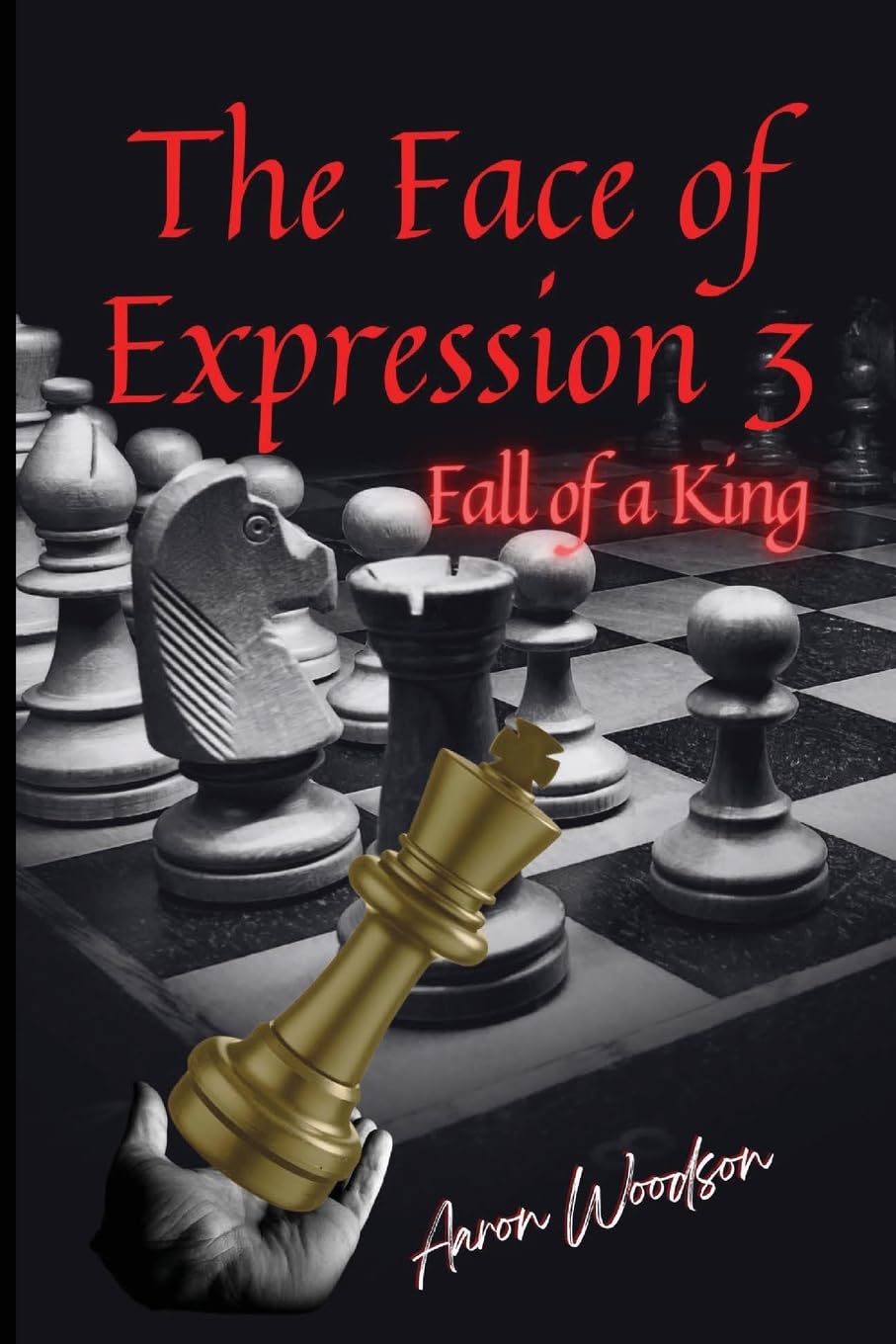

The Face of Expression 3: Fall of a King by Aaron Woodson is a sprawling, deeply personal poetry collection about faith, masculinity, love, Black identity, heartbreak, endurance, and spiritual repair. It moves like a long testimony, beginning with surrender in “Chess With God,” swelling into declarations like “Leading With Love,” “Black By Popular Demand,” and “Heart of A Lion,” then circling through romance, loneliness, self-worth, social pain, fatherhood, exhaustion, and legacy before arriving at the title poem, “Fallen Kings,” and the quieter ache of “Swan Song.” The book feels less like a neat, curated volume and more like a life poured straight onto the page, sometimes polished, sometimes raw, but almost always emotionally direct.
I felt the force of that in poems like “Still on My Feet,” where the speaker is bruised but refuses to retreat, and in “Quitting,” where the honesty turns darker, wearier, and more vulnerable. Woodson writes often from the posture of a king, a soldier, a lover, a believer, but the most moving moments come when the crown slips a little and I can see the tired man underneath it. In “Anchor,” the prayer isn’t ornamental. It sounds like someone genuinely close to breaking, asking God to hold him in place before the storm takes him. That kind of naked need gives the collection its heartbeat.
Woodson’s style is conversational, repetitive, sometimes sermon-like, and he often leans into big declarations rather than subtle turns. I admired the sheer openness of the voice. Poems like “Waves” and “Pilot” stretch an idea almost playfully until it becomes metaphor, memory, flirtation, joke, and testimony all at once. “Black By Popular Demand” has a proud, pulsing confidence that feels communal rather than merely personal, while “Hello Handsome” turns self-affirmation into something funny, sensual, and strangely tender. The ideas in the book are not shy ones. Love heals. God rescues. Blackness is beautiful. Men hurt. People fail each other. Grace remains.
By the end, I felt like I’d spent time with someone determined to bless the wounds that shaped him, not deny them. The Face of Expression 3 isn’t a delicate book, and it isn’t trying to be. It’s loud, searching, romantic, wounded, faithful, proud, and full of hard-earned hope. This collection works best when read as a testimony in motion, not as a pristine literary object. I’d recommend it to readers who enjoy confessional, faith-centered poetry with a strong spoken-word current, especially those drawn to reflections on Black manhood, resilience, love, and spiritual recovery.
Pages: 414 | ISBN : 1953526322



