Blog Archives
Our Lives Mattered

In Stateless in Paradise, you share your family history, personal struggles, and your fight for recognition. Why was this an important book for you to write?
Stateless in Paradise was important for me to write because for most of my life, my existence was defined by paperwork I didn’t have, borders I couldn’t cross freely, and decisions made about me without my voice. When you are stateless, your story is often reduced to a case number, a detention file, or a legal problem. Writing this book was my way of reclaiming my humanity.
I wanted to document my family history and personal struggles, not out of self-pity, but out of responsibility. Statelessness is usually invisible. Millions live it, yet very few stories are told from the inside—from the fear of detention, the humiliation of deportation, the loneliness of exile, and the quiet resilience it takes just to survive. By telling my story, I wanted to put a human face on a condition that is too often discussed only in legal or political terms.
The book was also a way to honor the people who shaped and saved me: my mother, who raised me with dignity despite displacement; the strangers who showed compassion when governments did not; and the few mentors and loved ones who believed in me when the system erased me. Their presence in the book is my way of saying that survival is never a solo act.
Finally, Stateless in Paradise was an act of resistance. Writing it was my fight for recognition—not just for myself, but for others who live in legal limbo. I wanted to leave a record that says: we were here, our lives mattered, and our stories deserve to be heard.
I appreciate the candid nature with which you share your experiences. What was the most difficult thing for you to share?
The most difficult thing for me to share was not a single event, but the emotional truth behind them—the shame, fear, and sense of invisibility that came with being stateless.
It was hardest to write about the moments when I felt completely powerless: sitting in detention knowing my fate depended on signatures and stamps, being deported without dignity, or living in exile in American Samoa, where time felt suspended, and my life reduced to waiting. Those experiences stripped me not only of freedom, but of identity. Admitting how deeply that broke me—how close I came at times to losing hope—was far more painful than describing the physical circumstances.
Equally difficult was exposing the quiet loneliness. Statelessness isolates you in ways that are hard to explain: you cannot plan a future, you hesitate to form attachments, and you learn to survive emotionally by numbing yourself. Writing about that emotional survival mechanism meant confronting parts of myself I had long buried just to keep going.
I also struggled with writing about my family, especially my mother. Her strength, sacrifice, and the weight of what she endured as a refugee still carry deep emotional gravity for me. Putting that on the page meant reopening wounds that never fully healed.
But I chose to include these truths because anything less would have been dishonest. If the book was going to matter, it had to reflect not only what happened to me, but what it did to me. And in sharing that vulnerability, I hoped readers might better understand the real human cost of statelessness—not as an abstract issue, but as a lived reality.
What is one piece of advice someone gave you that changed your life?
What stayed with me—and ultimately became my guiding principle—was very simple advice: stand for yourself. Fight for yourself, because in the end, no one else is going to do it for you. When you are stateless, you learn very quickly that you are on your own. Sympathy is rare, and systems don’t protect people without status.
There was also a sentence someone once said— I don’t even remember who—that became my personal motto: try to take everything from this life, whether it’s good or bad, because one day you’ll turn around and realize the game is over. That thought struck me deeply. It forced me to stay awake, to stay present, even in the worst conditions.
That mindset carried me through six months in a detention center in Houston, through one year and five months of exile in American Samoa, and through nearly twenty years of being stateless in the United States. When everything is taken from you—your documents, your freedom, your future—the only thing left is your will to keep going.
So the advice I lived by was not romantic or comforting. It was survival advice: fight, don’t give up, and keep moving forward, even when you’re exhausted, even when the system is against you. Because stopping means disappearing—and I refused to disappear.
What is one thing you hope your readers take away from Stateless in Paradise?
If there is one thing I hope readers take away from Stateless in Paradise, it is this: a person’s worth is not defined by their legal status.
I want readers to understand that behind every label—stateless, undocumented, refugee, detainee—there is a full human being with dreams, love, intelligence, and dignity. Statelessness is not a failure of character; it is a failure of systems. And yet, even inside those broken systems, people continue to endure, resist, and find meaning.
I also hope readers walk away with a sense of responsibility. Not guilt, but awareness. Awareness that freedom, mobility, and belonging are privileges many take for granted—and that these can be taken away overnight. When readers recognize that, compassion stops being abstract and becomes personal.
Finally, I want the book to leave people with courage. If someone who was erased by borders, detained, deported, and exiled could keep fighting and keep moving forward, then maybe readers facing their own battles—visible or invisible—will feel less alone. If the book does that, then telling this story was worth it.
Author Links: GoodReads | X (Twitter) | Facebook | Website | Instagram | Amazon
Stateless in Paradise is the deeply human journey of a man living between borders. From the South Pacific to West Africa, from Eastern Europe to the United States, Mikhail’s life is shaped by movement, uncertainty, and the constant negotiations required of someone without a recognized nation.
Forced into detentions, threatened with deportations, and stranded for months in American Samoa, he confronts the global systems that decide who belongs — and who does not. Yet this memoir is also filled with connection: the kindness of strangers, the discovery of chosen family, the beauty of cultures encountered, and the love story that becomes his safe harbor.
Stateless in Paradise: A Stranded Soul’s Fight for Freedom


Stateless in Paradise tells the true story of Mikael Okuns, whose ordinary holiday trip turns into a year and a half of involuntary exile in American Samoa. The book moves from his childhood in Soviet Azerbaijan through his awakening identity, his escape from collapsing political structures, and his eventual entanglement in the American immigration system. It settles into a gripping account of what it means to have no legal country at all, no embassy to rely on, and no way home. The memoir blends family history, personal struggle, and a long fight for recognition. It becomes a record of survival and resilience inside a system that rarely sees the individual behind the paperwork.
When I first started reading, I expected a straightforward immigration story. Instead, I found something raw and relatable. Okuns writes with a kind of steady honesty that caught me off guard. He describes Soviet childhood scenes in warm detail, like the tiny library in the woods where he borrowed books or the crowded apartment where seven people shared two bedrooms. He also shares unsettling moments, like the political pressure he faced after writing to Margaret Thatcher as a schoolboy or the tightening fear that grew as war pushed his family from their home. His voice feels calm on the page, yet the emotion underneath builds quietly. I felt myself leaning in as he described life in exile in American Samoa, clinging to McDonald’s Wi-Fi to contact anyone who might help. The writing is simple and clear, and that simplicity gives his pain and confusion even more weight.
Okuns refuses to flatten his life into a neat arc. He shows messy parts of himself. He talks about desire, fear, and identity with a sort of brave directness. He brings forward the parts of coming-of-age that many memoirs rush past, and he does it without apology. I appreciated that vulnerability. It gave the whole book a pulse. Some chapters feel almost like small confession rooms. Others feel like travel logs written by someone who never meant to travel this far. And there were stretches where I sat with a tight feeling in my chest, especially when he describes what it is like to be truly stateless, to watch the world decide whether you belong anywhere at all. It is rare to read a memoir that mixes political reality with such personal tenderness, but this one does it.
Stateless in Paradise would be a strong fit for readers who want more than a travel story or a political drama, because it offers a deeply personal look at what it means to lose your place in the world and fight to find it again. It is especially good for people who enjoy memoirs rooted in resilience, LGBTQ+ identity, immigration challenges, and the complicated mix of family, culture, and selfhood. I would also recommend it to anyone who wants to understand statelessness on a human level rather than a legal one, since Okuns brings that reality to life with clarity and heart.
Pages: 470 | ASIN : B0FDYGFHS7

Hidden Gems

In Milepost 75, you share your purpose and determination with readers in a memoir that chronicles your journey through some of the world’s most captivating landscapes. Why was this an important book for you to write?
This book began when my daughter and I first attempted to hike the Grand Canyon rim-to-rim-to-rim 50/24. We could not complete it, but the experience changed our lives. When I finally completed that hike after two more DNFs, my life was enriched and I wanted/needed to share my story – to inspire others to keep going and never give up.
I appreciated the candid nature with which you told your story. What was the hardest thing for you to write about?
Thanks! As I grew older, bolder, and stronger, my husband, Arnie was slowing down and encountering more medical issues, especially having to go on oxygen. I wanted to include something about how our health and abilities were differing, but I needed to include that in a way that respected his desire for privacy. I finally wrote just one sentence that explained and still honored him and his wishes.
What is one piece of advice someone gave you that changed your life?
Wow! One piece of advice? So many people have advised and helped me on my life journey. It could be the stranger – another “angel” I met in Sabino Canyon when I was struggling with whether I should continue to keep training and trying to complete the Grand Canyon rim-to-rim-to-rim. I included this story in Chapter 2: Moving Forward One Step at a Time. When I shared my dilemma, she responded with the Rocking Chair test. “When you are too old to do much of anything except rock in your chair and review your past, what will make you happy? That you persevered? Or that you gave up?” I persevered and that has made all the difference.
What were some themes that were important for you to explore in this book?
The list of themes grew bigger as I wrote, edited, and share my book with others. Here are some that resonated most with my readers: 1) It’s okay to get stalled, but don’t get stuck. 2) There are benefits to slowing down as we age, such as embracing Plan B options, taking the time to notice and appreciate the tiny hidden gems along the trail, and connecting with people as we stroll and smile rather than simply speeding by. 3) Failing is fine as long as we don’t give up.
Author Links: GoodReads | Facebook | Instagram | Website | Amazon
Milepost 75 – Aging and Exploring Life Trails with Wonder, Resilience, and Love
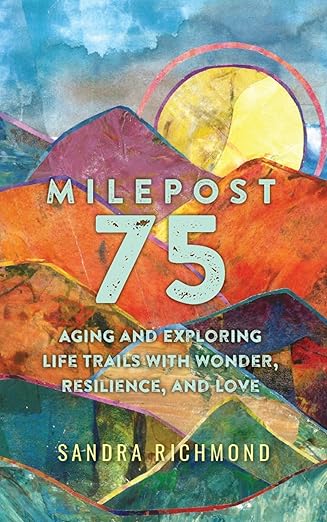
Sandra Richmond’s Milepost 75 is a memoir, a travelogue, and a call to action wrapped into one. At its heart, it’s the story of a woman who found her passion for walking and hiking later in life and refused to let age or physical setbacks stop her. She chronicles her journey through the Grand Canyon, the Inca Trail, and other stunning landscapes, all while dealing with the realities of aging, artificial hips, and the occasional self-doubt. Through humor, vulnerability, and an unwavering sense of adventure, Richmond paints a picture of a life lived with purpose and determination.
One thing I loved about this book is the raw honesty. Richmond doesn’t sugarcoat the difficulties of pushing her body beyond what doctors recommend. Early on, we see her doctor warn her about wearing out her implants, and her response is immediate: “That’s not an option. Not now. Not for my quality of life!” That moment hit me hard because it captures the fierce independence that drives this entire book. She acknowledges her limitations but refuses to be ruled by them. Her grit is infectious, making you want to lace up your hiking boots and take on a challenge of your own.
The storytelling is immersive and filled with rich details. Take, for instance, the moment when she and her daughter attempt to complete the Grand Canyon’s Rim-to-Rim-to-Rim hike. Richmond describes the grueling terrain, the exhaustion, and the heartbreak of having to turn back before reaching the top of the North Rim. But instead of seeing it as a failure, she reframes it as a lesson in resilience. The book is full of these moments where perceived setbacks transform into fuel for the next challenge.
Another standout aspect is the relationships Richmond builds along the way. She has a keen eye for the “angels” she meets on trails—strangers who offer encouragement, help, or just a moment of connection. Whether it’s the woman in Maine who found inspiration in Richmond’s slow but steady triathlon finish or the hiker who handed her daughter life-saving protein powder at Phantom Ranch, the book highlights how adventure is often about people just as much as it is about places. These interactions make the book feel deeply personal and universal at the same time.
Milepost 75 is perfect for anyone who has ever thought, “I wish I could, but I’m too old,” or “That dream is behind me.” It’s for those who need a reminder that adventure doesn’t have an expiration date. Richmond’s story is equal parts inspiring and practical, encouraging readers to embrace life’s uncertainties with an open heart. If you’re looking for motivation, humor, and a touch of wanderlust, this book is a must-read.
Pages: 276 | ASIN : B0CWJTVYZ6


