Blog Archives
Clarity

In Writing in the Wound, you share with readers what it means to be shaped by academia, gendered power, and migration, and how your reliance on music proved to be a method of rescue. Why was this an important book for you to write?
I began writing Writing in the Wound at a moment of profound emotional and political intensity in my life. After years of navigating the Canadian immigration system, I found myself confronting not only institutional barriers but also the deeper psychological and embodied impact of living within them.
Initially, I considered writing a more overtly critical, policy-driven book—one that directly addressed the failures and frustrations of the immigration system. But I realized that such a project would take me away from my core as an artist.
What felt more urgent was to write from within my own lived experience—through sound, memory, and relationship. This book became a way of tracing how I endured, and what allowed me to stay. In that sense, it is not only a story of struggle, but of artistic becoming.
In its early drafts, the manuscript was expansive and uncontained. Over time, it found its center—particularly through my relationship with my mentor, which offered a space of care, listening, and growth. That relational grounding became essential to shaping the narrative.
Ultimately, this book created a new path for me—a path where I was no longer masking who I am or what I am enduring within this system. It allowed me to situate myself clearly as an artist, while also naming the conditions I was navigating.
I wrote this book not just to document what happened, but to understand how one continues to create, even within systems that constrain and wound.
Music appears as discipline, refuge, and language—when did it become central to your survival?
Music became central to my survival during the uncertainty of the COVID-19 period. After serving as Music Faculty for Semester at Sea, I travelled to Karachi due to the pandemic and found myself unexpectedly unable to return to Canada for nearly two years, at a time when institutions were largely closed and opportunities had disappeared.
In that period of precarity, when academic institutions had stopped hiring faculty, and it was difficult to teach remotely from where I was situated, music shifted from being a practice of expression to a practice of sustenance. Earlier compositions, like Anticipating and Living with Purpose, had received recognition on international charts and in competitions, which gave me the confidence to continue applying for opportunities. Then, Perils of Heavy Rainfall received Second Prize in Listening during COVID contest (2020).
Gradually, commissions and invitations followed, including from organizations such as New Music Edmonton and New Music Calgary, as well as from the International Women’s Day festival and the Canadian Music Week platform. What began as a fragile thread of continuity became, over time, a means of survival—both materially and emotionally.
Was there a moment when you felt your voice shifting—from survival to assertion?
Yes—there was a moment when everything I had been experiencing condensed into a single, clear sentence: that after 17 years in Canada, I still did not have permanent residency, and that this was not incidental, but tied to the structural limitations of the immigration system.
This clarity came to me in July, during a later stage of working on Writing in the Wound. By that point, the writing had begun to settle, and I was able to see my experience not only as something I had lived through but as something I could name with precision.
Being able to name that so directly marked a shift for me. Until then, much of my writing had been about processing and surviving. But that sentence became a position—it allowed me to see my experience not as an individual struggle, but as part of a broader systemic pattern.
Around that time, I also began to explore new pathways within the immigration system, including applying on humanitarian and compassionate grounds. That process required me to articulate my story not only as narrative, but as a formal claim—something that could be recognized within institutional frameworks. In that sense, my voice was no longer only expressive; it became strategic and assertive.
This shift was also reflected in how my work moved into public space. My writing on the undervaluation of artistic labour was published in Canadian Dimension, and I began sharing my story in community settings, including an event with Action Dignity. Speaking in those spaces—where these issues are often not centered—felt like an important act of bringing lived experience into public discourse.
That momentum continued with invitations to speak at larger gatherings, including a Labour Day event, where my story was witnessed by a wide network of community organizations.
In that sense, assertion was not a single moment, but a series of acts—each one moving my voice from private endurance toward public articulation and advocacy.
What is one thing you hope readers take away from Writing in the Wound?
At its heart, the book asks: what happens when our scars begin to speak?
I hope readers come away with a deeper recognition that the wound is not only personal, but structural. Experiences of migration, racialization, and institutional struggle are not simply endured—they also carry strength, insight, and endurance. They shape ways of seeing, feeling, and creating that are often overlooked or undervalued.
For those navigating migration and racialization, these experiences are frequently internalized, fragmented, or rendered invisible. This book is an attempt to give them form—to show that what is carried in the body and in memory can become voice.
If there is one thing I hope readers take away, it is that these experiences are not only sites of injury, but also sites of knowledge. When scars begin to speak, they do more than tell a story—they begin to name the structures that produced them, and in doing so, open the possibility of shifting those systems—and one’s positionality within them.
Author Links: GoodReads | X (Twitter) | Facebook | Website | Amazon
For Dr. Shumaila Hemani, music began as a calling. It unfolded into a life path through a rare human connection with eminent ethnomusicologist Professor Regula Burckhardt Qureshi, whose faith in her awakened the courage to risk everything for the artist’s path.
Spanning nearly two decades — from 2006 to the present — across the academic corridors of Harvard and the University of Alberta to the soundscapes of London, Boston, Chicago, Edmonton, Mumbai, Karachi, Calgary, Banff, and Toronto, and a world odyssey aboard a floating campus, Writing in the Wound is a story of resilience and fragile belonging, of visibility and erasure, and of the power of art — in particular Sufi music — to transmute pain into wisdom.
It is an intimate testament to truth and vulnerability in the face of institutional silencing, immigration precarity, and the long endurance toward permanent belonging.
Writing in the Wound: Acculturation, Trauma, and Music
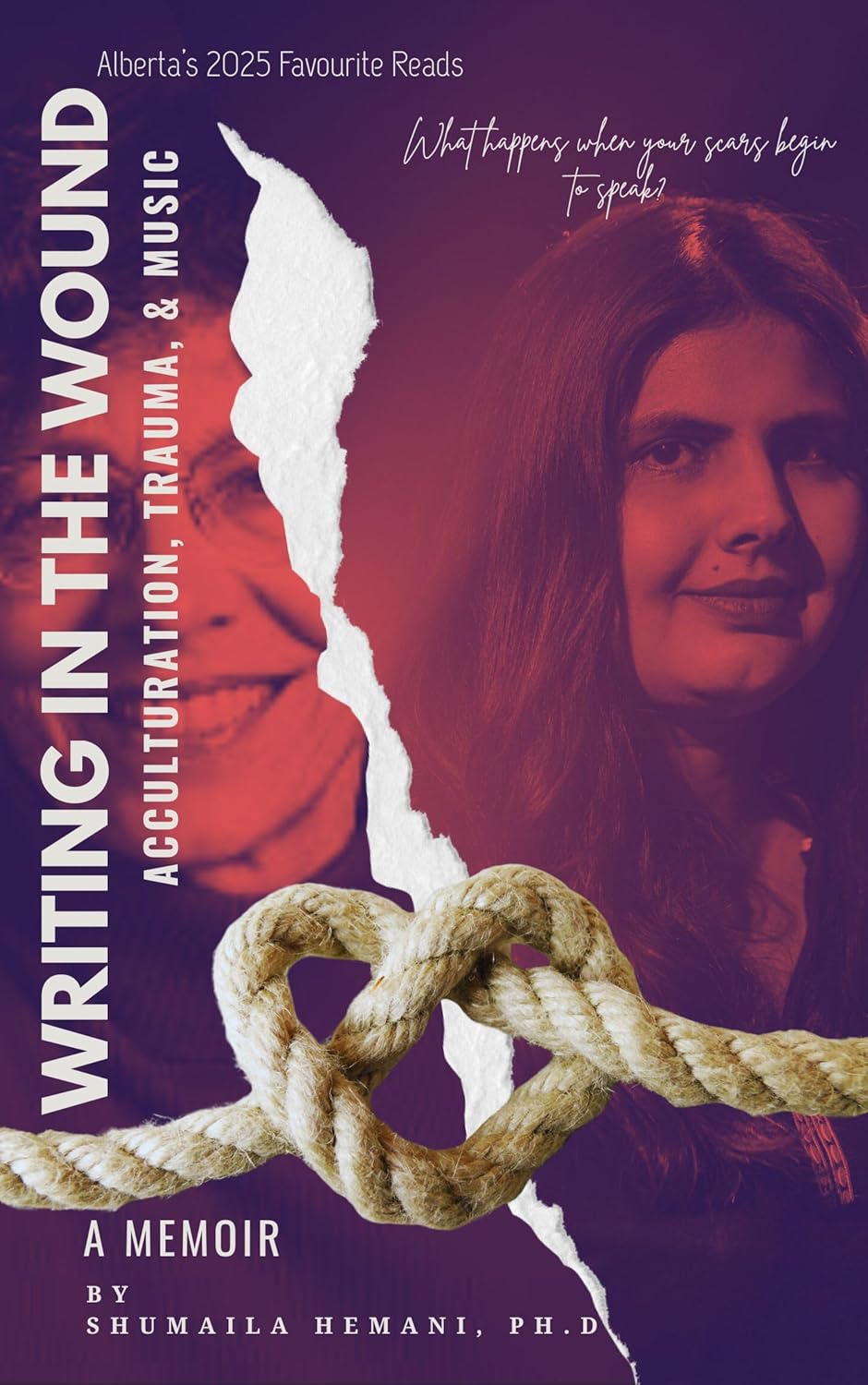

Writing in the Wound is a memoir about what it means to be shaped and repeatedly injured by migration, academia, gendered power, and the long bureaucratic violence of immigration precarity, while still refusing to let art go mute. Author Shumaila Hemani traces that struggle across Karachi, London, Edmonton, Harvard, Banff, Calgary, and beyond, returning again and again to music as both discipline and rescue. What stayed with me most was the book’s insistence that the “wound” is not just a private sorrow but a structural fact, something lived in the body and sharpened by institutions, and that song can become not a cure exactly, but a way of bearing truth without surrendering to it. Scenes like the freezing Alberta night when she seeks refuge in a restaurant lobby, her charged decision between Chicago and Harvard, and the later episodes of artistic endurance under precarity give the memoir a real narrative pulse beneath its reflective surface.
What I admired most was the book’s emotional candor and the seriousness with which it treats art. Hemani writes as if sound were breath, shelter, lineage, prayer, argument, and last defense all at once. I found that deeply moving. Some of the strongest passages are the ones where sensory memory and intellectual reflection fuse cleanly: Karachi’s street sounds and household textures, the strange thrill of hearing the theremin in London, the feeling of Cambridge as a place that “held” her differently, the sea storms aboard the World Odyssey, the pink-moon stillness that arrives after so much psychic abrasion. The prose can be overtly lyrical, but for me, that ambition is mostly earned because it rises from lived intensity rather than decorative flourish.
Its ideas are forceful and, at their best, unsettling. Hemani’s central claim that exclusion is often discussed in abstract policy language while its damage is absorbed by actual bodies felt painfully persuasive. The memoir is strongest when it shows that argument rather than merely stating it: in the humiliations of school and class performance, in the uneasy academic encounters where she feels reduced to a gap to be filled rather than a mind to be met, in the grinding absurdity of years of achievement that still do not translate into belonging. There were moments when I wanted a bit more compression, because the book sometimes circles its pain. But even that repetition began to make sense to me as part of the memoir’s design. Trauma here is not tidy, and Hemani refuses to fake tidiness for the reader’s comfort. I respected that.
I found Writing in the Wound arresting, thought-provoking, and fiercely alive. It’s a memoir that believes art can carry knowledge that institutions cannot properly hear, and that belief gives the whole book its tensile strength. It keeps faith with fracture while still making room for beauty, devotion, and survival. I’d recommend it especially to readers drawn to memoirs of migration, music, trauma, and intellectual becoming, and to anyone interested in how a life in art can be both exalted and terribly precarious.
Pages: 290 | ASIN : B0FVQB8XGV

Hidden Gems

In Milepost 75, you share your purpose and determination with readers in a memoir that chronicles your journey through some of the world’s most captivating landscapes. Why was this an important book for you to write?
This book began when my daughter and I first attempted to hike the Grand Canyon rim-to-rim-to-rim 50/24. We could not complete it, but the experience changed our lives. When I finally completed that hike after two more DNFs, my life was enriched and I wanted/needed to share my story – to inspire others to keep going and never give up.
I appreciated the candid nature with which you told your story. What was the hardest thing for you to write about?
Thanks! As I grew older, bolder, and stronger, my husband, Arnie was slowing down and encountering more medical issues, especially having to go on oxygen. I wanted to include something about how our health and abilities were differing, but I needed to include that in a way that respected his desire for privacy. I finally wrote just one sentence that explained and still honored him and his wishes.
What is one piece of advice someone gave you that changed your life?
Wow! One piece of advice? So many people have advised and helped me on my life journey. It could be the stranger – another “angel” I met in Sabino Canyon when I was struggling with whether I should continue to keep training and trying to complete the Grand Canyon rim-to-rim-to-rim. I included this story in Chapter 2: Moving Forward One Step at a Time. When I shared my dilemma, she responded with the Rocking Chair test. “When you are too old to do much of anything except rock in your chair and review your past, what will make you happy? That you persevered? Or that you gave up?” I persevered and that has made all the difference.
What were some themes that were important for you to explore in this book?
The list of themes grew bigger as I wrote, edited, and share my book with others. Here are some that resonated most with my readers: 1) It’s okay to get stalled, but don’t get stuck. 2) There are benefits to slowing down as we age, such as embracing Plan B options, taking the time to notice and appreciate the tiny hidden gems along the trail, and connecting with people as we stroll and smile rather than simply speeding by. 3) Failing is fine as long as we don’t give up.
Author Links: GoodReads | Facebook | Instagram | Website | Amazon
Milepost 75 – Aging and Exploring Life Trails with Wonder, Resilience, and Love
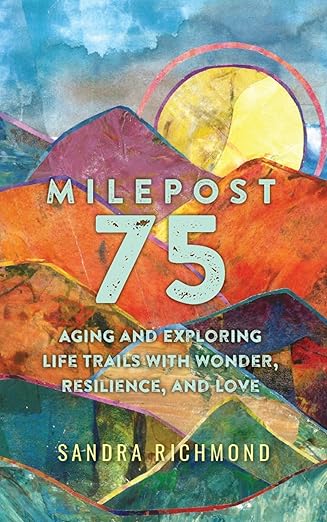

Sandra Richmond’s Milepost 75 is a memoir, a travelogue, and a call to action wrapped into one. At its heart, it’s the story of a woman who found her passion for walking and hiking later in life and refused to let age or physical setbacks stop her. She chronicles her journey through the Grand Canyon, the Inca Trail, and other stunning landscapes, all while dealing with the realities of aging, artificial hips, and the occasional self-doubt. Through humor, vulnerability, and an unwavering sense of adventure, Richmond paints a picture of a life lived with purpose and determination.
One thing I loved about this book is the raw honesty. Richmond doesn’t sugarcoat the difficulties of pushing her body beyond what doctors recommend. Early on, we see her doctor warn her about wearing out her implants, and her response is immediate: “That’s not an option. Not now. Not for my quality of life!” That moment hit me hard because it captures the fierce independence that drives this entire book. She acknowledges her limitations but refuses to be ruled by them. Her grit is infectious, making you want to lace up your hiking boots and take on a challenge of your own.
The storytelling is immersive and filled with rich details. Take, for instance, the moment when she and her daughter attempt to complete the Grand Canyon’s Rim-to-Rim-to-Rim hike. Richmond describes the grueling terrain, the exhaustion, and the heartbreak of having to turn back before reaching the top of the North Rim. But instead of seeing it as a failure, she reframes it as a lesson in resilience. The book is full of these moments where perceived setbacks transform into fuel for the next challenge.
Another standout aspect is the relationships Richmond builds along the way. She has a keen eye for the “angels” she meets on trails—strangers who offer encouragement, help, or just a moment of connection. Whether it’s the woman in Maine who found inspiration in Richmond’s slow but steady triathlon finish or the hiker who handed her daughter life-saving protein powder at Phantom Ranch, the book highlights how adventure is often about people just as much as it is about places. These interactions make the book feel deeply personal and universal at the same time.
Milepost 75 is perfect for anyone who has ever thought, “I wish I could, but I’m too old,” or “That dream is behind me.” It’s for those who need a reminder that adventure doesn’t have an expiration date. Richmond’s story is equal parts inspiring and practical, encouraging readers to embrace life’s uncertainties with an open heart. If you’re looking for motivation, humor, and a touch of wanderlust, this book is a must-read.
Pages: 276 | ASIN : B0CWJTVYZ6
13 Years Lost: An Unbelievable Story of Fleeing Communist Poland to Traveling the World Serving the United Nations

Christine Sadry’s 13 Years Lost is a moving memoir that chronicles her journey from a small village in rural Poland to a successful 31-year career at the United Nations. The story begins with the tragic death of her mother, which shatters her family and leads to Christine’s adoption and relocation to America. Separated from her loved ones, she endures 13 years of abuse and hardship, a period that defines much of her early life. Despite her painful past, Christine’s story is one of resilience and transformation. She builds a family, confronts her trauma, and achieves remarkable professional success, all while reconnecting with her Polish roots. Her writing is honest and vulnerable, offering an intimate exploration of the challenges she faced as a child, an immigrant, and a single mother.
This memoir is a testament to the power of determination, the complexities of human relationships, and the possibility of healing. Sadry’s triumphs at the United Nations and her eventual personal peace make her story both inspiring and deeply impactful. 13 Years Lost is a compelling read, celebrating the strength of the human spirit. Sadry’s writing captures her emotional journey with raw honesty. Her prose brings to life the anguish of her early years, the challenges of being a young Polish immigrant in America, and the triumph of a single mother determined to carve out a better future. The book is not only a personal testament to perseverance but also a profound exploration of the complexities of human relationships—the pain they can cause, the solace they can bring, and the strength required to navigate them. What stands out most is Christine’s ability to turn her pain into purpose. Her career at the United Nations, achieved through relentless hard work, becomes a symbol of her resilience. Her story is a testament to finding peace, success, and fulfillment despite the odds. Her relationship with her late husband adds another layer of depth, reflecting her capacity for love and connection after years of hardship.
13 Years Lost is a compelling read, both heart-wrenching and uplifting. It shines a light on the enduring strength of the human spirit, making it a must-read for anyone seeking inspiration. Sadry’s story reminds us that even in the face of unimaginable adversity, hope and determination can lead to triumph.
Pages: 235 | ASIN : B0DJS1NCXX



