Blog Archives
Grasp the “Soul” of a Language

Vademecum of English is a meticulously crafted handbook designed as a reference tool for English teachers and advanced learners that condenses linguistic knowledge into charts covering phonetics, grammar, vocabulary, and etymology. Why was this an important book for you to write?
Actually, I didn’t intend to write a book at all, I started gathering the information I needed for my classes —I have taught English for more than 40 years—, looking for logical explanations for the tricky aspects of the English language, such as irregular verbs, the “chaotic” spelling, and so on. I checked on several grammar books, dictionaries and the like and usually found 10-12 pages devoted to a single issue, sometimes with contradictory information. So I summarized the main features and rules in convenient diagrams to keep it handy. As I was solving different issues, I started organizing them in single-themed charts. At some point, I realized that all this information could be helpful for many other teachers facing the same problems. So I decided that it was time to share.
How much research did you undertake for this book, and how much time did it take to put it all together?
Gathering the information has been a lifetime endeavor and I have been shaping it for many years, trying to be exhaustive and considering every aspect of the language. Once I decided to publish it as a book, it was a matter of organizing all the material, and that took me about a year.
What were some ideas that were important for you to share in this book?
Few people pay attention to phonetics and phonology when learning (or teaching) a new language. Learning the correct sounds is crucial and should be the first step in the learning process. For example, a few charts show the different pronunciation options of the English letters, pointing out the patterns that native speakers follow.
Regarding vocabulary, we selected the basic and most frequently used words and organized them in thematic families. The grammar part deals with the combinatory structures that shape the language and highlights many hidden rules that even native speakers are unaware of, such as the patterns of irregular verbs.
From my own experience, in order to master a language, you must try to grasp its “soul” and make it yours. You can only achieve that if you really understand where words come from, what are the small pieces (roots and affixes) that shape them, and how they are built. For this, you need to explore the etymology of the words which is also very helpful when learning other related languages like Spanish, French, Italian, German, etc. That is the largest part of the book, 54 out of 120 charts are devoted to this aspect.
What is one thing you hope readers take away from Vademecum of English?
It is not meant to be read cover to cover but used as a companion and reference guide for anyone interested in understanding the features, mechanisms and idiosyncrasies of the English language. Languages are systems and systems follow a logic that is not always clear. I have tried to untangle the historical threads of the language to show such logic. I hope readers enjoy discovering the secrets of English through the pages of this book.
Author Links: GoodReads | X | Facebook | Website | LinkedIn – author | LinkedIn Lexiway
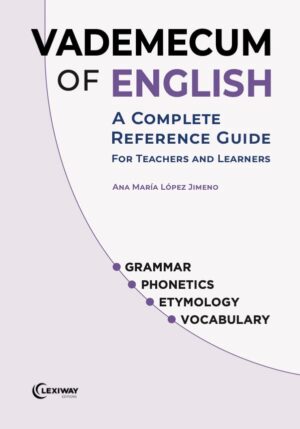
Vademecum of English: A Complete Reference Guide for Teachers and Learners
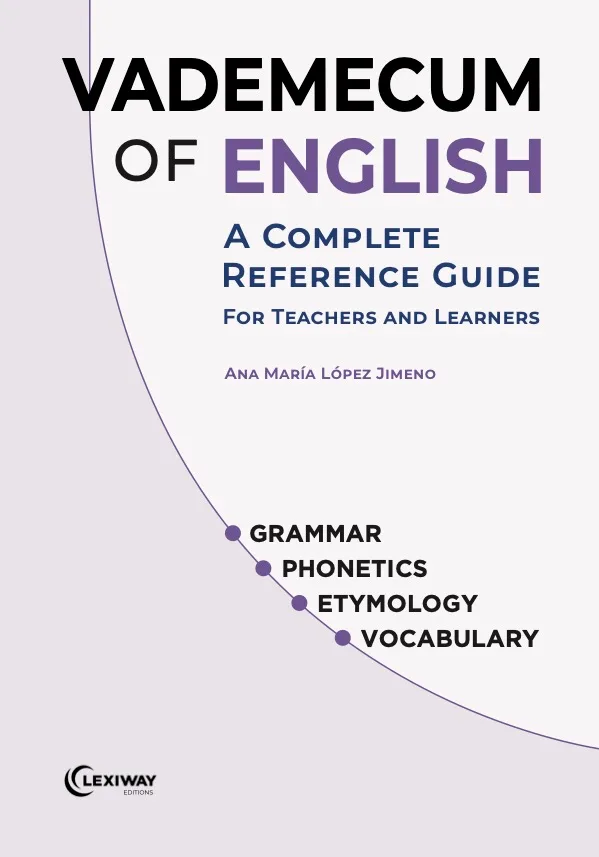

Vademecum of English, by Ana Maria López Jimeno, is a meticulously crafted handbook designed as a reference tool for English teachers and advanced learners. The book condenses a wealth of linguistic knowledge into charts covering phonetics, grammar, vocabulary, and etymology. With its focus on accessibility and clarity, it aims to demystify complex aspects of the English language, such as irregular verbs and the peculiarities of spelling, while offering insights into word origins and thematic vocabulary.
One of the strongest aspects of the book is its structure. López Jimeno organizes this guide in a way that makes learning intuitive. The phonetics section explains the production of English sounds while comparing them to Spanish, which is brilliant for bilingual learners or teachers working in Spanish-speaking environments. The attention to tricky sounds, such as differentiating /θ/ from /ð/, demonstrates that the author knows exactly where learners struggle. Reading this book is like having a teacher by your side.
That being said, the sheer density of the material can feel overwhelming at times. In the grammar section, the breakdowns of sentence structures and transformations are useful but can read more like a textbook. I feel that a more conversational tone might have made it less intimidating for casual readers.
What I found fascinating was the etymology section. It’s about where words come from and understanding the “soul” of the language. Learning that roots and affixes can open the door to hundreds of related words is a game-changer for anyone who is serious about expanding their vocabulary. This section feels like a treasure hunt, with every prefix and suffix uncovering a new linguistic gem.
Vademecum of English, by Ana Maria López Jimeno, is a powerful tool for those willing to take a deep dive into the intricacies of the language. It’s best suited for English teachers, linguists, and advanced students who thrive on detail and structure. If you’re someone who enjoys learning through charts and logical categorization, this is your book. It’s an impressive piece of work that reflects the author’s extensive experience and passion for teaching.
Pages: 152 | ISBN : 978-84-129623-0-7



 LITERARY TITAN