Blog Archives
History Often Forgets

Mrs. Orcutt’s Driveway tells the story of Margaret “Bonnie” Orcutt, a brilliant yet defiant woman who built a life and then defended it in the Mojave Desert against a government that sought to take her land and have her quietly disappear. What inspired you to tell her story?
I was drawn to Bonnie Orcutt’s story because it embodied everything I admire in a person – and everything I find frustrating about bureaucracy. Here was a woman living in one of the harshest landscapes in America, building a life with her own hands, and then being told by the government she had no right to exist there. It wasn’t just a driveway; it was a stand-in for every little fight that goes unnoticed.
What struck me most is how much Mrs. Orcutt reminded me of my maternal grandmother – same spirit, same stubborn fire, same sense of dignity. As a child growing up in Los Angeles, my mother and grandmother would drive us across the desert routes to visit family in Arizona. I remember spending hours staring out the window, mesmerized by that vast, unforgiving landscape. Desert culture always intrigued me – it’s sparse but rich, quiet but full of meaning.
I first came across Margaret’s story on the internet several years ago. It wasn’t a major headline – just a passing mention – but it stuck with me. I tucked it away in my mind, but it kept calling to me, quietly but persistently. Honestly, it felt like Margaret chose me to write it. That may sound strange, but I think stories sometimes pick their authors. And when one won’t let you go, you owe it to the truth to listen.
So, I told her story not just to honor her memory, but to spotlight how history often forgets the people who resist with quiet dignity. Bonnie didn’t kick down doors or make speeches—she just stood her ground, literally, on a patch of desert she loved. That, to me, is heroic
Bonnie was not your typical widow and retiree; instead, she built her homestead and stood up to those who wanted to erase all her hard work. Did you find anything in your research of this book that surprised you?
Absolutely. I expected to find an eccentric woman with a strong will—which I did—but what surprised me was how deeply principled and methodical she was beneath the surface. This wasn’t some impulsive desert dweller throwing sand in the face of authority. Bonnie was sharp, articulate, and relentless. She read the regulations. She filed appeals. She wrote letters to senators. She didn’t just resist—she researched.
At first, I thought this was just a story about a woman fighting the government and the legend she became for writing the White House. But as I dug deeper, I realized her backstory—her earlier life, the love and loss of her husband, the years of quiet determination before the conflict even began—was just as compelling as the rest. Her story wasn’t born from a single act of defiance. It was the culmination of a full, fiercely lived life.
What also caught me off guard was how her fight wasn’t just against land seizure – it was against erasure. The government wasn’t just trying to move her; they were trying to pretend she was never there. That kind of quiet wiping away of a life felt chilling, and it gave the story even more weight.
Lastly, I was struck by the contrast between how physically isolated she was and how visible her resistance became. Out there in the desert, surrounded by silence and sagebrush, she created a legacy that reached far beyond the boundaries of her land. That paradox – the lonely road that somehow leads to a public stand—still gives me chills.
What were some ideas that were important for you to share in this book about her battle or her personality?
One of the core ideas I wanted to share was that strength doesn’t always look loud. Bonnie wasn’t waving banners or giving press conferences -she was alone in the desert, armed with paperwork, stubbornness, and a deep sense of what was right. I think we often overlook people like that. But her quiet resistance, her unwillingness to be erased, speaks volumes about the kind of courage that doesn’t seek attention – it simply endures.
I also wanted to capture the emotional cost of these battles. It’s easy to turn someone like Bonnie into a symbol, but she was a woman who had lost her husband, who built her home from nothing, and who was being told by powerful institutions that none of it mattered. That kind of dismissal hits deep. So I wanted to preserve her humanity, not just her defiance. She wasn’t just standing up to the government— – was standing up for her right to exist with dignity.
And on a broader level, I hoped readers would see the story as a mirror of a larger theme: how ordinary people get caught in the gears of institutions. This wasn’t just about a driveway – it was about identity, belonging, legacy, and the fragile boundary between public power and personal sovereignty.
Lastly, I wanted to make sure readers felt the weight of the landscape. The Mojave isn’t just scenery in this story—it’s a character. It shaped her solitude, her resolve, her daily life. You don’t live out there unless you’re willing to be tested. And Bonnie Orcutt passed every test they threw at her.
What is the next book you’re working on, and when can we expect it to be available?
The next book is called The Chinese Room, and it’s a very different kind of story – though it still carries my obsession with people pushed to the edge by systems larger than themselves. This one leans more into the philosophical thriller genre. It explores what happens when artificial intelligence crosses the line between mimicry and meaning, and whether a machine that sounds human can ever be human.
It follows a disillusioned tech journalist, a reclusive professor, and a mysterious AI program that seems to know more than it should. It’s fast-paced, layered, and questions everything from identity to consciousness to control.
The official release date is September 1, and the audiobook is currently in production. If Mrs. Orcutt’s Driveway was a battle for a patch of land, The Chinese Room is a battle for the soul of what makes us human.
Unlike Orcutt, which is a true historical narrative, The Chinese Room is an AI thriller—but with a profound twist. It uses classic thought problems as the foundation, not just for the plot, but for the entire philosophical structure. It’s also the first installment in a proposed 10-book collection called The Paradox Series, where each book explores a different thought experiment brought to life.
I also recently finished Searching for Bowlby, a return to the historical narrative form. It explores the life of John Bowlby – the father of attachment theory—and is scheduled for release this October. It’s the first book of its kind to look at his life not only as a biography but also as a cinematic narrative, written with the flow and imagery of a screenplay. It’s personal, philosophical, and scenic—designed to bring his legacy to life in a fresh, accessible way.
Author Links: GoodReads | X (Twitter) | Facebook | Instagram | Website | Amazon
When bulldozers came to carve a highway through her property, one woman refused to move. Margaret “Bonnie” Orcutt wasn’t just protecting her home—she was standing her ground against the unstoppable weight of progress all the way to the White House.
Set against the sun-scorched backdrop of Newberry Springs, California, Mrs. Orcutt’s Driveway tells the true and stirring story of a retired widow, a long-forgotten patch of Route 66, and the power of quiet defiance. With goats, tortoises, and an island in her handmade lake, Bonnie’s life was anything but ordinary—and her resistance made headlines across America.
A historical narrative, this book is part biography, part roadside legend, and all heart.
A true-life David vs. Goliath tale that has become a legend.
Readers who enjoy the grit and emotional depth of Unbroken by Laura Hillenbrand, the candid resilience of The Glass Castle by Jeannette Walls, the environmental insight of Refuge by Terry Tempest Williams, the Americana charm of Blue Highways by William Least Heat-Moon, the folk spirit of The Milagro Beanfield War by John Nichols, or the investigative power of Killers of the Flower Moon by David Grann will find something to admire here.
Perfect for lovers of the 1960s, Route 66 history, desert mysteries, or tales of everyday grit, this is not just a story you’ll read. It’s one you’ll carry with you.
Travel the road.
Meet the woman.
Preserve the memory.
Download now, and decide for yourself: Are you as tough as Mrs. Orcutt?
GoodReads:
Mrs. Orcutt’s Driveway
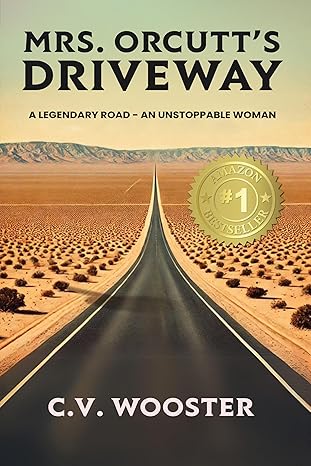

C.V. Wooster’s Mrs. Orcutt’s Driveway is a beautifully written historical narrative that centers on Margaret “Bonnie” Orcutt, a brilliant but defiant woman who built a life and then defended it in the Mojave Desert. Told with emotional depth and journalistic care, the book chronicles Bonnie’s journey from cultured harpist and biochemistry scholar in Indiana to desert homesteader fighting off a government highway project with nothing but her words and her will. It’s part biography, part environmental elegy, and part protest memoir. The prose lifts up not just Bonnie’s life, but the lives of all who resist erasure in quiet and persistent ways.
I was immediately swept away by the writing. It’s personal and poetic without being saccharine and sharp without being cynical. The author clearly adores his subject, but he never turns her into a saint. Bonnie is brilliant and fierce, but she’s also complicated, stubborn, reclusive, maybe even paranoid at times. And I loved that. The book doesn’t just build her legacy; it lets her be human. The rhythm of the storytelling shifts like the desert itself. One moment soft and reflective, the next hard and unflinching. I found myself holding my breath during Kenneth’s plane crash, and again when Bonnie faced the cold machinery of the law. And don’t even get me started on the heartbreaking detail about her planting brass nameplates in the dirt.
But what really stuck with me wasn’t the tragedy, it was the grit. The raw, unfiltered toughness of a woman who just refused to be moved. Bonnie built her adobe home with her own hands, embedded gun ports in the walls, raised fish in a desert pond, and used her typewriter like a sword. I found myself cheering for her, even when I didn’t fully agree with her methods. There’s something satisfying about watching someone hold their ground when the world expects them to vanish quietly. Wooster never loses sight of that emotional center, and it gives the book its power. It’s not just about what happened. It’s about what it meant.
If you value stories that breathe life into forgotten lives, that examine resilience without glamorizing it, that recognize the sacredness of land and memory, then this is for you. Mrs. Orcutt’s Driveway is a haunting and deeply moving tribute to one woman’s refusal to fade away. It reminded me that sometimes the biggest battles are fought by the quietest people, and that every driveway, no matter how dusty or cracked, can be a frontline.
Pages: 131 | ASIN : B0DN9R8KVN




 LITERARY TITAN