Blog Archives
The Girl in the Polka Dot Dress

Connecting the Dots takes a new look at RFK’s murder, moving from the physical evidence inside the Ambassador Hotel pantry to theories involving a possible second gunman and a wider network of participants. How did your understanding of the case change between beginning the investigation and completing the book?
My investigation started with the firm foundation of the RFK Autopsy Report by Dr Thomas Noguchi. I was directed to it by Dr Cyril Wecht. I have great respect and admiration for brave and expert professionals such as Wecht, Noguchi and Dino Brugioni (the CIA photographic expert). Then I examined as many of RFK’s enemies and political opponents as I could find. There were many. I realized early that RFK’s assassination was due to purely domestic motives and did not involve Russians or Cubans. My attention was drawn to the KKK when I researched Thane Eugene Cesar’s political leanings. I came to the conclusion that the Girl in the Polka Dot Dress clearly was there and could not understand why the LAPD were so intent on denying and covering up her existence.
What standards did you use to decide which pieces of physical or testimonial evidence deserved the greatest weight?
The evidence that appeals to an average person’s common sense deserves the most attention. The number of bullet impacts being greater than the capacity of Sirhan’s gun is easy to understand and easy to demonstrate and cross check. Once the LAPD single gunman story is demolished other explanations become more credible. The direction of Sirhan’s shots that injured 5 people were similar and completely different to the direction of the 4 shots at RFK.
What do the newly accessible government records add to our understanding of how authorities investigated Kennedy’s assassination?
RFK’s autopsy photos, declassified in April 2025 confirmed and well illustrated what was in Noguchi’s autopsy report. Many of the FBI telex messages gave insight into actions and opinions of the FBI.
What evidence would you most like to see discovered, released, or independently reexamined, and do you believe modern forensic methods could resolve any of the remaining disputes surrounding the assassination?
It would be great to find a stash of Jamie Scott Enyart’s photos taken in the Kitchen Pantry. Unfortunately, much evidence was destroyed. Many witnesses have passed away. It would be interesting if Steve DuBois, Nina Roman or even Sirhan Sirhan (all still alive) would recognize the girl in the polka dot dress from their distant memories when shown various photographs.
If all the newsreel footage and other photographs from the ballroom could be reexamined and the girl in the polka dot dress or Sirhan’s presence detected, that would be great.
Following a January 2025 Executive Order by President Trump, the federal government began a massive release of previously classified materials.
This book sets out the facts of the case that the second gunman was Thane Eugene Cesar and that Cesar’s shots were the shots that fatally wounded RFK.
This book does not argue that Sirhan Sirhan was innocent. He was intercepted by Karl Uecker amongst others. Sirhan seriously wounded 5 people with his attempts to kill RFK.
While the book does attempt to draw out the other possible conspirators it is not dogmatic in it’s approach.
Connecting the Dots – RFK


Connecting the Dots – RFK is an expansive investigative reconstruction of Robert F. Kennedy’s murder that approaches the case from almost every available angle: the events inside the Ambassador Hotel, Thomas Noguchi’s autopsy, ballistics, eyewitness accounts, Sirhan Sirhan’s history and behavior, the LAPD investigation, the Pruszyński audio recording, and the people the author believes may have formed a larger assassination network. From the beginning, the book makes its thesis clear: Sirhan fired his weapon, but he wasn’t the gunman whose bullets killed Kennedy. The author builds toward that conclusion, which gives the book the feel of a prosecutor assembling a case piece by piece. It’s also unusually current, drawing on material released in 2025 while acknowledging that the underlying sources vary in reliability and that some evidence may have been misinterpreted.
The book is at its most compelling when it stays close to the physical evidence and the people who were actually in the pantry. Noguchi’s autopsy becomes the anchor of the argument: Kennedy was struck from behind and to the right, with the fatal shot fired at extremely close range, while witnesses placed Sirhan in front of him. From there, the author layers in the disputed bullet count, damage to the pantry, the destruction of physical evidence, the Pruszyński recording, and witnesses such as Donald Schulman and Nina Rhodes-Hughes, whose accounts challenged the eight-shot scenario. The sections on the LAPD are especially effective because they connect those forensic questions with missing photographs, destroyed door frames, altered or disputed witness statements, and the failure to treat armed security guard Thane Eugene Cesar as a serious suspect.
The investigation becomes considerably more ambitious as it moves outward from the pantry. The author develops a theory in which Cesar was the second gunman, Sirhan was a willing but possibly manipulated participant, Robert Maheu served as a “cut-out” capable of organizing the operation, and the mysterious woman in the polka-dot dress may have been Klan extremist Kathy Ainsworth, perhaps accompanied by Danny Joe Hawkins. The chapters on MKUltra, hypnotist William Joseph Bryan, Maheu, Ainsworth, the White Knights of the Ku Klux Klan, and FBI infiltration of extremist groups give the book a wide historical canvas and explain how the author believes such an operation could have been assembled. These later connections are more speculative than the autopsy and eyewitness evidence, and the book itself occasionally signals that distinction with phrases such as “possible,” “likely,” and “it is not hard to imagine.” That difference in evidentiary weight is important, but it also reveals what kind of book this is: a determined attempt to connect overlooked facts, suspicious relationships, institutional failures, and unresolved questions into one coherent explanation.
What gives Connecting the Dots – RFK its energy is the author’s refusal to let familiar conclusions make the evidence feel settled. There’s an almost obsessive attention to names, positions, weapons, timelines, witness recollections, photographs, government records, and contradictory statements, and that accumulation makes the reader understand why this case has resisted closure for nearly six decades. The book will be especially absorbing for readers of assassination history, forensic controversies, intelligence history, and investigations of institutional misconduct because it gives them a large body of material to weigh for themselves. Its central achievement is that it restores uncertainty to an event whose official explanation has long been presented with certainty, then makes a detailed and forceful case for a very different reconstruction of what happened in that crowded pantry. Connecting the Dots – RFK is an unsettling investigation that makes you look again at every shot, every witness, and every official certainty.
Pages: 207 | ASIN : B0H6ZCC18F

Flawed Interviews

Queer Justice follows a defense lawyer whose young client’s explosive claim about a Supreme Court Justice draws him into a web of FBI surveillance, political coercion, and buried truths. What inspired the setup of your story?
The FBI memo I received after 13 years of FOIA litigation against the Bureau. It was buried in Director J. Edgar Hoover’s “Official and Confidential” files that he stored under lock and key in his personal office. In 1983, the FBI claimed in a letter to me that it had no files on the Supreme Court. After suing them, I unearthed tens of thousands of pages of files including the blackmail memo accusing Justice Abe Fortas of a homosexual encounter. Such an allegation, if disclosed, would destroy his career, true or not. The FBI protected Justice Fortas to gain leverage over him.
How did you decide where documented fact should end and informed imagination should begin?
The jumping-off point for the fiction was where my factual investigation ended.
What did characters such as Cake and Max allow you to explore about queer life that the official records could not capture?
The FBI files were written in Bureau speak based on an informant’s report. Nothing about their target’s humanity was included. Cake and Max allowed me to show professionals living their lives in secret because to do otherwise would subject them to prosecution and the loss of their professions.
Why was it important to extend the story into 2016 and 2021 through Mitch Jr.’s investigation?
I wanted to show how flawed interviews conducted decades after the fact might be. Also, I wanted to make the FBI own the blackmail of a sitting justice in a powerful way. A modern queer attorney picking up the investigation seemed a good way to uncover further secrets.
Author Links: GoodReads | X (Twitter) | Facebook | Website | Amazon
Mrs. Orcutt’s Driveway
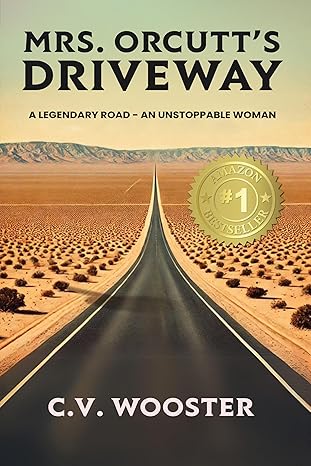

C.V. Wooster’s Mrs. Orcutt’s Driveway is a beautifully written historical narrative that centers on Margaret “Bonnie” Orcutt, a brilliant but defiant woman who built a life and then defended it in the Mojave Desert. Told with emotional depth and journalistic care, the book chronicles Bonnie’s journey from cultured harpist and biochemistry scholar in Indiana to desert homesteader fighting off a government highway project with nothing but her words and her will. It’s part biography, part environmental elegy, and part protest memoir. The prose lifts up not just Bonnie’s life, but the lives of all who resist erasure in quiet and persistent ways.
I was immediately swept away by the writing. It’s personal and poetic without being saccharine and sharp without being cynical. The author clearly adores his subject, but he never turns her into a saint. Bonnie is brilliant and fierce, but she’s also complicated, stubborn, reclusive, maybe even paranoid at times. And I loved that. The book doesn’t just build her legacy; it lets her be human. The rhythm of the storytelling shifts like the desert itself. One moment soft and reflective, the next hard and unflinching. I found myself holding my breath during Kenneth’s plane crash, and again when Bonnie faced the cold machinery of the law. And don’t even get me started on the heartbreaking detail about her planting brass nameplates in the dirt.
But what really stuck with me wasn’t the tragedy, it was the grit. The raw, unfiltered toughness of a woman who just refused to be moved. Bonnie built her adobe home with her own hands, embedded gun ports in the walls, raised fish in a desert pond, and used her typewriter like a sword. I found myself cheering for her, even when I didn’t fully agree with her methods. There’s something satisfying about watching someone hold their ground when the world expects them to vanish quietly. Wooster never loses sight of that emotional center, and it gives the book its power. It’s not just about what happened. It’s about what it meant.
If you value stories that breathe life into forgotten lives, that examine resilience without glamorizing it, that recognize the sacredness of land and memory, then this is for you. Mrs. Orcutt’s Driveway is a haunting and deeply moving tribute to one woman’s refusal to fade away. It reminded me that sometimes the biggest battles are fought by the quietest people, and that every driveway, no matter how dusty or cracked, can be a frontline.
Pages: 131 | ASIN : B0DN9R8KVN
JFK FYI

JFK FYI, by Gary B. Haley, offers a meticulously researched exploration into one of America’s most enduring mysteries: the assassination of President John F. Kennedy. Haley delves deep into the intricate details of this historic event, examining a variety of suspects and their potential motives, supported by a wealth of evidence.
This book stands out for its commitment to uncovering lesser-known aspects of the assassination. Haley’s approach includes sifting through early evidence, witness accounts, and documents, adding a fresh dimension to the well-trodden narrative of this pivotal moment in history.
While firmly rooted in historical analysis, JFK FYI transcends the typical boundaries of the genre. Haley skillfully weaves a narrative that is both informative and engaging, appealing to readers beyond just history enthusiasts. His ability to inject a sense of adventure into the recounting of these events speaks to his notable storytelling prowess. One of the book’s strengths lies in Haley’s extensive research, which is evident in the depth and detail of the information presented. He doesn’t just rely on well-known facts and evidence; instead, he delves into the pre-assassination events, uncovering new suspects and angles that have previously been overlooked. This thorough approach offers readers a comprehensive view of the assassination, encompassing both well-known and obscure details.
In JFK FYI, Haley not only shines a new light on a significant historical event but also engages readers with his compelling narrative style. The book stands as a testament to Haley’s dedication and expertise, making it a valuable contribution to the field of historical literature.
Pages: 203 | ASIN : B0CJ6HJ54H


