Blog Archives
What’s So Bad About Being Poor? Our Lives in the Shadows of the Poverty Experts
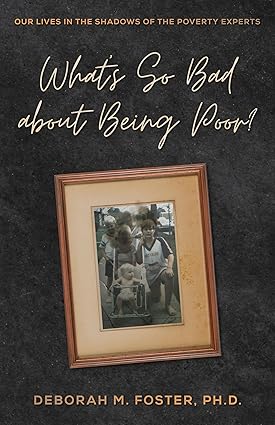

Deborah M. Foster’s What’s So Bad About Being Poor? is a gripping exploration of poverty and mental illness through the lens of her own tumultuous family history. Spanning multiple generations, the book deftly intertwines personal memoir with societal critique, offering a candid, often raw account of the struggles her family faced. Foster’s storytelling blends vivid memories, poignant observations, and biting commentary, making it both a heartfelt narrative and a call to action against systemic inequities.
What struck me most was Foster’s ability to illuminate the deep scars poverty leaves, not just on finances but on the human spirit. The opening chapters introduce us to her father, grappling with schizophrenia, and her mother, struggling with bipolar disorder. These challenges, compounded by the weight of economic instability, create an almost suffocating sense of inevitability that permeates the family’s life. One particularly haunting moment involves Foster’s father’s psychotic episode while serving in the Air Force, a turning point that sets the stage for the family’s challenges with mental health and stigma. These moments are rendered with a stark honesty that makes them both heartbreaking and relatable.
Foster’s critique of societal attitudes toward poverty is both personal and razor-sharp. She targets the toxic ideologies of figures like Charles Murray, whose dismissal of poverty as “not so bad” fuels her lifelong determination to counter such views. The book cleverly juxtaposes Murray’s theoretical musings with Foster’s lived reality, exposing the absurdity of detached policymaking. Yet, the book isn’t all gloom. Foster finds moments of resilience and even humor in her family’s chaos. Her descriptions of her mother’s encounters with eccentric faith healers or her father’s UFO theories add a surreal, almost darkly comedic layer to the narrative. These anecdotes, while strange, serve as a reminder of the lengths people will go to find meaning and hope in desperate circumstances. Foster’s ability to weave these lighter threads into her otherwise heavy tale is a testament to her skill as a writer.
What’s So Bad About Being Poor? is as much a memoir as it is a rallying cry. Foster’s journey from a poor, marginalized child to an academic fighting against the very systems that oppressed her family is inspiring. This book is for anyone who wants to understand the lived experience of poverty beyond the numbers and policies. It’s for those who appreciate a narrative that is as fiercely intelligent as it is deeply personal. For me, it was a stark reminder of the resilience of the human spirit, even in the face of unimaginable hardship. Highly recommended.
Pages: 418 | ASIN : B0CQJ3K8SH

Deadly Dilemma: A Memoir
Anthony Gurley’s Deadly Dilemma is a raw and intimate memoir that explores the tumultuous emotional journey of a man grappling with his past, his fears, and his place in the world. From his childhood in a poor North Carolina housing project to his struggles with self-worth and his attempts to reconcile with faith and family, Gurley paints a vivid portrait of his life. The story begins with a poignant letter that sets the tone, one of unvarnished truth, pain, and introspection, before taking the reader through a labyrinth of formative moments, personal trials, and eventual reckonings.
What I liked most about the book was Gurley’s ability to convey vulnerability without self-pity. The letter at the beginning is a gut punch, laying bare his struggles with depression and fear. As he recounts his childhood memories, such as a terrifying encounter with Hurricane Hazel or his days playing sports at the Boys Club, Gurley brings a sense of nostalgia tinged with melancholy. These anecdotes felt relatable, especially his longing for recognition and connection. His descriptions of trying out for the basketball team and the heartache of not making it are heartbreakingly universal moments of rejection that linger long after adolescence.
At times, Gurley’s narrative meanders, pulling the reader into minute details of his early years or internal thoughts. While this makes the book deeply personal, some passages felt overly detailed and repetitive. For example, his recounting of ironing clothes and relating it to a George Washington Carver biography is insightful but I think it could have been condensed. That said, this unfiltered style makes the memoir feel like a candid conversation with the author, one where he is unafraid to show every bruise and scar.
I appreciated Gurley’s reflections on his relationship with faith and community. His introduction to Quakerism and his attempts to find solace in religion add depth to the book. However, the most powerful sections for me were his examinations of family. The story of his father leaving when he was a child, coupled with his own feelings of inadequacy as a parent, hit me hard. It’s in these moments that the memoir transcends its specific context and becomes a universal exploration of loss and resilience.
By the time I reached the conclusion, I felt both drained and inspired. Deadly Dilemma is not a light read. It forces the reader to confront uncomfortable truths about fear, loneliness, and the human need for love and belonging. I’d recommend this book to anyone who enjoys deeply personal memoirs that wrestle with life’s big questions.
Pages: 318 | ASIN : B0CQ6GXGRW

From Deep Within: A Clinical and Forensic Psychologist’s Journey
Susan J. Lewis’ From Deep Within: A Forensic and Clinical Psychologist’s Journey offers an intimate and enlightening exploration of her career as a practicing psychologist. Part memoir and part professional reflection, the book begins with Susan’s early life and the path that led her to the field of psychology. From there, it shifts focus to her encounters with various patients, offering detailed accounts of both individual and group therapy sessions. She candidly discusses the challenges and breakthroughs she experienced, providing readers with a rare glimpse into the emotional complexities of working in forensic and clinical psychology.
The book’s core lies in Susan’s vivid depictions of her patients, each presented with care and nuance. Through these accounts, Susan illustrates the intricate dance of building trust and forging connections, often against significant odds. In group therapy sessions, she describes the collective dynamics, highlighting the initial states of her patients and the progress they achieved. One particularly compelling example involves the “Blackjack group,” where Susan’s persistent effort to introduce games that resonated with the participants ultimately revealed their preferences and opened pathways for engagement. Similarly, her experience with Vicky—a patient who initially resisted interaction—shows the power of patience and empathy. Their eventual bond, centered on Vicky’s tattoos that told her life story, exemplifies the breakthroughs possible when psychologists find unique ways to connect.
The memoir also delves into the emotional toll of the profession. Susan is refreshingly honest about her struggles with empathy, especially with challenging patients like Michael and Ruth. These moments underscore the human side of psychology, revealing the internal conflicts practitioners face while maintaining professional boundaries. Susan doesn’t shy away from discussing the unpredictable and sometimes volatile nature of her work, as demonstrated by her experiences with patients like Kristen. The book’s structure, divided into sections based on individual patients or groups, enhances readability. This organization allows readers to navigate the text with ease and focus on specific stories. Susan’s reflections, woven throughout the narrative, add depth and make her journey relatable.
From Deep Within is a thought-provoking memoir that offers valuable insights into the challenges and triumphs of forensic and clinical psychology. Susan J. Lewis writes with authenticity and compassion, making her journey as engaging as it is educational. This book is a must-read for anyone interested in the psychological field or for those curious about the human stories behind mental health care.
Pages: 217 | ASIN : B07L3WSM3C
Transformational Betterment

I’m Not Dead…Yet shares your journey through the adversities of cancer, addiction, mental health struggles, and time in prison, ultimately leading to self-acceptance and redemption. Why was this an important book for you to write?
For several years, I’ve had a few different thoughts and ideas for writing manuscripts, but the one story I felt would be the most difficult to write was the story of my own life. I say this because, it is obviously so close to my heart and so raw, that a potential rejection of the book itself could easily be construed as a rejection of myself. For this and several other reasons, I had to make sure that I was removed from these past atrocities of my life just enough to ensure I wasn’t re-traumatizing myself and could bear the possibility of being judged. I made the “mistake” of trying to write this memoir a few years ago. I would start writing and soon after start weeping so badly I couldn’t see the page in front of me. This happened a few times, and I refused to relent because in my heart I knew there would be other people out there who could benefit from my story. This is the main reason why I knew it had to be written. Also, I wanted to get my “toughest” story out into the universe so that I could begin the process of writing those other stories I’ve wanted to complete. In my mind, I thought, if I can make it through this memoir, I can make it through anything else I decide to write.
I appreciated the candid nature with which you told your story. What was the hardest thing for you to write about?
I wish I could whittle it down to just one thing. The truth is, there are a few different scenarios that were very difficult to write about. It’s one thing to generally talk about hard times with people I know during a conversation. It’s much harder to reveal the details of these situations to complete strangers, most of whom I will never meet. This is especially so for the most intimate details that have scarred my soul, yet make me the person I am today. In the end, the potential reward of helping others have hope weighed more heavily than the potential for embarrassment and rejection.
What were some ideas that were important for you to share in this book?
Outside of the litany of situations that contributed to a deleterious cycle in my life, I felt it was just as important to imbue some humor when appropriate — at least my hope is that it comes across as appropriate. Also, I felt it was important to show that transformational betterment is possible, no matter how bad things get for us. It’s not easy to change for the better, but it is absolutely necessary and crucial for us to survive and flourish. I also feel very strongly that people need as many chances as possible to make things “right” for themselves and those they may have hurt. For this reason, I don’t believe in “second” chances; but instead, take every failure as an opportunity to become closer to the change I want and need, no matter how many times it takes to make the change stick in the long term.
What do you hope is one thing readers take away from your story?
Everyone has a past. Everyone must endure hardships, no matter who we are. While I’ve likely experienced more difficulties than the typical person out there, that doesn’t make me better than anyone else. No matter what we must endure in life, there is always hope and opportunity for betterment, and I am living proof of that. Bottom line: don’t ever give up on yourself.
Author Links: GoodReads | X(Twitter) | Facebook | Website | Amazon
This memoir is an open invitation into Joshua’s life, a connection point for those facing or who have faced similar hardships, and a beacon of hope and empowerment for anyone in need of strength. Through his experiences, Joshua illustrates that despite monumental setbacks, it is possible to emerge stronger and more resilient.
Readers will glean valuable insights into the power of resilience, the lessons inherent in adversity, and the importance of self-acceptance free from judgment. Joshua’s narrative offers coping mechanisms for societal taboos, strategies for managing mental and physical health challenges, and a profound message about the significance of self-acceptance.
As a cisgender, gay Puerto Rican survivor, Joshua’s perspective is both unique and universal. His memoir speaks to individuals seeking inspiration, understanding of the human condition, and guidance on navigating various challenges, especially those within the LGBTQ+ community.
The writing style is marked by maturity, heartfelt introspection, vivid descriptions, and relatable anecdotes that evoke a spectrum of emotions. Themes of survival, empowerment, overcoming adversity, self-discovery, and the journey toward self-love and acceptance resonate throughout the narrative.
While there are other books covering similar topics, “I’m Not Dead…Yet” distinguishes itself as a deeply personal account that resonates on a profound level. Joshua’s memoir is not just a story; it is a testament to the resilience of the human spirit and the transformative power of embracing one’s truth.
For readers seeking solace, inspiration, and the courage to confront their own challenges head-on, “I’m Not Dead…Yet” is a must-read. Joshua’s memoir is poised to make a meaningful contribution to the literary landscape, offering hope and healing to all who turn its pages.



 LITERARY TITAN