Blog Archives
The Urantia Revolution 200,000 BC
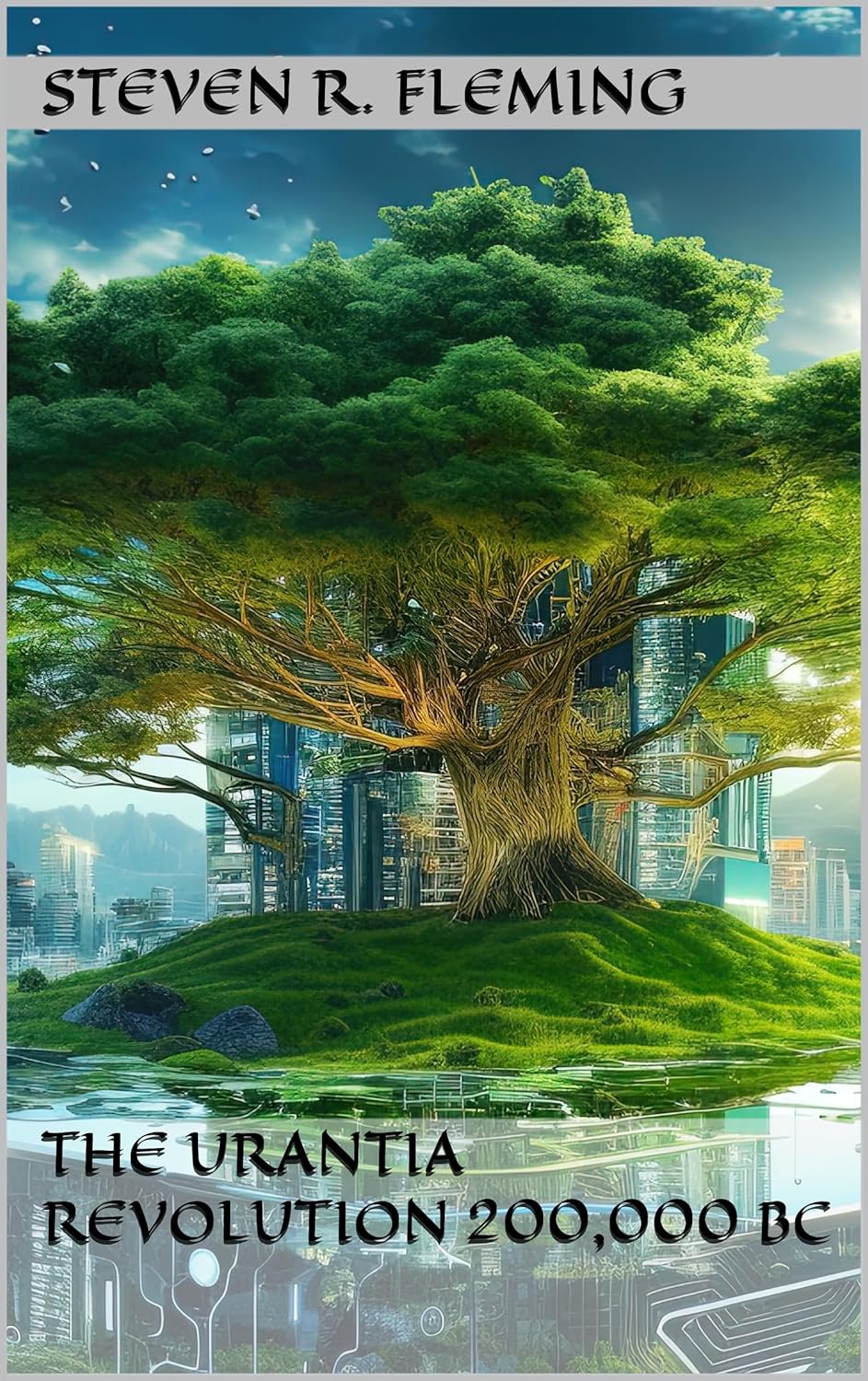

The Urantia Revolution 200,000 BC by author Steven R. Fleming follows Mendal, a young and underqualified Life Carrier, who becomes the unlikely third in command to Caligastia, the Planetary Prince of Earth, under the watch of the icy System Sovereign Lucifer. Around him move Lisa, Don, the tribal woman Fay, and a whole cast of celestial bureaucrats and early humans as Earth’s first civilizations take shape. The core of the story is Mendal’s delayed choice between Lucifer’s rebellion and the loyal “government of Michael,” a decision that will lock in the spiritual fate of the planet, ripple through primordial tribes around Dalamatia, and eventually spill forward into the life of a modern man named John Brueggemann who carries Mendal’s unfinished work inside him.
The book is big and ambitious in a way that I ultimately found quite charming. The opening chapters in space and at the Academy hooked me right away, and the scenes in the Life Implantation Laboratory, the shimmering city of Dalamatia, and the tribal world around Fay feel vivid and cinematic. These are helped by rich visual descriptions and the art pieces scattered throughout the book. The stakes are always high, and it’s clear that Fleming enjoys playing in a huge creative sandbox. The prose leans into a kind of operatic melodrama, with intense stares, clenched jaws, and booming speeches, which gives the story a larger-than-life, almost theatrical energy. Dialogue sounds like formal council addresses rather than casual talk, and that gives some emotional scenes a stately, ceremonial tone. The pacing is lively and unpredictable, with some stretches of day-to-day life in Dalamatia or the tribes moving quickly, while longer discussions about policy and loyalty invite you to slow down and sit with the ideas. I kept turning pages, curious to see what bold twist or striking image would come next.
What really stayed with me was the mix of ideas the story keeps throwing at you. The book leans on Urantia cosmology and uses it to pose some very human questions. Mendal’s reluctance to decide, Lucifer’s “majorities rule” argument, the Court of Appeals, the strange creature Zee, the brutal personification of the Rage of Lucifer, and finally Mendal’s rebirth as John all circle the same themes: What does free will look like when the stakes are cosmic, why is evil allowed to run, and how much weight does one soul really carry in a universe full of beings. The theology and the action snap together cleanly, and I felt a jolt, especially in the scenes where Mendal is torn between fear, love for Lisa and Fay, and a very raw sense of responsibility he didn’t ask for.
I would recommend The Urantia Revolution 200,000 BC to readers who enjoy spiritually flavored science fiction, who are curious about Urantia teachings, or who simply like high drama set against prehistory and outer space at the same time. If you are open to a cosmic soap opera that takes its metaphysics seriously and wears its heart on its sleeve, this book offers a wild ride and plenty to think about afterward.
Pages: 191 | ASIN : B0GP51Q4PB

Mirrors of Humanity
Terra Secundus follows a war-weary journalist sent to Titan, where humanity’s quest for discovery collides with its oldest flaws: ambition, control, and the fragile meaning of being human. What inspired you to set Terra Secundus on Titan rather than another world or moon?
In my exploration of the world of science fiction, I often encountered situations where many famous writers with multiple awards and nominations set their novels on many planets of the solar system and seldom on any satellites of the gas giants such as Jupiter, Saturn, Uranus, and Neptune. Before I decided to place my protagonist in a new world, I carefully studied the science literature about the possibilities of colonizing moons and planetoids orbiting the gas giants. Saturn’s moon Titan was a very strong contender for such an endeavour, and after studying everything I could about that unique moon, I decided to send my protagonist there, since Titan is considered a good candidate for a colony. Many scientists believe it could become a smaller version of Earth, since Titan has a thick atmosphere composed of nitrogen and other gases. Add oxygen to it, and humans could theoretically breathe its air.
The novel’s tone feels both futuristic and nostalgic. Was that a conscious stylistic choice to evoke classic science fiction?
I love classic science fiction novels and my exploration into this literary genre started with many memorable books by Ben Bova, Issac Asimov, Ray Bradbury, Arthur C. Clarke, Frank Herbert, Allen Steele, and Robert Heinlein. When writing about a future removed from our time more than 1,200 years, I tried to imagine a future society of the 32nd century to develop amazing new technologies and modify its social and religious beliefs. In this novel, I tried to use a classic style of storytelling, because for most readers it is much easier to understand. I believe that every society must learn from the past experience and try to avoid repeating tragic mistakes that led to the fall of ancient civilizations and magnificent extinct cultures. The roots of the future are in the present, and I hoped to tell this story in such a way as to entertain and educate my readers about the fascinating distant worlds, new technologies that border on magic and what it means to be human.
How did you approach writing the Artborn androids like Erika, as characters, machines, or mirrors of = humanity?
Interesting question. I like robots. Even as a kid, living in a different society during the Cold War, I liked all science fiction movies that featured cyborgs and robots. Since those days, robotics and and cybernetics both made giant strides forward, and now we see many cybernetic models starting to imitate humans. We are also witnessing the radical advances in Artificial Intelligence and autonomous systems that help us to explore other places and other planets. My approach to such characters as Artborn Erika was both scientific and philosophical. In my story, Artborns are advanced synthetic humanoids that were created to assist humanity, working in most dangerous places in space and underwater. They are essential mirrors of humanity and in some ways are better than us when it comes to programmed mission parameters and sense of duty. In my novel, androids like Erka are employed as explorers, personal servants and bodyguards but they can certainly do much more than that.
If Paul Rexton were alive today, what story would he report on Earth in 2025?
If my protagonist, Paul Rexton were alive today, I believe that he would be deeply fascinated, intrigued and disturbed by the Earth in 2025. His world is certainly very different from ours in many respects, but he would be able to understand our world and form his own unbiased opinion about it. He would no doubt be pleased about the technological progress and human rights, Very concerned about environmental pollution and deeply affected by the fact that there are still powerful evil forces exist on the planet, making life difficult for their neighbors and many other countries. He would no doubt be fascinated by our means of mass entertainment and our taditionsl and electronic libraries of vast human knowledge that contain many centuries of wisdom. I would imagine Paul Rexton standing on a hotel balcony in a quiet and beautiful Japanese village, visiting the beautiful museums of Europe or enjoying a good book at home with a glass of old, smooth, wellaged brandy.
Author Links: GoodReads | Amazon
Invisible Tragedy

Driven follows a woman recovering from the brink of madness who discovers a man is searching for unammi survivors to experiment on, and humans are being kidnapped, leaving her determined to find a way to save them all. What was the inspiration for the setup of your story?
Our own world is beset with social issues. I wanted to take these two—slavery and medical experimentation on living beings (humans and animals)—and kind of push them into the reader’s face, so that they couldn’t be ignored. Slavery, also known as “human trafficking” or “sex trafficking,” takes place every day, but for those of us who are insulated in privilege, it’s an invisible tragedy and easy to overlook.
It’s the same with the experimentation; though that’s a bit harder to see in contemporary civilization, it’s definitely there, hidden behind closed doors and shuttered windows. Because we don’t see these problems, it’s easy to pretend they don’t exist.
There are many ways to fight these issues, not all of which are as bold as Alira’s choices. But here’s the thing: if we don’t face them with unflinching outrage, they will never stop.
Regardless of the methods we choose with which to fight, no one person can solve all these problems. Not alone. Yet even though one person can’t save everyone, they can help a few. And that can start a larger movement.
Alira is that person, the one who saves those she can reach. She’s already gone through so much; she is the unflinching (okay, she does flinch on occasion, but it doesn’t stop her from moving forward) individual who says, “If not me, then who?”
Alira is a fascinating character. What scene was the most interesting to write for that character?
That’s a tough choice. Alira’s whole character arc is so tightly woven that choosing a single scene as “most interesting” is like trying to choose a single favorite thread in a completed tapestry. And Alira has her peak moments in each book in this trilogy.
For Driven, I lean toward one of Alira’s “rescue” scenes—either of Bika (which has two parts, the rescue and the aftermath), the ikanne harvesters, or the brothel slaves. Each of those times gave Alira’s spur-of-the-moment creative problem-solving skills room to shine.
I find that authors sometimes ask themselves questions and let their characters answer them. Do you think this is true for your characters?
Definitely. Sometimes, their answers surprise me.
But at least one major focus of my writing is to ask big questions, sometimes even the ones we don’t want to face. I think The Founder’s Seed trilogy manages to do that. I feel like Alira’s answers to those questions came from a courageous heart and a strong spirit.
Where do you see your characters after the book ends?
Oh, their story continues in the coming follow-up trilogy, tentatively titled Nexus. That trilogy will be told through the eyes of non-POV characters that were introduced in The Founder’s Seed, but Alira, Botha, and Galen/Thrace will all be there. We see the start of that at the end of Driven, in the new secret colony Alira and Kilbee have established.
Stay tuned.
Author Links: GoodReads | Facebook | BlueSky | Website | Niveym Arts | Amazon
On Danua, acting Clan Admiral Knøfa experiments on his unammi prisoner. Except the squib isn’t healing any longer, and the medics aren’t working fast enough to save her. Knøfa starts searching for another unammi—maybe a male this time, so he can create all the test subjects he wants.
Stopping the Cartel is enough to keep Alira’s hands full. She doesn’t want to fight the Clan, too. Yet, when she learns Knøfa is searching for the unammi survivors, she races to warn them. As Knøfa’s ship approaches them on Earth, the council tries to force it to leave. But Alira knows that if the humans escape, the unammi are doomed. Knøfa’s “experiments” will escalate, and other humans will follow his example. To protect her people’s secrets, she must stop that ship. Her only hope is to attempt something no Founder’s Daughter has ever done.
A Broader Canvas
Broken centers around a shapeshifter plagued by the chaos of living as a human and enduring her own lost sense of self. What was the inspiration for the setup of your story?
I have to admit that my own experience has partly led to Alira’s story. While I don’t have dozens of voices in my head (other than the characters in my stories, that is), I always felt like an outsider among those around me. It took me many years to find my tribe, and to reach a place in my life where I felt I could be myself and not struggle to fit in.
I’ve known many others like this, and it’s hard. For all of us. Struggling to be the kind of person you think others expect of you can be soul-draining. That’s what started Alira’s tale for me. From there, it took off on its own.
What is it that draws you to the science fiction genre?
I like science fiction because it allows me to stretch reality in ways that drive home the point of the story. I feel like The Founder’s Seed books could also be called science fantasy, since there are elements of it (the harvesting of souls, for one) that can’t be supported by science. But these genres expand the boundaries of what is possible or probable, and allow the reader a greater leeway for suspension of disbelief.
My stories usually ask big questions; so far, science fiction and science fantasy have both offered a broader canvas for that work.
Do you have a favorite character in The Founder’s Seed series? One that his especially enjoyable to craft?
Of course, Alira is my favorite. She’s me in so many ways that count. She’s definitely the hardest to write, but also the most rewarding.
A very close second favorite is Botha; he’s a joy to write! Putting myself in his head, so that I can write him with authenticity, is always fun!
Where will the next book in the series take readers? When can we expect to see it released?
The next book, Driven, picks up where Broken left off; it gives a closer—and thoroughly raw—look at the new antagonist, Knøfa; follows Alira’s journey through her time with Botha, and what comes after (no spoilers!); settles Thrace/Galen in her/his role; and sets the threads for the follow-up trilogy that is already in the works.
Driven was released in late June and is now available for readers.
Author Links: GoodReads | BlueSky | Facebook | Website | Amazon
To make matters worse, the harvests of knowledge and memories she’s gathered from the dead aren’t adequate to fully understand her assumed role—unless she surrenders control to the one internal voice she thinks can make things right. But that harvest isn’t willing to share the space in her head, and soon Alira is no longer sure which voice is his, and which is her own.
Galen has vowed to help Alira succeed and follows her increasingly unbalanced directives, until he realizes that her harvests have corrupted her conscience, maybe even her sanity. Galen has never been a leader. But as the crisis screams toward them, he must make a choice: abandon their people to save Alira or sacrifice her to save them all.
Driven: The Founder’s Seed Book 3
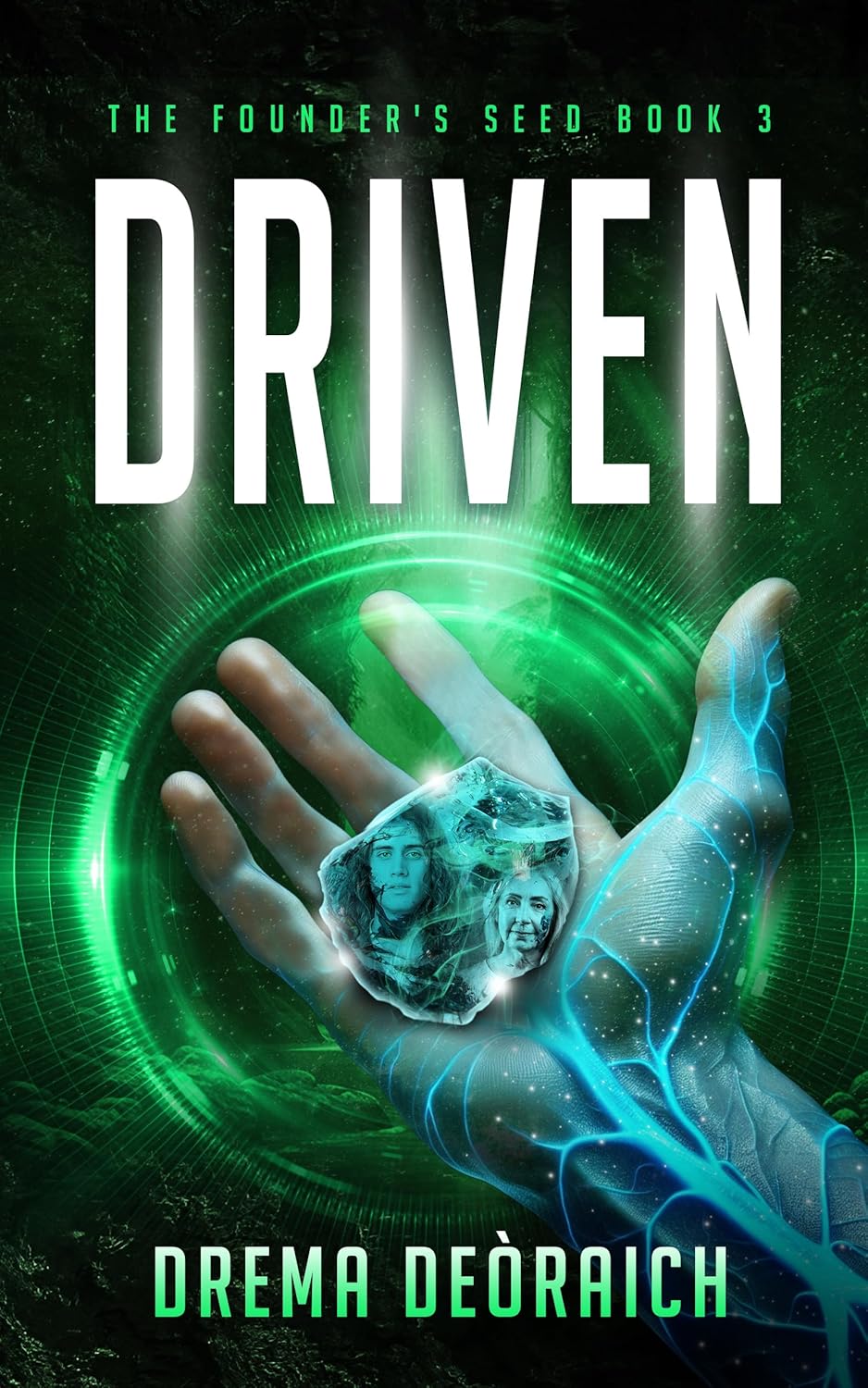

Driven is the third installment in The Founder’s Seed series, continuing the riveting saga with even higher stakes and deeper revelations. The book pulls you straight into a galaxy alive with politics, betrayal, and fragile alliances. Admirals, traders, and hidden survivors of a nearly lost people clash in a world where loyalty is currency and compassion is weakness. At the heart of it all are Alira, still wrestling with her fractured self, Botha with his quiet wisdom, and Thrace carrying the burden of leadership under constant threat. The novel moves between brutal experimentation on the mysterious Iridosians, tense negotiations among rival factions, and deeply personal struggles for survival. It is a story of ambition, cruelty, resilience, and the thin thread of hope that refuses to snap.
Reading this book stirred a mix of awe and discomfort in me. The clinical coldness of Knøfa’s experiments made my stomach twist, yet I couldn’t look away. The writing is vivid, even when it’s painful, and that’s part of its power. I found myself admiring the author’s willingness to go dark, to show how curiosity can turn into obsession, and how power can warp good intentions. At the same time, the quieter moments between Alira and Botha gave me room to breathe, to feel the warmth of trust slowly taking root in frozen soil. Their scenes lingered with me, like a candlelight after the storm.
There are a lot of moving parts here. Political factions, shifting alliances, plots within plots, and it took me a while to sort through them all. But once I settled in, I found myself hooked. The author doesn’t coddle the reader. She trusts us to keep up, and I respect that. What I loved most was the emotional honesty tucked between the battles and schemes. Fear, hope, guilt, tenderness, it all feels raw and real, even in the middle of starships and alien physiology.
Driven left me both unsettled and uplifted. It’s a rewarding read. I would recommend it to readers who enjoy science fiction with grit and heart, to those who don’t shy away from moral grayness, and to anyone who loves stories that ask what survival truly costs. If you like your space operas full of high stakes but also deeply human at the core, this book will leave a mark.

Broken: The Founder’s Seed Book 2


When I opened Broken, I was immediately pulled into a world brimming with tension, betrayal, and the complicated weight of carrying other people’s lives inside your own head. Drema Deòraich’s story follows Alira, Galen, and Thrace as they navigate shifting identities, political intrigue, and the brutal cost of survival among human and unammi factions. The author builds a layered tale of power struggles, loyalty, and moral compromise, where every choice feels like a thread tugging at the larger web. The book is about what it means to stay whole when you are forced to fracture yourself for the sake of others.
The writing has a pace that rarely lets up, and the dialogue carries a sharpness that feels lived-in. The shifting perspectives, the sudden bursts of violence, and the moments of quiet reflection all come together to create a rhythm that feels alive. At times, the narrative voices inside Alira’s head became almost overwhelming to read, but I realized that was the point. It mirrored her chaos, her crowded sense of self. I found myself admiring how boldly Deòraich leaned into that confusion, refusing to make it easy for the reader, because life inside a fractured mind is never easy.
Beyond the writing, I was moved by the book’s ideas. Questions about identity, about whether survival justifies the blood on your hands, and about how much of yourself you can give away before there’s nothing left. I was thinking about these ideas for a long time afterwards. I felt both sorrow and admiration for Alira. Her choices often frustrated me, yet I couldn’t help but ache for her struggle. The themes of slavery and exploitation, woven into the politics of the factions, hit me hard. They were ugly and uncomfortable, and that’s exactly why they mattered. Deòraich didn’t flinch from showing cruelty, and in that honesty, the book had teeth.
Reading Broken reminded me of Frank Herbert’s Dune in the way it blends political intrigue with questions of identity and survival, but it feels more intimate and raw, pulling me closer to the characters’ inner battles. I’d recommend Broken to readers who love science fiction that challenges them. If you like tales that balance heart with grit, that mix character-driven drama with political maneuvering, this book is more than worth your time.
Pages: 420 | ASIN : B0DLTLQMQP
A Pivotal Lens

Trace of Arcane follows a teenage girl navigating life in a fractured society as she struggles to find autonomy while facing the pressure of the coming ceremonial passage. What was the idea, or spark, that first set off the need to write this novel?
What drew me to this story, and to Eden as a protagonist, was the challenge of portraying the neurotype colloquially known as psychopathy with nuance and texture. Over four years, I had extended conversations with individuals living with this form of neurodivergence. I wasn’t interested in the usual caricatures. I wanted to understand them not as villains, but as whole, observant, complex human beings. Eden’s voice emerged from those conversations, and Trace of Arcane became a space to explore deeper questions around conscience, survival, and the systems we live within.
Early on, I noticed that many neurodivergent individuals don’t automatically adopt social structures the way neurotypical people often do. Instead, they examine these systems critically and only mirror them to the extent necessary to avoid social exclusion. This observation made me reflect on the psychological mechanisms embedded in our institutions—religious, political, and cultural. These structures often act as filters, helping people manage the complexity of life. But for those with shallow affect or atypical emotional processing, these filters don’t function the same way. They mimic them, rather than experience them. That dissonance opened up new questions for me: about belonging, about power, and about how easily such systems can be co-opted to marginalize outgroups or consolidate control.
I also did not want the views of the neurodivergent characters to remain unchallenged within the story. Around that time, I came across the work of Dr. Zoran Josipovic, who has studied the brains of meditating monks and found heightened activity in the prefrontal cortex—the part of the brain associated with empathy. By contrast, researchers like Dr. James Fallon have shown that in psychopathy, this same region is often underactive during decision-making. That contrast fascinated me. It felt like the two neurotypes (even though those who have meditated for many years are not a neurotype) were engaging with the world in fundamentally different ways, and I wanted to explore what might happen when they collided.
This led me to dive into monk-centered spiritual teachings, which eventually inspired the creation of other key characters—individuals whose worldviews would directly challenge the neurodivergent characters within the story. Their interplay became a core tension not just in Trace of Arcane: Viridis, but across all three novels in the series.
The science inserted in the fiction, I felt, was well balanced. How did you manage to keep it grounded while still providing the fantastic edge science fiction stories usually provide?
My primary focus wasn’t on science fiction in the traditional sense. My attention was on the social and psychological structures people use to navigate the world—institutions, belief systems, hierarchies—and how those structures shape identity, belonging, and power. The science in Trace of Arcane: Viridis emerged as a secondary layer, more as a tool for exploring those dynamics.
The story follows a neurodivergent girl trying to cope within a fractured, post-apocalyptic world, and I was more interested in her internal logic: how someone with her cognitive wiring might perceive and respond to systems that often demand emotional conformity. That lens helped keep everything grounded. The speculative elements are there, but they’re tethered to real-world dynamics and grounded human experience.
In Book Two, I do lean further into the science behind the fiction—especially in terms of technology, cognitive science, and surveillance systems—but even then, it’s all in service of the characters and the ethical questions they’re grappling with. The “fantastic edge” becomes sharper as the story unfolds, but it’s always rooted in something psychologically or politically real.
What was one scene in the novel that you felt captured the morals and message you were trying to deliver to readers?
There’s a scene early in the novel where Eden recalls using a hidden path to avoid Amaia’s constant lectures on respect. At first glance, Eden comes across as brash and disrespectful, especially in how she speaks to characters like Amaia, and I wanted the reader to sit with that impression. But as the story unfolds, we begin to see Eden’s inner world more clearly. That scene becomes a pivotal lens: Eden isn’t reacting; she is mirroring.
She sees adults demanding respect without offering it, and when she reflects their tone back at them, she’s punished for it. There’s a line where she thinks, “If she hates it so much that I mimic her, then why not change to the behavior she wants reflected?” That moment, to me, captures the core moral tension of the book: Eden is labeled as the outsider, the disrespectful one, but she’s actually holding up a mirror to a society that is itself contradictory and hypocritical.
This becomes a quiet call to the reader: when we encounter something in someone else that unsettles or irritates us, what does that reaction reveal about us? Eden challenges the social norms around her not by preaching or resisting outright, but by reflecting them back. The discomfort that causes isn’t a flaw in her—it’s a diagnostic of the world she lives in.
That’s the heart of Book One: Eden is learning, engaging, adapting—and in doing so, forcing others (and the reader) to confront the assumptions they live by.
What is the next book you are working on, and when will it be available?
Having finished the Trace of Arcane trilogy, the next book I’m working on is called Angel of Death. It follows Azrael, a character introduced in Trail of Arcane: Book Two of the Trace of Arcane series, and dives deeper into his journey: before, during, and beyond his interactions with Eden. While Trace of Arcane was focused more on societal structures and psychological dynamics, Angel of Death leans further into the science of the science fiction. It explores the technologies, surveillance systems, and hidden architectures of power that govern the post-apocalyptic world.
At its core, Angel of Death is a character study about a teenager who begins as an idealist, committed to truth and justice, but slowly transforms into someone willing to break the very rules he once upheld in order to expose systemic injustice. As society fails to respond ethically, and as the costs of truth-telling mount, he becomes increasingly disillusioned. His ideals fracture. Inevitably, he learns about what it means to evolve without losing oneself.
It’s a more expansive story in some ways: technically intricate, politically charged, and emotionally layered. It also offers a more grounded, hard science-fiction tone, exploring how systemic forces can shape a person into exhibiting behaviors we label as psychopathic—while still holding a mirror to the systems that create those very outcomes.
As for the release date, I’m currently deep in the writing process and will announce more details soon. But if Trace of Arcane asked what it means to survive within broken systems, Angel of Death asks what it means to resist them, and what it costs to do so.
Author Links: GoodReads | Amazon
Book One of the Trace of Arcane Series
Trace of Arcane follows Eden, a neurodivergent girl born in Viridis—a remote Fringe society resisting the quiet rule of Lux, an authoritarian power that rose from the ruins of a lost civilization. Lux controls history, suppresses knowledge, and manipulates the Fringe societies through fear, rumor, and erasure.
From a young age, Eden knows she’s different—not in a way that draws admiration, but in a way that draws suspicion. Her mind works differently: precise, emotionally detached, and deeply observant. To survive, she learns to hide it, to mimic what others expect. To pass.
As tensions rise and Lux’s control creeps closer, Eden begins to question the systems around her—who controls truth, who gets to belong, and what is sacrificed to keep the peace. When a forgotten archive is discovered by a society called Arcane, Lux ignites conflict in the Fringe societies before Arcane can share their knowledge with the rest of humanity.
Set in a post-apocalyptic future where memory is controlled and difference is discouraged, Trace of Arcane is the first in a character-driven sci-fi trilogy. More introspective than explosive, it’s a slow-burn story about power, perception, and what it means to live honestly in a world that asks you to disappear.
Human Stupidity
Endless Fall of Night follows a woman who is convicted as an insurrectionist and sent to prison, where she is compelled to join a mission to discover what has happened to the Martian colony that has gone dark and left severed heads in its wake. What was the inspiration for the setup of your story?
The set up was the novella Heart of Darkness by Joseph Conrad. Similar to that work, I wanted to show how the human condition and society has not changed much whether it is a Belgium Company’s outposts along the Congo River in Africa in 1899 or a US Swift Boat going up the Nung River in Vietnam in 1969, human emotions and behaviors construct our present day of 2025 and sets the stage for a future like 2126.
What are some things that you find interesting about the human condition that you think makes for great fiction?
Themes around prejudice, racisms, fascism, misogynistic and misanthropic bents will still be challenged by courage, strength in community and resilience are all part of being human. It is the journey that makes us. It is the discomfort and challenges that forge who we are.
What were some themes that were important for you to explore in this book?
Of all the themes presented, human stupidity is the focus of this story as defined by Carl Jung – blaming others for own flaws, inability to self-reflect, rigid thinking and dogmatism, lack of empathy and emotional intelligence, overconfidence without competence and repeating the same mistakes without learning.
Will there be a follow-up novel to this story? If so, what aspects of the story will the next book cover?
The Heavy Weight of Darkness, published in September 2024 follows one of the antagonists tasked with terminating the heroine, and then finds himself transformed.
Author Links: GoodReads | Instagram | Website | Second Website
Based on Joseph Conrad’s Heart of Darkness, we see our future that shows striking similarities to this age of imperialism, classism, and capitalistic expansion where racism is commonplace, slavery exists, and a minority of people are in absolute power. Instead of Belgium Company’s outposts along the Congo River in Africa in 1899 or a US Swift Boat going up the Nung River in Vietnam in 1969, this is the great Third Republic on Earth and colonies on Mars in the year 2126.
Cassandra XI, patrician and first-class citizen, is exposed to a traumatic experience that later has her questioning the established social order. She is eventually tried and convicted as an insurrectionist, her personal AI deactivated, social status and titles revoked, and she is sent to prison. Cassandra is then approached by Captain Willard Bennett of the light cruising ship the Jefferson Davis to investigate why the Martian colony New Georgia went dark, leaving severed heads on spikes and the message “Bring Cassandra Kurtz.”
With no choice but to go, Cassandra’s life is about to change in unimaginable ways.


