Blog Archives
Christianity and Global Civilization

Conflict & Peace explores the struggles of twelve Biblical figures and their contributions to Christianity as it is known today. Why was this an important book for you to write?
Growing up as the son of a pastor, my Christian faith came to me as a young child. Growing into early adulthood, like many I came to question my faith. Seeing obvious (and less obvious) seeming inconsistencies in the Bible, I focused in on the often accepted but unspoken assumption that there is a complete harmony of the various gospel and other biblical accounts. For me, the breakthrough came when I realized that “harmonization” is nowhere mentioned in the Biblical text. Rather, I could take the approach of taking in whatever each biblical author has to say in that individual’s own voice. Accept and explain the conflict where possible. And where not, just let it be.
How much research did you undertake for this book, and how much time did it take to put it all together?
I have been at the research off and on for about 30 years – reading a wide range of authors, interacting as a teacher in a variety of one-on-one and group settings.
What were some themes that were important for you to explore in this book?
Once I got past the issue of forced harmonization, my next question and key theme for the book was the divine and earthly roles that Jesus of Nazareth played in observing, creating and/or resolving conflict. And then tracking how these conflicts of personality, theology and mission were experienced by the diverse characters that helped shape Christianity and global civilization.
What is one thing you hope readers take away from Conflict & Peace?
I hope that readers can draw from the experience of inevitable conflicts driving Christian pioneers to search out pathways for renewed peace. Day by day and at home with Jesus.
Author Links: X | Facebook | Website
In this book, author Eric Hovee traces a seemingly never-ending Christian dialogue and practice that may espouse peace but often engages in conflict. The author explores this interplay through the lives, beliefs, and practices of 12 pioneers who helped shape Christianity as it has been handed down to us today. We begin with the contrasting perspectives of the four gospel writers – Matthew, Mark, Luke, and John – and continue with pivotal, yet sometimes conflicted, early church leaders such as Paul, James, Peter, Thomas, and Mary Magdalene. The journey then skips forward three centuries to the Roman Emperor Constantine, who sought to marry church and state, before moving another millennium ahead to Martin Luther, who sought to radically reform it all, and finally circles back to our starting point: Jesus, as the one who intended it all.
How best to experience conflict, and yet find peace? Every day and through every phase of human existence, there is an opportunity for resolution and partnership, in step and at home with Jesus. We seek a Jesus who consistently demonstrates that, just when we think we have the answers, new questions arise. When we feel we’ve run the race, we find we’ve only just begun.
Conflict & Peace: At Home with Jesus
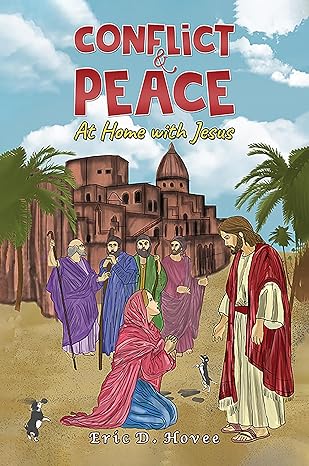

When I first opened Conflict & Peace: At Home with Jesus, I expected a familiar retelling of biblical stories, but instead I found something far richer and more layered. The book walks through twelve figures ranging from Matthew and Mark to Constantine and Luther and explores how each shaped, struggled with, or even fractured the Christian story. Eric D. Hovee doesn’t shy away from pointing out contradictions, tensions, and the uneasy balance between faith and evidence. What emerges is less a polished theology and more a raw chronicle of pioneers wrestling with belief, doubt, politics, and power. The book argues that Christianity has always lived at the crossroads of conflict and peace, heresy and orthodoxy, struggle and hope.
The writing style surprised me. It’s not slick or overly academic, and that’s what makes it work. Hovee mixes scholarship with a kind of candid storytelling that feels personal and searching. He admits where his own faith has faltered, where scholarship has raised more questions than answers, and where interpretations may lean too heavily in one direction. I appreciated this honesty. The detail can be overwhelming at times, with deep dives into language debates or church history that slow down the flow, but even then, I never felt the effort was wasted. It gave weight to his central claim that truth isn’t always clean or easy.
What I liked most, though, was the emotional undercurrent. This isn’t just about doctrine, it’s about Hovee’s father, about legacy, about the ache of wanting faith to feel real in a world of contradictions. I felt that ache with him. When he points out Matthew’s overreach on prophecy, or the way Constantine’s empire-building warped Christianity, I didn’t just learn facts, I felt the tension of a man trying to reconcile devotion with doubt. The book left me inspired. It made me look at my own beliefs with sharper eyes and a softer heart.
I think Hovee’s work is best for readers who want faith that is not easy, neat, or dogmatic. It’s for Christians wrestling with the weight of history, skeptics curious about the roots of belief, and anyone who values honesty over certainty. If you want a book that stirs you, challenges you, and leaves you thinking long after you close it, then Conflict & Peace: At Home with Jesus is well worth the read.
Pages: 401 | ASIN : B0F5641XR1



