Blog Archives
The STEWARD Blueprint: A Compass for a Purposeful Life


In The STEWARD Blueprint, author Andy C. Tseng offers a thoughtful, faith-centered approach to living with greater intention, balance, and purpose. Drawing from his experiences as a physical and occupational therapist, his Christian faith, and his personal journey from Taiwan to the United States, Tseng explores what it means to take good care of everything we’ve been given. His central message is that stewardship extends far beyond managing money or possessions. It involves caring for our bodies, nurturing relationships, developing our abilities, and using our resources to make a difference in other people’s lives. The book’s foundation is distinctly Christian, with Scripture guiding its ideas about personal responsibility, generosity, and fulfillment. Tseng writes with sincerity and a genuine desire to help readers recognize the value of their everyday choices.
The book is organized around seven interconnected pillars: Spirituality, Training, Eating, Wealth, Attitude, Relationships, and Development. Each chapter examines an area of life that deserves intentional attention, explaining how improvement in one area can positively influence the others. Tseng’s professional background is particularly evident in his discussions of exercise, nutrition, and physical well-being. He introduces practical concepts for incorporating movement, rest, and healthier eating habits into daily routines. His financial guidance addresses budgeting, saving, investing, and generosity, while his chapters on attitude and relationships explore gratitude, resilience, hospitality, and meaningful connections. Throughout the book, biblical teachings are paired with practical suggestions, personal experiences, and references to health and wellness research. Each chapter also concludes with reflection questions that encourage readers to consider their own habits and identify opportunities for growth.
I appreciated Tseng’s willingness to share his experiences with vulnerability and humility. He discusses professional frustrations, personal challenges, and lessons learned through difficult seasons, giving his advice a relatable, human quality. His stories about working with patients, participating in church communities, and discovering new ways to serve others make the larger principles feel tangible. Particularly engaging is his perspective that caring for ourselves strengthens our ability to care for others. This idea connects the book’s diverse subjects and gives the STEWARD framework a consistent purpose. Tseng’s writing is encouraging and accessible, often addressing readers directly through questions and invitations to reflect. His enthusiasm occasionally leads to repeated reminders about the importance of intentional living, but that repetition reinforces the habits he hopes readers will develop. The combination of personal testimony, biblical interpretation, and actionable guidance makes the book well suited to thoughtful, unhurried reading.
The STEWARD Blueprint will especially appeal to Christian readers who want to connect their faith with practical decisions about health, finances, relationships, and personal growth. It’s also a valuable choice for people navigating life transitions, reconsidering their priorities, or looking for ways to contribute more meaningfully to their communities. Readers involved in healthcare, ministry, mentoring, or volunteer work may particularly appreciate Tseng’s emphasis on service and his understanding of wellness as something that involves the whole person. Although the book’s perspective is firmly rooted in Christianity, its discussions of gratitude, discipline, connection, and lifelong learning offer ideas that readers from other backgrounds can consider. I’d recommend it most to anyone who enjoys reflective personal-development books with clear spiritual guidance and practical exercises. Tseng leaves readers with an inviting challenge: to recognize the gifts already present in their lives, care for them intentionally, and discover how those gifts can benefit the people around them.
Pages: 80
Literary Titan Gold Book Award: Nonfiction

The Literary Titan Book Award recognizes outstanding nonfiction books that demonstrate exceptional quality in writing, research, and presentation. This award is dedicated to authors who excel in creating informative, enlightening, and engaging works that offer valuable insights. Recipients of this award are commended for their ability to transform complex topics into accessible and compelling narratives that captivate readers and enhance our understanding.
Award Recipients






Visit the Literary Titan Book Awards page to see award information.
What If He Was Only A Man

Conspiracy of Faith follows a human and fallible Jesus who conspires to survive the crucifixion, only to discover that a disciple is turning the deception into a religion that will erase the man behind the message. What was the inspiration for the setup of your story?
Conspiracy of Faith started with four years of downtime.
I spent that stretch living in Algeria, head coach of the national basketball team, which sounds busier than it was. Between training sessions and travel for competitions, there were long, quiet hours to fill, and I filled a lot of them thinking about history, faith, and the things I’d grown up believing without ever really questioning.
The actual spark came later, on a trip to Rome with my wife. We were sitting outside St. Peter’s Basilica, a couple of beers in, looking up at one of the largest monuments to religious power ever built — and I remember thinking, plainly: this could not be what Jesus intended.
That thought turned into a question I couldn’t put down: What if he was only a man, and everything still happened exactly as it did?
That question became this book.
The writing came in broken mornings and late nights. The editing took longer than I expected. I was cutting, tightening, deciding what the story actually needed to say versus everything I wanted to say. This taught me more about writing than writing itself. Conspiracy of Faith is the result: a story about a man, the people who loved him, and what happens to a message once it outlives the person who spoke it.
How did you approach the challenge of humanizing figures such as Judas and Jesus while respecting their cultural and religious significance?
That tension was really the starting point of the whole book. I grew up in Catholic school, so the crucifixion story was never abstract to me. It was liturgy, ritual, something I heard told the same way every year of my childhood. Years later I lived in Algeria, a predominantly Muslim country, where Jesus is also deeply revered, a prophet honored and loved, but the story around him is told completely differently. There’s no crucifixion at all in the traditional Islamic account. That contrast never left me. Here was the same man, central to two enormous traditions, and the ending of his story simply diverges depending on where you’re standing in the world.
Living inside that contrast for years, rather than just reading about it, is what planted the seed. I wasn’t trying to adjudicate between those traditions or pick a side. I was interested in something underneath both of them: what would it take, physically and emotionally, for a man to survive his own execution and protect the people he loved by letting the world believe he hadn’t? That’s a human question, not a doctrinal one, and it felt like the one place I could stand that wasn’t already staked out by one tradition or another.
Judas came out of the same instinct. Every version of this story I’d encountered, Catholic and later the very different framing I found in Algeria, treated Judas as a symbol first and a person second: the betrayer, a name that’s become a synonym for treachery in half the world’s languages. I wondered what that story looks like from the inside, if the “betrayal” wasn’t treachery at all but the hardest, most loyal thing a brother could do, taking on a lifetime of being hated by history so someone he loved could live. Once I had that reframe, the rest of the book followed naturally. Peter, Mary, Joseph, Vespasian, all of them became people making difficult choices under pressure rather than figures fulfilling a preordained script.
My goal was never to provoke anyone or pick a fight between traditions. If anything, living in Algeria taught me how much reverence different faiths can hold for the same figure while telling entirely different stories about him. I wanted to write toward that shared humanity rather than away from it: strip away the certainty each tradition brings to its own ending, and ask what’s left when you’re just looking at a man, his family, and the people who loved him enough to risk everything. Whether readers come to this book from a Christian background, a Muslim one, or no religious background at all, I hope what they find is a story about love, sacrifice, and the terrible cost of protecting the people you care about. That’s a human story before it’s anyone’s theology.
Why did you choose Peter as the character who transforms Jesus’s compassionate teachings into a system based on spectacle, guilt, and institutional power?
Peter was a deliberate choice, both narratively and historically. There is an old saying that when investigating an unforeseen death, the first person you look at is the one who has the most to gain. During my research, I kept returning to that question: who stood to gain the most from transforming Jesus’s teachings into something more structured, authoritative, and institutionally powerful?
Peter emerged as a compelling answer. For the story to challenge the traditional understanding of Jesus, the opposing force needed to be someone who held genuine reverence in the modern vision of Christianity, not simply an obvious villain from outside the faith. Peter occupies that position. He is remembered as one of Jesus’s closest disciples and as a foundational figure in the Catholic Church.
I was also drawn to the historical relationship between Peter, Rome, and the development of church authority. During some of the most corrupt periods in church history, Rome and the institution built around Peter became focal points in discussions of religious power, wealth, and influence. That history provided a powerful foundation for the novel’s central conflict.
My intention was not to suggest that every aspect of Christian institutional history can be reduced to one man, or to make a claim about Peter’s actual historical motives. Rather, Peter became the ideal character through whom to explore the possibility that compassionate teachings could, over time, be reshaped into a system dependent on spectacle, guilt, and institutional power. He represents the tension between the message Jesus may have intended and what others might gain by controlling how that message is remembered and practiced.
What historical research helped you construct the practical details of the staged crucifixion, entombment, and recovery?
My approach to the historical research was to establish a consistent foundation rather than select individual details from different accounts whenever they suited the story. I limited my scriptural research primarily to the Gospel of John. I wanted the novel’s version of events to follow one narrative tradition, rather than picking and choosing between the four Gospels to construct the outcome I needed.
I also researched the practical details surrounding Roman crucifixion, including the use of wine and gall, as well as the procedures and structures associated with execution and entombment. These details were documented across multiple historical and religious sources, which helped me ground the fictional events in practices that were plausible for the period.
There is also a subplot in the novel suggesting that John may have been attributed to Mary, allowing the Gospel to be interpreted as Mary’s account of the events. That idea gave me another way to explore how history is recorded, preserved, and potentially shaped by those who tell it.
The tomb scene required a more practical question: could one man, in Jesus’s physical condition, have moved the stone? I researched the mechanics of ancient stone-moving techniques and the simple machines used by the Greeks and Romans. Those technologies demonstrated that very large objects could be moved by surprisingly few people, making the scene more plausible when approached as an engineering problem rather than a miracle.
The recovery itself became more straightforward once I considered the people involved. In the novel, Philip’s knowledge as a physician plays an important role, and I also examined the absence of explicit documentation that Jesus’s feet were nailed in the crucifixion accounts I was using. Those details helped me construct a recovery that relied on human knowledge, physical possibility, and preparation rather than supernatural intervention. The goal was to make the reader consider not whether the events could happen, but whether they could have been understood differently.
Author Links: Goodreads | Facebook | Website | X
History remembers him as the Son of God.
But what if history got it wrong?
Jesus of Nazareth is no miracle worker. He is a husband, a father, and a man determined to survive long enough to protect the people he loves. As his influence spreads across Judea, the Roman Empire tightens its grip and the religious elite demand his death.
Execution is inevitable.
Unless he can convince the world he died.
With the help of a handful of trusted allies, Jesus sets in motion an impossible conspiracy—one that must withstand betrayal, unimaginable suffering, and the scrutiny of Rome itself. Every wound must appear real. Every witness must believe. Because if even one person uncovers the truth, everyone involved will be executed.
The plan succeeds.
But the resurrection story takes on a life of its own.
As whispers become conviction and conviction becomes a movement, Jesus faces an impossible choice: reveal the truth and destroy everything…or remain silent and become the foundation of the greatest religion the world has ever known.
CONSPIRACY OF FAITH is a provocative historical thriller that blends history, suspense, and psychological drama into an unforgettable reimagining of one of humanity’s most influential stories.
What if belief wasn’t born from a miracle…but from the greatest conspiracy in history?
They Were Living A Lie

The False Paradigms of Today and the Timeless Truth of Tomorrow examines how perception, social conditioning, group identity, history, psychology, and inherited ideas shape what people accept as truth. Was there a particular assumption about modern life that first made you question the larger worldview behind it?
As a child I saw that the basic assumptions people make about life were wrong. As I looked around at the adults, they were living a lie, and probably didn’t know it. They bought into the whole story that you have to go to college, get a job, get married, work hard, get a mortgage, have children–that if you do all of that, you will be living the best life. But as I looked around, I saw people who were not happy, who did not have fun, and did not seem to be doing anything great. There was no way, I thought, that I would fall for these lies. There was a truth out there that could set us free to be happy and fulfilled in life, and the people around me had totally missed it.
Why do you think people become so emotionally attached to beliefs that challenge can feel like a personal attack?
I think Eckhart Tolle explained it well. People believe that they are their minds. They think their minds are clever. They have worked a lifetime creating their admirable minds, much like a sculptor creates a perfect statue out of block of granite. (I once believed that too, and being supremely arrogant, I thought my mind was a work to be admired by all young attractive women. Of course, they rarely admired my creation, and shied away from me.)
When an outsider questions basic tenants of our belief systems, people see it as a personal attack. You are attacking their persons–well, their minds. And to them, this is the same thing. But they are completely wrong. If you sit and try to meditate, you can watch all the garbage, half-baked thoughts the mind comes up with. Nobody would be proud of those thoughts.
But there is more to that question. If you can destabilize someone’s thinking, make them realize that their entire outlook was wrong, now what are they going to do? That is a very uncomfortable place to be. Who wants to reassess their lives, and reconstruct their world outlook? It can mean that they have spent decades doing the wrong things. Nobody wants to face that. It is easier to just tell me, and other troublemakers, that we are wrong, and get back to the football game.
What do you believe people misunderstand about the relationship between scientific models and reality itself?
In the book, I think the chapter that rattles people the most is when I question science, and I believe it is because to differing degrees we have all unconsciously absorbed science as the bedrock of truth. Most of us lost God in the 18th and 19th centuries, and so we gravitated towards science. We need some ultimate authority. It used to be God. Everything that was so, was so because of God. Now, science has become the bedrock of our life views. And it has become the ultimate authority. Even for religious people.
Almost everyone believes in evolution, big bang, and cave men. Are they all true? I don’t know. They are theories. If you question some aspects of science successfully, where does that leave the reader who blindly accepts it all? If parts of science are just conjecture, then how are people to decide what is real and what is not? We are not scientists. It was easier to just accept all of science without thinking too hard about it. But questioning the fundamentals of our belief systems is not a comfortable place to be. All of a sudden our outlook on the world is imperiled. Again, it is easier to just tell me I am wrong..
Ah, but you asked about scientific models and reality itself. . .Probably all scientists realize that theories are theories. They are not necessarily the truth. Theories cannot be proven. They are generally accepted explanations of reality. But they usually are disproven in time, although it may take centuries. When we find data that contradicts our theories, our scientists will typically amend the theory, but rarely will they cast it out. It is only when a generation of scientists dies, that their theories can die with them. (That is one of the great things about death. It brings change, as the newer generations replace old ways of thinking with newer ones.)
But normal people, we tend to confound theories with all the rest of science. We are black and white thinkers. To us, science is true or it is not. We can put rocket ships on the moon, therefore, science is true, including all of its theories. But in reality, some science is true, and some is just conjecture–theories.
So, if scientific theories are not necessarily true and likely to be discarded at some point, why do we base our beliefs on them? Why have we made scientific theories the central tenant of our worldview and why do we use them to define who we are? It has become just this for a great many of us. We do not realize to what extent science has replaced the Catholic Church in providing much of the foundation of our collective understanding of the world. In the past, people would be aghast if you stated that Christ was not God but was instead a divinely inspired man. You would be shunned, tortured or perhaps executed as a heretic if you spread those blasphemous thoughts. It is similar today with regards to science. In much of Western society, if someone professed that evolution is a fanciful theory and is not true or, even better, that the Earth does not rotate around the sun, you would be considered an idiot and would likely be shunned as ignorant or crazy. It’s the same.
To sum it all up. . .the likely reason people misunderstand the relationship between scientific models and reality itself, is probably due to lazy black and white thinking. People have a tendency to take the whole package, or none of it. Just like in the Middle Ages, you accept everything the Church says, and now, you accept everything science says. No picking and choosing. It is so much easier to just chunk it all together, and accept it all as one package. Science is good, therefore all science is true.
Do you see the transformation you describe as something that could happen gradually through culture and education, or does it require a more fundamental shift in human consciousness?
The change I call for, is that people realize that individuals are not important, and that humanity, itself, the aggregation of all people, living and dead, is what really matters. To focus on only ourselves is to be short-sighted. To reach our potential, to help others reach theirs, that is the proper outlook. It took a book to explain this concept, so I won’t try in a few sentences, or I risk sounding trite.
But, yes, humanity will transform into this realization. It will become fundamental, and we will create different social systems and personal outlooks completely different based on this fundamental realization. But likely not in our lifetimes, possibly not even in our grandchildren’s lifetimes. Fundamental change on this scale takes centuries, not years. Humanity is the creature that matters, not us individuals. We come and go and are forgotten, but humanity persists, doing whatever it is it does, but it is heading somewhere. We just cannot know where. I personally believe, but do not know, that the type of change I see coming, will happen soul by soul, individual by individual, and slowly, over the generations, people will think and act differently. Christianity took almost 350 years before it really started growing, that is, when it became the state religion of Rome. Until then, it was a very small movement, slowly proceeding, slowly growing. Nobody in the first generation thought it would ever be the religion of Rome, or that it would take over Latin America or Africa. This is the same. We cannot know what the future holds. (Yes, including me.) But as I see it, this is where we are headed.
Author Links: Goodreads | Website
What do we believe? Whatever they told us to believe.
What do we do? Whatever other people are doing.
How many lies have we welcomed into our lives without having seriously analyzed them?
It’s the reason many of us feel empty inside—there’s nothing there but convenient mistruths, and at some level, we all know it. We then orient our lives based on these false beliefs, wasting our precious limited time among the living striving for goals that leave us ultimately unsatisfied.
The False Paradigms of Today and The Timeless Truth of Tomorrow by John Bliss takes a steak knife to these common delusions with 13 irreverent essays that rip and tear at the foundations of our collective worldview. Little is held sacred to Bliss.
The essays in Part 1: Your Understanding of Reality is More Fabricated Than You Think dispel our delusions one at a time, including:
our mistaken belief in progress,
our misplaced confidence in our own rational prowess,
our loss of personal identity from group identification,
our misplaced faith in science as a true representation of the world, and
our morality: what it is and where exactly it comes from.
After carving away these restrictive untruths, Part 2: An Exploration of Truth Across Historical, Mystical, and Philosophical Dimensions introduces a deeper understanding of humanity based on history, mysticism, psychology and philosophy. Some of the topics in Part 2 include:
how our religions became second-rate pathways to God,
our reliance on logic and how it warps our decision-making,
how idealism can lead to mass murder and tyranny,
the overriding importance of history, where we’ve been, where we are going and why,
our immaterial connection to all people living and dead—Jung’s collective unconscious, Emerson’s Over-Soul, and Varro’s Soul of the World, and finally
the bedrock assumption that we all got wrong. Switch this out, and everything changes.
The essays are filled with stories from history, including meetings of the apostles Paul and Peter with the Emperor Nero and Simon Magus the magician, the mystical transformation of Emmanuel Swedenborg, the nineteenth century German intellectual revolution, the establishment of three French religions worshipping not God but Reason and Humanity, the abdication of the World Teacher, and the genocide of the Tibetan culture.
The book is ideal for seekers of deeper meaning, arm-chair philosophers and historians, and those disillusioned with the emptiness of contemporary thought. Discover why your view of reality may be distorted—and how by changing the one assumption on which your entire world-view is based, everything shifts.
Two Individuals I’ve Seen Make a Difference

My Last Day follows a wealthy Wall Street trader who plans to end his life on his own terms after learning he has only months to live, recording the experiences of his final day in a candid journal. Where did the idea behind this novel come from?
The idea came from two directions: Two individuals I’ve seen make a difference in the world through self-sacrifice, and the courageous way I’ve seen some friends handle terminal illness with grace and a continued commitment to life.
Rob’s voice is intelligent, humorous, skeptical, and deeply reflective. How did you develop his perspective and the way he processes his circumstances?
I wanted this book to be a celebration not only of his past life but also of the time he had remaining. I didn’t want Rob to be an incredible philosophical individual. I wanted him to be a successful, kind person who, when faced with his own mortality, found those perspectives you mentioned, amplified, not dampened.
Faith and spirituality play an important role in Rob’s transformation. What questions about belief, purpose, or mortality did you hope the story would explore?
The value of every moment, the importance of kindness, the value of faith, God’s forgiveness and role in our lives, and the connections we create in this world, even if we’re unaware of them. The question of how much in life we control was also important. Rob faces a situation beyond his control, but he thinks he can reassert control. He’ll make the decision when and how he dies. He learns that maybe that’s not his decision. In a book that begins with a planned suicide, it’s not about the ethical questions surrounding suicide. It’s about what we do with our time, our lives up to the moment we leave this world. Spoiler alert: Rob does pass away, but the story is uplifting.
If Rob could leave readers with one final message, what do you think he would want them to remember?
As long as you’re alive, live. It’s simple, but not always easy. There’s a Japanese saying I recently learned, ichi go, ichi e, which is an invitation to live every moment because that moment will never occur again. The US version might be YOLO, however, the Japanese version is a bit more reflective.
But, as he wanders through New York City those last two days, life has other plans. An attempted mugging becomes an unlikely moment of grace. A box of Girl Scout cookies turns into a chain reaction of kindness. A bartender in Brooklyn offers unexpected wisdom, and a mysterious church opens a door to a peace he thought he’d long lost.
Through a series of raw, humorous, and profoundly human encounters, Rob finds himself rediscovering faith, compassion, the guiding hand of God, and the simple power of choosing to care—one stranger, one act of kindness at a time.
Told through Rob’s intimate journal, which is book-ended by a forward and an afterword from a financial advisor, My Last Day is a moving meditation on regret, redemption, and what it really means to live while you’re alive.
Love’s Cauldron: Reclaim Your Wild Feminine, Book 2: Savior


Love’s Cauldron: Reclaim Your Wild Feminine, Book 2 – Savior by Jennifer J. Lehr is a deeply personal spiritual memoir about healing, intuition, feminine power, and the gradual work of becoming more fully oneself. Lehr describes the book as a nonlinear memoir, and that structure suits the material beautifully. Rather than following a conventional timeline, she moves among childhood memories, relationships, illness, therapy, spiritual experiences, encounters with animals and nature, and moments of sudden inner knowing. Poetry and brief meditations are woven throughout the narrative, giving the book the feeling of a collage made from memory, reflection, image, and emotion. At its center is Lehr’s understanding of the witch as a person willing to listen inwardly, honor the natural world, develop intuition, and consciously transform what life has handed her.
As a witchcraft memoir and book of feminine spirituality, Love’s Cauldron is especially interested in the relationship between wounds and power. Lehr writes candidly about an authoritarian childhood, frightening early experiences, difficult relationships, chronic illness, and the ways trauma can fracture a person’s sense of self. She then follows those fractures into the years of therapy, meditation, twelve-step work, spiritual practice, writing, and self-examination that helped her build a more integrated life. Her idea of healing is active and ongoing. Anger can become a boundary, vulnerability can become connection, grief can open into love, and an old story can be examined until a different way of living becomes possible. That process gives the memoir much of its emotional weight.
The book becomes increasingly expansive as Lehr explores intuition, spirit guides, Wicca, the numinous, tarot, yoga, ritual, words as forms of magic, death, transformation, and communication with realities beyond the five senses. These subjects make Love’s Cauldron a distinctive spirituality and self-discovery memoir, but Lehr keeps returning them to ordinary human concerns: How do we trust ourselves? How do we love without abandoning ourselves? What do we do with suffering? How can we become gentler without becoming powerless? Some of the most memorable passages connect those questions to the physical world, from birds and apple trees to weather, water, animals, moonlight, and the changing seasons. Nature isn’t simply scenery here. It’s part of the spiritual vocabulary through which Lehr understands belonging, abundance, death, renewal, and the feminine.
By the final chapters, Love’s Cauldron has become a memoir of reclamation. Lehr gathers together the writer, therapist, wounded child, intuitive, healer, animal lover, wife, seeker, and witch rather than asking any one identity to replace the others. The closing movement toward empowerment feels earned because the book has spent so much time showing the slow work beneath it. Her recurring language of alchemy is particularly fitting: difficult experiences are held, examined, and transformed into greater self-knowledge and a capacity to offer something useful to others. For readers drawn to spiritual memoirs, witchcraft, divine feminine spirituality, and personal transformation, Love’s Cauldron, Book 2: Savior offers an intimate account of a woman learning to trust the many parts of herself and to treat that wholeness as both a source of power and an expression of love.
Pages: 326 | ASIN : B0GY43NQZ7

Healthy Minds, Healthy Nation: How Meditation, Shamanism, and Indigenous Healing Can Tap into Your Light Within and Change the World
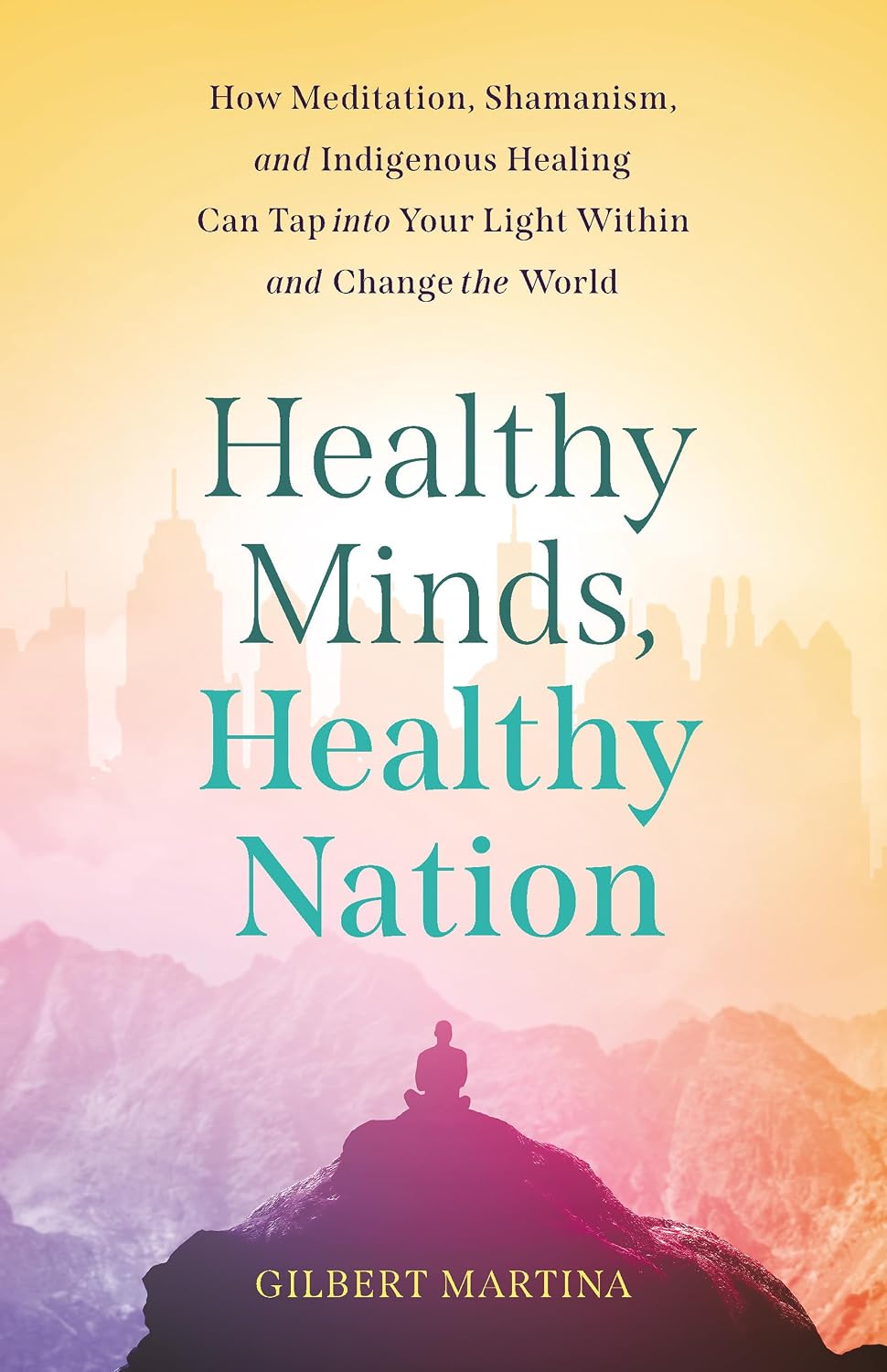

Healthy Minds, Healthy Nation, by Gilbert Martina, is a personal, spiritual, and socially minded exploration of the idea that healthier societies begin with healthier individuals. Martina builds the book around his own experiences with grief, chronic pain, professional pressure, family trauma, and leadership in Curaçao, then connects those experiences to larger questions about consciousness, morality, and collective well-being. The book moves through four broad stages: establishing the foundations of a healthy mind, examining how trauma can affect whole societies, describing spiritual awakening, and introducing practices such as Transcendental Meditation, shamanism, and Indigenous healing. What makes the book especially personal is that Martina rarely presents these ideas from a distance. His parents, marriage, career, physical pain, and Curaçaoan heritage are woven directly into his argument, so the book reads partly as memoir, partly as a guide to spiritual development, and partly as a reflection on leadership.
One thing that was most interesting to me was the way Martina moves between individual trauma and national history. His discussion of Curaçao gives the book a strong sense of place, particularly when he considers slavery, colonialism, discrimination, political power, and the long psychological effects of historical wounds. He argues that unresolved trauma can shape not only individual behavior but also relationships, institutions, leadership, and entire communities. That argument becomes more compelling when Martina connects it to his own life, including his mother’s fight against discrimination, his professional battles over integrity, and his struggle to separate what he calls the ego from the true self. The Papiamentu sayings passed down by his mother are especially memorable because they turn abstract ideas such as honesty, discipline, humility, resilience, and responsibility into something lived and specific.
The book becomes more explicitly spiritual as it progresses, especially in its treatment of meditation, energy healing, shamanic practice, chakras, ancestral trauma, vision quests, and ayahuasca. Martina treats neuroscience, psychosomatic medicine, spiritual experience, and Indigenous healing as parts of a connected picture of human health. That gives the book a distinctive confidence and makes his worldview easy to understand, even when some of the scientific and spiritual claims are presented with different kinds of supporting evidence. His strongest material tends to come when he describes what these practices have meant in his own life. Still, the central thread remains clear: healing requires attention to mind, body, relationships, history, and spirit, and personal transformation matters because it changes the way a person acts in the world. By the final chapter, Martina turns that idea toward moral courage, arguing that an awakened person should be willing to speak up against injustice and choose principle over fear, status, or money.
I recommend Healthy Minds, Healthy Nation to readers who are interested in spirituality, meditation, holistic approaches to healing, personal transformation, and values-based leadership. It will also have particular appeal for readers interested in Curaçao and the Caribbean, especially those thinking about how colonial history and inherited trauma continue to shape modern communities. Martina writes with the conviction of someone trying to make sense of his own life while also offering that meaning to others, and the book’s warmth comes from that personal investment. By the conclusion, his message has become both intimate and ambitious: quiet the mind, care for the body and soul, loosen the hold of ego, heal what has been carried from the past, and let that inner work influence families, communities, and nations. Readers who enjoy books that bring memoir, spirituality, leadership, cultural history, and self-development into the same conversation are likely to appreciate it most.
Pages: 246 | ASIN : B0GP4Y8JF2
Vivid Visions and Lucid Dreams

The Lord of Records Speaks shares a series of channeled conversations with the spiritual presence you call the Lord of Records, a Keeper of Information within the Akashic realm. Before these experiences began, how would you have described your relationship with spirituality or metaphysical ideas?
I had never been particularly interested in spirituality or metaphysical ideas until 2018-2019, when I began experiencing flashes of what felt like memories from a past life. From that moment on, the vivid visions and lucid dreams I experienced led me to ask questions and search for answers.
The energetic entity known as the Lord of Records was somehow familiar to me from the very first time I accessed the Akashic Realm, although I did not have any direct interaction with it until 2025. Later, driven by curiosity, I initiated the communication myself, and over time the relationship developed naturally and harmoniously.
We discussed a wide range of metaphysical topics that intrigued me at different moments, yet every conversation ultimately connected back to aspects of our human reality and experience. Its answers continually inspired me to ask deeper questions and, whenever an explanation seemed difficult to understand or accept, I frequently asked for evidence, practical examples, or further clarification.
Communication with the Lord of Records is spontaneous, appearing and ending just as unexpectedly. It remains one of the most inspiring and transformative experiences I have ever had.
Today, I have a strong interest in metaphysical and spiritual topics, and I read extensively to explore different perspectives and experiences. I am curious not only about ideas that support my own experiences but also about those that challenge them. I find value in considering a wide range of viewpoints, as they help me deepen my understanding and approach these subjects with both curiosity and an open mind.
Your background in psychology gives you an unusual vantage point. How did psychological training affect the way you evaluated your experiences?
My academic background in mathematics and psychology has made me naturally skeptical of anything that seems unusual or difficult to explain. I do not dismiss such experiences, but neither do I accept them blindly. Instead, I treat them as working hypotheses, exploring them with curiosity while searching for arguments both in favor of and against them.
This has been my approach to experiences such as past-life memories, astral projections, contact with non-terrestrial intelligences, and my more recent communication with the Lord of Records. I have always sought evidence, questioned my own interpretations, and looked for alternative explanations. Maintaining a balance between open-mindedness and critical thinking has been essential throughout this journey.
What would you say to a skeptical reader who interprets the dialogues as expressions of your own subconscious?
One of the things I value most is the freedom people have to interpret reality in different ways. I enjoy this diversity of thought and would never want to take it away from anyone. We are enriched by our different perspectives, experiences, and ways of understanding the world.
I am not interested in convincing others to believe my experiences or my interpretations of them. What I hope for instead is curiosity and openness. Even when someone is skeptical, I would appreciate if they first considered the experience as a possibility, or at least as a hypothesis worth exploring, before dismissing it outright.
In my view, belief is not necessary, but sincere examination is. Only after considering an experience carefully can we form an opinion that is truly our own.
What did writing the book teach you that simply having the conversations had not?
The process of writing this book was transformative in itself. It helped me connect ideas that had previously appeared as separate pieces of a much larger puzzle. As I revisited the conversations, I developed a more comprehensive understanding of the universe, the role of the Source, and the influence of the primordial particle across different layers of reality.
Perhaps the most unexpected discovery was realizing how clearly I could explain these concepts. While the conversations were unfolding, I was focused on asking questions and seeking understanding. It was only when I began writing that I saw the bigger picture and found simple, relatable ways to express ideas that initially seemed complex and abstract. In many ways, writing the book became another stage of learning and discovery.
Author Links: GoodReads | Facebook | Website
What if you could challenge those answers, ask for clarification, and be guided with patience through the hidden layers of meaning?
Are you ready to explore a perspective that may intrigue, provoke, and expand your understanding of existence?
Adria Sanders has spent years in conversation with an energetic being she calls the Lord of Records—the Keeper of Information within the Akashic realm. Through channeled dialogues, she reveals the context of these encounters, the impact they had on her own belief systems, and the profound insights that reshaped her understanding of reality.
The Lord of Records offers answers that invite you to question what you think you know and to explore consciousness with new awareness.
Within this book, you’ll embark on a fascinating journey into the hidden mechanics of existence. You’ll learn about the primordial particle that sparked creation and shaped the architecture of our Universe, and explore how emotional particles influence humanity and cosmic evolution. You’ll uncover the surprising connections between artificial intelligence and holographic worlds and discover the role of light in its relationship with the Source and its manifestations. The book also reveals the meaning and laws of cosmic strings, showing how they give rise to diverse universes. The Lord of Records Speaks concludes with a thought‑provoking look at possible future scenarios awaiting human races.
Through these topics, you’ll discover an intriguing and illuminating exploration of what it means to exist as a soul in the Universe, and the role each of us plays within the greater design. Step into a dialogue between a patient, wise master and a skilled investigative interviewer. Meet the Lord of Records, and allow his guidance to expand the horizons of your inner knowing.


