Blog Archives
God Is Good: Simply the Gospel of Jesus Christ


God Is Good: Simply the Gospel of Jesus Christ by Ivon Hartness is a heartfelt, chapter-by-chapter walk through the Gospel of Matthew, written as both a teaching guide and a personal testimony. Hartness begins with Jesus’ genealogy and birth, lingers over Joseph’s quiet righteousness, follows the wise men, John the Baptist, the Sermon on the Mount, the temptations in the wilderness, the parables, the cross, and finally the resurrection and Great Commission. The book’s central conviction is steady and unmistakable: God is good, Jesus is the promised Savior, and the Gospel is not merely information to study but truth meant to remake the heart.
What moved me most was the book’s sincerity. Hartness writes like someone who isn’t trying to impress a classroom but to sit beside a reader with an open Bible between them. I felt that especially in the early chapters, when Joseph’s choice to protect Mary becomes more than a familiar Christmas detail. It becomes a picture of restraint, mercy, and obedience under pressure. The same warmth appears in the discussion of the wise men, where Hartness gently corrects popular nativity assumptions without sounding smug, and in the resurrection chapter, where the stone rolled away is treated not as a theatrical flourish but as an invitation to look inside the empty tomb. That kind of devotional imagination gives the book its pulse.
Hartness is passionate, direct, and deeply personal. The book explores themes of grace, repentance, obedience, spiritual warfare, and the new heart, with a preacher’s urgency. For me, that made the book feel wonderfully earnest in places. When he writes about the Beatitudes as a progression of the soul, or about Jesus resisting temptation through Scripture, the theology feels authentic. I didn’t always find the style polished in a literary sense, but I found it honest, emotionally present, and anchored by a genuine desire to help readers encounter Christ rather than merely analyze Him.
I found God Is Good to be an affectionate, plainspoken, and conviction-filled guide to Matthew, one that values clarity over complexity and devotion. Its concluding emphasis on the risen Christ gives the whole book a fitting sense of arrival, like a long walk ending in morning light. I’d recommend it especially to newer believers, small-group readers, or Christians who want a warm devotional companion through Matthew.
Pages: 199
My Search For The God of the Big Book (Hadassahʼs Story)

My Search for the God of the Big Book is part memoir, part spiritual argument, and part ministry manual. Hadassah Roach begins in childhood chaos, moves through alcoholism, AA, and her immersion in Reiki, then builds toward a hard-won conversion experience in which sobriety, for her, is no longer the end of the story but the threshold to Christian salvation. Along the way, she revisits the language of the Big Book, argues that its real destination is the God of the Bible, and closes with a devotional and a twelve-week study guide that turns her testimony into a framework for others in recovery. The result is a book that moves from private wreckage to public mission with absolute conviction.
What stayed with me most was the nakedness of the personal narrative. The early pages have real hurt in them. Her descriptions of growing up in fear, of becoming a mother while still feeling half-feral herself, of trying to care for Kevin through his disabilities while her own inner life was collapsing, carry a bruised immediacy that doesn’t need polishing. The scenes that linger are intimate and oddly quiet: her mother teaching her Reiki hand positions as a form of closeness, the bleak humiliation of being years sober and still wanting to vanish, the small human absurdity of pizza plans turning into a rainy doorway conversation that changes two lives. In those moments, the book feels most alive to me, because the prose becomes less declarative and more inhabited. She is trying to tell the truth as she has come to see it, and that gives the book emotional force.
The author’s central claim, that AA has drifted from explicitly Christian roots and that the steps are incomplete without Jesus, is stated with certainty. At times, I found that bracing, even moving. Her distinction between being sober and being free has real moral and existential weight, especially because she has earned the right to make it through lived anguish. The testimonial sections and study-guide material deepen her sense of mission, but they also shift the book away from literature and toward witness. I admired the book’s fervor more consistently than I admired its subtlety.
I found this book affecting, earnest, and at times surprisingly tender. I don’t think its power comes from stylistic refinement so much as from the intensity of a life reinterpreted through faith, grief, and service. When Roach writes about cutting the rope of bitterness with her father, about the ache that remained after years of outwardly successful recovery, or about building “a place for the unfinished,” I felt the book opening into something larger than argument, something wounded and generous at once. I’d recommend it most strongly to readers in recovery, especially Christians or spiritually restless AA readers who feel unconvinced that sobriety alone has answered the deepest question in them.
Pages: 175 | ASIN : B0GHZM5PDW

God’s Salvation Manifesto


James A. Hale’s God’s Salvation Manifesto is a work of Christian theology that frames the human condition as a spiritual emergency and presents the gospel, in strongly Reformed terms, as the only sufficient answer. The book moves from diagnosis to proclamation with a very deliberate architecture: it begins by arguing that the world’s visible disorder points to sin rather than merely social or political failure, then presses through themes of repentance, divine holiness, human inability, sovereignty, atonement, and final victory before ending in a direct summons to the reader. Along the way, Hale repeatedly translates doctrine into vivid modern images, setting Neo’s unease in The Matrix, the sacrificial pull of The Iron Giant, the terrible goodness of Aslan, Apollo 13’s helplessness, and the scandal of the cross into one sustained evangelical argument.
Hale doesn’t write as if he’s offering a spiritual supplement to an otherwise workable life. He writes with an intensity that gives the book real force. It feels sharpened by conviction rather than dulled by abstraction, and I found myself admiring how often he reaches for concrete, emotionally legible scenes instead of hiding behind theological shorthand. The opening use of The Matrix is clever because it captures that half-formed human suspicion that something is wrong, and the pages on Christmas versus Good Friday are among the book’s strongest because they show his instinct for contrast, tenderness, and pressure all at once. I also think he’s at his most compelling when he leans into image rather than assertion, as in the description of the torn veil, or the claim that people prefer the manger because the manger feels safe while the cross does not.
The author’s voice is clear, assured, and often stirring. He returns to ultimatum, polarity, and total spiritual incapacity. The book’s confidence in its theological framework was its strength. If a reader already leans toward Reformed doctrine, the arguments about sovereignty, repentance, and the Father sending the Son will likely feel bracing and coherent. Hale plainly believes these claims matter beyond the page, and that belief gives the book a kind of stern emotional honesty that I respected, even when I wanted more scrutiny.
I found God’s Salvation Manifesto intense, earnest, and often memorable. It’s not a cool or detached book. It wants to confront, persuade, and press the reader toward repentance, and on that front it’s remarkably consistent from first page to last. I’d recommend it most to readers interested in unapologetically doctrinal evangelical writing, especially those drawn to Reformed theology, conversion-centered preaching, and Christian books that treat belief as a matter of eternal consequence rather than private preference.
Pages: 159
Worldwide Miracle

Obadiah & the Last 100 Prophets of Edom follows a faithful man who risks everything to protect a hidden remnant of prophets, as faith, persecution, and divine confrontation collide. How do you approach writing faith not as an abstraction, but as a lived experience under pressure?
A difficult question for me. An author friend of mine discussed how we responded after questions like, “Do you write an outline, do you write a synopsis?” Our answers were similar. I have an idea for a story, just the beginning of an idea. I start writing the story with one or two defined characters. The opening could be a scene with or without a dialogue. Then the characters react to what is happening in the scene with some dialog that connects with other entities that are responsible for what is happening. Now you may have five or six additional characters/ensemble. All now reacting in ways that move the story forward. By page 10, you should have a good idea of how it all ends.
Though rooted in biblical history, the novel’s themes feel contemporary. Do you see parallels between this world and our own?
For years, during and after the wars in Korea, Viet Nam, Iraq, Afghanistan, and then adding the wars through the ages, it became apparent to me that most were fought because of a religious belief. When you look at that history, most beliefs were grounded in one worship, the belief in a God. Except in some cases, like Egypt, and Canaanites who worshiped many Gods. You can see that now in many countries. What if the world, or many parts of our world, believed in one God only? Could that reduce the number of wars? Could that save millions of lives? Obadiah emphasizes with the phrase “there is only one God,” which reinforces its central message.
What do you hope readers feel after finishing the book?
A worldwide miracle would do it, but one could only pray.
Author Links: Amazon
The Diaries of a Teenage Pilgrim: The Early Journey
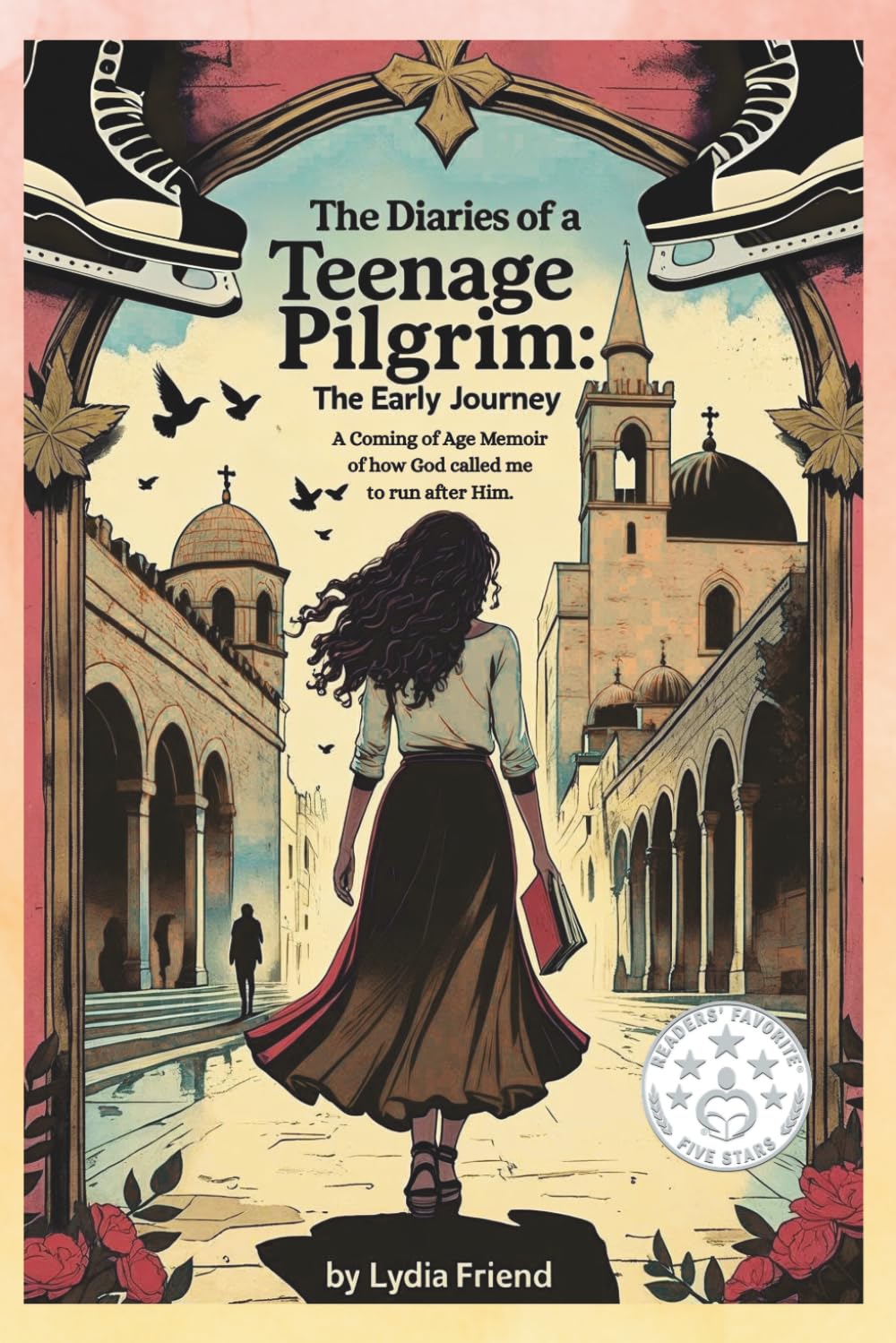

I found The Diaries of a Teenage Pilgrim: The Early Journey to be, at heart, a coming-of-age memoir about spiritual identity under pressure. Lydia Friend begins in the warm, enclosed world of Spooner, Wisconsin, then is swept into a family move to Israel that feels at once providential and deeply destabilizing. What follows is not a tidy overseas faith ministry narrative but a long, uneven apprenticeship in exile: Jerusalem and Metulla, homesickness and fervor, poetry and loneliness, the ache of being pulled between the Ozarks and the Galilee, and finally a devastating car accident that becomes a hinge point rather than a climax. The book keeps returning to one question in different forms: what does it mean to belong when every earthly home feels provisional, and when faith asks not for certainty but for surrender?
I liked the book’s emotional candor. Friend has a gift for rendering memory through texture and atmosphere, so that a white cat in an airport carrier, a farewell quilt from a small church, or a frantic run through Atlanta with a harp on her back can carry real emotional voltage instead of merely serving as anecdote. I admired the way she lets adolescent intensity remain intense. She doesn’t flatten her younger self into someone wiser or more ironic than she was. That gives the memoir a rawness I found moving, especially in the sections where she feels caught between two worlds and can’t tell whether she’s being formed or simply undone. The prose has a luminous, devotional quality. It lingers over rain, cedar, songs, hospital fear, and the strange tenderness of being cared for after catastrophe. There were moments when the language tipped toward repetition or overstatement for me, but even then I felt the pressure of a real inner life behind it.
I also found the book’s ideas both compelling and specific. Friend’s central vision of pilgrimage, displacement, and what she calls being “Stranger Lovely” gives the memoir its theological spine. She reads exclusion, longing, and even creative repression as part of a larger divine romance, and whether or not a reader shares every article of that belief, it’s hard not to feel the force of how fully she has lived inside it. I was especially struck by the way the accident and recovery chapters reframe suffering not as abstract lesson material, but as something bodily, terrifying, and humiliating before it becomes meaningful. That sequence gave the book real gravity.
The Diaries of a Teenage Pilgrim is a sincere memoir, and sincerity here is not a small thing. What I valued most was its refusal to separate spiritual formation from embarrassment, adolescence, longing, family history, art, or pain. Friend writes like someone trying to recover her own song while she’s still hearing its echoes, and that gives the book an intimacy I found affecting. I’d recommend it especially to readers who are drawn to faith memoirs, overseas faith ministry childhood narratives, and stories of displacement that are as inward as they are geographical. It will likely speak most powerfully to readers who have felt out of place in the world and have tried to make meaning of that estrangement without denying its cost.
Pages: 322 | ISBN : B0FP31B2LW

Literary Titan Gold Book Award: Nonfiction

The Literary Titan Book Award recognizes outstanding nonfiction books that demonstrate exceptional quality in writing, research, and presentation. This award is dedicated to authors who excel in creating informative, enlightening, and engaging works that offer valuable insights. Recipients of this award are commended for their ability to transform complex topics into accessible and compelling narratives that captivate readers and enhance our understanding.
Award Recipients











Visit the Literary Titan Book Awards page to see award information.
Obadiah and the Last 100 Prophets of Edom

Obadiah & the Last 100 Prophets of Edom is a biblical historical novel that plays like a faith-driven epic, with palace intrigue, desert escapes, prophetic confrontation, and open warfare all braided together into one long narrative push. It takes the world around Obadiah, Ahab, Jezebel, and Elijah and turns it into a high-stakes story about loyalty, persecution, and public belief. From the opening battle sequence onward, the book aims for sweep and intensity, and it rarely lets the pressure off. It isn’t shy about its purpose either. This is a novel built to declare, repeatedly and unapologetically, that history, power, and survival all bend toward one divine truth.
What stood out most to me was how clearly the book understands its own register. The prose is deliberate, solemn, and often cinematic, with short emphatic lines that give scenes a drumbeat rhythm. That style works especially well in moments of danger, whether the story is following hidden prophets through caves, women trying to survive inside Jezebel’s orbit, or crowds gathering for judgment and spectacle. The repeated refrain about one God gives the novel a liturgical pulse, so even when the plot branches into many characters and locations, the book keeps pulling everything back to the same spiritual center.
Obadiah himself comes across less as a conventional action hero and more as a steady spiritual axis for the whole story. Other characters bring different kinds of energy around him: Ahab is proud and unstable, Jezebel is coldly theatrical, Elijah arrives with force, and figures like Jazer, Tobia, Elena, and Hadar help widen the book’s emotional range. I liked that the novel keeps returning to the cost of faith in ordinary bodies and ordinary homes, not just in courts or battlefields. One of its best lines, “Belief does not always remove peril. Sometimes it invites it,” gets at the book’s real subject better than any plot summary could.
The novel also has a strong sense of momentum. Once the hunt for Obadiah and the prophets is underway, the story keeps moving through raids, imprisonments, secret rescues, prophecies, and the long build toward Carmel. Even when the book pauses for speeches or declarations, it still feels like it’s advancing toward a reckoning. By the time it reaches the mountain, it knows exactly what kind of climax it wants, and a line like “The people think fire will decide this,” he said. “But it is obedience that summoned it” captures the book’s mix of drama and conviction really well.
What I came away with, more than anything, is that this book is an earnest, full-throated religious epic. It’s interested in kings and prophets, but also in servants, villagers, prisoners, and those caught between fear and devotion. It treats faith not as background decoration, but as the engine of every choice, every conflict, and every act of endurance. If that’s the kind of novel it set out to be, then it succeeds by committing all the way, with conviction, intensity, and a voice that never backs away from what it believes.
Pages: 125 | ASIN : B0GPMG7WY4
The Radiant Word: Reflections in the Orthodox Tradition

V.K. McCarty’s The Radiant Word is less a conventional theological study than a gathering of lived sermons, meditations, and keynote reflections that move through the Orthodox liturgical year while lingering over Scripture, icons, saints, hymnody, and patristic sources. The book begins in light, with the Transfiguration and the idea that Christ’s radiance reaches into “the complicated corners of our lives,” then widens into reflections on the Theotokos, desert mothers, Mary Magdalene, the Prodigal Son, the Jesus Prayer, Kassia’s hymn, Pentecost, Basil, and finally love and beauty in pandemic life. What binds it all together is McCarty’s desire to make ancient sources feel not archival but immediate, devotional, and warm.
What I admired most was the book’s intensity of attention. McCarty doesn’t write about doctrine as an abstract system. She writes as someone who has spent time with icons, stood in candlelight, listened hard, and let texts work on her over time. The most arresting pages for me were the ones on the Mandylion icon, where her encounter with the face of Christ becomes almost physically unsettling: tired, dirty, painfully alive, even a little repellent before it turns mesmerizing. That passage has real voltage. It’s intimate, vulnerable, and odd in the best way. I also liked the way she reopens familiar material through unexpected angles, as when the Prodigal Son becomes a question about “Prodigal Daughters,” or when the Dormition meditation frames Mary not as a static emblem but as a figure of action, stillness, assent, and eschatological hope all at once. At her best, McCarty has a tactile, sensuous prose style that can make theology feel inhabited rather than explained.
McCarty’s voice is ardent, recursive, and devotional, and that makes the book can feel luminous for long stretches, but also rhetorically saturated. The imagery is often beautiful. I respected the seriousness of the vision. She is trying to restore a scriptural and patristic imagination she thinks modern Christians have thinned out, and the argument lands most powerfully when she centers women whose authority has often been reduced or sidelined. Her pages on the Desert Mothers, on Mary Magdalene, on Kassia, and on early Christian women at prayer give the book a distinctly generous moral texture. Even the closing reflection on pandemic life, with its idea of the Church as an “Arc of Safety” and its insistence that strange online intimacies could become occasions of grace, carries a tenderness.
The Radiant Word is a personal book disguised as a collection of sermons, and that personal quality is what gives it its pull. I never doubted the depth of McCarty’s reading or the sincerity of her spiritual imagination. This is a book for readers who want theology with incense still clinging to it, who don’t mind being asked to feel as much as think, and who are open to finding beauty in the old, the liturgical, the icon-filled, and the unabashedly reverent. For readers drawn to Orthodox spirituality, sacred art, women saints, and reflective devotional prose, I’d warmly recommend it.
Pages: 176


