Blog Archives
Modern New Adult Audience

Moonlight Desires, a Gothic retelling of Cinderella, follows a woman abused by her family who is lifted from drudgery by a royal figure who appears in spider form. What inspired you to retell this classic tale with a Gothic flair?
I’ve always had a thing for fairy tales, the kind we used to call “wonder tales” before they were sanitized. If you look closely at my work, the Brothers Grimm are almost always lurking under the surface. These are classic stories we all know by heart, which gives me a great foundation to build on. It allows me to focus my energy on reshaping those familiar bones into a Gothic fantasy retelling that feels gritty and real for a modern New Adult audience.
The imagery—especially the web, the dress, and the spectral coach—feels symbolic as well as aesthetic. What meanings did you intend behind those elements?
I actually used the Italian Commedia dell’arte as a sort of mental map for these characters. In that world, you have the “unmasked” lovers. These are the ones who are vulnerable and can actually change. And then you have the “masked” figures who are stuck in their ways.
In Moonlight Desires, Aurelia is the “unmasked” one. She’s going through loss and resentment, and she has to choose to forgive to find her path. Princess Kipira, though, is a “masked” figure. Her spider form isn’t just a choice; it’s a reflection of her own selfishness, trapped under a hideous curse. Then you have the Desires. These beautiful yet hollow spirits of the underworld only come alive in the moonlight. They’re yearning for a life they can’t have. By weaving these magical elements together, I wanted to create the kind of atmospheric writing and vivid world-building that fans of dark romance and monster fantasy are looking for.
Some readers have mentioned they wanted more technical details about the “Ingridelite Weave,” which is the pattern of Aurelia’s dress. But the weave is a metaphor of the story itself. In adult fairy tales, you don’t always need a manual for how the magic works and what makes it significant. You need to experience it. Kipira explains the Ingridelite Weave simply: every part of the pattern is connected to everything else. That’s how I see fantasy retellings across history: their patterns are endlessly moving, reshaped, and retold while staying recognizably themselves.
Just as the threads of the dress guide Aurelia’s movement when she dances, the inherited patterns of Ye Xian and Ashputtel guided my own hand as a writer.
What question did you most want readers to wrestle with after finishing the book?
I try to create a literary space where the symbolism does the heavy lifting. I don’t want to be a control freak and tell you exactly what questions to ask. I’d rather give you a dark, moody environment where you can find your own questions and answers within the frame of an adult fairy tale.
What is the next book you are working on, and when will it be available?
I’m currently finishing up Spider Sister, which is the sequel to my novel Spider Seeds. It’s part of the Spider Seeds Universe and links directly back to Moonlight Desires. You can expect a 2026 release, which will officially bring my spider horror series to a close.
Author Links: GoodReads | Website | Amazon
From her webs arise quiet works of fantasy: a gown, slippers, and a horse-drawn carriage, their threads quickened by moonlight and inhabited by the restless spirits of Hades.
Carried to Duke Andrew’s court festival, where jeweled crowns glint and his son must choose a bride, Aurelia steps into a world that finally sees her worth. Yet the curse gripping Kipira tightens, for she can only be freed through an act of true kindness, and even her best intentions are shadowed by self-interest.
As romance awakens, fate begins to stir.
Aurelia is about to discover that destiny is as fragile as threads of moonlit silk…and they are all woven into MOONLIGHT DESIRES
Moonlight Desires


Moonlight Desires is a Gothic, moon-drenched Cinderella retelling that begins in familiar sorrow and then slips somewhere stranger, sadder, and more haunted. Aurelia, abused by her father, stepmother Julia, and stepsister Lysandra, is lifted out of drudgery not by a fairy godmother but by Princess Kipira, a royal figure cursed into spider form after an act of pride and cruelty. What follows is a tale of enchanted web-woven dresses, silent spectral coaches, a courtship with Lord Samuel, and a surprisingly weighty meditation on forgiveness, selfishness, and the difficulty of true kindness. What stayed with me most was the book’s doubleness: it offers the pleasure of romance and transformation, but it also keeps pressing into darker moral territory, especially through Kipira’s confession and Charlotte Sophia Janicker’s closing reflections on the old Cinderella pattern itself.
I admired the atmosphere almost immediately. Tocher writes as if he wants the fairy tale to keep its ceremonial bones while letting rot, grief, and desire show through the silk. The image of Aurelia being carried over the ground on Kipira’s web, laughing into the speed after years of misery, is one of those moments that feels both eerie and liberating. The spider-silk gown, alive with the shifting Ingridelite Weave, is gorgeous in exactly the right unsettling way, and the coachman’s macabre delight in how “the dead travel fast” gives the whole transformation sequence a morbid charge that separates this book from sweeter, safer retellings. I also liked that the prose is unafraid of lushness. Sometimes it leans almost incantatory, then suddenly turns intimate or severe. That tonal elasticity gave the story real texture for me.
What interested me even more, though, was the book’s moral and emotional argument. Aurelia’s repeated return to her mother’s little poem about goodwill and forgiveness could have felt merely dutiful, but here it becomes the story’s beating heart. Her mercy toward the people who degraded her is moving precisely because the novel does not pretend forgiveness is easy, clean, or instinctive. The most fascinating character in the book for me is Kipira. Her letter transforms the story from a dark fairy tale into something more searching because she understands that even her generosity has been contaminated by self-interest. That idea, that a good deed can be hollow if its hidden motive is restoration of the self, gives the novella a spiritual unease I genuinely appreciated.The erotic honeymoon passage plus Charlotte’s explicit feminist afterword create a sharp shift in register. For me, though, that oddness was part of the book’s identity. It doesn’t smooth itself into one thing. It remains a little thorny, a little hybrid, and more memorable for it.
I found Moonlight Desires sincere, peculiar, and unexpectedly compelling. It’s a fairy tale retelling that blends romance, horror, theology, sensuality, and a self-aware literary sensibility. That mix makes the story feel distinct. I came away feeling that the writing is at its best when beauty and dread are touching, and that the book’s deepest idea is not enchantment but the hard, almost painful mystery of becoming good. I’d recommend it to readers who enjoy darker fairy-tale revisions, Gothic textures, and stories that are willing to be earnest about mercy, longing, and moral struggle.
Pages: 72 | ASIN : B0GDHV1151

Facing the Evil in Our Own Hearts

Spider Seeds follows a successful author who finds what seems like the perfect houseplant to add to her new home; however, she never suspects the deadly secret that lies within its foliage. What was the inspiration for the setup of your story?
The idea for Spider Seeds began with a nightmare I had around 2015. In this dream, I watched a garden where plants were growing in time-lapse speed. Instead of flowers, the bulbs sprouted spiders. I woke up both awed and creeped out, thinking, “I need a plot to hang this concept on!”
Two short stories cast their shadows over this work: Prey by Richard Matheson and Battleground by Stephen King. So, instead of a Zuni Fetish Doll or a box of plastic army men, I chose one of those haunting spider seeds from my dream to wreak havoc in someone’s condo.” — from the Author’s Note to Spider Seeds.
Madison is a fascinating character with considerable depth. What scene was the most interesting to write for that character?
Thank you—I really enjoy writing about her. I have especially fond memories of living in Victoria, British Columbia, and I sometimes miss it, so writing Chapter One was particularly meaningful. In that scene, Maddy walks through James Bay, past the Inner Harbour, along Government Street, and finally into Fan Tan Alley. Experiencing the city again through her eyes made the scene especially vivid and personal. More than that, it was in writing that chapter that Maddy truly came to life for me. By the end of it, I understood what she wanted out of life—and how her desires would shape not only her objectives in each scene but also the tactics she’d use to pursue them.
I felt that Spider Seeds delivers the drama so well that it flirts with the grimdark genre. Was it your intention to give the story a darker tone?
That’s an interesting question. Collins Dictionary defines Grimdark as “a genre of fantasy fiction that portrays amoral or morally ambiguous characters engaged in violent struggles in dystopian environments.” I didn’t set out to write Spider Seeds in that genre, but I can understand why it might feel that way. The story confronts dark themes and emotional intensity, but its core is not about moral ambiguity or despair—it’s about facing the evil in our own hearts and choosing to overcome it.
My influences come more from the Romantic and Victorian periods of English literature. Writers like William Wordsworth and Percy Bysshe Shelley gave me permission, so to speak, to write emotionally, drawing from my memories of Victoria, BC. In his Preface to Lyrical Ballads, Wordsworth’s idea of poetry as “the spontaneous overflow of powerful feelings… recollected in tranquility” spoke to me and inspired me in how I wrote about Maddy’s quiet moments, such as her walks through downtown Victoria or along Dallas Road. These scenes are rooted in that Romantic sensibility.
Spider Seeds also draws from the Gothic, a branch of Romanticism that explores how the past haunts the present—think Dracula, where ancient evil intrudes on modern London, or The Castle of Otranto, where young Isabella flees to a church after her father-in-law, an old man, attempts to marry her following his son’s death. Maddy’s trauma from her youth resurfaces in many ways. The story includes other Gothic elements as well: the atmospheric presence of Victoria’s heritage buildings, the Janicker women’s mysterious legacy of guarding an ancient spider in plant form, the consequences of dismissing old rituals as mere superstition, and the idea of psychological inheritance passed through pain rather than blood.
There’s also a quiet thread of Victorian sensibility reflected in the moral, spiritual, and social questions that shape Maddy’s inner world. That’s why her cat is named George, after George Eliot, and why Wuthering Heights appears in the prologue. These literary traditions don’t define the story, but they’ve certainly helped shape it. Spider Seeds may carry a darker tone at times, but it’s a story that I hope is told with hope, emotional honesty, and a clear moral framework.
I didn’t write Spider Seeds to revel in the darkness but to walk steadily toward the light.
What is the next book that you are working on, and when can your fans expect it to be out?
I’m currently working on the sequel to Spider Seeds, which is tentatively scheduled for release in fall 2025. Interestingly, the review from Literary Titan said, “I felt that a few narrative beats, like the mythos surrounding the plant and the shop’s family legacy, felt rushed. I wanted just a little more from the ending.” That feedback didn’t surprise me—in fact, I’d already begun expanding on those very elements in two companion books.
The first is a prequel titled She Who Hunts: The Tale of T’lejhánka, a 66-page illustrated chapbook that reads like a dark fairy tale. It explores the ancient origins of the mysterious plant from Spider Seeds, providing a closer look into its mythos and symbolic meaning. You can find it on Amazon here: https://a.co/d/bYyEkWp
The upcoming sequel (title to be revealed in spring or summer 2025) will dive even further into the Janicker women’s legacy and their role as custodians of the plant. Readers will uncover where the T’lejhánka came from, why it crossed into our world, and how Maddy might play a role in returning it to the realm it belongs to—if she can survive the journey.
If you’d like to be the first to know about cover reveals, release dates, exclusive previews, and behind-the-scenes notes from the world of Spider Seeds and more, I invite you to subscribe to my newsletter here: https://mailchi.mp/4e8d9fccd0a6/thank-you
Author Links: GoodReads | Facebook | Website | Amazon
When Madison Perth adds what seems like the perfect houseplant to her new home, she never suspects the deadly secret that lies within its foliage: a vicious spider, hungry for human prey. Now, trapped in her beachfront condo, Madison must fight for survival as the relentless terror closes in.
Spider Seeds delivers heart-pounding suspense and claustrophobic tension that will leave you breathless. If you loved A Quiet Place or Love and Monsters, this gripping thriller will keep you turning pages.
Prepare for the deadly harvest of… SPIDER SEEDS.
Spider Seeds
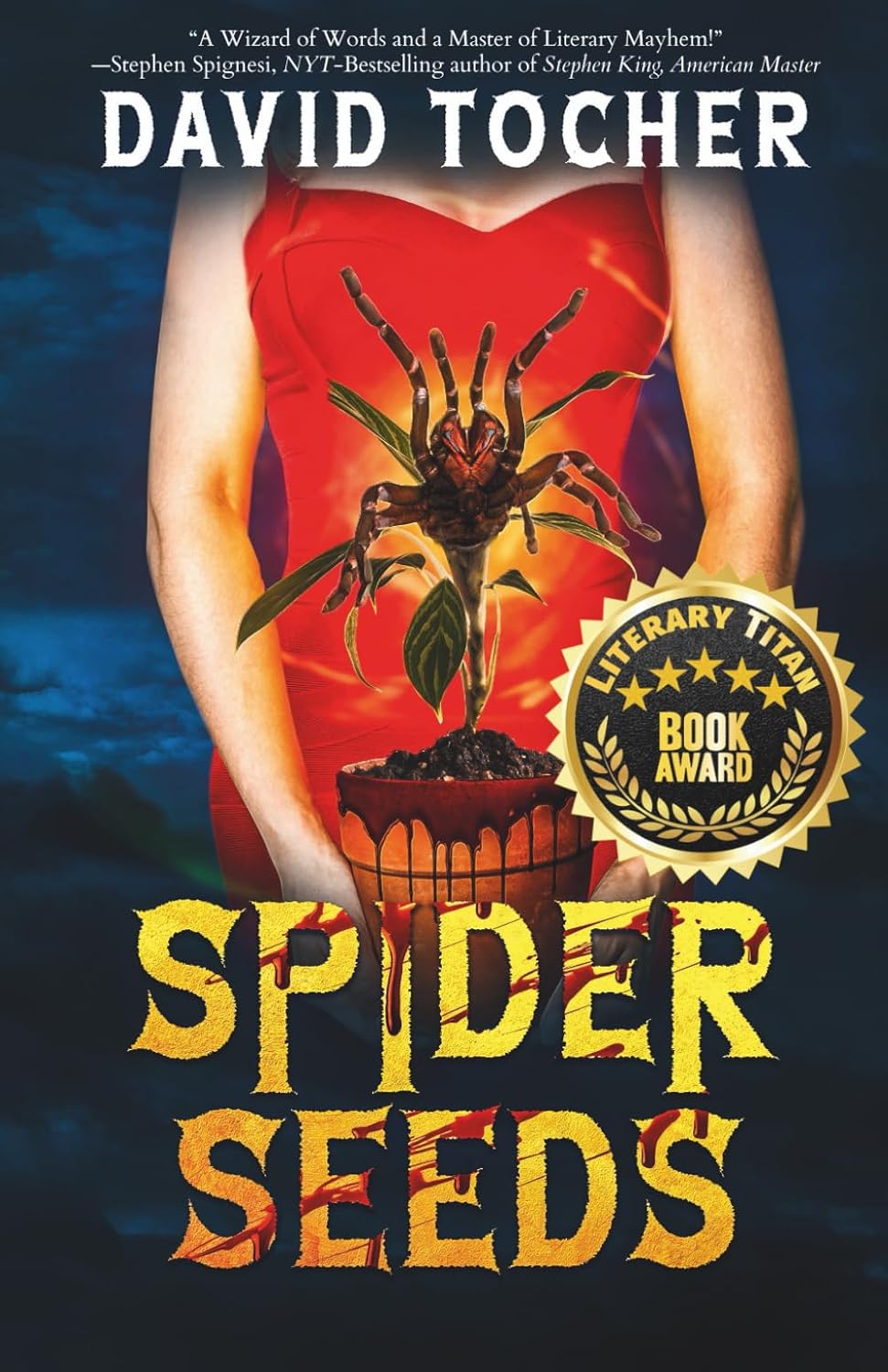
David Tocher’s Spider Seeds is a genre-bending literary tale that blends horror, folklore, and psychological drama into a haunting and poignant coming-of-age story. The novel follows Madison Perth, a successful author haunted by a brutal act of teenage bullying and the creeping darkness that event plants within her. As an adult, she crosses paths with a strange plant shop and unwittingly reignites the sinister forces tied to her past. From the ghostly forests of British Columbia to the cozy neighborhoods of Victoria, the novel peels back layers of trauma, resilience, and transformation, both emotional and otherworldly.
Tocher’s writing hits hard and fast, then lingers like the sticky web it describes. What impressed me most was how vividly he brings scenes to life—one minute, you’re on a nostalgic walk through a peaceful, cherry-blossomed city; the next, you’re choking on dread in a shadowy gully. His prose carries the rhythm of folklore but is sharp with modern sensibility. The characters—especially Maddy—feel incredibly real. She’s prickly, vulnerable, brilliant, and deeply scarred, and that’s what makes her so compelling. Her inner monologue, particularly when battling the internal venom of her past, left me shaken and nodding in recognition.
But what stuck with me even more than the plot was the slow, chilling realization that Spider Seeds is really about infection, not just by something supernatural, but by hate, memory, guilt, and self-protection. The horror isn’t loud or gory; it’s soft, parasitic, and psychological. That said, I felt that a few narrative beats, like the mythos surrounding the plant and the shop’s family legacy, felt rushed. I wanted just a little more from the ending. Still, the way Tocher plays with tension and emotional stakes more than made up for it.
Spider Seeds is a novel for readers who enjoy their horror quiet but unforgettable—less jump scare, more creeping dread. It’s perfect for fans of Stephen King’s more psychological work, or even Neil Gaiman with a darker twist. Anyone who’s ever been bullied, or who still carries the weight of being “the outsider,” will see pieces of themselves in Maddy.
Pages: 124 | ISBN : 1068965495


