Blog Archives
Hidden Meanings

Into the Fire follows a princess imprisoned for her rare gift of controlling Fire and Water Einn, whose escape sparks a journey of self-discovery. What draws you to the fantasy genre?
Fantasy is not bound by reality. It’s a creative way to use words teaching morality: Good versus evil. Spiritual lessons disguised in magic systems. Symbols that represent so much more. Hidden meanings.
Huldar has a rich mythic atmosphere. What were your influences when creating the setting?
The Bible. Iceland folklore Hidden People: Huldufólk. Stuðlagil Canyon, located in East Iceland. Admiral Richard E. Byrd the hollow earth map.
The novel often suggests that resentment is easier than hope. Why did that idea resonate with you?
It’s easier to hate. To hold on to resentment. Real strength is found in change. Ascending upward away from hatred. Leading to hope and to the last book of the series End of Joro.
Can you give us a glimpse inside the second book in The Huldar Chronicles? Where will it take readers?
The prequel. To the beginning, to pain. Out of the Water. Svaryur and Drifa’s story. What led to all the chaos of Into the Fire. Pain influenced purpose.
Author Links: GoodReads | Amazon
Will they ever find peace?
Will they be able to overcome the curse of human nature?
Into the Fire


Into the Fire, by K. Browning, is a character-driven fantasy about power, fear, and the hard work of choosing hope when resentment feels easier. The story begins with Sigrun, a princess locked away in the Haven because she can wield both Fire and Water Einn, a rare ability called Tvier. Her escape sets the plot in motion, but the book isn’t just about breaking out of a prison. It’s about what happens after freedom, when Sigrun has to decide who she wants to become.
The world of Huldar has a strong mythic feel, with rival kingdoms, secret codes, elemental magic, masked warriors, ancient wrongs, and a hidden third power called Joro. Browning builds the story around the tension between the Ljos and Dokkur Kingdoms, but the heart of the book is more personal than political. Sigrun and Aron, also known as Hrafn, are both shaped by loneliness, family wounds, and the heavy expectations placed on them. Their connection gives the story its warmth, especially because Aron keeps meeting fear with compassion instead of control.
One of the strongest ideas in the book is stated early: “There’s only one way to ascend and that’s with someone else.” That line carries through the entire story. Sigrun’s power is frightening, but the book is much more interested in whether she can trust anyone enough to stop surviving alone. Aron’s role in the story works because he isn’t there to overpower her or fix her. He gives her another way to see herself, and that makes their bond feel meaningful.
The book moves with a lot of urgency, especially once the escape widens into a conflict involving kings, warriors, old betrayals, and the truth behind the Fallen Kingdom. The magic system has a dramatic physical cost, which gives the battles more weight: Fire affects the heart, Water affects the eyes, and Joro affects the breath. That connection between body, emotion, and power fits the book’s bigger focus on discipline, endurance, forgiveness, and the danger of letting fear rule every choice.
Into the Fire becomes a story about ascension in the emotional and spiritual sense, not just the magical one. Sigrun’s journey from anger to trust gives the title real meaning, and Aron’s final promise, “I’ll be there to catch you when you fall,” lands as a fitting close to everything the book has been building toward. It’s a fantasy full of big feelings, high stakes, and sincere belief in redemption, with a cast that keeps pushing toward unity even when the world around them keeps choosing division.
Pages: 208 | ASIN : B0DLX15FR9

The Soundless Symphony: At the Heart of Night


The Soundless Symphony: At the Heart of Night is a poetry collection steeped in darkness, longing, nature, myth, and emotional survival. Stacy Seraphina White moves through grief, desire, silence, and renewal with a voice that often feels like it’s standing at the edge of night, listening for something tender beneath the hush. The book begins in an almost self-aware creative space with “The art of creation,” then drifts through poems of inner fracture, romantic ache, fantasy realms, and finally the natural world’s fragile light. By the time the collection reaches pieces like “To reach for Theia’s light” and “Familiarity,” it has become less a linear journey than a nocturnal procession, one where sorrow, beauty, and imagination keep brushing against each other in the dark.
What struck me most was the intensity of the imagery. This isn’t a quiet book in the plain sense, even though silence is one of its central moods. White writes in lush, shadowed textures, full of black roses, moonlit melodies, scarred palms, river pearls, pegasus wings, phoenix fire, and goddess light. At times, I found the poems almost baroque in their layering, especially in “Step into my realm,” where the speaker tumbles through a fantasy landscape of demons, fae, griffins, and a dark kingdom. That kind of abundance won’t be for every reader, but I admired how fully the book commits to its atmosphere. It believes in its own dream logic, and that sincerity gives the collection its emotional pull.
I also appreciated the ideas underneath the ornamentation. The book returns again and again to the cost of feeling too deeply, of being unseen, of turning pain into something that can be held without being simplified. “Reflection” captures that sense of being trapped by memory, while “Silence” turns grief into something thorned and alive. The love poems are often wounded rather than sweet, with desire mingling with abandonment in pieces like “Adrift” and “Heartache, a moonlit melody.” Even when the language is heavy with velvet and shadow, there’s a genuine emotional intelligence working beneath it. White understands that beauty doesn’t cancel ugliness. Sometimes it’s the only vessel strong enough to carry it.
I came away from The Soundless Symphony feeling as if I’d wandered through a candlelit gallery of grief, myth, and private weather. It’s a collection with a distinct sensibility, romantic, mournful, ornate, and deeply invested in transformation. This book is at its best when its darkness opens toward tenderness, when the night doesn’t merely consume but shelters. I’d recommend it to readers who enjoy atmospheric poetry, gothic romantic imagery, mythic flourishes, and emotionally saturated writing that lingers in sorrow without surrendering entirely to it.
Pages: 75 | ASIN : B0H1NCP5Z8
Modern New Adult Audience

Moonlight Desires, a Gothic retelling of Cinderella, follows a woman abused by her family who is lifted from drudgery by a royal figure who appears in spider form. What inspired you to retell this classic tale with a Gothic flair?
I’ve always had a thing for fairy tales, the kind we used to call “wonder tales” before they were sanitized. If you look closely at my work, the Brothers Grimm are almost always lurking under the surface. These are classic stories we all know by heart, which gives me a great foundation to build on. It allows me to focus my energy on reshaping those familiar bones into a Gothic fantasy retelling that feels gritty and real for a modern New Adult audience.
The imagery—especially the web, the dress, and the spectral coach—feels symbolic as well as aesthetic. What meanings did you intend behind those elements?
I actually used the Italian Commedia dell’arte as a sort of mental map for these characters. In that world, you have the “unmasked” lovers. These are the ones who are vulnerable and can actually change. And then you have the “masked” figures who are stuck in their ways.
In Moonlight Desires, Aurelia is the “unmasked” one. She’s going through loss and resentment, and she has to choose to forgive to find her path. Princess Kipira, though, is a “masked” figure. Her spider form isn’t just a choice; it’s a reflection of her own selfishness, trapped under a hideous curse. Then you have the Desires. These beautiful yet hollow spirits of the underworld only come alive in the moonlight. They’re yearning for a life they can’t have. By weaving these magical elements together, I wanted to create the kind of atmospheric writing and vivid world-building that fans of dark romance and monster fantasy are looking for.
Some readers have mentioned they wanted more technical details about the “Ingridelite Weave,” which is the pattern of Aurelia’s dress. But the weave is a metaphor of the story itself. In adult fairy tales, you don’t always need a manual for how the magic works and what makes it significant. You need to experience it. Kipira explains the Ingridelite Weave simply: every part of the pattern is connected to everything else. That’s how I see fantasy retellings across history: their patterns are endlessly moving, reshaped, and retold while staying recognizably themselves.
Just as the threads of the dress guide Aurelia’s movement when she dances, the inherited patterns of Ye Xian and Ashputtel guided my own hand as a writer.
What question did you most want readers to wrestle with after finishing the book?
I try to create a literary space where the symbolism does the heavy lifting. I don’t want to be a control freak and tell you exactly what questions to ask. I’d rather give you a dark, moody environment where you can find your own questions and answers within the frame of an adult fairy tale.
What is the next book you are working on, and when will it be available?
I’m currently finishing up Spider Sister, which is the sequel to my novel Spider Seeds. It’s part of the Spider Seeds Universe and links directly back to Moonlight Desires. You can expect a 2026 release, which will officially bring my spider horror series to a close.
Author Links: GoodReads | Website | Amazon
From her webs arise quiet works of fantasy: a gown, slippers, and a horse-drawn carriage, their threads quickened by moonlight and inhabited by the restless spirits of Hades.
Carried to Duke Andrew’s court festival, where jeweled crowns glint and his son must choose a bride, Aurelia steps into a world that finally sees her worth. Yet the curse gripping Kipira tightens, for she can only be freed through an act of true kindness, and even her best intentions are shadowed by self-interest.
As romance awakens, fate begins to stir.
Aurelia is about to discover that destiny is as fragile as threads of moonlit silk…and they are all woven into MOONLIGHT DESIRES
Red Ghost Trilogy: The Complete Series

Red Ghost Trilogy is a big, pulpy, wide-angle genre mashup in the best sense. It opens with a sixteenth-century sea disaster, swings into modern criminal conspiracies and cosmic horror, and keeps expanding until it becomes an apocalypse story with time travel, myth, telepathy, pirates, and spacefaring war. What makes it hang together is that author Gerry Eugene writes like he genuinely enjoys every strange ingredient he’s tossing into the pot. The book isn’t shy about being large, dramatic, and weird, and that confidence gives it a real charge.
What the trilogy really is, though, is an ensemble adventure built around people with mythic nicknames and very human grief. Anders Benson, Emerson Beekman, Anne Forcetti, Fred Collier, and especially Genevieve Cocklin all arrive with outsized abilities, but the story keeps grounding them in loss, loyalty, and stubbornness. Genevieve ends up being the emotional center of a lot of the book, which surprised me in a good way. She’s introduced with the blunt, perfect line, “Genevieve was a pirate,” and Eugene spends a lot of time proving how many shades that can hold: strategist, lover, killer, commander, and eventually something close to legend.
The thing I liked most was the book’s scale. Eugene doesn’t think in narrow lanes. He thinks in collisions: old Spain and future war, organized crime and folklore, fungal plague and sacred cure, helicopters and demons. Even the diction likes to leap upward. Early on, one of the villains offers a string of clues that sounds like a thesis statement for the whole trilogy: “Cosmology. Cosmic vortices. Conical wormholes. Triggering megahertz. Auditory mandalas.” That line tells readers exactly what kind of ride this is. It’s not interested in staying tidy. It wants to be vivid, maximal, and just a little feverish.
Eugene likes ornate prose, formal phrasing, dramatic entrances, and chapter-to-chapter momentum, and that gives the book an old-school storytelling energy. He also has a gift for giving emotional pain a clean, memorable shape. One of the strongest stretches in the first book is Genevieve’s rush toward Seattle after the world has started collapsing around her. That whole sequence works because the action never floats free of feeling. For all the telepathy, monsters, and battlefield planning, the trilogy keeps coming back to what catastrophe does to love, friendship, and chosen family.
Red Ghost Trilogy is a sprawling speculative epic that runs on sincerity, imagination, and momentum. It’s the kind of book that wants to entertain generously. It gives readers haunted history, end-of-the-world stakes, magical combat, and a found-family core sturdy enough to carry all that spectacle. Anyone who likes fiction that blends science fiction, fantasy, horror, and adventure, this collection has a lot to offer. It feels less like a neatly engineered machine and more like a huge, eccentric saga told by someone who loves stories too much to keep them small.
Pages: 748 | ASIN : B0GKXKF9Z6
A Vivid Dream

Shiloh follows a paramedic who discovers and cares for a wounded wolf that mysteriously disappears and is replaced by a stunning woman who bears the same wound. What was the inspiration for the setup of your story?
The inspiration for Shiloh was a result of a surreal dream I had one night. The dream was so vivid, I was compelled to write down as much of it as I could remember the following morning. Over the course of several years, I would review those notes and add ideas and notations. When it came time to sit down and write the story, it only took a couple of months. The story basically wrote itself – it was like watching a movie play out in my mind’s eye.
Why set the story in the remote forests of northern Idaho?
I wanted a location which was close to British Columbia in Canada – someplace fairly remote and isolated. Someplace where wolves are also prevalent. In choosing Bonners Ferry for the location, the area seemed to fit perfectly into the overall plot and mood of the story.
How did you approach writing a character who exists between human and animal?
That was easy. It was all a part of the dream I had. I just had to figure out a way to characterize the wolf and the woman into a fairly believable tale.
Do you see this story as complete, or is there more to explore in this world?
The human mind is a strange and wonderful thing. I’m not sure if we’ll ever fully know or understand how it works the way it does. Mental health issues are all too real in this day and age, and I wanted to tell a unique love story, one which was based on what the mind created. Shiloh literally became Sam Henderson’s “dream” lover.
Then he meets Shiloh – a strong, enigmatic and beautiful woman – and his world begins to shift. Their connection is intense, improbable, and deeply human. It also harbors undertones of something more sinister.
Set against the rugged beauty of northern Idaho, Shiloh is a gripping psychological thriller that explores the boundaries between man and nature, love and obsession, control and surrender. As secrets surface and tensions build, Sam is forced to confront the unpredictable forces around him and within him.
In the end, the question isn’t will he survive, but will he recognize the man he’s become?
Shiloh – An Act of Compassion Becomes a Prelude to Madness
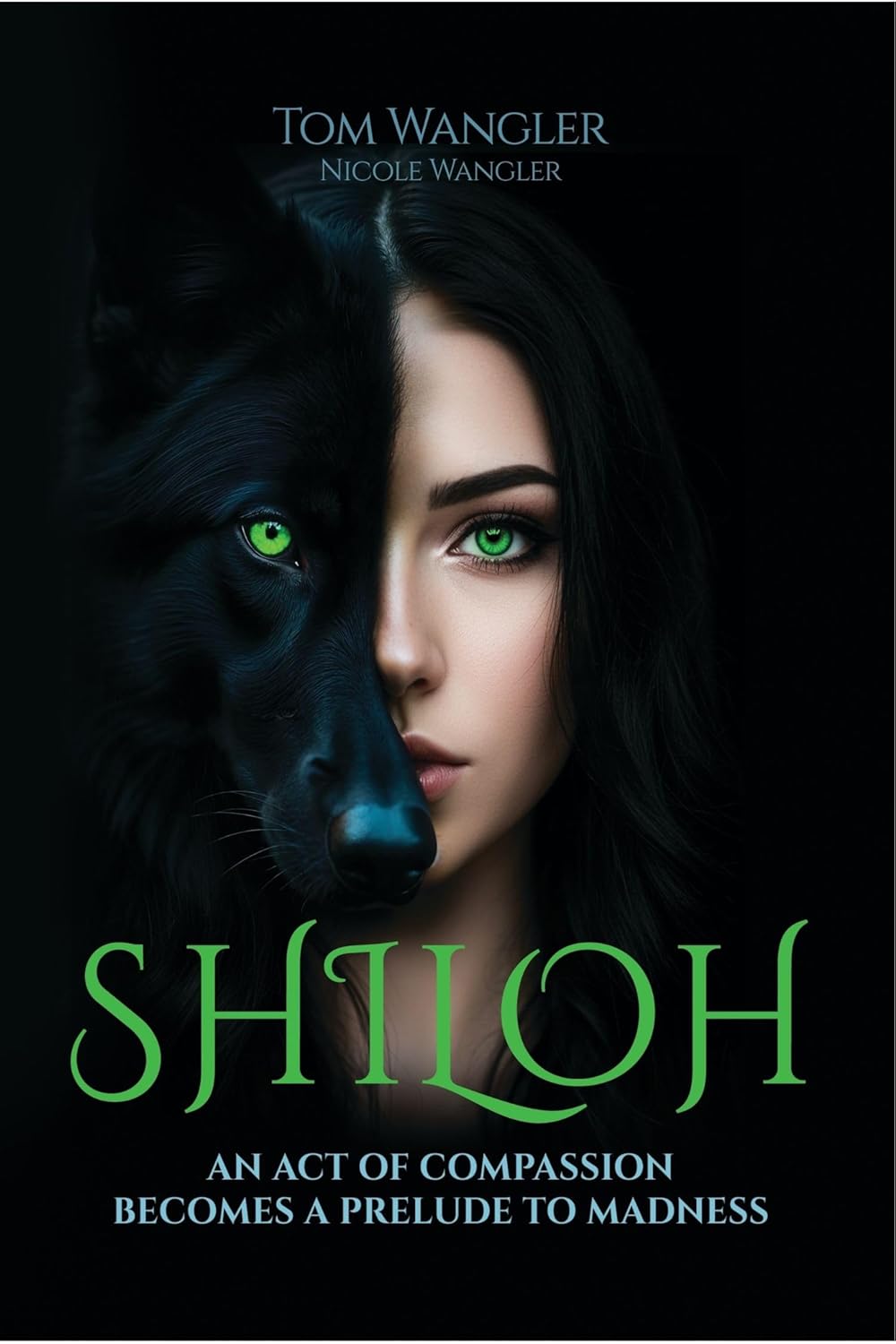
The story begins with Sam Henderson, a quiet paramedic living in the remote forests of northern Idaho. One night, he discovers a wounded wolf on his porch and uses his medical skills to save it. By morning, the wolf is gone, and in its place stands a mysterious and stunning woman named Shiloh, bearing the same wound. What follows is a haunting blend of myth, romance, and psychological unease. The book steadily unfolds a strange world where compassion collides with the supernatural, exploring the blurred lines between man, nature, and the monstrous.
The writing is vivid and unhurried, striking in how it paints the forests, the silence, and Sam’s isolation. The tone is eerie, yet tender. I could feel Sam’s confusion and curiosity, his logical mind struggling to comprehend what stood before him. The authors have a way of turning quiet moments into something tense and electric. At times, though, the dialogue feels old-fashioned or a bit heavy-handed, like a stage play where everyone speaks too carefully. Still, the emotional honesty pulls it through. I found myself caring deeply for Shiloh, even when her story turned darker and more complex.
What struck me most was the mix of compassion and madness. The book digs into loneliness, faith, and what it means to help someone, or something, you don’t understand. Sam’s empathy is both his strength and his undoing. There’s a sadness beneath it all, the kind that lingers. The supernatural angle, tied to ancient curses and human cruelty, feels oddly believable because the emotions ring true. It’s not a horror novel exactly, but it unsettled me in the quietest ways.
I’d recommend Shiloh to readers who like stories that mix realism with myth, who enjoy character-driven suspense more than fast-paced thrillers. It’s for anyone who’s ever felt the tug between logic and instinct, love and fear. Shiloh reminded me of The Shape of Water by Guillermo del Toro, with its mix of tenderness and unease, where love brushes up against the strange and the boundaries between human and creature begin to blur.
Pages: 126 | ASIN : B0GTMBH4HK
Art is for Everyone

The Mermelf: A Fable for Our Times follows a wingless, tailless blue mermelf that falls from the stars into the enchanted world of Merbay, whose awakening sparks a resistance on Earth where imagination is outlawed. What was the original spark for Xiu?
In my book, an idea from 1803 is a living presence: ..” The Idea / breathed two sighs, one of relief and one/ of a shortcut onto a dusty and / forgotten shelf of Cranny’s mind.” In the book, I see ideas as living things looking for someone to manifest them. Xiu comes from Cygnus. Throughout history, the stars of Cygnus were seen as a point of origin and return for the human soul. Many ancient sites -including the Pyramids of Giza, and various European megaliths (Newgrange) -are claimed to align with the stars of Cygnus, particularly the star Deneb. This ancient reverence may have been based on an understanding that high-energy cosmic rays that influenced life on Earth may have originated from the binary star system Cygnus X-3. In the March 2006 edition of Astronomy Now, the British anthropological writer Denis Montgomery argues in favour of a connection between cosmic ray activity and the relatively sudden transitions in human behaviour patterns around 35,000 BP. Gwythian’s relatively dark, coastal location provides excellent viewing opportunities, especially for locating the star Deneb. I was on holidays in Gwythian, Cornwall when I dreamed of a blue mermelf coming to Merbay astride her fireflier. The depth of the ocean I had swam in earlier, the blue of the sky, Virginia Woolf’s lighthouse on the horizon, the shape of Cygnus in the night sky, and the fantasy novels strewn over the coverlet of the sofa in the little tin hut I was renting from the enigmatic Queenie all coalesced. I think many fantasy writers are inspired by myths, as we see ourselves as heirs to ancient folklore. Tolkien drew heavily from Norse and Anglo-Saxon mythology, and I am often inspired by both myth and answering a ‘what if’ in the context of scientific logic. But my mind is most open when it is in a dremang state. Dream as it meets with the what-if of characters who become lifelong companions. It took some time to find Xiu’s name, arriving as it did when I eventually wrote the line: ‘Cygnus catches dreamers with her daughters’. When something is outlawed, it goes outside the norms of a given place and time. My own life had followed a trajectory that did not include accepting the received wisdoms of status: I holidayed in Cornwall every year as a balm against liaising through prejudice in my work as a Community Worker. The systems and structures that uphold a world of insiders and outsiders is one that needed imaginative repsonses to navigate. Imagination is one of the tools that we as human beings have at our disposal to make this world a fairer and more equitable one for everyone, including Nature and the inhabitants of all our imaginary worlds too, so my dreams brought me a blue mermelf from the Cygnian constellation to help my readers and me see another way.
Your prose is lyrical and rhythmic. Do you write with sound in mind first, or image?
What a lovely question. I tend to experience sound and image arriving together rather than separately. I’m very conscious of rhythm and cadence as I write-the movement of a line, the weight of a syllable, the way phrasing carries emotion-but at the same time, I’m seeing the moment visually. For me, metre and image coalesce; the music of the line often shapes the image, and the image in turn suggests its own pace and tone. I’m also led strongly by character. Once I’ve a sense of who is present in a scene, their emotional life begins to guide the language, the rhythm, and even the imagery that emerges. It often feels less like I am constructing the moment and more like I am listening and watching my characters move, speak, and perceive the worlds in which they find themselves. And the language follows those impulses. The sound, the image, and the characters all work together to carry the story forward or backward, as Time is not linear.
The book feels timely in its warning about forgetting what makes us human. What concerns were you exploring?
That is another excellent question. I believe that art is for all of us, not for the privileged few. To that end, I have always tried to bring poetry into the community, sometimes on a voluntary basis, sometimes more formally, as in the Japanese Poetry Workbook: Master Haiku, Tanka, Renku, Haibun & more with prompts and exercises I just self-published on Amazon Kindle. Imagination is coralled by so many gatekeepers, sometimes financially but more often by draconian groups such as The Nomenclature. The idea behind the Nomenclature grew partly from looking at how regimes built on fear try to control not only other people’s actions but their inner lives. I was thinking about periods in history where imagination, books, and independent thought were treated as dangerous, and how conformity was treated as dangerous. I was also thinking about periods that particularly outlawed imagination for girls, as my lead characters are female. Throughout history, women’s access to imagination and creative expression has often been constrained, especially during times of authoritarian control: Fascist Europe, the Middle Ages, the Victorian era and the early twentieth centuryto name a few. Sauron and his legions in Middle-earth,, Imagination, fantasy, and creativity and anomaly have always intertwined with how we see and interpret Nature, and how we construct real and imaginary worlds. Many of the fantastical worlds that women writers have imagined have been a blend of imagination, science, and social critique, whether the eerie landscapes of Mary Shelley’s Frankenstein or the cultural worlds in Le Guin. The anomalies in my book reflect a long history in which society has often restricted imagination, particularly for anyone or anything that is different, and very often it is the female who carries the brunt of this censure. Imagination thrives in freedom, and I have tried to show in my book that Imagination remains both necessary and revolutionary, and how the wider society, no matter what that society is or in which timeframe it exists, has still never solved the problem of fearing it. That is, until the mermelves and those marked with a blue birthmark. Beacons of hope in this, our Age of the Machine.
If imagination is a star, as the book suggests, what happens when people stop looking up?
When we stop looking up, we become our shadow selves, and the world becomes a shadow of what it could and can be. The light that guides creativity, curiosity, and hope begins to fade. Life becomes smaller, meaner, confined to what can be quantitatively measured, confined to GDP. Not that the small and the tiny are not larger than life in The Mermelf. It is all a question of perception.
Author Links: Facebook | X | Instagram | Website


