Blog Archives
Modern New Adult Audience

Moonlight Desires, a Gothic retelling of Cinderella, follows a woman abused by her family who is lifted from drudgery by a royal figure who appears in spider form. What inspired you to retell this classic tale with a Gothic flair?
I’ve always had a thing for fairy tales, the kind we used to call “wonder tales” before they were sanitized. If you look closely at my work, the Brothers Grimm are almost always lurking under the surface. These are classic stories we all know by heart, which gives me a great foundation to build on. It allows me to focus my energy on reshaping those familiar bones into a Gothic fantasy retelling that feels gritty and real for a modern New Adult audience.
The imagery—especially the web, the dress, and the spectral coach—feels symbolic as well as aesthetic. What meanings did you intend behind those elements?
I actually used the Italian Commedia dell’arte as a sort of mental map for these characters. In that world, you have the “unmasked” lovers. These are the ones who are vulnerable and can actually change. And then you have the “masked” figures who are stuck in their ways.
In Moonlight Desires, Aurelia is the “unmasked” one. She’s going through loss and resentment, and she has to choose to forgive to find her path. Princess Kipira, though, is a “masked” figure. Her spider form isn’t just a choice; it’s a reflection of her own selfishness, trapped under a hideous curse. Then you have the Desires. These beautiful yet hollow spirits of the underworld only come alive in the moonlight. They’re yearning for a life they can’t have. By weaving these magical elements together, I wanted to create the kind of atmospheric writing and vivid world-building that fans of dark romance and monster fantasy are looking for.
Some readers have mentioned they wanted more technical details about the “Ingridelite Weave,” which is the pattern of Aurelia’s dress. But the weave is a metaphor of the story itself. In adult fairy tales, you don’t always need a manual for how the magic works and what makes it significant. You need to experience it. Kipira explains the Ingridelite Weave simply: every part of the pattern is connected to everything else. That’s how I see fantasy retellings across history: their patterns are endlessly moving, reshaped, and retold while staying recognizably themselves.
Just as the threads of the dress guide Aurelia’s movement when she dances, the inherited patterns of Ye Xian and Ashputtel guided my own hand as a writer.
What question did you most want readers to wrestle with after finishing the book?
I try to create a literary space where the symbolism does the heavy lifting. I don’t want to be a control freak and tell you exactly what questions to ask. I’d rather give you a dark, moody environment where you can find your own questions and answers within the frame of an adult fairy tale.
What is the next book you are working on, and when will it be available?
I’m currently finishing up Spider Sister, which is the sequel to my novel Spider Seeds. It’s part of the Spider Seeds Universe and links directly back to Moonlight Desires. You can expect a 2026 release, which will officially bring my spider horror series to a close.
Author Links: GoodReads | Website | Amazon
From her webs arise quiet works of fantasy: a gown, slippers, and a horse-drawn carriage, their threads quickened by moonlight and inhabited by the restless spirits of Hades.
Carried to Duke Andrew’s court festival, where jeweled crowns glint and his son must choose a bride, Aurelia steps into a world that finally sees her worth. Yet the curse gripping Kipira tightens, for she can only be freed through an act of true kindness, and even her best intentions are shadowed by self-interest.
As romance awakens, fate begins to stir.
Aurelia is about to discover that destiny is as fragile as threads of moonlit silk…and they are all woven into MOONLIGHT DESIRES
Moonlight Desires


Moonlight Desires is a Gothic, moon-drenched Cinderella retelling that begins in familiar sorrow and then slips somewhere stranger, sadder, and more haunted. Aurelia, abused by her father, stepmother Julia, and stepsister Lysandra, is lifted out of drudgery not by a fairy godmother but by Princess Kipira, a royal figure cursed into spider form after an act of pride and cruelty. What follows is a tale of enchanted web-woven dresses, silent spectral coaches, a courtship with Lord Samuel, and a surprisingly weighty meditation on forgiveness, selfishness, and the difficulty of true kindness. What stayed with me most was the book’s doubleness: it offers the pleasure of romance and transformation, but it also keeps pressing into darker moral territory, especially through Kipira’s confession and Charlotte Sophia Janicker’s closing reflections on the old Cinderella pattern itself.
I admired the atmosphere almost immediately. Tocher writes as if he wants the fairy tale to keep its ceremonial bones while letting rot, grief, and desire show through the silk. The image of Aurelia being carried over the ground on Kipira’s web, laughing into the speed after years of misery, is one of those moments that feels both eerie and liberating. The spider-silk gown, alive with the shifting Ingridelite Weave, is gorgeous in exactly the right unsettling way, and the coachman’s macabre delight in how “the dead travel fast” gives the whole transformation sequence a morbid charge that separates this book from sweeter, safer retellings. I also liked that the prose is unafraid of lushness. Sometimes it leans almost incantatory, then suddenly turns intimate or severe. That tonal elasticity gave the story real texture for me.
What interested me even more, though, was the book’s moral and emotional argument. Aurelia’s repeated return to her mother’s little poem about goodwill and forgiveness could have felt merely dutiful, but here it becomes the story’s beating heart. Her mercy toward the people who degraded her is moving precisely because the novel does not pretend forgiveness is easy, clean, or instinctive. The most fascinating character in the book for me is Kipira. Her letter transforms the story from a dark fairy tale into something more searching because she understands that even her generosity has been contaminated by self-interest. That idea, that a good deed can be hollow if its hidden motive is restoration of the self, gives the novella a spiritual unease I genuinely appreciated.The erotic honeymoon passage plus Charlotte’s explicit feminist afterword create a sharp shift in register. For me, though, that oddness was part of the book’s identity. It doesn’t smooth itself into one thing. It remains a little thorny, a little hybrid, and more memorable for it.
I found Moonlight Desires sincere, peculiar, and unexpectedly compelling. It’s a fairy tale retelling that blends romance, horror, theology, sensuality, and a self-aware literary sensibility. That mix makes the story feel distinct. I came away feeling that the writing is at its best when beauty and dread are touching, and that the book’s deepest idea is not enchantment but the hard, almost painful mystery of becoming good. I’d recommend it to readers who enjoy darker fairy-tale revisions, Gothic textures, and stories that are willing to be earnest about mercy, longing, and moral struggle.
Pages: 72 | ASIN : B0GDHV1151

Gods of Glenhaven
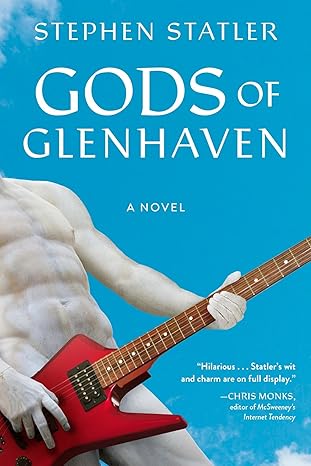

Gods of Glenhaven is a raw, darkly funny, and deeply human story about people falling apart and trying to stitch themselves back together. It follows Christian Orr, a man sliding into middle age with a broken marriage, sexual dysfunction, and a pile of humiliations that somehow keep getting worse. His wife, Sloan, is a driven attorney who mistakes dominance for control until her life unravels, too. Their teenage daughter Francesca floats between them, trying to make sense of the wreckage. Around these three, the town of Glenhaven buzzes with gossip, longing, and absurdity. It’s a small world full of big emotions, where humor and despair share the same seat.
I found Statler’s writing disarmingly sharp. Every line feels alive with awkward truth. He doesn’t flinch from embarrassment or pain, and he writes humiliation with the kind of precision that made me both laugh and squirm. The dialogue is quick and biting, but the silences hit harder. Christian’s spiraling self-awareness feels almost too real at times; I could feel the claustrophobia of his failures and the absurd hope that something, anything, might still redeem him. Sloan, on the other hand, made me furious and fascinated in equal measure. She’s brittle, proud, often terrible, but undeniably human. The novel moves like a tragic comedy that keeps threatening to tip either way.
What really struck me was how the book keeps shifting tones without losing its rhythm. One page had me laughing at Christian’s disastrous attempts at self-improvement, and the next left me staring, a little shaken, at how much loneliness the humor covered up. Statler writes like someone who has seen both the joke and the wound and refuses to pick one. The story feels like real life that’s been turned just slightly toward the absurd, so everything painful also glows with a weird kind of beauty. It’s messy, brave, and very alive.
Gods of Glenhaven is a brutal but compassionate look at failure and forgiveness. I’d recommend it to readers who love flawed people written with empathy. Fans of writers like Richard Russo or Jonathan Franzen will probably feel at home here. If you’ve ever felt lost, humiliated, or ridiculous and still had to get up the next morning, this book might hit uncomfortably close to the truth.
Pages: 378 | ASIN : B0F8KPGH67
Warrior Mystics
A Shroud of Sorcery centers around a mystic and his companions, simultaneously navigating tribal politics and the emergence of a ritualistic killer. What was the inspiration for the setup of your story?
I visited a hillfort in Shropshire called Bury Ditches about a year before I started writing. Whilst there, I imagined what it would be like at the pivotal point in ancient British history when these Iron age tribes with their pagan beliefs and mysticism came up against the technologically advanced but brutal Roman Empire as they took over Britain. Other sites, such as the great stone circles at Avebury, inspire me to think of what spiritual and magical beliefs led the builders and successive generations to build and use these monuments. What if they were not just meeting places or locations to celebrate the dead, but, instead, they were used by tribal mystics, mages, and seers? In this book, I wanted to use these ancient sites more dramatically to weave a fantastical, yet believable tale, and still within a real historical framework.
A Shroud of Sorcery continues to explore the tensions within the Cornovii. Big characters such as Toryn remain loud and full of bluster, and just when you think he and Alba are getting along, it can change in an instant. These interactions are forced into cooperation both by the ritualistic killings and the ongoing Roman threat. It was important to me that the characters should be believable, yet colourful enough for the reader to understand their loyalties, emotions, and personal circumstances to explain how they interact. Even lesser characters like Duro had to have a personality that, whilst unpleasant, fits within a culture of its time. In this book, I explore more of Favius’s background – what made him the cold killer he became with a look at his initial history of assassinations within the Organisation. He also represents the opposite of the likes of Toryn, who airs his views and emotions (and anger) openly, whilst Favius connives and plots in secret. Both are strong, both are very different.
A Shroud of Sorcery has several moments where the darkness of the sorcerer’s actions or the threat of the Roman legions are balanced by introducing moments of humanity, and sometimes these prevail, others they do not. This was an exploration of character, and I wanted to illustrate how light and dark, good and evil are not absolutes; there are positions in between these two polar opposites, such is real life. For example, the sorcerer occasionally makes a decision not to kill, but I want the reader to understand why that is, and hopefully that comes through in the book. Favius can be brutal, but he always acts from his own reasoning or logic, dispassionate though it is. Of all the characters, he is the most absolute for there is no compassion in a void.
The sorcerer was conceived to be a complex character, not just someone who kills with barbarity. The story weaves a tale around their origin, which explains where they came from, but deliberately sets up the reader to realize that environment is not always the explainer for evil actions. Yet, there are times when a sliver of compassion hovers intriguingly about their decision to let someone live, but would you rely on it – probably not!
How did you handle balancing the power and use of magic in the story?
I wanted the use of magic to be menacing and dark, but at the same time grounded and believable. The contrast between the sorcerer (dark) and Alba (light) exemplifies how, like our own modern technology, there is no good or bad magic or technology; rather, it comes down to the people who use it for good or ill. As such, magic in the story is a tool, used to project good or evil, but it is still a tool. Because I use it in this way, it becomes an aspect of the characters, who are the real power. In contrast, Favius, who (as far as we know) is not skilled in the dark arts, uses his power to steer the Roman Empire to the will of the Organisation. He does not need tools such as magic and instead uses assets like the sorcerer or his legionary commanders to achieve his aims.
The use of magic in this book is what delivers the main threat. Even Alba, when emotionally compromised, can use it for ill, and at one point we see that when he and Toryn have one of their disagreements. It is the threat of magic and its use for evil that first brings Toryn to Alba, for even a seasoned warrior such as Toryn knows his limitations when faced with such a force.
What do you think were some of the defining moments in Alba’s development?
As a character, Alba had to be first and foremost a man who believed in the old ways – someone who viewed his culture and history as something worth protecting in the face of a powerful conquering empire that regarded him and his kind as nothing more than barbarians and subhumans.
I have set him at a time when the Cornovii’s entire way of life is under threat, including their beliefs in their own gods. Set amongst this, he is one of the last remaining warrior mystics, capable of fighting with sword or bow as well as skilled in ways of magic.
In A Shroud of Sorcery, Alba is also defined by loss. The love of his life is gone, lost to a sickness which would of course have been a constant threat two thousand years ago. Grief often leaves a hole, and for Alba, that is an exploitable weakness as we see the sorcerer take advantage of (and for other reasons!). Alba worries about his tribe becoming redundant and subsumed within the Roman empire, but there is also the doubt he has over his own skills becoming redundant. This is not merely because his is a declining art but also that his knowledge and his own skills in magic have become stale and stuck. In contrast, the sorcerer has knowledge that he does not have, and this plays out in his mind as a character flaw.
Alba’s balance is often Argyll, who, with friendship and humour, keeps him centred. I originally conceived Alba as more of a loner, potentially with just a horse or dog as a companion, but I wrote Argyll as someone who could provide a deeper interplay – someone who can hold his own in a fight, who backs up Alba in a fight, and who keeps him focused on his own abilities in the face of whatever threat faces them.
Can fans look forward to seeing Book 3 of the Alba Mysteries released soon? Where will it take readers?
Planning for Book 3 is underway, and I aim to start writing in October. I have outlined the overall plotline and visited some of the locations that will feature in it.
I have also started writing a side novel, focused on Favius and the Organisation he works for. Set in multiple locations, it explores his younger years when he was climbing the ranks of the Organisation and becoming one of their top assassins. I have not yet decided whether to release this before or after the third book – we will see!
Author Links: Goodreads | Website | Amazon
“In all the legends the child is taken and trained in the magickal arts. Seldom do they return.”
Attempting to subvert the native Cornovii to Imperial rule, the Romans are increasing their presence in one last effort to turn the barbarian to Roman rule. Legionary commanders want all-out war; an opportunity to defeat Cornovii resistance once and for all which will send a powerful message to other British tribes who resist.
The Organisation, the hidden overlords of Imperial rule, deploy a new asset to encourage the barbarian Cornovii tribe to turn to Rome for their protection. A series of brutal murders follow where victims bear witness to ritual magick and sorcery.
Cornovii warrior mage Alba must uncover an adversary who has deep knowledge of the dark arts, perhaps exceeding his own. Their identity is a mystery reaching into the most ancient myths of the craft. The killer uses illusion to subjugate their victims and soon Alba finds himself battling elemental entities, hexes and even traps laid in the dreamworld.
Chieftains, tribal elders, spies and assassins inhabitant the turbulent and often violent world of Roman Britain, where the old ways of magick and tribal allegiance slam into Empire and Imperial domination.
Set in the mysterious landscape of ancient Britain amongst stone circles, hillforts and rock caves, A Shroud of Sorcery takes the reader on a journey into the mists of another time where magick, conflict and a secret organisation will determine the future of an entire tribe.
A Shroud of Sorcery is the second book in the Alba Mysteries.
Where history meets fantasy; where magick meets reality.
A Shroud Of Sorcery

A Shroud of Sorcery plunges the reader into first-century Romano-British Britain, where the fragile balance between tribal independence and Roman occupation teeters on the edge of war. We follow Alba, a mystic of the Cornovii tribe, and his companions as they navigate mounting Roman incursions, tribal politics, and the unsettling emergence of a cunning and ritualistic killer whose methods suggest dark, supernatural forces at work. Griffiths weaves a tale that shifts between tense skirmishes, eerie encounters, and moments of quiet reflection, building a world steeped in ancient magick, folklore, and the gritty realities of survival in a land caught between cultures.
This book was an immersive experience. Griffiths has a knack for painting landscapes that feel both tangible and ominous, from the shadowy forests of Wyre to the fortified hilltops of tribal strongholds. The opening scenes grip you with breathless pursuit and never quite let go. I found the interplay between historical detail and mystical elements especially engaging. Neither overwhelms the other, and both work in tandem to keep the stakes high. The pacing occasionally lingers in dialogue-heavy sections where tempers flare and egos spar. Still, those moments reveal the personal grudges, fragile alliances, and shifting loyalties that underpin the plot, giving weight to every confrontation.
The characters are the heart of the story, and they’re written with a mix of grit, stubborn pride, and surprising vulnerability. Alba’s blend of mystical insight and pragmatic warrior sense kept me invested, while Argyll’s sardonic humor balanced the darker beats. Even minor characters, like the prickly and insecure Duro or the calculating Roman officers, feel distinct. The antagonist’s presence, both human and possibly otherworldly, hangs over the story like a cold mist, and while not all mysteries are resolved, the sense of dread they bring is palpable. There’s a grounded cruelty here, both in Roman tactics and in the killer’s methods, that makes the moments of trust and camaraderie stand out all the more.
This book will appeal to readers who enjoy historical fiction laced with dark fantasy, as well as anyone drawn to stories where political maneuvering, ancient beliefs, and personal vendettas collide. If you like your battles visceral, your landscapes vivid, and your mysteries threaded with the supernatural, A Shroud of Sorcery is worth your time.
Pages: 324 | ASIN : B0F6KLHYQP
Involuntarius

Involuntarius plunges into darkness, unraveling a tale of religious dominance, hidden truths, and brutal rituals. The story follows Ellis, a young man entangled in the sinister web of the Congregatio, a powerful religious order that dictates every aspect of society. Ellis, seeking answers, uncovers unsettling connections within his family, spiraling deeper into a nightmarish reality where nothing is as it seems.
Izquierdo’s writing is gripping. The prose, dense and vivid, pulls you into a world that feels alive yet eerily off-kilter. Early on, Ellis stumbles upon his mother’s lifeless body. The scene is stark and haunting. You feel the horror, the despair. This intensity doesn’t let up; it keeps you hooked. The rapid pace, combined with the heavy language, makes this book hard to put down. The Congregatio dominates, and its presence is tangible, almost like that of a character itself. Rigid hierarchies, secretive rituals, and absolute power—this is a world where blind faith is dangerous. The tension between control and rebellion pulses through the narrative. Sadie, an enigmatic figure, is both captivating and terrifying. Her relationship with Ellis and his father is a twisted dance of power, leaving you questioning who’s really in charge. The plot is filled with twists and tangles. Supernatural elements sneak in, voices whisper, and heat shimmers. There is a sense of something dark lurking beneath the surface that keeps you reading.
Involuntarius is a dark journey. Fans of gothic horror and psychological thrillers will find it compelling. Izquierdo crafts a world that’s as terrifying as it is fascinating. The characters are shadowed in mystery, their secrets pulling you deeper. It’s a story that will linger long after you’ve turned the last page.
Page: 343 | ASIN : B0D9ZZDJVB
I Wrote the Book I Always Wanted to Read

Tears of the Aeon: The Gothic War blends fantasy with meticulously researched historical detail, convincingly portraying the era while integrating divine intervention into human conflict. What inspired the fantastic journey your characters take?
There were several inspirations that pushed me into writing this book. For example, my first main inspiration was “Homer’s the Odyssey.” In “the Odyssey,” after the Trojan War ended, the main character, Odysseus, goes through trials and tribulations in order to go back to his home, his wife Penelope, and his son Telemachus. And Just like Odysseus, “in Tears of the Aeon: The Gothic War” Ahediel is a skillful warrior who goes through his own entire odyssey, wishing to go back and reunite with his beloved Amia, sacrificing his own kind, his training, and his world in the process. Knowing that Amia is a forbidden love, he searches for her everywhere but can’t find her, fearing the worst. And just like Odysseus who arrives on the island of the Phaeacians nearly losing his life, Ahediel crashes into earth and remains in a place where he does not belong or desires to be. He’d rather be with the love of his life than to fight in a war. Also, I took some inspiration from “the Iliad,” “the Prose Edda,” and “the Epic of Gilgamesh,” to give shape to a grandiose tale.
As a fan of Greco-Roman and Norse Mythologies, I always wanted to read or watch a movie combining both, making them take part in ancient times, like in the movie “Clash of the Titans,” for instance. But unlike like “Clash of the Titans,” I wanted to write a story that takes both mythoi into the same universe and makes them coincide in a fluid and cohesive narrative.
I can say now that I finally wrote the book I always wanted to read…simple as that.
What kind of research did you do for this novel to ensure you captured the essence of the story’s theme?
I saw a TV documentary back in 2004 or 2005 (I can’t recall the exact date). This TV documentary was the one that ignited my desire to start writing this novel. Something inside me wanted me to write this book, torturing me every time I tried to sit down and watch Television. It created some sort of anxiety in me that would not allow me to live my life in peace. I had to let it out. When I found out that the TV documentary did not have enough historical details for me to begin writing the story I wanted to tell, I decided to buy four historical books back in the summer of 2011, about the Gothic War. I immersed myself within this ancient world and started to imagine myself walking on the streets of Roman Pannonia, running scared in the mysterious Germanic forests, and stand on the marble floor inside Emperor Valens’ throne room, listening to his council speak about the politics of the time. I was overwhelmed during that early phase of my book. I had to read a lot, do a lot of research, because I wanted to write this book and make it as truthful to the era as I could make it.
One of the themes I wanted to tap into the overall storyline was the concept of “family” and “bloodline”. In ancient Greek mythology, it was a tremendous sin in the eyes of the gods for a family member to harm or kill another family member. This was very frowned upon by their gods and their society; it was the ultimate sin. It was definite that the gods would curse the aggressor for such transgression. You could count on that. To give you an idea, for example, this concept of “blood and family” is used in the story of “the Iliad,” when King Agamemnon tricks his daughter Iphigeneia in thinking that she is going to marry the hero Achilles. Then her father sacrifices her to the goddess Artemis. Because of this forbidden blood sacrifice, the goddess listens to Agamemnon’s wishes and makes the wind guide his battle ships into Troy, to unleash war on the city. Iphigeneia’s death by the hand of her father brings unfortunate events to Agamemnon’s house.
What were some themes that were important for you to explore in this book?
The theme of “family” was very important for me to explore in this book. As you well know, the title of each chapter begins with “The Son of…” or the “Daughter of…” and then the name of their father’s follows after. Back in those ancient times, it was very important for a father to leave a good track record within society if he wanted his bloodline to continue. Their children could suffer bad treatment in the society where they lived if their fathers were not well received or left a bad reputation behind. It was a very patriarchal culture, indeed, which I did not want to exclude as part of that culture.
The other themes I had fun including in the story were the concepts of “choices and consequences,” “power,” “true love versus lust,” “trust and betrayal,” and “vengeance.”
Is this the first book in the series? If so, when is the next book coming out and what can your fans expect in the next story?
Yes, it is the first book in the series I’ve been planning out for a long time. Right now, the manuscript for book two is nearly completed. Book two could be out by the beginning of 2026. At the beginning of next year, I’m planning to launch book one in Spain. Since I was a child, it has always been a dream of mine to publish a book in both English and Spanish. Book two will be longer than book one because there were a lot of loose ends at the end of “the Gothic War” that needed to be addressed. You could expect a massive resolution with the main character as he interacts with other Goths of the tribe. Also, expect more from Liecia and Chieftain Vidumavi, more of Chieftain Fritigern, the Warlord Humphrey and his children, more characters, action, horror, suspense, and the supernatural.
Author Links: GoodReads | X | Facebook | Website | Book Review
Tears of the Aeon : The Gothic War

Set against the backdrop of 376 AD, Tears of the Aeon: The Gothic War by R.F. Pina masterfully melds historical fiction with mythological intrigue. This novel plunges readers into the epic clash between the formidable Roman Empire and the resilient Visigoths, led by the enigmatic Chieftain Fritigern. In an unexpected twist, Fritigern seeks assistance from Emperor Valens, igniting a chain of events destined to reshape history. Amidst this upheaval, a powerful Roman warrior falls for a Gothic woman from the Taifali tribe, triggering a series of events that capture the gods’ attention. As cosmic deities intervene, the ensuing drama sets the stage for a world-altering saga.
Tears of the Aeon: The Gothic War evokes the grandiosity of films like “Clash of the Titans” and the intricate mythos of “American Gods.” Pina seamlessly blends fantasy with meticulously researched historical detail, convincingly portraying the era while integrating divine intervention into human conflict. This fusion of reality and fantasy is executed so deftly that readers readily accept the gods as pivotal characters in the narrative. The novel is rich with epic battles that enthrall the reader, but it is the intricate human and celestial entanglements that truly captivate. Pina’s evocative prose brings the settings and dialogues vividly to life, with the fantasy elements standing strong alongside the works of Tolkien and George R.R. Martin. Pina’s profound knowledge of the historical period adds depth and authenticity to the narrative.
Tears of the Aeon: The Gothic War is a sprawling, imaginative work that intertwines historical events with the legends of the time. Pina’s skillful blend of fact and fantasy results in a mesmerizing tale that will captivate readers from beginning to end.
Pages: 637 | ASIN : B0CTFT6PLR


