Blog Archives
Being Broken: Tales and Essays of Survival and Death from Narcissistic Parental Abuse
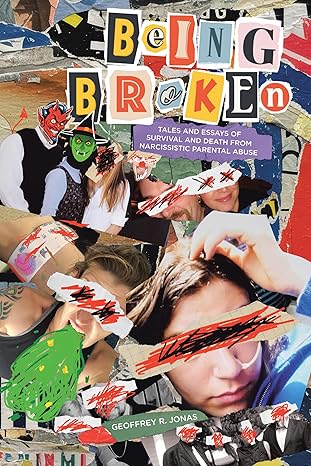

Being Broken, by Geoffrey R. Jonas, is a brutally honest memoir about trauma, addiction, and survival. It follows Jonas through a childhood steeped in neglect and narcissistic abuse, into years of substance dependence, and finally toward healing and self-understanding. He recounts the deaths of his sister, father, and mother, all in a single year, and how those losses forced him to face the damage that shaped his life. The book mixes memoir with insight–part psychology, part confession, and all heart.
Right from the start, Jonas pulls no punches. In the foreword, he admits, “I am spewing my head out onto these pages,” and that’s exactly how it reads, raw, direct, and strangely freeing. The prologue on narcissistic parental abuse hooked me. He doesn’t just define the concept; he exposes how it poisoned his family dynamic and left scars that followed him into adulthood. The mix of personal detail and clinical explanation makes it both heartbreaking and fascinating.
What I love most about this book is its honesty. Jonas never paints himself as a victim. He admits to his own part in the chaos, lying, manipulating, and self-destructing. There’s something refreshing about how he refuses to hide the ugly parts. When he writes about his sister’s overdose or his parents’ emotional absence, he doesn’t look for pity. He looks for truth. The section “Fault vs. Responsibility and Blame” really stuck with me. His idea that “it’s not their fault, but they are responsible” reframes forgiveness in a way that feels mature and real.
Jonas’ writing hits hard because it’s unfiltered but thoughtful. The poem “Broken,” written for his sister, might be the emotional heart of the book. It’s tender and painful, a mix of love, guilt, and memory. And by the end, when he says, “Here I am. A survivor,” it doesn’t sound like a line from a movie. It feels earned.
Being Broken isn’t a light read, but it’s a powerful one. It’s for people who’ve faced trauma, addiction, or toxic family systems, and for anyone curious about how self-awareness can lead to recovery. Jonas writes like a man who’s been through hell and decided to document the landscape. It’s dark, hopeful, and deeply human.
Pages: 274 | ASIN : B0DZPGY1BZ

An Exhilarating Experience

The Twelve Steps: A Modern Hero’s Journey reframes the well-known path of addiction recovery using Joseph Campbell’s hero’s journey as a guide and drawing from storytelling, Jungian psychology, and classic spiritual traditions, to map each of the Twelve Steps onto an archetypal journey from despair to renewal. What was the inspiration for the original and fascinating idea at the center of the book?
Early in my recovery, around three years of sobriety, I read Joseph Campbell’s seminal work, The Hero With A Thousand Faces. I felt like I was having a spiritual experience with each page I read. It dawned on me that what I was reading was the journey not only of the hero throughout cultures and time, but it was also the direct experience I was having working the Twelve Step program of recovery. I was on my own hero’s journey, as were all the people in the rooms I was “trudging the road of happy destiny” with. It was an exhilarating experience, and I was alive as never before. I set about writing, researching, and organizing my thoughts and insights, and it took many years (twenty-five to be exact), but after many drafts and rewrites, this book, The Twelve Steps, a Modern Hero’s Journey, finally came alive.
What were some ideas that were important for you to share in this book?
The whole pattern of transformation–from the broad strokes of Separation, Initiation, and Return, to the details included in each of these categories. For example, early on in the Separation stage, the hero always gets a mentor–think of Luke Skywalker meeting Obi-wan Kenobi (Ben), and eventually, Yoda. These figures mentor and teach Luke, and often save him from his reckless immaturity. The same is true in recovery. During the first and second Steps, the person new in recovery also gets a mentor–called a sponsor–who has the experience the newcomer doesn’t have–but needs to survive the journey.
In addition, during this initial stage, the hero also develops friendships with companions who add their own talents and experience to the hero, and who have traveled the road before him and so can lend their experience, strength, and hope. Think of Dorothy in The Wizard of Oz and the scarecrow, the Tin Man, and the cowardly lion. Together, these companions travel the journey together and support one another as each of them grows. The same is true, of course, in recovery, as newcomers and old-timers alike surround themselves with the fellowship of the program, and together, they can do together what neither one of them could do alone.
There are many, many examples throughout each stage of the journey, and throughout each Step of the recovery journey. Each one is fascinating, enlightening, and ultimately, life-changing.
What was the most challenging part of writing your book, and what was the most rewarding?
The most challenging part of writing this book was finding the right way to incorporate all the wonderful stories of myth that give the hero’s journey its context within the history of mankind. The challenge was to find a way to include this material without it diluting the main thesis: the comparison of the hero’s journey and the journey of recovery. I finally resolved this by including this valuable material in the appendix. This allows me to tell the main story and highlight the duality of the two journeys, yet it also gives the reader access to these wonderful and enjoyable stories.
The most rewarding part of writing this book has been the initial reception and comments from advanced readers, reviewers, and websites like Literary Titan. Perhaps the biggest acknowledgment the book has received so far is from Kirkus Reviews. Kirkus thought so highly of the book, that they automatically entered it into their very exclusive “Kirkus Prize” literary contest…Kirkus only chooses 10% of the books they review annually for this prestigious award, they automatically nominated The Twelve Steps, A Modern Hero’s Journey for this award. See the full Kirkus review here: https://www.kirkusreviews.com/book-reviews/anonymous3/the-twelve-steps/ And read about the Kirkus Prize here: https://www.kirkusreviews.com/prize/
What is one thing that you hope readers take away from The Twelve Steps: A Modern Hero’s Journey?
The depth of meaning and overall importance the journey of recovery contains. My hope is that everyone who is either in a Twelve Step recovery program, or who knows someone who is, reads this book and comes to a new understanding of not only the work required to attain sobriety or abstinence, but also the importance of why someone goes through this. I hope they learn what the true significance of someone having a spiritual experience is, and what it means not only to the person taking the journey, but for society and the world as a whole.
Author Links: GoodReads | Website | Amazon
The Twelve Steps: A Modern Hero’s Journey
The Twelve Steps: A Modern Hero’s Journey reframes the well-known path of addiction recovery through the lens of mythology, particularly Joseph Campbell’s hero’s journey. Drawing from storytelling, Jungian psychology, and classic spiritual traditions, the book maps each of the Twelve Steps onto an archetypal journey from despair to renewal. Along the way, the author pulls examples from literature and film, like Star Wars, The Wizard of Oz, and Harry Potter, to show how this ancient path mirrors the personal transformation found in recovery. Part memoir, part myth, and part manual, the book paints sobriety as nothing short of a heroic quest.
Reading this book hit me harder than I expected. I’ve read plenty on the Twelve Steps before—some dry, some preachy, some so vague they feel like bumper stickers. But this one? It felt alive. The writing is warm, honest, and steeped in lived experience. It’s not afraid to be poetic or personal. I found myself genuinely moved by the way the author honored both the pain and the promise of the recovery process. I appreciated that it didn’t lighten the agony of hitting bottom or the grit it takes to stay on the path. And when it described recovery as both death and rebirth, that resonated with me.
What really stood out, though, was the use of myth. At first, I thought it might come off as gimmicky. But the comparisons—Luke Skywalker finding purpose, Dorothy leaving Kansas, Harry confronting himself—felt real. They didn’t just decorate the narrative; they deepened it. I started seeing how we all play out these stories in our own ways, whether we’re battling addiction or just trying to grow up. The structure was clear and well-paced. Sometimes the spiritual language leaned a bit heavy for my taste, but it never lost its footing. The writing stayed grounded even when it reached for the stars.
The Twelve Steps: A Modern Hero’s Journey is a stirring read. It’s smart and hopeful. I’d recommend it to anyone in recovery, especially those looking for something more soulful than standard fare. It’s also great for folks outside recovery who are curious about transformation, or anyone who loves myth and wants to apply it to real life. You don’t need to be a wizard or Jedi to take this journey, you just need to be willing.
Pages: 336 | ASIN : B0DXFY4ZD8
Should’ve Been Dead: Lessons from a Crack Addict Who Broke Free
Should’ve Been Dead is a gripping memoir that dives into the tumultuous life of a former crack addict who miraculously transformed his life from the depths of addiction to become a successful businessman. Written by Sweta Patel, with Londer’s candid input, the book chronicles Rory Londer’s journey from the streets to owning a million-dollar home improvement business, all while battling his demons and coming to terms with his past.
I enjoyed this book because I found the narrative to be raw, unapologetic, and often heart-wrenching. The book offers readers a visceral glimpse into the struggles of addiction and the relentless pursuit of redemption. It doesn’t shy away from the grim realities of addiction. Early chapters like “Moment of Crisis” and “Stuck Like Chuck” vividly depict Rory’s desperation, from robbing a gas station to surviving the terror of crack houses. These scenes are not easy to digest, but they are necessary to see what life was really like for him.
The writing pulls you into Rory’s world, where paranoia and fear are constant companions. The book also highlights Rory’s painstaking recovery. In chapters such as “Fork in the Road” and “Keep Your Side of the Street Clean,” readers see him gradually rebuild his life. These sections are marked by small victories that slowly add up. The writing here becomes more reflective and offers a glimpse into Rory’s internal transformation. He’s not merely quitting drugs he is reshaping his entire existence. The emotional depth in these parts is profound and leaves a lasting impression.
What sets this memoir apart for me is its dual perspective. Patel, a teacher who invited Rory to speak to her students, doesn’t just observe his journey, she shares how it affected her life. This intertwining of narratives adds a unique layer to the book. It becomes more than Rory’s story and becomes a testament to the ripple effect one person’s life can have on others. Patel’s reflections add depth and makes the memoir more relatable and engaging.
Should’ve Been Dead is a story of resilience, transformation, and hope. Rory Londer’s journey is heartbreaking and uplifting and is a powerful reminder that change is possible no matter how deep one has fallen. This book will resonate with anyone seeking inspiration or understanding of the human capacity for redemption.
Pages: 232 | ASIN : B0CVG46NL9



 LITERARY TITAN