Blog Archives
Justice and Loyalty

Part of the Solution: A Mystery follows a New York professor who experiences a chance meeting that pulls her back into the 70s and brings her closer to a death that shook the community she once called home. What was the inspiration for the setup of your story?
Setting Part of the Solution in 1978 was an easy choice because the very first version of the book was written in 1978! I had just finished a dissertation in English literature, and I’d survived graduate school by sneaking off to read murder mysteries when I couldn’t bear one more page of “serious” literature. A few years ago, I reread my original manuscript and decided to rewrite it as a period piece. I thought it would be interesting to go back to that time and wrestle with who we “Boomers” were back in the day – idealistic, earnest, and hopeful but also very young and sometimes very silly. The book is completely different now. In some ways, it’s a comedy of manners as much as it is a mystery.
Yet comedy of manners though it is, I don’t want to overemphasize the humor in the book. In the process of rewriting, the mysterious death at the core of the original plot took on a deeper meaning. Now my main character, Jenifer, has had forty years in which she has had to live with what happened. The decisions she made at the time as the “amateur detective” have shaped her life in ways that she – and even I – could never have imagined at the time.
What is it that draws you to the mystery genre?
I have a complicated relationship with the mystery genre. I love the structure and discipline of the classic whodunit in which all the clues and red herrings line up in a way that plays fair with the reader. I love the puzzle at the heart of the genre and, to quote the title of my book, the `solution’ that is revealed at the end. But I am also troubled by how much fun such mysteries are because death, even in fiction, shouldn’t be fun. I worry that devouring mysteries the way a lot of us do ends up dulling our responses and thus numbing an important piece of what makes us human. I don’t want the characters, or even the reader, to get off scot-free.
In Part of the Solution, I tried to tell a story in which the characters don’t get off scot-free because they are changed forever by what has happened to them. I wanted them to have to wrestle on a deeply personal level with the issues that are raised. What does justice mean? What does loyalty mean? How do different people understand those terms, and what difference does that make? Jennifer and Ford – the amateur detective and the official detective – have very different relationships to questions of justice and loyalty, and those questions matter to them both. The very different answers they come up with have never stopped haunting them.
How did the mystery develop for this story? Did you plan it before writing, or did it develop organically?
The mystery plot was there from the beginning. I had a wonderful time inventing a set of wonky characters in an imaginary little hippie town in the Berkshires, with the challenge of trying to figure out who among these various peace activists, artisans and poets, leftwing intellectuals, and spiritual seekers would murder someone, and why. Once I had the mystery structured, I could relax into writing the dialogue and the scenes. What were they listening to on the stereo? What were they arguing about? Laughing about? What were all of them wearing? How did they understand the world around them, and how were they trying to change it for the better?
What is the next book that you are working on, and when will it be available?
I want to bring Jennifer and Ford back together in the present day. They are both in their late ‘sixties now, and they meet up again at a conference during which someone dies mysteriously. I have the plot lined up as well as most of the characters. I haven’t gotten very far in the writing yet, but I’ve booked myself some time away this winter just to write, and I’m planning to have it done by the end of this coming year.
Concern for her community prompts Jennifer to investigate the murder with the sometimes-reluctant help of Ford McDermott, a young police officer. Little does she know that the solution lies in the hidden past.
Part of the Solution blends snappy dialogue, unconventional settings, and a classic oldies soundtrack, capturing the essence of a traditional whodunnit in the era of sex, drugs, and rock-and-roll.
Part of the Solution: A Mystery
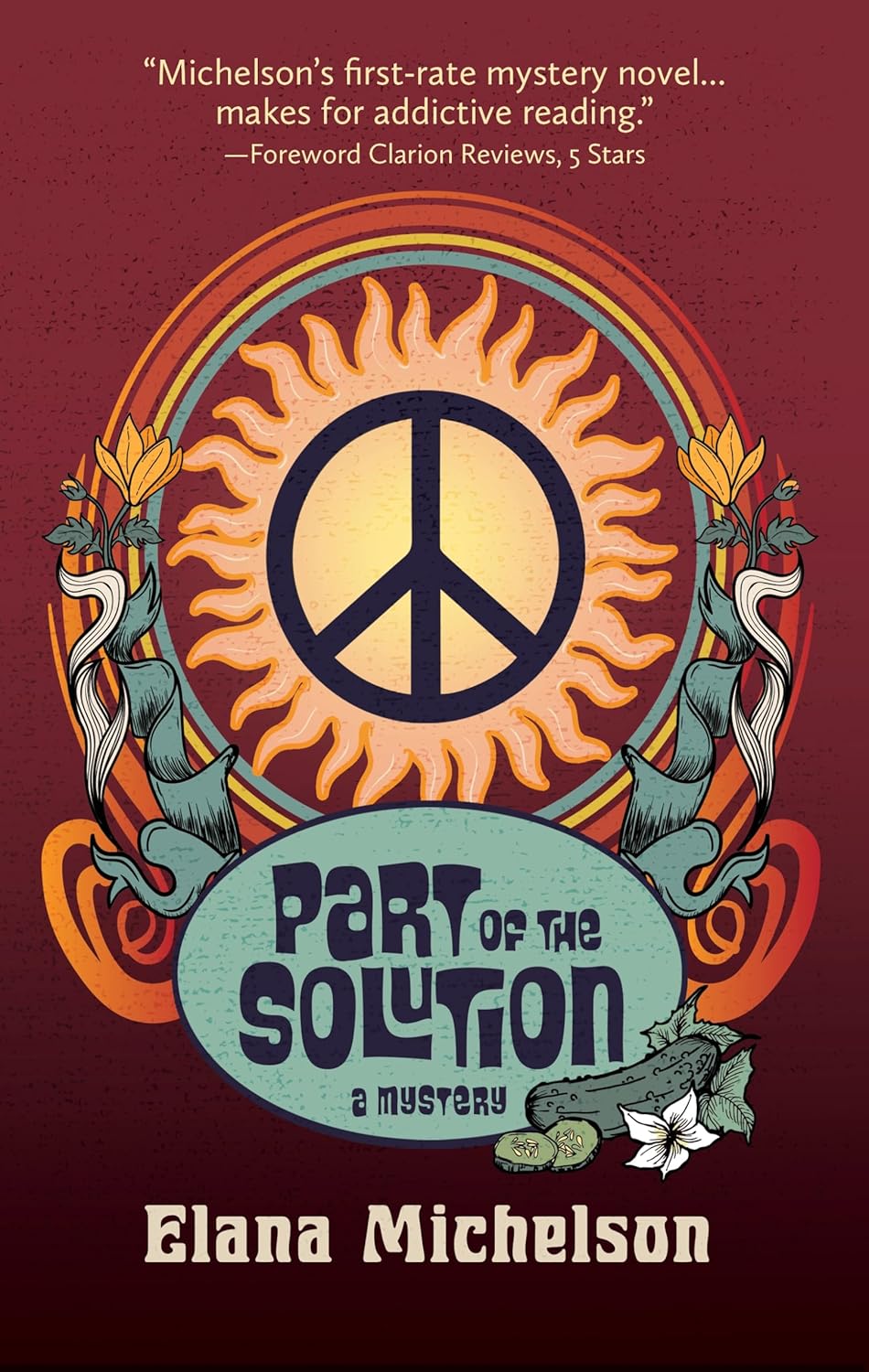

Part of the Solution follows Jennifer Morgan, a New York professor who returns to Boston for a conference and suddenly collides with her past. A chance meeting pulls her back into the late seventies, when she lived in a tiny Massachusetts town full of hippies, activists, dreamers, and drifters. The book moves between the present and that earlier world, and the story slowly circles a death that shattered the odd little community she once called home. The narrative blends memory, mystery, romance, and political reflection in a way that feels alive and warm and a little bittersweet.
Reading it felt like stepping into a room that smells like coffee and incense and old books. The writing has a cozy quality. It rambles in a good way, like someone talking while cooking dinner, and I found myself leaning in. I had moments of real affection for the characters. They fight. They love. They hold grudges that make no sense and cling to ideals that make no sense either. The dialogue has a lively spark that kept surprising me. Sometimes it hopped around. Sometimes it took its time. I liked that. And even when the tone shifted into darker territory, the heart of the book kept beating steady.
The ideas underneath the story resonated with me more than I expected. Michelson captures the messy idealism of the counterculture era with charm and also with a sharp pinch. I kept nodding because the book understands something about how people try to build a better world and then stumble right over their good intentions. The spiritual seekers. The radicals. The shy intellectuals who think too much and then think even more. I felt the book’s tenderness toward them, and I felt its frustration too. The tension between hope and disillusionment had real weight. It made me sit back and think about my own younger self and the beliefs I thought would never bend.
I would recommend Part of the Solution to readers who enjoy character-driven mysteries, stories about found communities, and novels steeped in the moods of the sixties and seventies. If you like fiction that mixes warmth with tension and lets people be flawed in recognizable ways, you’ll enjoy this book.
Pages: 298 | ASIN : B0FL4MH5WY




 LITERARY TITAN