Blog Archives
Gelding Rock


K. E. Thompson’s Gelding Rock, the second novel in the Stewart’s Camp series, is an ambitious work of historical and contemporary fiction built around buried crimes, damaged people, and the uneasy relationship between guilt and redemption. The novel moves primarily between 1997 and 2010, with earlier episodes reaching back into the history of Stewart’s Camp and the nearly abandoned community of Gelding Rock. At its center is the improbable relationship between Adelyn O’Malley, an elderly woman who has lived alone for years, and Hartford Daniels, a predatory and deeply troubled man who arrives at her home after becoming stranded during a storm. Thirteen years later, young friends Jacob Moses and Ruthie begin uncovering the physical remains and secrets left by an earlier mudslide, while retired detective Harold Capps revives his interest in Hartford’s long-unsolved disappearance. These strands gradually converge into a story in which the excavation of old objects becomes inseparable from the excavation of memory.
The novel’s greatest strength is its treatment of character, particularly Adelyn and Hartford. Thompson gives neither of them a simple moral identity. Adelyn is vulnerable, funny, traumatized, lonely, nurturing, and capable of alarming decisions. Hartford enters the novel with a clear awareness of his own cruelty, yet years of isolation, physical suffering, work, and companionship alter the way he understands himself and other people. His development is deliberately uncomfortable because the book never requires the reader to erase what he has done in order to recognize what he later becomes. Adelyn’s history provides a parallel examination of how violence can remain active in a person decades after the event itself. Near the end, the narrator observes of her past, “It wasn’t so easy to escape one’s self.” That sentence captures much of the novel’s psychological argument: time can change a life profoundly, but it doesn’t automatically dissolve memory, responsibility, or injury.
Thompson balances this darker material with an unusually broad ensemble and a distinctive vein of humor. Jacob Moses and Ruthie give the 2010 sections curiosity and momentum as their amateur investigation moves from artifacts in the mud to family history, hidden documents, and finally Gelding Rock itself. Their friendship also provides an emotional counterweight to the adult characters, whose relationships have often been shaped by secrecy, regret, and avoidance. The book’s shifts in viewpoint allow the same events to acquire different meanings depending on who is watching, and its references to Crime and Punishment reinforce its interest in confession, punishment, conscience, and the burden of concealed wrongdoing. The historical material involving Harriet Stewart deepens that inquiry further. Her attempt to protect the young Adelyn becomes another morally complicated act whose consequences reach across generations, connecting the novel’s mystery structure to its larger questions about whether violence can ever be cleanly divided into victims, perpetrators, protectors, and bystanders.
What makes Gelding Rock especially affecting for me is that its mysteries serve a story about human connection. The resolution of Hartford’s disappearance matters, as do the buried histories of Stewart’s Camp, but the book’s emotional culmination belongs to Adelyn, Ruthie, and Hartford as the past and present finally occupy the same room. Ruthie’s willingness to become, for a dying woman, the long-lost Harriet she needs is one of the novel’s most moving developments. In Adelyn’s final consciousness comes the simple realization, “And if she was loved, everything was alright.” The novel earns that sentiment by placing it beside decades of fear, shame, violence, loneliness, and compromised choices. Gelding Rock is therefore both a mystery and a character-driven meditation on conscience, trauma, forgiveness, and the forms of grace people sometimes extend to one another. Thompson’s combination of dark subject matter, eccentric humor, historical layering, and compassionate characterization gives the novel a strong identity and an ending that brings its many timelines together with considerable emotional force.
Pages: 298 | ASIN : B0GLKBSHYM

Everyone’s Always Performing

Hypnotized follows an Army veteran, a missing teen, an aspiring actress, and a retired detective who become entangled in a decades-old disappearance. What was the inspiration for the setup of your story?
Hampton’s character grew out of a short story I wrote back in the late 60s about draft dodgers. He was hanging out in a pool hall when he met a Whittier woman named Margo who attempted to convince him to burn his draft card. Also, legends about Hell’s Gate and Turnbull Canyon Road are numerous, and I wanted to use them to provide an atmosphere that would hopefully intrigue my readers.
Nick’s reflective narration gives the novel a distinctive personality. Why did you choose him as the primary voice rather than the detective?
Detective Roach was introduced in my previous book, Surf and Sand, The Girl in the Seaside Hotel, wherein he’s seen considering his upcoming retirement in Whittier. See, I was already thinking about Hypnotized then. But when I actually started writing it Nick was the first character that came to me, and I soon realized I wanted to tell most of the story from a first-person perspective and let the novel become a kind of memoir. I’d just reread Charles Portis’s novel, True Grit, and was inspired by the narration of his character, Mattie Ross. She’s an elderly woman looking back on something that happened to her when she was young. I wanted to try and capture that feeling. (And by the way, everyone’s seen the films, but if you haven’t heard Donna Tartt‘s narration of the audio book, well, you ain’t heard nothin’ yet!)
Identity, performance, and self-deception appear repeatedly throughout the novel. Why do those ideas interest you?
Identity is kind of a big deal these days, but I wasn’t trying to make any statements about that, I just want my characters to live in other people’s heads besides my own. I worked on this book for about 7 years, on and off. Eventually the characters take over and can even become kind of demanding. And when we look at real life, people are always performing, aren’t they? Trying to do their best, or to be as good as someone they admire, or to be “like” someone they look up to. Self-deception too, is common, just look at my not so healthy diet! But performance is something else when it’s used to deceive others.
Without giving anything away, what do you think continues to haunt Turnbull Canyon long after the final page?
Memories. Wishes. Hopes. Desires. And a few deadly curves!
Author Links: GoodReads | Website
Hypnotized: A Turnbull Canyon Mystery


W. B. Edwards’s Hypnotized: A Turnbull Canyon Mystery is a historical mystery novel set in Whittier, California, during the summer of 1969. The story opens with an ominous encounter near Turnbull Canyon, then moves among several characters whose lives become connected through attraction, deception, buried family history, and the unsettling possibility of hypnosis. Nick O’Brien, a drifting Army veteran, remembers that summer as the end of an era and a season filled with unexpected turns. With its Southern California setting and late-sixties atmosphere, the novel blends historical fiction, crime fiction, psychological suspense, and supernatural mystery.
Rather than following a single investigator, the book builds its mystery through multiple viewpoints. Nick’s conversational narration gives the story much of its personality, while Hampton Masters III brings vulnerability and growing confusion to the psychological suspense plot. Retired detective Harry Roach supplies the traditional cold-case mystery element as he investigates the 1943 disappearance of fourteen-year-old Margaret “Margo” Stewart near the abandoned property known as Hell’s Gate. Imelda’s story adds another layer involving identity, performance, ambition, and a strange ability that becomes increasingly important as the characters’ paths cross.
The novel’s strongest quality is its lived-in sense of time and place. Pool halls, drive-ins, hot rods, stereo equipment, cigarette smoke, smoggy sunsets, and Whittier Boulevard cruising give the historical fiction setting real texture. Edwards lets conversations wander and relationships develop gradually, so the characters feel like people caught up in an increasingly bizarre situation. That unhurried approach also suits Nick’s reflective voice, which often circles around the uncertain nature of memory. The result is a mystery novel where personal regrets and half-remembered experiences matter as much as physical clues.
As the separate storylines come together, Hypnotized grows into an offbeat Turnbull Canyon mystery about manipulation, obsession, desire, and the stories people tell themselves. Its crime-fiction plot reaches a satisfying confrontation, but the supernatural questions remain slippery enough to keep the ending in your mind. The book’s final reflections on memories, dreams, and possible spells fit its hazy 1969 world especially well. Readers who enjoy character-driven historical mysteries, California noir, psychological suspense novels, and supernatural crime fiction will find plenty to discuss here.
Pages: 270 | ISBN : 9798235560857

Nuremberg, Mississippi

Melvin E. Edwards’s Nuremberg, Mississippi is a historical legal drama set in 1965, where the machinery of Jim Crow operates through permits, curfews, courtroom procedure, and the quiet exercise of official discretion. Henry Logan, a Black tradesman trying to protect his livelihood and dignity, asks white attorney Silas Thorn III to challenge a system designed to appear neutral while producing consistently unequal results. Their lawsuit against Mississippi gives this work of literary fiction its central conflict, but the novel’s real subject is the gap between a law’s wording and the lives shaped by its enforcement. The book identifies itself as a fictional examination of historically documented institutional patterns, particularly the ways lawful systems can create predictable harm without open illegality.
As a courtroom drama, the novel builds tension through process. Filings, hearings, delayed decisions, missing records, professional warnings, and seemingly reasonable compromises become sources of pressure. Edwards makes bureaucracy feel active and personal, showing how a clerk’s hesitation or a supplier’s business decision can carry as much force as a judge’s sentence. The short chapters suit this approach, giving the story a deliberate, accumulating rhythm that reflects how institutional harm is often experienced through separate incidents that only reveal their full design when viewed together.
The relationship between Henry and Silas gives this Southern historical fiction novel its emotional weight. Henry is observant, intellectually curious, and painfully aware that every act of resistance must be measured against what it may cost his family. Silas begins as a man who believes restraint and professionalism are forms of fairness, then gradually recognizes how those values can protect an unjust system from scrutiny. Their conversations about responsibility, law, faith, and endurance are frequently more compelling than the formal arguments in court. Edwards also gives Helen Logan an important presence, grounding the case in household finances, health, fear, and the daily labor required to keep a family intact.
Nuremberg, Mississippi, is thoughtful civil rights fiction with an unusually close interest in legal reasoning and institutional behavior. Its prose is controlled and often aphoristic, returning to words such as order, discretion, restraint, and consequence until their meanings begin to shift. The later chapters carry the case beyond its judgment and into the lives shaped by it, which gives the ending a lasting emotional force. This is a serious, accessible novel about what justice demands from the people seeking it, the people administering it, and the people who’ve learned to benefit from delay.
Pages: 329 | ASIN : B0GX52XMDF
Patriots in Shadows: Inspired by a real event, a historical political thriller set in British India during World War II

Krishna Kumar’s Patriots in Shadows is a historical political thriller set in British India during World War II. Inspired by real events, the novel reimagines the catastrophic 1944 explosion at Bombay’s Victoria Docks as the culmination of a coordinated campaign of sabotage. Its story moves among Calcutta, Allahabad, Bombay, New Delhi, and Simla, connecting warehouse fires, disrupted communications, altered currency shipments, destroyed military equipment, and a vast police investigation. This geographical scope gives the book the character of a wartime dossier while steadily revealing the network operating beneath the colonial administration’s notice.
The novel’s central achievement is its portrayal of resistance as disciplined, collaborative work. Rohini, Penelope, Shreya, Rashmi, Sonali, Lieutenant Colonel Biswas, and their associates rely on compartmentalized information, professional access, coded messages, and carefully constructed identities. Their operations are juxtaposed with investigations led by capable officers such as Partho Chatterjee, Manoj Pande, and Harrison, which prevents the authorities from becoming simple caricatures. The epigraph’s quotation, “He who saves his country violates no law,” captures the moral conviction driving the conspirators, even as their methods force the reader to confront the human consequences of political violence.
Kumar writes with a historian’s interest in institutions and logistics. The novel explains rail networks, shipping procedures, police hierarchies, military supply chains, wartime censorship, and the administrative structure of the British Raj in considerable detail. These passages give the acts of sabotage practical credibility and place them within the pressures of the Bengal famine, the Indian National Army’s campaign, and the broader war in Asia. The amount of contextual explanation slows the immediate action, but it also establishes how an empire functioned and how determined individuals could exploit its routines, divisions, and dependence on Indian personnel.
Patriots in Shadows offers an expansive account of covert resistance shaped by patriotism, grief, intelligence, and patience. Its ensemble structure asks the reader to follow numerous characters and investigations, yet the separate threads converge effectively in the destruction of military trains and the Bombay harbor operation. The closing gathering in Simla provides a restrained sense of triumph while preserving uncertainty about several participants, fitting the novel’s final observation that “Some details are better left unexplained…” The result is an ambitious thriller that combines historical reconstruction with a sustained examination of the people who chose to challenge colonial rule from within its shadows.
Pages: 308 | ASIN : B0GQV1YTNT
Psychological Growth

Church Shoes centers around a teenager from her mother’s mysterious disappearance after a Sunday church service to her adult career as a lawyer and her ongoing determination to uncover the truth. Where did the idea behind this novel come from?
I was born in 1944. My dad was in the Army Air Force overseas in the South Pacific.
My initial impressions of life were from my mom and maternal grandparents, who were Czech immigrants. WWII was the major social, cultural, social, and economic influence in people’s lives. I learned of my grandparents’ lives and my mom’s and dad’s and family relatives’ lives from the 1920s, 30s, and 40s and have always had an interest in those historical periods, as well as my decades during the 50s to the current time.
Many of my novels are inspired by American and European history. The Discontent of Mary Wenger and Paper Dolls are historically related to Church Shoes and draw on people, locations, and events from the 30s, 40s, and 50s.
Teens becoming adults living during those periods are an integral foundation for those novels.
Alice Quint conveys the complex emotional caring, psychological growth, and physical and mental fortitude portrayed by all my female protagonists. Each of their stories is a unique personal journey.
I enjoy writing women’s fiction. Women are incredibly amazing people.
They have had an influence on my life since I was born to this day.
My wife and I have been married for 60 years. We are 82 years old and are sorry, but grateful, that we and others have A Limited Time Only, the title of my 27th novel.
The idea behind Church Shoes comes from those influences and my own experiences growing up in the 40s and 50s in the rural and urban Middle West.
The prevalence of the Nazi German American Bund during the 30s and 40s created the dramatic conflicts Alice and her family encountered and the ironic lifelong friendship she developed with a Mafioso’s daughter, a girl and her family I once met when I was 13 years old.
Where did the inspiration for Alice’s traits and dialogue come from?
Alice is a character who is very much alive in my head. Her physical appearance, habits, manners, and manner of speaking, and sardonic sense of humor at extreme human behavior are tools of her personality to confront and deal with what she considers stupidity, discrimination, and injustices.
The church shoes become more than just evidence—they represent memory, loss, and the search for answers. How did you develop that symbol throughout the story?
Alice identifies, realizes, and comments on her mother’s church shoes as symbols of her mother’s human values, which are treasured by Alice and conveyed in her many character encounters and interactions throughout the novel.
What do you hope readers take away from Alice’s journey about persistence, justice, and the importance of confronting the past?
Alice’s journey of persistence in pursuit of justice against political corruption provides readers with a strong feminine hero to admire and to be inspired.
Confronting the past, the phrase that “history repeats itself” is more evident now than ever with the attempted destruction and demise of American Democracy by Donald Trump’s authoritarian dictatorship, his corrupt administration, and his racist ICE brownshirts terrorizing, intimidating, and imprisoning innocent citizens, including children, as a revisitation of Hitler’s SS, the basis for the Nazi German American Bund in Church Shoes.
Author Links: GoodReads | X (Twitter) | Facebook | Website | Amazon
Church Shoes

Robert Tucker’s Church Shoes is a historical mystery and coming-of-age novel centered on Alice Quint, a sharp, stubborn teenager whose mother disappears after a Sunday church service. The only immediate clue is a pair of church shoes found along a country road. Set against the Great Depression and the rise of the German American Bund, the story follows Alice from her family’s uneasy relocation to rural Illinois through her adult career as a lawyer. What begins as a missing-person mystery gradually widens into a story about family secrets, political extremism, institutional cruelty, and a daughter’s refusal to stop asking questions.
Alice is the book’s strongest feature. She’s intelligent, combative, funny, insecure, and sometimes exhausting, which makes her feel like a person rather than a polished heroine. Her narration has an appealing bluntness, especially when she comments on social expectations for girls and women. The novel also gives plenty of space to family life, friendships, school, romance, and professional ambition. These everyday experiences matter because they show how Alice’s search for her mother shapes nearly every stage of her development. The church shoes become a moving symbol of decency, memory, and the trail Alice follows toward the truth.
The book is ambitious in scope, moving through several decades and bringing together organized crime, Depression-era hardship, fascist movements, abusive institutions, wartime change, and women’s growing participation in law and public life. Its most powerful scenes involve Alice uncovering what happened to her mother and confronting the human consequences of secrecy and unchecked authority. The pacing is leisurely, with long conversations and detailed side episodes, but those passages create a broad picture of Alice’s world and the people who influence her. The historical material is woven directly into her personal journey, so political events feel connected to the dangers facing her family.
Church Shoes will appeal most to readers who enjoy character-driven historical fiction with a strong mystery at its center. It’s especially well suited to readers interested in determined female protagonists, complicated family histories, Depression-era America, early women lawyers, and stories about ordinary people caught in larger political forces. Book clubs may also find plenty to discuss, from the meaning of the shoes to Alice’s moral choices and the lasting effects of trauma. Readers who like a novel that follows a character across many years, while steadily uncovering a buried family truth, should find this an absorbing and thoughtful read.
Pages: 289 | ASIN : B0H1ZTM4TS
The Cartographer’s Silence
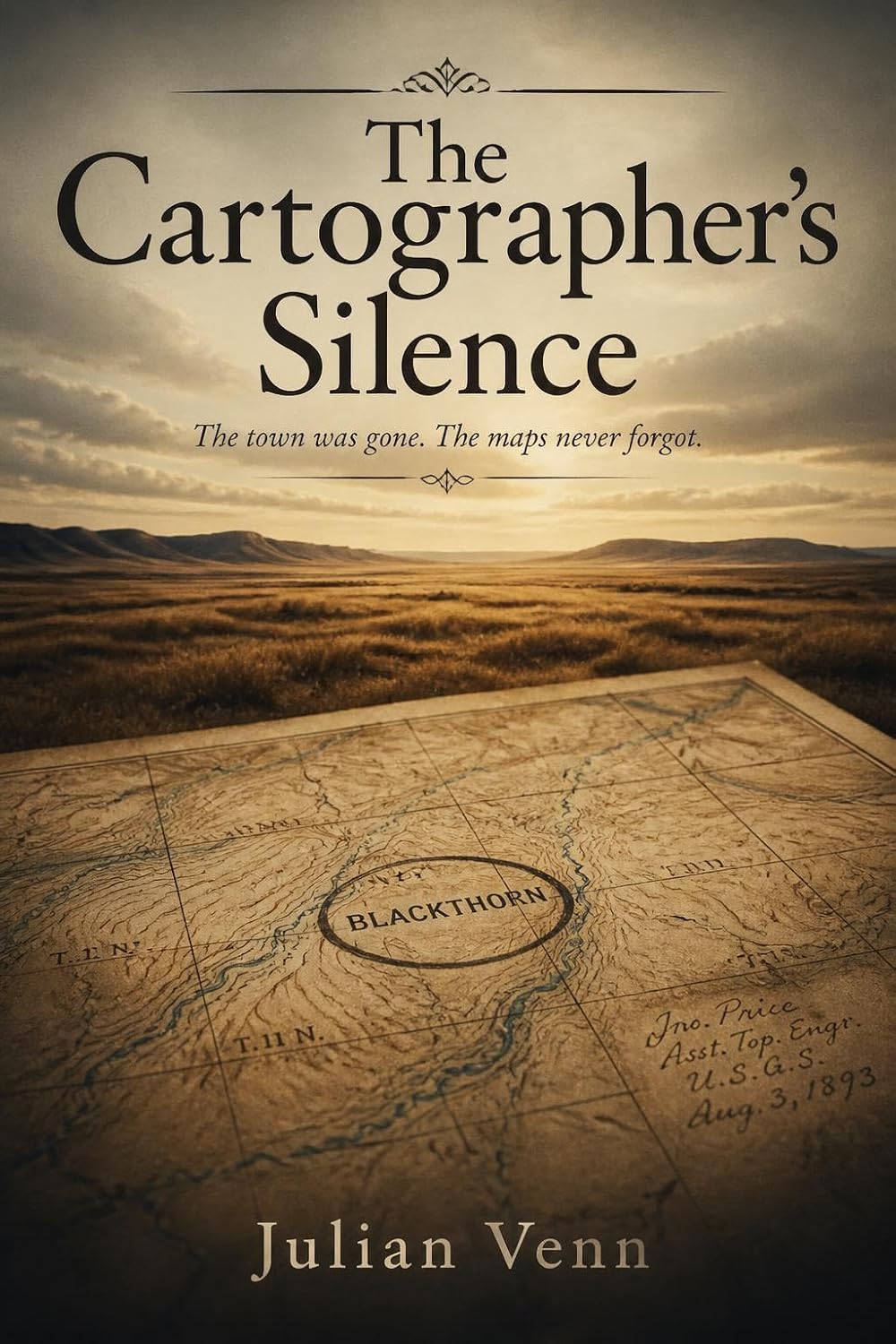
Julian Venn’s The Cartographer’s Silence follows Evelyn Price, a meticulous U.S. Geological Survey cartographer whose faith in maps begins to fracture when she discovers Blackthorn, a town that appears in old records but has vanished from the land itself. What begins as a cartographic discrepancy becomes an investigation into arson, forced displacement, falsified ledgers, and the disappearance of Evelyn’s father. As Evelyn follows buried foundations, altered records, and the long shadow of official silence, the novel turns a missing town into a reckoning with the people who profit when history is redrawn.
I was immediately drawn to the book’s patience. Venn doesn’t rush his mystery; he lets it accumulate like dust in an archive, each receipt, survey note, and scorched document adding pressure to the next. Evelyn’s voice is spare but not cold, exacting in the way of someone trained to trust measurements, yet increasingly aware that precision can be weaponized. The novel’s strongest pleasure is watching her learn that a map isn’t merely a record of the world but a moral document.
What surprised me most was how physical the mystery feels. This isn’t just a puzzle solved in rooms full of paper, though those scenes have their own austere charm. The prairie, the courthouse stones, the wind over erased roads, and the smell of camphor in the archive all become part of the evidence. The prose circles its revelations with deliberate repetition, but that cadence also suits a story about erasure: truth here must be named again and again before it can survive. I admired the way the book makes bureaucracy feel sinister without losing sight of the human cost beneath the documents.
Readers who enjoy historical mystery, frontier fiction, thrillers, suspense, and conspiracy fiction will find much to savor here, especially those drawn to stories about buried records and contested memory. The book would appeal to fans of Kate Morton’s layered historical secrets, though its frontier starkness and procedural rigor give it a sharper, more sepulchral edge. The Cartographer’s Silence is a haunting historical mystery about the violence of omission and the courage required to draw the truth back onto the page.
Pages: 345 | ASIN : B0H6NXG3S9


