Blog Archives
We Can Demand Better

Making Democracy Count explores the impact of mathematics on the many facets of the democratic process. Why was this an important book for you to write?
This book grew out of my various efforts in the math and democracy space. I teach a course called Math and Politics at Wellesley College and direct the Institute for Mathematics and Democracy. Through my many interactions and projects with students and researchers, I realized that there was a need for a book serving as a reader-friendly, gentle introduction to the math of democracy and that I actually had something to say about the subject.
How much research did you undertake for this book, and how much time did it take to put it all together?
If you count the years that I taught the Math and Politics class — which is when I learned much of the material that is in the book, tested the examples, and adjusted things based on student feedback — then it took more years than I care to admit. But once I sat down to start writing, it took about a year and a half to complete the book. The amount of research I had to do was immense, but also very fun since I had to learn a lot of statistics, history, political science, economics, and law which I knew nothing about before.
What is one misconception you think many people have regarding the election process?
The general misconception is that the democratic processes we use, including those that govern our elections, are the right ones and that they are unchangeable. We take so many things about the engine of our democracy for granted. We do not realize that the voting methods we use are flawed, that the Electoral College is a terrible relic of the past, that districting as we do it is a horrific instrument of disenfranchisement. But we can change these processes. We can demand better, more mathematically sound ones.
What is one thing you hope readers take away from Making Democracy Count?
Mathematics can point the way toward better democratic processes. Our democracy runs on algorithms, and mathematics can tell us which ones are flawed and which ones we should use instead. From the objective, non-partisan point of view of mathematics, things like ranked choice voting, multi-winner districts, and open primaries are clearly better because they provide more representation and a more complete picture of the will of the people. We should embrace the mathematical point of view and work to increase our political quantitative literacy.
Author Links: GoodReads | X (Twitter) | Facebook | Website | Amazon
How we can repair our democracy by rebuilding the mechanisms that power it
What’s the best way to determine what most voters want when multiple candidates are running? What’s the fairest way to allocate legislative seats to different constituencies? What’s the least distorted way to draw voting districts? Not the way we do things now. Democracy is mathematical to its very foundations. Yet most of the methods in use are a historical grab bag of the shortsighted, the cynical, the innumerate, and the outright discriminatory. Making Democracy Count sheds new light on our electoral systems, revealing how a deeper understanding of their mathematics is the key to creating civic infrastructure that works for everyone.
In this timely guide, Ismar Volić empowers us to use mathematical thinking as an objective, nonpartisan framework that rises above the noise and rancor of today’s divided public square. Examining our representative democracy using powerful clarifying concepts, Volić shows why our current voting system stifles political diversity, why the size of the House of Representatives contributes to its paralysis, why gerrymandering is a sinister instrument that entrenches partisanship and disenfranchisement, why the Electoral College must be rethought, and what can work better and why. Volić also discusses the legal and constitutional practicalities involved and proposes a road map for repairing the mathematical structures that undergird representative government.
Making Democracy Count gives us the concrete knowledge and the confidence to advocate for a more just, equitable, and inclusive democracy.
Making Democracy Count: How Mathematics Improves Voting, Electoral Maps, and Representation


Making Democracy Count is an intellectually stimulating exploration of how mathematics underpins the fabric of our democratic processes. Author Ismar Volić takes readers on a journey through the mathematical principles that govern voting, districting, and representation, revealing how these often-overlooked aspects are crucial to the fairness and functionality of democracy. From the nuances of voting methods to the complexities of gerrymandering, Volić unravels the intricacies with clarity and enthusiasm, making a strong case for the importance of mathematical literacy in civic life.
What struck me most about Volić’s writing is his ability to make complex mathematical concepts accessible without sacrificing depth. The opening anecdote about a classroom movie vote is a perfect example of how he distills abstract ideas into relatable scenarios. The discussion about the flaws in plurality voting is both compelling and eye-opening. Volić’s knack for storytelling shines as he connects everyday experiences with broader, systemic issues, effectively engaging readers who might not typically be drawn to mathematical discourse.
While the book is enlightening, it can occasionally feel overwhelming in its detail. The chapters on different voting methods and their mathematical justifications are fascinating but may require multiple readings for those not well-versed in mathematics. The depth of analysis, particularly in chapters like “The Impossible Democracy,” where Volić delves into Arrow’s Impossibility Theorem, is impressive but can also be dense. This level of detail provides a thorough understanding for dedicated readers.
Volić’s examination of gerrymandering and districting is a section that really stood out to me. The author explains the mathematical tools used to detect and prevent gerrymandering, such as symmetry and compactness tests, in a particularly insightful way. His discussion of the impact of these mathematical strategies on political representation is both timely and crucial.
Making Democracy Count is a must-read for anyone interested in the intersection of mathematics and democracy. It’s particularly well-suited for readers with a background in mathematics or political science, as well as educators and policymakers who want to deepen their understanding of how to improve democratic processes. Volić succeeds in showing that mathematics is not just a tool for scientists but a powerful framework for creating a more just and equitable society.
Pages: 394 | ASIN : B0CKPHRLHD

By Means of Peace
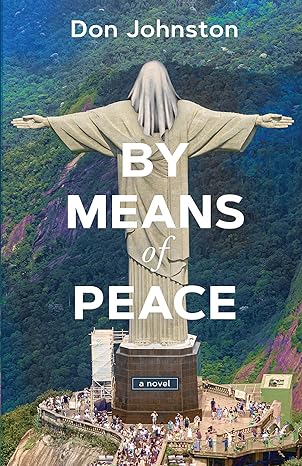

Don Johnston’s By Means of Peace is an intriguing political fiction novel set in the mid-22nd century. The novel interweaves the lives of Darien, a sci-fi writer facing career challenges, and Marisa, an ambitious politician. Their journey unfolds in an era marked by significant political change, especially following the re-election of a president from an independent political party—an event that raises suspicions.
While the book might initially appear dense to readers less familiar with political narratives, a deeper understanding of contemporary politics enhances the story’s resonance. Johnston skillfully mirrors the current political landscape, projecting a future that feels like a natural extension of today’s world. This approach gradually transforms the novel from a straightforward narrative into a thrilling exploration of potential realities. The story’s power lies in its ability to blur the lines between fiction and reality, sending a chill down the spine of readers who discern the subtleties hidden within its pages.
The book’s strength is undoubtedly in its worldbuilding and the acute observation of current political trends, even hinting at major global events akin to pandemics. The novel takes a focused approach in its character development. While it excels in creating a richly detailed backdrop, the characters are designed primarily to drive the plot forward. This streamlined characterization ensures the narrative progresses smoothly, with interactions that directly contribute to the story unfolding. This approach may appeal to readers who prefer a plot-centric novel, offering a clear, uncluttered path through the complex political landscape Johnston creates. The characters, in their simplicity, provide a stable foundation for the intricate world and the thought-provoking themes the book explores
For those interested in political fiction and speculative narratives, By Means of Peace is a thought-provoking novel. It offers a captivating glimpse into a society shaped by our political decisions today and leaves readers questioning what the future may hold.
Pages: 247 | ASIN : B0CB6ZZZ5H




 LITERARY TITAN