Blog Archives
The Boy in the Back: A True Story of Survival in Auschwitz and Mauthausen


Fern Lebo’s The Boy in the Back recounts the life of Jan Blumenstein, a Czechoslovakian Jew whose ordinary adolescence was destroyed by Nazi persecution. Written in the first person from extensive interviews with Blumenstein, the book begins with his childhood in Nové Zámky and follows the tightening restrictions on Jewish life, his family’s confinement in a ghetto, and his deportation to Auschwitz on June 5, 1944, his sixteenth birthday. From there, the narrative traces his imprisonment at Auschwitz and Świętochłowice, his transport to Mauthausen, the death march to Gunskirchen, and his eventual liberation. Lebo combines Blumenstein’s recollections with historical context, giving the memoir both the intimacy of personal testimony and a wider account of the system in which his experiences occurred.
At the center of the book is Blumenstein’s method of survival. He learns to become “the boy in the back,” remaining inconspicuous, avoiding unnecessary relationships, watching other prisoners closely, and making practical decisions about food, work, and physical safety. His survival is presented less as a series of dramatic acts than as an accumulation of judgments made under conditions in which the smallest error could be fatal. That emphasis gives the memoir much of its psychological interest. Blumenstein describes hunger, cruelty, forced labor, selections, beatings, transports, and death with an often restrained matter-of-factness that reflects the emotional detachment he developed as a means of enduring them. Yet he also makes an early commitment that gives purpose to his survival: “I will be a witness to the world of the unspeakable evils that occur here.” The promise turns survival into an obligation to remember, even though he would spend much of his later life avoiding discussion of the camps.
The book gains additional depth when it follows Blumenstein beyond liberation. His return home brings illness, loneliness, and the realization that the family and community of his childhood have largely disappeared. He eventually immigrates to Canada through the War Orphans Project, builds a new life in Toronto, studies medicine, establishes a family, and becomes a physician. These later sections matter because they allow the memoir to examine survival as a lifelong process. His career in medicine becomes especially meaningful in this context. The teenager who survived by making himself difficult to notice eventually becomes a family doctor whose work depends on attention, trust, and human connection. Looking back on that transformation, he observes, “No longer was I the invisible boy at the back of the soup line.” His professional and family life gives the narrative a second trajectory, one concerned with rebuilding identity after systematic efforts to erase it.
Lebo also places Blumenstein’s testimony in conversation with the present, particularly his concern about contemporary antisemitism, public indifference, Israel, and the aftermath of October 7. These reflections occupy a substantial part of the later book and reveal why Blumenstein, after decades of keeping his experiences private, finally agreed to speak. The resulting work is therefore both a record of what happened to one sixteen-year-old boy and an elderly survivor’s argument about the responsibility that accompanies memory. Blumenstein’s perspective can be forceful and intensely personal, especially when historical recollection gives way to commentary on current events, but that urgency is central to the book’s purpose. At ninety-six, he views testimony as a final form of responsibility, an attempt to connect the consequences of hatred and indifference he witnessed as a teenager with the world his descendants will inherit. The Boy in the Back ultimately preserves the distinctive voice of a survivor who built his life through watchfulness, resourcefulness, work, family, and service, then chose near the end of that life to make himself visible by telling the story he had once tried so hard to hide.
Pages: 198 | ASIN : B0FMFPC4BY

Sand, Grit and Dangerous Supply Missions-The Unsung Civilian Heroes of the Iraq War
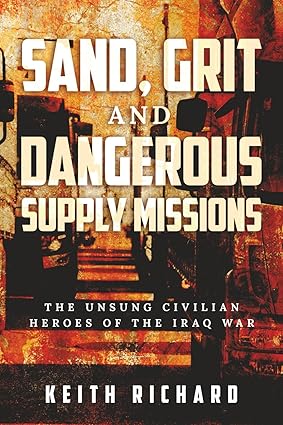

Keith Richard’s Sand, Grit and Dangerous Supply Missions offers a vivid and personal account of civilian logistics operations during the Iraq War, told from the perspective of someone who lived it firsthand. The book follows Richard’s unexpected journey from a seasoned logistics executive in the U.S. to leading one of the largest civilian military support efforts in a war zone. Through stories packed with emotion, hardship, and bureaucratic chaos, he lifts the curtain on the thousands of unsung civilian workers. Many of them are truck drivers who put their lives on the line without a uniform or a weapon. It’s part memoir, part tribute, and part exposé of how civilian contractors played an essential but invisible role in modern warfare.
I found the writing to be raw, honest, and sometimes unpolished, but in a way that works. Richard doesn’t try to sound like a polished author. He writes the way he talks, which makes the whole thing feel personal, like a friend telling you a war story over coffee. Some chapters hit hard, especially the ones where lives are lost or where Richard grapples with the emotional toll of being away from his family. But just as powerful are the quiet moments: awkward airport layovers, cigarette breaks with skeptical soldiers, dusty meetings in sweltering trailers. Those little things made the story feel real. The voice is genuine and heartfelt, though sometimes a bit repetitive or tangential. But I didn’t mind. It gave the story a rhythm that felt true to the chaos he was living through.
What I liked most were the ideas beneath the surface. This book isn’t just about logistics or war. It’s about leadership, identity, and purpose. Richard steps into a role that he never could’ve fully prepared for, and instead of folding, he adapts. He leads through grit and connection, not ego. That said, there were moments when I wished he pushed harder on the system itself. The bureaucracy and mismanagement he described were shocking. Maybe that’s loyalty, maybe it’s diplomacy. Either way, the book raises important questions about how we treat the civilians who support military efforts and whether we even acknowledge them at all.
I’d recommend this book to anyone interested in military history, leadership, or stories of resilience in the face of overwhelming odds. It’s especially compelling for those who’ve worked in logistics or operations, since it highlights a side of war that’s rarely talked about but absolutely vital. It’s a gritty, heartfelt memoir that gives voice to the everyday heroes who get left out of the headlines.
Pages: 150 | ASIN : B0F91X5ZYD


