Blog Archives
Separateness

Lila’s Dance follows a young Carthusian monk whose discovery of a secret letter leads him to question Church doctrine and, after being sent to St. Kitts, develop a transformative relationship with a woman shaped by religious persecution and Indian philosophy. What was the inspiration for the setup of your story?
The inspiration came from three distinct sources. First, as a lifelong meditator, I have wanted to share my inner path experiences with others. But I am not a Guru, and a non-fiction “this is how you do it” book didn’t seem right. The idea was to weave it with some kind of fictional narrative that would be fun as well as informative.
Second, I was inspired by the documentary movie Into Great Silence (cited in the Afterword) about monks living in silence at the Grand Chartreuse Monastery in the French Alps. What is the inner experience, and how does it compare to my own? These were questions worth exploring.
Third, while on our annual holiday on the Caribbean island of Nevis, I came across a set of books written by a British expat who had lived on the island, in which he recorded the history of Nevis and its sister island, St. Kitts. One short paragraph briefly described an incident where a St. Kitts priest who was asked to convert the French governor’s Huguenot daughter to Catholicism instead eloped with her to Protestant Nevis and married her. This was certainly a story that had to be told.
What attracted you to Lila as a character, particularly her background as the daughter of a Huguenot mother and a Catholic scholar interested in Indian philosophy?
When writing Lila, I wanted to maintain a balance between the masculine and feminine perspectives. Having grown up with four sisters, I have always enjoyed and appreciated the company of strong women. It was important to me that I fully develop Lila’s character and that it be a strong one.
As noted in the Introduction, “lila” in Sanskrit means “play,” as in the “play of consciousness.” Early on, I saw Lila as the “Krishna” to Sebastian’s “Arjuna” in the Bhagavad Gita. Being an historical novel, Lila required adherence to a specific timeline and actual events that occurred during that timeline. I also needed a vehicle for showing how the principles of Eastern mysticism apply to all seekers on the inner path regardless of cultural or religious background. While researching the history of France and the Huguenot movement at the end of the 17th century, I found Pondicherry, which fit perfectly in the timeline and provided the connection to Eastern mysticism. From there, Lila’s character began to write itself. I didn’t write the last chapter, “Eternal Dance,” until the final draft because I felt I needed to emphasize the importance of Lila’s inner journey as well as that of Sebastian.
How did you balance the novel’s philosophical and metaphysical ideas with its historical-adventure elements?
It has become increasingly apparent to me that the difference between the inner world and the outer, physical world is an illusion created by our concept of separateness. We are all searching, in one way or another, for the divine. The mystic will tell us that to reach our goal, we must lose the idea that we are separate from the divine. To do this, we must become detached from our ego, not lose our self-identity, but not be driven by it. And we must come to understand how we create our world through the power of our consciousness.
Sebastian learns of these goals through his inner journey, but he seems to make the most progress toward achieving them while on his outer journey. In Lila, I was not concerned with balancing mystical philosophy with historical adventure, but instead was focused on blending them together and losing the distinction between them. “Nothing exists that is not Shiva” sounds abstract and incomprehensible, but it is a simple and practical mantra. There is nothing that is not spiritual; that simply living your life is as spiritual as spending it in silence in an Alpine monastery. It is a plain truth you cannot avoid.
What do you hope readers will continue thinking about after they finish Lila’s Dance?
The world at the end of the 17th century was as messed up as it is today. Love, devotion, and righteousness were how we survived it then and how we will survive it today.
The metaphysical principles are universal – detach from self-identity, accept your oneness with the divine, and understand the power of consciousness.
Though the inner journey may be a most useful and wondrous path, the outer journey is no less important and wonderful in our quest for the divine.
Putting all the metaphysical philosophy aside, Lila’s Dance is simply a fun read.
Author Links: GoodReads | Facebook | Substack | Amazon
Lila’s Dance is an historical fiction that weaves a narrative of adventure and romance with a soul’s inner journey and the mystical nature of reality.
The story describes a soul’s experiences exploring the infinite and not-so-silent world of inner meditation with an epic tale that touches on four different millennia and three different continents.
Sebastian, born in the Dutch low country in1670, faithfully follows a destiny that leads him to life as Catholic priest in the Grand Chartreuse monastery high in the French Alps, committed to a life of silence and inner exploration.
Eventually, he comes to a crisis of faith which propels him into a new world where a different reality awaits him.
Lila is born in 1681 to French parents who are living in a French trading colony on the southern coast of India. Her parents are Huguenots in a time when the Church and King of France are violently persecuting such believers. When her parents return to France, Lila grows into a gifted young woman in Paris society while her family’s religion remains precariously hidden from those who would persecute them.
How these two souls come together to support and instruct each other in their divine quests offers the reader a profound understanding of our reality and the power of our consciousness.
A Sacred Hunger

Two Hearts Within One Soul, Volume 2 follows a woman in her fifties whose quiet life in Hampshire opens into love, grief, faith, and self-discovery after her connection with a man she meets over a book changes how she sees herself. What was the inspiration for the setup of your story?
Layla was inspired by the transformative power of an unforgettable courtship. I wanted to explore the moment someone truly loves you enough to mirror your own worth back to you before you even recognize it yourself. This story is about being introduced to a world of passion and purpose—a world that encourages you to reclaim your identity rather than letting it be consumed by the rules and standards of society.
Your book is as much about Layla reclaiming her own worth as it is about the romance with Mate’O. How do you write a love story where the most important relationship is the one the protagonist has with herself?
Layla represents the many souls who have endured loss and simply surrendered to the life they were given. I wrote her journey to show that when a love is truly pure, it acts as a catalyst. Mate’O doesn’t just offer romance; he challenges the status quo of her heart. Being “in love” creates a sacred hunger for more—more growth, more understanding, and more life. Her relationship with herself changes because his love gives her the courage to explore the parts of her soul she didn’t know existed.
The invisible red thread is the book’s central symbol. Where did that image come from, and how did you develop it?
The image is a bridge between East and West. It draws from the Southeast Asian legend of the “Red Thread of Fate,” which may stretch or tangle but can never break. I wove this together with the Greek myth of the original “split soul”—the idea that we were once whole and are now destined to find our other half. Across the series, the thread evolves from a mere symbol into a living, mathematical heartbeat. It is the literal weaving of a mirror soul searching for its counterpart across time and geography.
The book treats love almost as a sacred force. What does “soul recognition” mean to you as a storyteller?
To me, soul recognition is the ultimate cosmic memory. It is the moment two souls, bound across every lifetime, fulfill the promise to meet again with the same depth, passion, and desire. As a storyteller, it is the most haunting theme I can explore: the idea that if these two do not find one another, the soul will continue to yearn with a “cosmic ache” until breath finally departs from flesh and bone.
Author Links: GoodReads | Website | Amazon
After World War II, Layla, an orphan and former maid in Versailles, France, lives a quiet life in a Tudor cottage in Hampshire, England. In her early fifties, she has made peace with a solitary life-until fate intervenes.
In the quiet corners of an old bookstore, Layla’s fingers brush a weathered Jane Austen novel and the hand of Mate’O Conti Amatto. A man of high society, hazel eyes, and Italian good looks, Mate’O awakens an echo of lifetimes lived, a love long destined. That brief encounter shakes Layla to her core, unraveling everything she thought she knew about love, destiny, and herself.
Mate’O may lie silent, but the invisible red thread connecting their souls tightens, pulling her toward a deeper truth in a story not of second chances, but of remembering, of love that transcends time and a woman who dares to rise from heartbreak to reclaim her worth.
Would you stay in the safety of what’s known-or pull the thread?
Prince in the Wilderness: An Easter Story
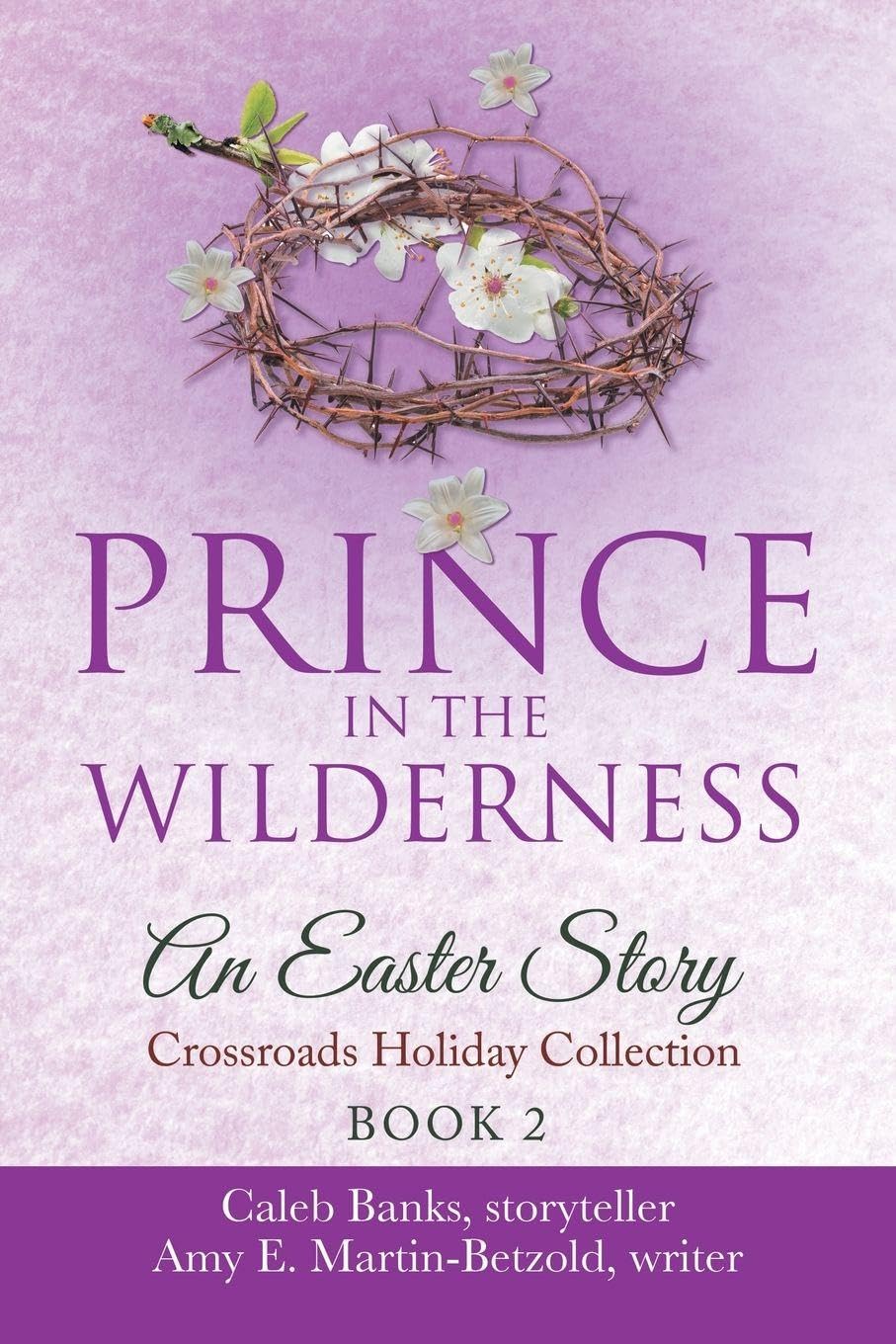

Prince in the Wilderness is a work of Christian historical fiction, and it reads like an Easter story told around a fire, with Scripture, family memory, and frontier life all braided together. Set in 1846 Indiana, it follows Laurent Fontaine, a young man standing between boyhood and adulthood, as he moves through the demands of family, faith, wilderness, and first love. Around him, the novel builds a full household world: his mother and father, his younger sisters, the rhythms of trapping and homesteading, and a deep sense that the natural world is not just background but part of the book’s spiritual language.
I enjoyed the book’s warmth. It’s earnest in a way that can feel rare now. The family scenes are where it really comes alive. The joking between Laurent and his sisters, the meals, the storytelling, the small household rituals, all of that gives the novel its pulse. I also liked how much the authors trust the domestic details. Food, chores, baths, tools, prayer, reading aloud, all of it matters. That gives the story weight. The prose is very rich. Still, I never doubted the sincerity behind it. The book knows exactly the kind of world it wants to build, and it commits.
I found the authorial choices interesting too, especially the way faith is not tucked into the corners but placed right at the center. This isn’t a novel that nods vaguely toward belief. It’s openly shaped by Christian conviction, and the wilderness becomes both a physical place and a spiritual testing ground. That worked for me more often than not because the book is at its best when it lets those ideas arise through character and scene rather than explanation. Laurent’s sense of responsibility, his tenderness toward his sisters, and the family’s conversations about protection, obedience, gender, and calling give the story something to wrestle with. I didn’t agree with every idea, but I respected that the book is honest about what it believes and lets those beliefs shape the stakes.
The book reminded me a little of Janette Oke’s work, especially Love Comes Softly, because it shares that same gentle Christian historical fiction tone, where faith, family, and everyday frontier life matter as much as plot. There is also a touch of Laura Ingalls Wilder in the attention to household rhythms and the feel of the natural world, though Prince in the Wilderness is more openly devotional.
I came away feeling that this book will mean the most to readers who enjoy faith-forward historical fiction with a strong family core, a coming-of-age thread, and a frontier setting that feels lived in rather than decorative. People who like their fiction reflective, morally serious, and rooted in Christian themes will probably find a lot to appreciate here. For those who want an intimate, heartfelt Christian historical story with frontier texture and a sincere spiritual center, Prince in the Wilderness has a steady, generous pull.
Pages: 298 | ASIN : B0GNT8V9X9

Hodgepodge of an Author’s Experience

The Changed Man follows a former CEO who leaves the family business to become a thriller author, causing some strain among family and friends. What was the inspiration for the setup of your story?
In Book 1 of this series, The Silent Woodsman, fraternal twins Joe and Jake have a rivalry that dates back to high school. Joe was a musician and a babe magnet from an early age. He matured earlier than Jake and was far more confident; that gave him a distinct advantage with the girls. Two incidents in particular caused their estrangement, and that plays heavily into the plot. In this book, I wanted to redeem Jake, who never got a chance to justify his actions in Book 1.
My sister and I were close in age. She was “the athlete” and I was “the brain.” Actually, she was plenty brainy, and although I didn’t have her coordination, I was athletic, too. But for a while, we both felt trapped in our roles. So I definitely understand feeling irrationally competitive with a sibling. In Jake’s case, Joe did deserve some blame.
Inspiration… it’s all a hodgepodge of an author’s experience. I dated a track star at a Catholic high school when I was 16, so my memories of him play into it. I was a German literature major and am the daughter of a professor of Russian History, and writing romance novels is somewhat on par with writing thrillers–a profession some “serious” people look down on. Especially in academic circles. Let’s just say that I don’t rely on friends and relatives as my main fan base, although my sister and I are very close, and she is wonderfully supportive of my writing.
I dated a CEO once, who turned out to be dating someone in San Francisco at the same time.
Your characters’ energy and personality really bring this story to life. Did you incorporate anything from your own life into the characters in your novel?
Thank you! I share Jake’s appreciation for the absurd. I also know a man who hiked in the Himalayas with his best friend–the trip was a lifelong dream–only to have him drop dead in their hotel room. It made me think about how men cope with grief and how great it would be if his friend’s spirit could have comforted him somehow.
When I was 17, my family stayed in a hotel outside of Florence that was run by minor nobility. We met the son and his friend, and my sister and I had an extremely innocent “romance” with them. I put it in quotes because it involved nothing more than flirting, but it was very exciting to my innocent and naive teenage self.
I don’t write about evil characters. My antagonists are mostly immature and selfish–but charming. Before I met my husband, I had a weakness for “bad boys.” They didn’t treat me particularly well, but I don’t really blame them. They were clear about who they were; I just wasn’t listening. I have known several men like George Reed Masters. They’re a blast if you can keep from falling hard for them.
I enjoyed Jake and Chiara’s romantic relationship. How did it develop while you were writing it? Did you have an idea of where you wanted to take it, or was it organic?
I made it up as I went along, but I did have a clear idea in my head of who they are. Like Chiara, I am fascinated by how idioms reflect a country’s culture. My strongest languages are French and German, but I also studied Italian for a year in college. Chiara and Jake are both insecure, but also intelligent and intuitive. That plays into how their relationship develops. Both are powerfully attracted but neither quite believes anyone can truly love them back. Whenever I encounter a house (or castle) that’s been made into a museum, I want to tour it! Especially if it contains the original furniture. I love thinking about how people used to live in the days before technology. Chiara and Jake are also enchanted by the past, another thing they have in common.
I hope the series continues in other books. If so, where will the story take readers?
In Book 5, The Fallen Man, we learn Edward’s story. For the past ten years, Edward has been a priest in Philadelphia, but when he arrives in Port Townsend, he’s finished with the Church. When I was a kid, the big bestseller was The Thorn Birds. I wanted to write a story about a sexy priest who isn’t plagued by guilt or sexually repressed and doesn’t meet a bad end. Edward had his reasons–good ones–for becoming a priest. Read the book to find out why he becomes disenchanted. And of course, he meets a beautiful woman in Port Townsend to cushion his “fall.” I won’t give away who she is, though she’s appeared in prior books and has a brief scene in The Changed Man. Book 5 will be released June 1st. Right now, I’m giving it one final edit. I’ve been mulling over spinoff books featuring minor characters or the O’Connell children as adults since this series takes place in the ’90s.
Author Links: GoodReads | Twitter | Facebook | Website | Amazon
Now Jake is content to rattle around in a rented Victorian mansion. He appears easygoing, though distracted. His recently dead friend haunts his thoughts, making him fear for his sanity.
Jake has a new career, one frowned upon in his social circle. He writes thrillers. The muse he finds in Port Townsend is just as inappropriate: the married, beguiling Chiara.


