Blog Archives
Global History and Politics

Jigsaw: Sonora follows a group of ideological extremists who travel back in time to WWI to alter history, and a group of temporal guardians must stop them before their plan unfolds. What was the inspiration for the setup of your story?
Excellent question. Most of the attention given to World War I seems to center on what happened on the Western and Eastern Fronts in Europe. Outside of the Zimmerman Telegram, little attention is given to the efforts to keep the United States out of the war or keep many of their military assets occupied on the Southern Border. This book touches on that as well as the origins of the Influenza virus in that period and the attack on Wall Street, where a real one did take place in 1920.
What intrigues you about this time period enough to write such a thrilling novel in this era?
This time period influenced global history and politics for the next century, from World War II to the Cold War, to the growth of the United States’ influence, to the advance of the modern welfare state and labor movement, to the creation of modern nations and nationalist movements that are still with us today.
What was your favorite scene in this story?
The climax on the Zepplein Sonora. I do not want to spoil the climax for readers, so I will leave it there.
Can you tell us where the book goes and where we’ll see the characters in the next book?
Yes. The next book, Jigsaw: Shadow Ball is already out where our Time Traveling heroes have to save the creation of the Negro Leagues in the 1920’s and the integration of Major League Baseball in the 1940’s with Larry Doby and the Cleveland Indians. That adventure will be followed in 2026 with Jigsaw: Temporal Apocalypse, where our heroes have to stop the ultimate attempt to change reality in the post-World War I Era by disrupting events in Italy/Yugoslavia over Fiume and the Russian/Polish War.
Author Links: GoodReads | X (Twitter) | Facebook | Instagram | Website | Amazon
Renegade Novus Ordo operatives have formed Global Harmony and have launched Project Sonora, a plan to draw the United States out of World War One, start a continental war in the Americas, and unleash a genetically coded pathogen that would cause population segments to fall to the Influenza Virus.
The Temporal Guardians, led by Francesca and Noah must stop Global Harmony before the Forces of Evil can change history and destroy reality.
Educate Readers
Jigsaw: Powder Keg flips between timelines, ancient Persia, WWI and WWII Europe, post-Holocaust Italy, 1950s Alabama, and even Victorian England, while weaving together a massive, complex tale of shadowy global conspiracies, time travel, and supernatural battles. What was the inspiration that created the fantastic journey these characters go on?
I wanted to write a book that especially focused on the events leading up to Pre World War One not normally dealt with in great detail in general high school history textbooks. Jigsaw Powder Keg, like all my books, is designed to appeal to and educate readers from mature middle school level on up. The other historical and religious/mythological events covered in the book like those in Ancient Persia, Post Holocaust Italy, and 1950’s Alabama are also not regularly known and I wanted readers to be aware as well as see our major characters in action. The scene with the time-traveling dog, Nicki, uncovering the identity of Jack the Ripper, was kind of a back in pilot to my Adventures of Moly: Time Traveling Dog series.
I felt that the action scenes were expertly crafted. I find that this is an area that can be overdone in novels. How did you approach this subject to make sure it flowed evenly?
Great question. I generally outline the chapters and map the action sequences out before writing the first draft. For me, dialog is also a great mover of the action. I am also greatly aided by a very good line editor, Natalie Bavar, who is a great partner in smoothing out and polishing these scenes.
Did you find anything in your research of this story that surprised you?
That the photographer, Gordon Parks, who was being persecuted in 1950’s Alabama was not widely known. I actually found out about him while doing a reading activity with second graders in the elementary school where I am an Instructional Assistant and I thought after reading about him that this would make a great scene in the book with the Antonia and Rene characters.
Another area that kind of surprised me was that the Italian-Libyan War revealed to other powers at the time that the Ottoman Empire was truly “The Sick Man of Europe” and Italy’s defeat of it motivated other powers like Serbia to take advantage of that situation in the resulting Balkan Wars which also led to World War One.
Can you tell us more about what’s in store for Temporal Guardian Foundation and the direction of the next book?
The next two books in this story arc are out. The first is Jigsaw Sonora which deals with our time-traveling heroes thwarting an attempt by Global Harmony to take the United States out of World War One by staging a border war, an attack on Wall Street, and a Zeppelin bombing raid over Tucson with a bioweapon. The second, Jigsaw Shadow Ball deals with the Guardians saving the creation of The Negro Leagues and the integration of Major League Baseball with Larry Doby and the Cleveland Indians. The final book in this arc, Jigsaw: Temporal Apocalypse is coming out in 2026 and will deal with the end of World War One in Bulgaria and the post-war conflicts and incidents in Russia/Poland and Fiume.
Author Links: GoodReads | X (Twitter) | Facebook | Website | Amazon
Novus Ordo has not given up on its Mission to Shape Reality In its Neo-Fascist Image
Working with the Novus Ordo organization from the beginning of the Twentieth Century, they have launched Operation Powder Keg, an attempt to steer the course of World War One to their benefit.
But they did not factor in the involvement of Ahriman, the Devil who sees this as an opportunity to finally remake the world in his image.
They also did not consider the intervention of Francesca, Mariah, Noah, Bonomi, and other members of the newly formed Temporal Guardian Foundation.
Now the heroes from the Jigsaw Universe must race across 1903 Serbia, 1911 Italy, 1913 Macedonia, 1914 Sarajevo, and the Ancient Middle East to stop the plans of Novus Ordo and the Devil…
And save existence.
Fighting for Equality

Eroshenko follows a blind Ukrainian Esperantist and writer who moves to Tokyo, where he winds up at the center of early 20th-century Tokyo’s anarchist, feminist, and literary circles. What was the inspiration for the setup of your story?
For years I kept coming across references to Vasily Eroshenko in Japanese art and literature–seeing his portrait in the Museum of Modern Art Tokyo, his photo in the Nakamuraya restaurant, reading about him in novels by famous writers like Kawabata Yasunari and Hirabayashi Taiko. Then a few years ago, I discovered that he had been close friends with Kamichika Ichiko, who has her own wild story of a love triangle with feminist Ito Noe and anarchist Osugi Sakae. I just knew I had to bring these two stories together. About a year after I got the inspiration and started planning the novel, the first translation of some of Eroshenko’s short stories was published under the title The Narrow Cage. In the introduction, the translator, Adam Kuplowski, briefly summarizes Eroshenko’s biography. Several reviewers mentioned that Eroshenko’s life was worthy of a novel. I agreed–I was already working on one.
It was a bit intimidating to write about real people. I wasn’t sure if I had enough material at first. But I discovered that many of Eroshenko’s friends published autobiographies: Kamichika Ichiko, Soma Kokko, Akita Ujaku and others. There was also a biography of Eroshenko published after his death, and the author, Takasugi Ichiro, had interviewed Ichiko, Akita and others who knew him. Some of Eroshenko’s letters and speeches have also been published along with his short stories. Once I realized there was a lot of material, it was more a matter of fitting it together into a narrative and making decisions about personality and motivations.
As much as possible, I used real events and incidents. Every named character is a real person. Ito Noe really did let her baby pee off the verandah in the Bluestocking editorial office, which was just a room in Hiratsuka Raicho’s parents’ house. The other women editors complained about Noe, but it shows how little she cared about propriety. I also used Eroshenko’s and Ichiko’s own words as much as I could, especially when they deliver public speeches.
In some ways, I think of Eroshenko as a companion to my previous novel, Flowers by Night, which is set in Japan about a hundred years earlier. In Flowers by Night, the main character, Ichi, belongs to the guild of blind men, the Todoza, which provided training and a job, and was run by blind people themselves. That history of self-determination and independence of blind communities in Japan explains why Eroshenko found the situation there superior to Moscow and even London. Both novels also show how the gay-straight binary did not exist in Japan until they imported Western-style homophobia in the early twentieth century
What are some things that you find interesting about the human condition that you think makes for great fiction?
I’m very interested in finding states of being that are very unlike our own and making them relatable. What did it feel like to walk down the street in Tokyo in 1915? So much of the outward details are so different, but on the inside we’re all just people. I love being transported to a different time and place but still recognizing that essential humanity.
What were some themes that were important for you to explore in this book?
Even though the story is set in 1915-1916, it’s both inspiring and chilling how many parallels there are with today. The characters are activists for socialism, anarchism, sexual freedom, disability rights, queer identity, women’s rights, birth control and abortion, all things we are still struggling with more than a century later. The real people behind these characters were incredibly brave to protest publicly despite censorship, government repression, and police brutality. At the same time, they made a lot of mistakes, like letting ego and petty jealousy sabotage the movement. The toxic rivalry between Sakai Toshihiko and Osugi Sakae over who would be the leader of the socialist movement in Japan is unfortunately a common story in leftist organizing.
The feminist struggles also feel very relevant to me: Ito Noe trying to manage a career and children; Kamichika Ichiko thinking of herself as sexually liberated, but still finding herself bound by the conventions and sexism around her; men like Osugi Sakae proclaiming themselves feminist allies, then treating the real women in their lives very badly.
Above all, I wanted to depict the struggle for self-determination that was happening in the blind community at that time. Many of the things that Eroshenko said were decades ahead of his time in terms of disability rights. In particular, his comment that the problem was not blindness itself, but the fact that blind people were not taught to live independently nor hired in jobs that would allow them to support themselves. This prefigures the social model of disability by around 50 years. Eroshenko’s imagined solution was to create self-sufficient communes of blind people, which also prefigures by almost a century ideas about disabled people as a class being created by capitalism. I felt it was important to tell his story not only for his remarkable life as an individual, but to challenge the way disability is often represented in literature. Too often, the character with a disability is a lone individual, but in real life, community is essential. Eroshenko’s travels were facilitated through international networks of blind schools, and he dedicated his life to teaching and to publishing in Braille. It was important to me to represent his friendships with other blind people in Japan.
Eroshenko’s life was very hard, full of struggle. But it’s also important to remember people who spoke out against fascism and for peace and equality even in the face of tremendous odds.
Author Links: GoodReads | Website
While WWI rages, half a world away, Tokyo is a hotbed of radical ideas, as cosmopolitan intellectuals and activists from around the world cross paths in a rapidly modernizing city. Socialists and anarchists, musicians and artists from Japan, China, Korea, India, and Russia all passionately advocate for a more just and equal world.
Blind Ukrainian Vasily Eroshenko is drawn to Tokyo in search of greater opportunities and respect for blind people. At a salon for radicals on the second floor of a bakery, he meets the anarcho-feminists of Bluestocking magazine, fearless women fighting for bodily autonomy and free love.
Kamichika Ichiko is a contributor to Bluestocking and the first woman reporter at the Tokyo Daily News. She is most at home among the Bluestockings who dress like men and engage in “sister” relationships. Yet she is drawn to Eroshenko and helps him publish his political fables.
As Eroshenko becomes a celebrated writer and public speaker, he becomes more outspoken in advocating for socialism, feminism, and disability rights, but the authorities will not long tolerate this disruptive foreigner.
Based on extraordinary, heartbreaking true events, Eroshenko is a wild fever dream of utopianism, polyamory, artistic creation, jealousy, and persecution, unfurling against the backdrop of Japan’s belle époque, called Taishō Romanticism. When high and low, East and West, old and new intermingled, these activists dreamed of a better world, trying to stem the tide of growing fascism.
Eroshenko


Eroshenko is a richly textured historical novel that follows the life of Vasily Eroshenko, a blind Ukrainian Esperantist and writer who finds himself at the center of early 20th-century Tokyo’s anarchist, feminist, and literary circles. Through the eyes of Kamichika Ichiko, a headstrong lady reporter navigating her own path in a rigid, patriarchal society, we experience Eroshenko’s passionate ideals, his gentle spirit, and the political tensions simmering just below the surface of Meiji and Taishō-era Japan. The book blends historical facts and imagined dialogue seamlessly, offering a vivid snapshot of a revolutionary time and a cast of unforgettable characters.
I was immediately pulled in by the opening at the Nakamuraya salon. Lennox’s writing here is lush but never showy; the scent of cream buns and the dusty stairs, the eclectic furniture, the buzz of political energy, all of it just hit the right note. And the way Eroshenko is introduced, with his halo of blond curls and strange, tilted eyes, was so captivating I reread that section twice. The dialogue sparkled with personality, especially between Ichiko and Raichō, and there was a real sense of history being made in these cramped, smoky rooms.
Ichiko is smart, proud, and fiercely independent, but she’s also vulnerable, a bit naive, and maybe even a little lost. Her relationships with the other women, especially Noe, were complex and emotionally raw. That conversation over sweets and tea, with Noe breastfeeding and letting her baby pee off the veranda while talking about revolution and broken marriages? That was wild and intimate and, honestly, one of my favorite parts. It made me laugh, feel a little sad, and somehow more hopeful at the same time.
The story of Eroshenko himself, it’s hard not to fall in love with him the way Ichiko does. He’s this strange mix of gentle dreamer and idealistic firebrand. His ideas about Esperanto, storytelling, blind independence, and massaging for a living might sound like an odd combo, but Lennox makes it work. When he’s on the train to Enoshima or kissing Ichiko at the seaside lookout, you feel like you’re watching two lonely people touch the edges of something bigger. But even then, he stays a bit enigmatic. That ambiguity made the emotional payoffs more subtle, and in a way, more real.
This book’s a slow burn in the best way. If you’re the kind of reader who loves character-driven stories, rich dialogue, and historical fiction that doesn’t just name-drop but fully immerses you, Eroshenko is gold. It’s perfect for readers who have a soft spot for the underdog intellectuals and badass women navigating love, politics, and personal truth. It made me think, made me laugh, and made me want to look up everyone in it to learn more. Highly recommended.
Pages: 366 | ASIN : B0DTKL38GR

Selfless Sacrifice
A Place More Dark follows a Lance Corporal in WWII who is forced to join the march across Central Europe, where he risks his life to save someone from the SS. What was the inspiration for the setup of your story?
With a grandfather who was a POW in World War Two, I have a natural interest in the subject. When researching the topic, two things struck me: firstly, how ill-prepared the British army was at the start of the war and how, in the debacle leading to the famous evacuation at Dunkirk, many of the less well-trained troops were sacrificed to allow others to escape; and secondly, those same men, held in captivity for the war’s duration, were often considered to have ‘sat out’ the conflict, avoiding the dirty but heroic business of fighting and earning victory. This double body-blow to their reputation is inherently unfair and so I was inspired to present them in a more heroic light and do justice to their memory. Beyond the escape story, POWs have had limit representation in fiction. With my Jock Mitchell series, I want to show other aspects but also demonstrate they were still in the war, fighting battles of a different kind and winning by surviving.
I enjoyed the depth of the main character, Jock Mitchell. What was your process to bring that character to life?
Jock is an everyman, leading an unassuming life before the war, but he now finds himself in a dramatic, complex world of conflict where simple survival shapes his every action. He clings to the nostalgic, balanced world he recalls in better times with his family, drawing strength from those memories to do the right and heroic thing when chaos and cruelty threatens. But equally, he finds anger, pain, or self-preservation driving him in other situations. He has little control, dragged and thrown by the currents and crashing waves in this tempest. Emotions, risks, and friendships are intensified by the war: stoic determination mixing with fragility and despair, laughter blending with tears. It is trauma played out in a world with no time or opportunity to succumb to it.
What were some themes that were important for you to explore in this book?
A Place More Dark is literally about a journey across Europe from one hell into another, but at its heart is the journey into the human spirit. From cruelty to selfless sacrifice, the spectrum of basic human behaviours is explored using the stage of a war. I was keen not to present conflict one-dimensionally: of just good against bad. Each character is stripped raw and shown to be flawed, being extraordinary as monsters or saints, sometimes both, because order has collapsed, and survival is the name of the game. In this primitive landscape, it is light that leads them out of the darkness: the camaraderie, acts of kindness, sacrifice, and humanity.
Where does the story go in the next book and where do you see it going in the future?
Book one in the series, Triumphant Where it Dares Defy, left a few threads dangling that need tying up and so I intend to bring Jock back in a post-war world, exploring the impact of five years of captivity on a man in peace-time. Did the war ever truly end for them? There was also a new world order taking shape and so that will provide a perfect stage for a new adventure. At some point I will return to the start of the war, a prelude to Jock’s captivity, and find out his story in those confused and terrifying weeks as the British and French armies collapsed, and the free world hung in the balance.
Author Links: GoodReads | Website | Amazon
Already half-starved, disease-stricken and brutalised, the last thing the prisoners of Stalag XXa need is an order to pack their meagre belongings and begin marching through the harsh winter of early 1945. Under the watchful eye of their guards and the SS, they walk into the unknown, facing the bitter cold across hundreds of miles of Central Europe, while the dangerous frontline between the Wehrmacht and Red Army followings close on their heels.
Lance Corporal Jock Mitchell, a POW of five long years, leaves Stalag XXa with a hole in his boot and a sledge converted from his old bunk. It doesn’t take long for Jock to realise fighting nature, as well as the Nazis, will be his greatest challenge ever. With blizzards and an empty stomach, just placing one foot in front of the other is hard enough, but when Jock steps in to save someone from the barbarity of the SS, his march westward takes on a greater importance and far more danger. From the hell of the prison camp, Jock finds himself in a place more dark.
Book Two in the Jock Mitchell Adventures continues the thrilling story of survival and danger for those whose war continued in captivity but who never stopped fighting.
A Place More Dark
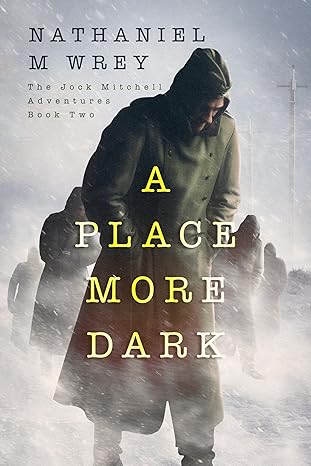
Nathaniel M. Wrey’s A Place More Dark plunges readers into the grim and unforgiving world of Stalag XXa, a Nazi prisoner-of-war camp that serves as a brutal stage for the horrors of World War II. For Lance Corporal Jock Mitchell, survival is already an immense challenge, but his ordeal intensifies when he is forced to join the grueling march across the frozen plains of Central Europe. With the Red Army and Wehrmacht clashing close behind, Jock faces unimaginable trials. Yet, his journey gains significance when he risks everything to save another life from the merciless hands of the SS.
Wrey crafts a historical war story that spares no detail, confronting the barbarity of war with unflinching realism. His narrative recalls the raw intensity of Hemingway’s wartime prose and the methodical precision of Tom Clancy’s storytelling. Though this is the second novel in the series, newcomers will find it accessible, as the author deftly weaves essential backstory into the tale without slowing its momentum.
At its heart is Jock Mitchell, a stoic yet layered character whose resilience and humanity anchor the story. Initially hardened by his environment, Jock reveals unexpected depths of compassion and moral courage as the story unfolds. The novel’s tone is appropriately stark, yet Wrey’s prose has a way of shifting gears during pivotal moments. His descriptions become vivid and visceral when portraying the heinous acts of the SS, forcing readers to confront the raw brutality of these events. This deliberate contrast highlights the extremes of human cruelty and the fragile sparks of kindness and heroism that endure despite it.
Wrey’s careful attention to historical detail enriches the story, creating a backdrop that feels authentic and immersive. A Place More Dark is not a light or easy read. Its unflinching portrayal of war’s atrocities makes it a tough and sometimes harrowing experience. But for those willing to endure its darker passages, the book offers immense rewards. The character development is fantastic, the narrative is gripping, and the ending is satisfying. This is a story about the resilience of the human spirit in even the bleakest circumstances.
Fans of historical fiction, particularly those who appreciate stories steeped in wartime realism and moral complexity, will find much to admire. A Place More Dark is a powerful and unforgettable journey into the depths of humanity and the enduring light of courage.
Pages: 195 | ASIN : B0DJ7N9VT2
Crossroads of Empire

Crossroads of Empire dives into the tumultuous waters of World War I, presenting a thrilling narrative enriched by a blend of historical and fictional characters. The story follows Evan Sinclair, a young man thrust into the global conflict, whose journey from France to the strategic depths of the Middle East unveils a panorama of espionage, imperial ambitions, and the cultural crossroads that define the era. With the Middle East as a pivotal battleground for control over key resources like the Suez Canal and oil reserves, Cooper intricately maps the convergence of history and personal saga, underlining the lasting impact of wartime decisions on today’s geopolitical landscape.
Michael J. Cooper’s writing is compelling and richly detailed, offering a tapestry of scenes that bring early 20th-century conflicts vividly to life. His ability to intertwine factual historical events with the personal fates of both real and imagined characters allows the narrative to flow seamlessly between action and introspection. The portrayal of Kaiser Wilhelm II’s complex personality and his obsessions with Jerusalem provides a fascinating glimpse into the psyche of a ruler whose decisions shaped the course of history. The inclusion of characters like Aaron Aaronsohn and T.E. Lawrence adds layers of authenticity and intrigue, enhancing the novel’s exploration of loyalty, betrayal, and the harsh realities of war.
While the intricate descriptions of settings and historical context are generally a boon for the narrative’s richness, I think they can sometimes bog down the pacing, especially during crucial transitions between significant plot points. Nonetheless, Cooper’s fantastic character development ensures that readers remain engaged, rooting for individuals caught in the machinations of empires.
Crossroads of Empire is a blend of historical fiction and detailed storytelling that offers readers a window into a pivotal time in world history. Michael J. Cooper’s work is highly recommended for its educational value and its ability to entertain, making it a suitable read for both history buffs and fans of intricately plotted narratives.
Pages: 368 | ASIN : B0DGVWD54Q


