Blog Archives
Timing is Everything


Timothy Bernard Carr’s Timing Is Everything is an ambitious alternate history novel that mixes time travel fiction, baseball historical fiction, and one man’s search for redemption. Mark Killoran begins as a dispirited Detroit Tigers executive in 2003, weighed down by alcoholism, family estrangement, and grief from the Vietnam War. A mysterious doorway sends him into baseball’s past, where his knowledge gives him the chance to reshape history. The premise quickly becomes larger than a wish-fulfillment fantasy, asking what might happen if a struggling person found purpose by creating second chances for others.
The richest sections are rooted in baseball history. Carr clearly enjoys the statistics, personalities, ballparks, and executive maneuvering that shaped the sport. Mark saves Jim Thorpe’s Olympic legacy, brings Babe Ruth to Detroit as a player-manager, recruits Ty Cobb as an executive, and helps integrate Major League Baseball years ahead of schedule. Josh Gibson, Satchel Paige, Turkey Stearnes, Oscar Charleston, and Monte Irvin become the core of a formidable Tigers dynasty, while Mickey Mantle receives an opportunity to build a healthier, longer career. Fans of baseball fiction and Detroit Tigers history will have plenty to chew on, especially when Carr constructs new lineups, pennant races, records, and World Series results from familiar names.
As Mark’s influence expands, Timing Is Everything grows into a broad work of speculative fiction. Baseball integration helps accelerate social change, an integrated military transforms race relations, and a conversation with John F. Kennedy produces a dramatically different political future. Carr’s alternate history is openly optimistic and driven by the idea that timely action can redirect institutions, nations, and individual lives. The historical background and explanatory passages give the novel the feeling of an enthusiastic storyteller walking readers through every ripple in the revised timeline.
This time travel novel is about choosing to use knowledge in service of other people. Mark’s journey gains emotional weight from his sobriety, his longing for his family, and his gradual understanding that redemption comes through sustained effort. The final return to 2003 brings the book’s many revisions together in a warm, personal payoff, with the altered Tigers legacy standing beside the restored relationships that matter most to him. Timing Is Everything will speak most to readers who enjoy baseball historical fiction, counterfactual history, and hopeful stories about how one well-timed decision can echo across generations.
Pages: 206 | ASIN : B0GN3CTRSF

Infinity Dreams


C.P. Schaefer’s Infinity Dreams is a science-fiction thriller built around a wonderfully provocative idea: what if the experience of a life flashing before death were actually a doorway through time? In 2048, FBI investigator Henry Bowman and bioethics official Selene Finley discover that scientist Marcus Emery has learned to follow dying people into their memories and beyond. His strange, hovering orb turns the afterlife into something measurable, navigable, and dangerously open to interference. What begins as an investigation into a bombing soon grows into a sprawling conflict involving altered presidents, future agents, nuclear terrorism, and rival factions fighting over humanity’s timeline. It’s an ambitious blend of metaphysical speculation, political drama, and military adventure.
The opening sections are the book’s strongest. The burned euthanasia center, Emery’s laboratory inside an abandoned prison, and the nighttime experiments among the ruins of Chaco Canyon give the story an eerie identity of its own. Schaefer also creates an appealing ensemble. Henry’s cynicism hides old grief, Selene’s moral certainty is repeatedly tested, and Michael Porter brings both scientific curiosity and a welcome streak of vulnerability. Chief provides the group with warmth and perspective, while Lyra gradually becomes the novel’s driving force. Her transformation from disciplined guardian to vengeance-fueled warrior gives the later chapters a darker edge. The characters’ campfire conversations, meals, romances, and teasing help the story remain personable even when governments and entire cities hang in the balance.
This book reminded me of Michael Crichton’s Timeline. Both novels turn a complicated scientific premise into an accessible adventure, and both are more interested in the consequences of using time travel than in presenting a perfectly airtight theory. Crichton approaches the subject as an engineering problem and lets historical immersion carry much of the excitement. Schaefer connects it to consciousness, spirituality, and the fear of death, then widens the story into a war over competing futures. His scope is considerably broader, sometimes thrillingly so. That breadth also produces long stretches of explanation, repeated debates, and action sequences that follow similar patterns. The dialogue tends to state motives and themes directly, while Soren Webb’s almost effortless political authority can make her feel more symbolic than human. Still, the book moves with the earnest energy of someone determined to chase a huge idea wherever it leads.
What I liked most was the novel’s uneasy treatment of moral compromise. Nearly every major character begins by claiming to protect life or history, yet many eventually accept killing, torture, secrecy, and coercion in the name of a better future. Schaefer doesn’t always interrogate those choices as deeply as the premise allows, but the accumulating violence gives the ending a bitter force. Victory keeps slipping into catastrophe, powerful inventions survive attempts to erase them, and history behaves less like a line than a recurring temptation. The final glimpse of the third millennium brings the story back to curiosity, the quality that created both its wonders and disasters. Infinity Dreams is a big, sincere, idea-packed thriller that will appeal most to readers who enjoy speculative science, geopolitical stakes, and stories willing to ask whether humanity could ever possess godlike power without reaching for it again.
Pages: 420 | ASIN : B0HGMNJBN9
Jigsaw: Temporal Apocalypse

Jigsaw: Temporal Apocalypse is a sprawling time-travel adventure that combines historical fiction, supernatural fantasy, science fiction, political intrigue, and a generous amount of pulpy action. It’s the tenth Jigsaw novel and the fifteenth book in the larger Jigsaw Universe, and the author recommends reading the earlier installments first. The story follows the Guardians as they try to stop Lilith, Ahriman, Pilo, and their allies from reshaping history and triggering a Temporal Apocalypse. The plot moves across centuries, from Roman-occupied Judea and medieval trade routes to postwar Europe, 1910s Arizona, the Russo-Polish War, and the strange political experiment in Fiume. That scale gives the book the energy of a season finale in which nearly every character, artifact, rivalry, and historical thread has returned for one enormous confrontation.
David Alyn Gordon’s greatest strength here is his enthusiasm for overlooked history. The novel doesn’t treat the past as scenery. Labor struggles, racial violence, extremist movements, wartime upheaval, political opportunism, and religious traditions all become active parts of the story. The shifting missions in Arizona, Poland, and Fiume gradually connect through the fragments of a powerful amulet, while the Nazi Bell and other temporal devices add a science-fiction framework to the supernatural conflict. There’s a lot happening, but the structure creates the feeling that separate pieces of history are clicking into place. Gordon also has a knack for choosing settings that are dramatic on their own, then finding ways to raise the stakes with demons, immortals, vampires, zombies, and time travelers.
For all its apocalyptic danger, the book is often funny and affectionate. Noah, Francesca, Tori, Mueller, Mariah, and the rest of the Guardians speak to one another like people who’ve survived far too many bizarre missions together. Their teasing, arguments, romantic bonds, and family connections give the story warmth between battles. The dialogue can be blunt and deliberately theatrical, especially when the villains explain their plans or heroes trade jokes during a crisis, but that style fits the book’s larger-than-life personality. The emotional farewell scenes near the end are particularly effective because they draw on relationships built across the series. Even after the central conflict is settled, the final chapters leave room for births, reunions, new beginnings, and the amusing realization that retirement may be harder for these characters than saving history.
I’d recommend Temporal Apocalypse most strongly to established Jigsaw Universe readers, especially those who enjoy seeing long-running character arcs and earlier plot elements brought together. It’ll also appeal to readers who like alternate-history adventures packed with real historical figures, supernatural mythology, political commentary, and fast-moving ensemble action. Someone fascinated by lesser-known episodes from the aftermath of World War I or early Arizona history will find plenty to explore. Because the story assumes familiarity with a large cast and extensive backstory, its biggest rewards will go to readers who’ve already traveled through the earlier books and are ready for a crowded, energetic culmination.
Pages: 258 | ASIN : B0H28LCRTT
Waves Toward the Pebbled Shore

Waves Toward the Pebbled Shore, by David Backman, is a science fiction novel about time, family, grief, and the frightening weight of scientific power. Set mostly in the 22nd century, the story follows Aroha Whakatane, a brilliant Māori physicist, and her husband Rangi Ngata as they face a comet that could end all life on Earth. What begins as a planetary crisis becomes something more personal and morally complicated, especially as antimatter, tachyons, time travel, and heartbreaking loss force the characters to ask what should be saved, what can be changed, and what the cost of survival really is.
I was taken by how grounded the book feels even when the science fiction ideas get huge. Backman is dealing with extinction-level danger, advanced technology, artificial intelligence, and time loops, but the emotional center stays close to home. Aroha is not just a scientist solving a problem. She is a daughter, wife, mother, and Māori woman carrying her values into rooms where cold logic could easily take over. I appreciated that. The novel spends real time with grief, humility, responsibility, and cultural identity, which gives the science fiction genre a warmer and more human shape. The technical detail is heavy, but it also makes the world feel carefully built rather than casually imagined.
I also found myself thinking about the author’s choices long after certain scenes ended. Backman does not treat time travel like a clever trick. He treats it like a wound that might heal one thing while opening another. That made the book more interesting to me. The story asks whether doing the right thing is still right when the outcome is uncertain, and whether saving the world can excuse choices that damage the soul. Some parts move with the steady patience of a family saga, while others tighten into disaster-thriller territory. That mix will not be for every reader, especially those who want nonstop speed, but I liked the room it gave the characters to breathe.
I would recommend Waves Toward the Pebbled Shore to readers who enjoy thoughtful science fiction more than flashy spectacle. Fans of time-travel stories, near-utopian future settings, ethical dilemmas, and character-driven speculative fiction will likely find a lot to appreciate here. It’s best for readers who do not mind science, politics, and family drama sharing the same table, because that is where this novel is at its strongest.
Pages: 230 | ASIN : B0GX36QXXM
The Kikiloa Chronicles

The Kikiloa Chronicles: Book One, by Erik D. Larson, is a young adult science fiction/fantasy adventure about Hazel, an ordinary San Francisco teen whose strange friend Kiki turns out to be anything but ordinary. Kiki is ancient, playful, wounded, and tangled in time, and she pulls Hazel, Lee, Peter, and others into a story that stretches from the present day to deep prehistory, Hawaiʻi, possible futures, and branching versions of reality. This is a genre-blending book about friendship, justice, choice, and whether love can still be love when it tries too hard to control the outcome.
What stood out to me first was the energy of the writing. Larson gives the book a quick, bright pulse. One moment, it feels like a teen adventure with jokes, awkward crushes, and friends trying to make sense of the impossible. The next, it opens wide into something much older and stranger, with scenes that move across oceans, extinction, violence, grief, and human history. Kiki’s voice is especially interesting because she can be funny and reckless on the surface, but underneath that spark is someone carrying an almost unbearable amount of memory. She’s charming, but she’s not simple. That made me keep watching her closely.
I also found myself thinking about the author’s choices around power and responsibility. The time travel and multiverse elements are fun, but the book isn’t only interested in clever mechanics. It keeps circling back to moral questions. What does it mean to help someone? When does protection become manipulation? Can you claim to be acting out of love while taking away another person’s choice? Those ideas gave the story weight. The book takes big swings, moving from playful banter to deep reflection very quickly. For me, that ambition was part of the appeal. The story feels restless in a good way, like it’s always reaching for a larger pattern.
I would recommend The Kikiloa Chronicles: Book One to readers who enjoy young adult speculative fiction with time travel, found family, philosophical questions, and a strong emotional core. It’ll especially appeal to people who like science fiction and fantasy that mixes humor with heavier themes and doesn’t mind a story that asks them to think while the adventure is unfolding. It’s imaginative, sincere, and bigger on the inside than it first appears.
Pages: 401 | ASIN : B0GX314D3J
The Great Question of Life

Army of Three follows two brothers bound by loss and impossible power whose fragile alliance is shattered by the murder of the woman they love; grief drives one brother to gamble with time, destiny, and reality itself. What was the inspiration for the setup of your story?
The inspiration for Army of Three began with the most tragic day of my life. At age twenty‑one, I lost my father in a deeply traumatic way. Shortly afterward, I went through my first serious heartbreak. Axel’s great loss in the story represents these two events combined into one tragic incident. There were very few people who could understand the weight that had suddenly been cast over my life. My three brothers and my two closest friends became a new kind of brotherhood. Anyone who has lost someone close has wrestled with the great question of life: What if? What if I could have saved them? What if there were a way to go back?
As for the brothers and the family dynamic, my family was always a “family first” kind. Growing up the third of four, and moving constantly, left us with only each other more times than I can count.
A major part of my inspiration was J.R.R. Tolkien. Although my stories differ greatly from his, the creation of these tales came from the same logic: to write something meaningful enough to change how a reader thinks and feels. That kind of power can truly influence—and, God willing, make a positive impact on—a struggling world. I believe the call to writing isn’t simply enjoying books or earning an English degree. Those may help, but the calling runs deeper. The true call to writing is experiencing life in a way that shapes you, and feeling inspired to use that experience and knowledge to help others.
Axel’s choices can be frustrating yet understandable. Were there moments when you struggled with his decisions yourself?
Yes and no. Most of Axel’s choices reflected the tenderness of the human spirit. The idea is that true love is so powerful it defies logic, and the idea that love can be dangerous lives in that same space. The struggle didn’t happen when my pen pressed into the paper. It happened when I made the poor decisions that inspired Axel’s—when I was wrestling with them myself.
What were some themes that were important for you to explore in this book?
Love, Loss, redemption, and brotherhood. Most importantly, in real life it isn’t always a happy ending, but there can almost always be happiness found in the ending. When my father passed, it felt like we had lost. Eleven years later, I reflected on that feeling again and realized I had grown into a far greater man than I ever could have imagined if I hadn’t suffered and endured what I have.
What is the next book that you are working on and when will it be available?
Psychic Kids: The Secret of the Orphanage will exist within the same universe but following a completely new set of characters. It is fairly early in development and the earliest you could expect it would be January 2027.
Author Links: GoodReads | Website | Amazon
Axel and Karl Fassbinder were never meant to live ordinary lives. One survived a fall no human should endure; the other grew into a man strong enough to take on armies. Together they became a whispered legend — the Army of Two.
Everything changes when Azrael joins them. Scarred by tragedy and bound to a terrifying ritual where blood costs blood, she turns their duo into the Army of Three.
But her murder rips their world apart. Axel’s grief twists into a relentless drive that hurls him into conspiracies, android ambushes, and a future drowning under rising oceans. Desperate to undo the moment that broke him, he turns to the only force more dangerous than his enemies: a machine that can bend time.
Every step threatens the world he’s trying to save, and every choice pushes him toward one unescapable truth:
Some destinies can only be changed through sacrifice.
Inside these pages:
Two brothers shaped by impossible wounds — and the woman whose death may unravel time itself.
A future swallowed by storms, corruption, and shadows no one dares name.
Silent android killers, buried conspiracies, and a forbidden ritual that demands a soul in exchange for power.
Battles that defy logic, escapes no one should survive, and technology capable of bending reality.
A descent into grief, vengeance, and loyalty — and a dangerous question echoing through every chapter: How far would you go to rewrite fate?
Warning: This book will steal your sleep. Once you step into Axel’s world, the hours disappear, the pages won’t stop turning, and you won’t escape until the very last word.
Raw, cinematic, and unflinchingly emotional, Army of Three tears open a world built on broken promises and impossible choices — and refuses to let you look away.
Not just science fiction. Not just action.
A story about what we sacrifice for the people we love — even if it destroys us.
This is the book that grips readers while everyone else is still sleeping on it.
Buy Now and don’t be the last one to feel what everyone else is losing their minds over.
Tachyon Tunnel 3
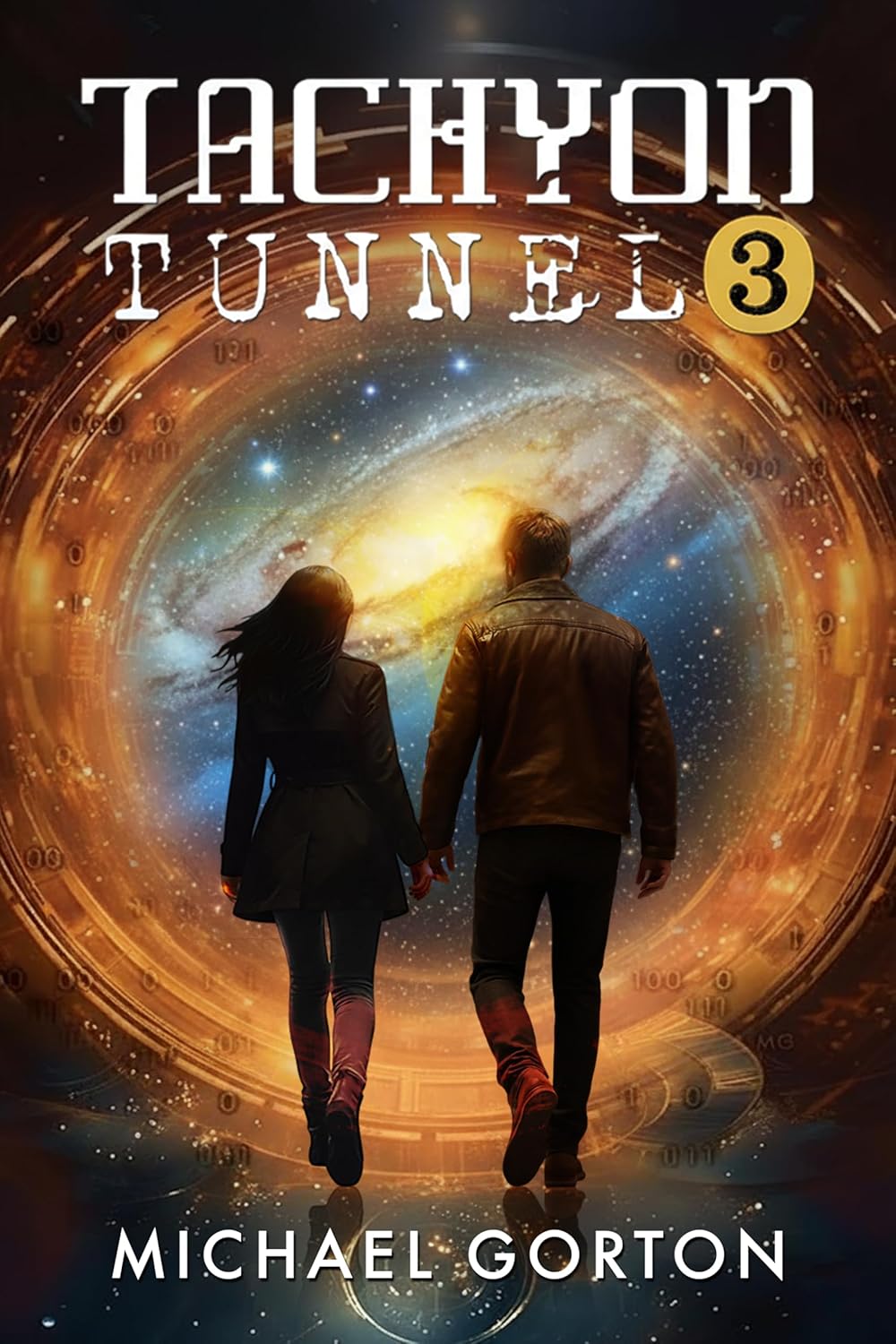
Tachyon Tunnel 3 continues the breathtaking saga of Alex Durant, Paula Campbell, and the evolving AI, Emily, as they face a galaxy on the brink. The story picks up where the last book left off: Earth barely spared from annihilation and the Daklin Empire’s grip tightening over the Milky Way. Author Michael Gorton plunges us into a universe brimming with complex technologies, alien politics, and impossible odds. We meet Fortak, a Daklin scientist stranded on Earth, and follow the growing resistance led by Alex and his allies. There are vast ships that hold cities within their hulls, civilizations millions of years old, and battles that unfold across the fabric of space and time. It’s part space opera, part philosophical exploration of humanity’s place in the cosmos.
Gorton’s writing crackles with energy. His descriptions of the Martian Empire and their cities made me feel the weight of their history, their pride, their downfall. The pacing runs hot, but it fits the chaos of a war that stretches between galaxies. I loved how science isn’t just a backdrop here. It’s part of the soul of the story. Tachyon tunnels, plasma consciousness, and sentient AI aren’t just gimmicks. They’re extensions of how we think about creation and survival. I wanted to sit longer with the characters, especially Fortak, who’s both villain and victim. His curiosity and isolation hit me harder than I expected.
Emotionally, this book is a roller coaster. It made me think about what it means to be human in a universe filled with beings far older and smarter. The scenes on Andromeda Prime, with its harmony and peace, contrasted beautifully with the Daklin Empire’s cruelty. There’s awe in the way Gorton writes about discovery. There’s sorrow in his portrayal of loss. And yet, there’s a spark of hope that keeps burning, even when the odds seem hopeless. I found myself rooting for Emily, the AI who feels more alive than most of the humans. Her growth and sharp wit gave the story its heart.
I’d recommend Tachyon Tunnel 3 to readers who love big ideas mixed with real emotion. If you enjoy science fiction that feels vast but still human, this one’s for you. It’s for those who want their space battles served with philosophy and heart. Gorton writes like someone who believes in both science and soul, and that combination makes his universe feel alive.
Pages: 519 | ASIN : B0DWKRQFJS

The Gift

The Gift follows Emery, a young woman pulled into a strange dimension where voices, shadows, and visions drag her into a fate she never asked for. The novel is about her journey to rescue her mother, uncover hidden truths about her powers, and navigate an ancient and perilous world that teeters between myth and science. There are black holes that bend time, creatures that lurk in slithering shadows, and tribes that live by instinct and survival. But underneath the cosmic spectacle, it is really about one woman’s fight to hold on to family, identity, and purpose in a reality that constantly shifts beneath her feet.
The writing surprised me. It has a dreamlike quality in places, flowing almost like waves, then suddenly crashing into moments of raw grit and pain. The descriptions of the void, of light turning into memory, of bodies disintegrating and reforming, made me pause and reread because they were so vivid. But then the author would drop Emery into the dirt, into hunger and thirst, into stumbling mistakes, and it grounded everything. That combination kept me engaged. Sometimes the prose was a little heavy, but the emotional weight pulled me through. I found myself caring about Emery’s stubbornness, her doubts, her messy humanity, even as she was tasked with saving more than just herself.
What really stayed with me was the emotional pull of Emery’s relationships, especially her bond with Visla. Their friendship felt tender and real, the kind of connection that lights up even the darkest setting. I loved how their language lessons became a bridge between two worlds. I felt warmth reading their moments together, and sadness knowing Emery’s destiny might tear them apart. Emery’s constant second-guessing sometimes slowed the story, and I wished she trusted herself more. But then again, maybe that’s what made her believable. She wasn’t some perfect heroine. She was clumsy, scared, and hopeful, and that made me root for her all the more.
I felt like I’d been on a strange and exhausting journey right alongside Emery. The Gift is not just for fans of science fiction or fantasy. It’s for readers who want to feel the clash of fear and hope, who enjoy sci-fi stories where survival is as important as destiny, and where the heart matters as much as the universe. I would recommend it to anyone who likes their adventure raw and relatable, layered with both cosmic wonder and everyday struggle.
Pages: 381 | ASIN : B0FM77FD39


