Blog Archives
Delaware at Christmas: The First State in a Merry State


Delaware at Christmas is a richly illustrated tour of how one small state has celebrated the holiday across four centuries. Author Dave Tabler moves from early Scandinavian and Dutch settlers to later British, German, Irish, Italian, Polish, Black, and Hispanic communities and shows how each group brought its own Christmas customs into Delaware life. The book then shifts to 19th-century practices like eggnog, sleigh bells, mumming, and plum pudding, before moving into the Victorian period with holly-wreath factories, Christmas seals, and toy trains. Finally, it lands in the late 20th and 21st centuries with house tours, IBM punch-card wreaths, handbell choirs, Kwanzaa, and even Christmas in July, then closes with a reflective postscript on technology and sustainability. The structure feels like a guided walk through time, with short thematic chapters, archival photographs, and clear, accessible explanations that keep the focus on place, people, and memory.
I found the writing warm, steady, and very readable. The tone stays careful and professional, yet it feels like a neighbor telling stories over coffee, not a distant professor. I appreciated the way Tabler anchors each chapter in a concrete detail, such as the Sankta Lucia procession at Old Swedes Church, the Feast of the Seven Fishes in Wilmington’s Little Italy, or the oplatek bread on Polish Christmas Eve, and then pulls back to show how that custom grew from older roots. The references to specific churches, festivals, and streets gave me a sense of real neighborhoods, real people, real weather in December. The short chapter format keeps the pace brisk, and I rarely felt bogged down, although now and then I wished for a touch more narrative glue between topics, especially when the book jumps from one ethnic group to another in quick succession. Overall, though, the style carries a lot of research without feeling heavy, and that balance impressed me.
Emotionally, the book hit me in a quiet but lasting way. It is worth noting that Tabler does not treat Christmas as a simple feel-good backdrop; he lets harder stories in, such as Antebellum Black Christmas and the rise of independent Black churches, and he gives those sections space and dignity instead of pushing them to the margins. At the same time, there is a playful curiosity in chapters on holly wreath factories, punch-card decorations, and Christmas savings clubs, and I caught myself grinning at the sheer oddity of some of those details.
The closing pages, with their focus on Delawareans adapting to online services, digital cards, and greener holiday habits, felt surprisingly tender; they invite the reader to think about their own family rituals and how those might change, or already have changed, over time. I finished the book with a mix of nostalgia, respect, and a little itch to go hunt down a local church festival and hear handbells in person.
I would recommend Delaware at Christmas to readers who love regional history, to Delaware locals and expats who want to see their home through a festive lens, and to anyone who collects books on Christmas customs and folk traditions. It will likely appeal to genealogists, church groups, and teachers who need strong, specific examples of how culture, faith, and migration shape a holiday over time. If you enjoy dipping into short, well-researched vignettes that together build a larger picture, this will be a very satisfying read.
Pages: 130 | ASIN : B0F4NJ2KTZ

Old-Time Tales

Pennsylvania Mountain Landmarks Volume I is a delightful exploration of hidden mountain treasures that are seldom visited yet rich with history and folklore passed down from pioneer days. What inspired you to write this book?
My inspiration was both homesickness and books by an early collector of central Pennsylvania mountain stories named Henry Shoemaker. After graduating from Penn State in 1967 I ended up working in New Jersey. I missed the mountains of my central Pennsylvania Tom Sawyer boyhood, and when browsing through books in Princeton’s Firestone Library I found many books by Shoemaker. His stories and descriptions brought home right into my lap since I recognized many of the places and family names he wrote about. After I had read all the Shoemaker materials I could find, the thought occurred to me that I could collect similar tales on my own and write about them. Not only would it give me a chance to roam the mountains I loved once more, but it would also alleviate my homesickness. And it did!
What started your passion for hiking and exploring the less-known areas of Pennsylvania?
It was something I always loved to do, and that passion increased when I had to work in other states. Hiking and exploring Pennsylvania’s cloud-covered peaks and fog-shrouded glens is still my favorite pastime. I like to say that when the mountains call I must go! There is a mystique about those hills and I yearn to uncover their secrets!
What were some ideas that were important for you to share in this book?
My purpose was two-fold. First, I wanted to preserve these old-time tales before they were lost in the currents of time. Second, I wanted to instill in my readers an appreciation for our Pennsylvania forests and natural areas, and by doing so, I would in some small way help preserve those forests and natural areas too.
What is one thing that you hope readers take away from your book?
A greater appreciation for Pennsylvania’s forests and natural areas and for its colorful history.
Author Links: GoodReads | Pennsylvania Fireside Tales | Sunbury Press Books | Website | Amazon
In this volume:
The King’s Stool (Dauphin County)
Stairways to the Stars (Berks et al.)
Umbrella Rock (Elk County)
The Three Sisters (Huntingdon County)
Lewis’ Rock (Cumberland County)
Infernal Evidence (Clearfield et al.)
Memento Mori (Jefferson et al.)
Picture Rocks (Lycoming County)
Boxcar Rocks (Lebanon County)
Warriors’ Mark (Huntingdon County)
Vampire Rock (Clinton County)
More of the Same (multiple counties)
Killing Shore: The True Story of Hitler’s U-boats Off the New Jersey Coast
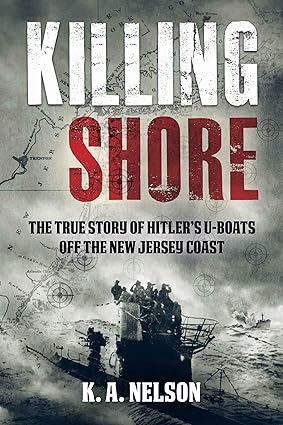

Killing Shore, the inaugural work of K. A. Nelson, distinguishes itself as an insightful foray into the realm of historical non-fiction, skillfully blending rigorous research with a compelling narrative. The book delves into the lesser-known exploits of Nazi submarines in the Western Hemisphere during World War II.
Nelson structures the narrative in three distinct parts. The first and third sections are dedicated to a detailed historical analysis, shedding light on the operational strategies of German U-boats near New Jersey and the factors contributing to their eventual defeat. Here, Nelson’s meticulous approach to research is evident, as he draws from a wealth of primary sources, including military archives from the United States, Britain, and even German logbooks. This thorough groundwork enables him to reconstruct the complex maneuvers and intentions of the Nazi forces with clarity and precision.
The most striking section, in my view, is the second part. Nelson shifts his focus to vividly portray life aboard the U-boats through first-hand accounts. He introduces a diverse cast of personalities, ranging from German to US commanders, and deftly weaves their personal stories into the larger tapestry of historical events. The vivid depiction of submarine warfare’s intensity, often echoing the suspense of a thriller, showcases Nelson’s ability to transcend the boundaries of traditional non-fiction.
Nelson’s expertise in exploring the technical aspects of submarine warfare is particularly noteworthy. He meticulously explains the design and functionality of these formidable machines, providing a detailed yet accessible account of their role in the conflict. This deep dive into the mechanics of submarines offers a unique perspective on the technological challenges faced by both the Allies and the Axis powers. Nelson’s narrative style ensures that the subject, which could easily become tedious in less capable hands, remains engaging throughout. He employs a vivid, almost cinematic approach to storytelling, bringing each anecdote to life with remarkable intensity. The book serves as an informative read for those with a keen interest in World War II naval warfare. It offers a captivating exploration of human resilience and ingenuity under duress.
In Killing Shore, Nelson respectfully and evocatively illuminates the struggles and triumphs of real-life figures. His ability to balance the technical aspects of warfare with the human dimension makes the book a compelling read, not just for history enthusiasts but also for a broader audience.
Pages: 761 | ASIN : B0CW1SRNC6




 LITERARY TITAN