Blog Archives
Powerful People – Outrageous Lies


Powerful People – Outrageous Lies is a wide-ranging investigative account that challenges the official explanation of President John F. Kennedy’s murder. The author argues that the assassination involved more than one shooter and that a larger group of officials and institutions later helped conceal what happened. The book begins with a focused question about Jacqueline Kennedy’s actions in the presidential limousine, then expands into the Zapruder film, the transportation of Kennedy’s body, the Bethesda autopsy, Lee Harvey Oswald’s background, Jack Ruby, and the official investigations that followed. Its central purpose is stated plainly: “The main reason for writing this book was the complete lack of a credible explanation from authorities, experts and authors for the actions of Mrs. Kennedy.”
The treatment of Mrs. Kennedy’s actions is one of the book’s two most convincing sections. After the fatal head shot, she climbed onto the limousine trunk and reached toward material that had landed behind and to the left of the president. The author argues that this instinctive movement matters because it provides physical evidence about the direction of the shot. Her reported words, “They have killed my husband. I have his brains in my hand,” give the scene a terrible immediacy while also supporting the author’s reconstruction of where the material landed. By connecting her actions with the blood spray, skull fragments, and witness descriptions of the rear head wound, the book builds a clear forensic argument for a shot from the right front.
The evidence of Dino Brugioni forms the other especially persuasive part of the book’s case. Brugioni was the CIA’s Chief Information Officer at the National Photographic Interpretation Center and one of its leading photographic interpreters. He supervised the preparation of briefing boards from the Zapruder film on the Saturday night after the assassination, while a different team prepared another set the following night. The two teams didn’t know about each other’s work at the time. The book argues that the film passed through the CIA-linked Hawkeye Works facility between those two sessions and returned in an altered form. Brugioni later maintained that the version he studied differed from the surviving film, especially in its depiction of the head explosion, which he remembered as appearing across more than one frame. Because of his expertise, position, and direct contact with the film, his testimony gives the book’s cover-up argument unusual weight.
From those two central pieces of evidence, the book develops a much longer reconstruction of the assassination and its aftermath. Separate chapters examine Oswald’s military service and time in the Soviet Union, his associations in Dallas and New Orleans, his trip to Mexico City, the murder of Officer J. D. Tippit, Ruby’s killing of Oswald, and the work of the Warren Commission, the House Select Committee on Assassinations, and the Assassination Records Review Board. Later chapters discuss intelligence figures, alleged participants, mortuary evidence, Dallas officials, and suspicious deaths connected with the case. The structure feels like a case file assembled gradually, with photographs, witness statements, timelines, and recurring details used to reinforce the author’s larger theory.
The book’s greatest strength is its insistence that physical details and witness actions deserve careful attention. Its discussion of Mrs. Kennedy and its presentation of Brugioni’s evidence give the overall argument a strong foundation, since both relate directly to the direction of the fatal shot and the possible alteration of the most important visual record. At times, though, the author moves quickly from possibility to certainty, and the lack of a full reference list makes some claims harder to assess independently. The author acknowledges that the information comes from internet sources and that some material may have been falsified or misinterpreted. Even with those limitations, Powerful People – Outrageous Lies offers a detailed, forceful, and often absorbing account of why the assassination and the conduct of the authorities afterward remain so deeply contested.
Pages: 172 | ASIN : B0FK2CB7B9

Secret Nebraska Sandhills: A Guide to the Weird, Wonderful, and Obscure
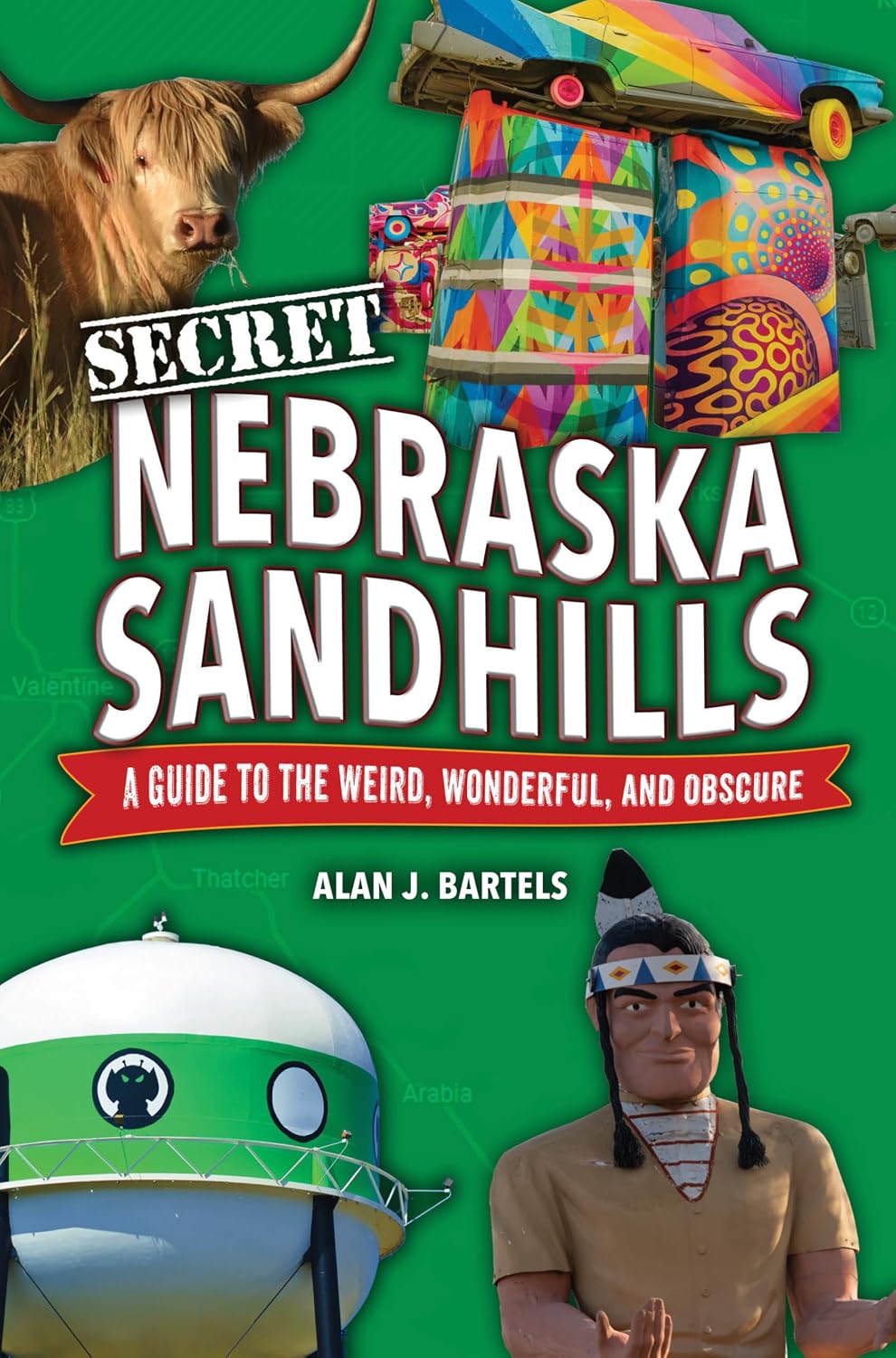

Secret Nebraska Sandhills is Alan J. Bartels’s lively tour through the stories, landmarks, people, and legends tucked across Nebraska’s vast Sandhills. Instead of following a continuous narrative, the book offers dozens of short, illustrated entries, each built around an inviting question. One minute Bartels is investigating a possible meteor crater or a lake monster, and the next he’s visiting a church without electricity, a cattle ranch filled with exotic animals, or a town with a population of one. Together, these pieces create a portrait of a region where history, folklore, conservation, tourism, and everyday life overlap in surprising ways.
Bartels’s greatest strength is his curiosity, which feels sincere. He’s fascinated by oddities such as the Sandhills Monkey, Carhenge, ghost stories, UFO rumors, unusual museum artifacts, and a supposedly bottomless spring, but he treats the people connected to those subjects with warmth. His research also gives the lighter material some substance. As he explains in the introduction, “I talked to real humans for each feature in this book,” and that choice is apparent throughout. Local historians, ranchers, business owners, museum volunteers, and longtime residents aren’t used merely as colorful background. Their memories and knowledge are central to the book’s personality.
The structure makes the book especially easy to browse. Most entries are only a couple of pages long, and the photographs, captions, addresses, costs, and “pro tips” give it the usefulness of a travel guide without turning it into a directory. Bartels writes in a friendly, playful voice, using jokes and wordplay while still making room for painful subjects such as murders, forced displacement, frontier violence, environmental loss, and family hardship. The shifts in mood can be sharp, but they reflect the variety of the Sandhills themselves. A reader can laugh at a fiberglass giant, pause over a lonely grave, and then learn about rare flowers or wildlife crossings within a handful of pages.
The photographs do more than decorate the stories. They show weathered buildings, rolling grasslands, historical objects, eccentric sculptures, community gatherings, and the people preserving local traditions. That visual attention reinforces one of the book’s most appealing qualities: Bartels notices things that travelers often pass without a second glance. A boot on a fence post, an abandoned railroad grade, an old jar of preserves, or an unusual bridge becomes an opening into a larger story. At times, the repeated question-and-answer format gives the entries a similar rhythm, but the range of subjects keeps the collection energetic.
By the final chapter, the book’s playful search for secrets has developed into something more personal and urgent. Bartels considers the pressure that cultivation, development, industrial activity, and changing land use place on a fragile grassland ecosystem, describing the Sandhills as “free to take in, impossible to replace.” That concern gives the earlier stories added weight. This isn’t simply a collection of curiosities. It’s an affectionate record of a place whose culture and landscape depend on attention, memory, and care. Secret Nebraska Sandhills leaves the reader with a fuller sense of the region and, more importantly, a reason to look closely when traveling through it.
Pages: 184 | ASIN : B0GQ5NDXPL
Writing is Like Sculpting

The Summer of ’76 follows a young girl as a secret time machine sends her from Bicentennial-era Massachusetts into the American Revolution, where she must protect her family’s farm and uncover its buried legacy. What was the inspiration for the setup of your story?
I began this story remembering an abandoned shed hidden in the woods behind my childhood home in Massachusetts. My friends and I used to imagine who lived there and why. While I was writing, the words of Longfellow’s poem, “Paul Revere’s Ride”, played in my head. I learned it when I was Betsy’s age and am still in awe of the brave people Longfellow memorialized. I knew I had to pay them tribute.
How did you balance the novel’s time-travel adventure with its more emotional story about family, healing, and legacy?
Reading each chapter out loud helped me think like a reader. I also asked for feedback from other authors I trust and respect. Writing is like sculpting. Little by little, I removed details that didn’t move the plot forward and added others that did until I knew I was done.
Betsy feels curious, impulsive, funny, and authentically twelve. How did you develop her narrative voice?
I was Betsy’s age in 1976. It was a more innocent time, which is why I picked it. I relied on my inner child to craft her point of view. Betsy comes to believe we can each make a difference, as do I.
What kind of historical research did you conduct to make Colonial life accessible and engaging for middle-grade readers?
I researched everything! The topics included the American Revolutionary War, life in Colonial Massachusetts, the Massachusett people, and the battles of Lexington and Concord. I visited Revolutionary landmarks in both towns and spoke with a number of people to get the details right.
Author Links: GoodReads | Website | Amazon
Twelve-year-old Betsy Ross thought the worst thing about the summer of 1976 was missing camp and being stuck on her grandmother’s farm in Lexington, Massachusetts. Her father has suffered a devastating emotional breakdown, her family is on the verge of losing their New York apartment, and now Betsy is trapped cleaning horse stalls and breathing through the smell of manure.
But the Ross Family Farm has secrets.
Hidden beneath the barn is a mysterious cellar, a forbidden button, and a journey through history Betsy never meant to take. When greedy developers threaten the farm and corner Betsy and her new friend Nate underground, they make a desperate choice that sends them hurtling back in time-to April 19, 1775.
The day the Revolutionary War began.
Now Betsy and Nate must survive Colonial America, avoid suspicion, and uncover the truth about Betsy’s family legacy before history-and their own future-is changed forever. Along the way, Betsy begins to realize that healing her father’s broken spirit may depend on understanding the generations of Rosses who came before him.
Blending heart, humor, mystery, and adventure, The Summer of ’76 is a fast-paced middle-grade novel about courage, family, friendship, and discovering where you truly belong.
We the Presidents

Ronald Gruner’s We the Presidents is an ambitious, highly readable history of the American presidency from Warren G. Harding through Joe Biden, followed by an epilogue examining the opening phase of Donald Trump’s second term. Rather than treating each administration as an isolated biography, Gruner traces how presidential decisions accumulate over time. Immigration restrictions enacted in the 1920s, New Deal programs, Cold War interventions, tax policy, civil rights legislation, healthcare reform, financial deregulation, and the growth of executive power all become parts of one continuing story. The result is a broad account of how the modern United States was built, altered, and occasionally damaged by the people occupying the White House.
The book’s greatest strength is its sense of historical continuity. Gruner regularly reaches backward and forward to show how an idea associated with one president reappeared under another. Andrew Mellon’s tax theories anticipate later supply-side economics. Herbert Hoover’s belief in rugged individualism continues to shape arguments about healthcare and social programs. Truman’s decisions help define the Cold War inherited by Eisenhower and Kennedy, while Johnson’s domestic ambitions become inseparable from the escalating war in Vietnam. These connections make the book feel like more than a procession of elections, scandals, and famous speeches. Policies have long afterlives here, and presidents frequently find themselves dealing with consequences created decades before they took office.
Gruner also has a talent for finding vivid human details that keep a long work moving. Harding’s poker games, Coolidge’s grief after his son’s death, Truman’s blunt sense of responsibility, Eisenhower’s preference for quiet leadership, Ford’s decency, Reagan’s optimism, and Obama’s composure all give the political history a personal dimension. The chapters are organized around clearly defined episodes, and the prose usually moves briskly between biography, economics, diplomacy, and social change. Photographs, political cartoons, charts, quotations, and statistical comparisons reinforce the narrative, making the book approachable even when it’s explaining subjects such as monetary policy, mortgage-backed securities, taxation, or federal regulation.
The same confident voice that makes the book engaging also gives it a distinctly argumentative character. Gruner isn’t simply assembling events. He reassesses neglected presidents, questions familiar reputations, praises courage and restraint, and identifies choices he believes produced lasting harm. Harding receives a more sympathetic treatment than many readers will expect, while presidents with celebrated public images are examined alongside their failures, contradictions, and missed opportunities. Some conclusions, especially those involving what might have happened under different leadership, are speculative. Still, the author generally makes his reasoning visible, supports it with extensive notes and data, and encourages readers to consider presidential performance in terms of consequences rather than party loyalty.
This book will appeal most to readers who enjoy accessible political history and want to understand how current American disputes acquired their present shape. It’s especially well suited to people who know the major presidents and events but haven’t yet seen the connections among tax policy, immigration, civil rights, foreign intervention, healthcare, regulation, debt, and public trust. Readers looking for a neutral reference work should expect a strong interpretive voice, but those open to a sustained historical argument will find plenty to think about. I’d recommend it for general history readers, civic-minded book groups, college students, and anyone trying to place today’s political conflicts within a century of presidential choices.
Pages: 648 | ISBN : 978-1737823100
Founding Crimes: How Smuggling, Fraud, and Treason Built the United States

Founding Crimes recasts America’s founding as a case assembled from twenty-seven documents, beginning with the Sugar Act and ending with the Alien and Sedition Acts. Author David H. Tolly treats declarations, constitutions, treaties, financial reports, and political essays as evidence rather than ceremonial artifacts. His central idea is that the founders committed one set of crimes against British authority while permitting another set through slavery, Native dispossession, political exclusion, and corruption. The result is a chronological narrative that connects familiar documents into one developing argument about who receives liberty, who controls it, and who pays for it.
The book’s crime-history structure gives the material unusual momentum. Tolly introduces each major document as an “exhibit” and interrupts the official record with “witnesses” such as Phillis Wheatley, Abigail Adams, Elizabeth Freeman, Benjamin Banneker, and Robert Carter III. These chapters keep the book from becoming a procession of famous white statesmen talking to one another. They also show how people excluded from the founding’s promises understood those promises, challenged their selective application, and sometimes forced courts or lawmakers to honor them. Episodes involving John Hancock’s smuggling case, Thomas Paine’s pamphleteering, the negotiations in Paris, Hamilton’s financial program, and the Yazoo land scandal are told with the pace and scene-building of narrative nonfiction.
Tolly’s background as a chief financial officer shapes an approach that looks closely at buried clauses, interested estimates, political bargains, and benefits flowing to parties who preferred not to advertise them. The sections on the Constitution are especially effective because he places its euphemistic language beside blunt explanations of what its slavery provisions accomplished. He’s also careful to distinguish documented fact, later legend, and contested interpretation, openly marking disputes such as the possible influence of the Somerset decision on slaveholding colonists. The repeated courtroom language and recurring formulations occasionally make the argument feel more emphatic than it needs to be, but that repetition also gives a long, document-heavy book a clear spine.
This book will be most appreciated by readers who enjoy American history but find conventional textbook treatments too polished or fragmented. It’s particularly well suited to fans of narrative history, political biography, legal history, and financial investigations, as well as teachers or discussion groups looking for an accessible way into primary documents. Readers willing to hold admiration and moral judgment together will get the most from it. Tolly’s recommendation isn’t that the founding should be worshipped or discarded, but that its promises should be read closely, its bargains understood honestly, and its unfinished work treated as an inheritance that still belongs to the public.
Pages: 254 | ASIN : B0H777HG7F
The Jingu Magical Garden

In The Jingu Magical Garden, Lillian Jingu, the youngest daughter in a big Japanese American family living inside the Japanese Tea Garden in San Antonio in the late 1930s discovers a strange egg by the koi pond, hatches a tiny blue dragon she names Kokoro, and hides him with the help of her brother Kimi, a very dignified turtle, and a tough gray cat. At first, it feels like pure magic and mischief in a hidden garden. Then a crack in time opens, and Lillian and Kokoro are pulled into moments that show how war, rumor, and racism creep into their world and shake the life they love in the tea garden. The story braids fantasy with the real history of the Jingu family and the garden, all the way through World War II and beyond.
I had a soft spot for Lillian right away. She just wants to grow her hair long, wear a white Stetson, blend in at school, and also secretly raise a baby dragon who drinks Coca-Cola and eats sardines out of a tin. That mix of ordinary kid worries and wild magical stuff really worked for me. The family scenes in the Bamboo Room kitchen made me feel like I was sitting at the table, listening to sisters tease each other while their parents try to keep everyone fed and in line. Kokoro is goofy and sweet and a bit chaotic, so every time he bursts out of hiding I could feel my shoulders tense and my brain go “oh no, not now,” in the best way. Some chapters feel cozy and funny, and then the tone shifts, and I felt my stomach drop when hints of war and suspicion started creeping into their everyday life.
The book talks about anti Asian prejudice without turning into a lecture, and that made it more powerful to me. You see how quickly neighbors and officials can turn on a family that has done nothing wrong, and it hurt to watch, because we know this stuff did happen in real life and still echoes today. At the same time, the dragon and the time travel bits keep the story from feeling hopeless, almost like the past itself is reaching out to protect this family and their garden. I liked that the author doesn’t pretend everything gets neatly fixed, but she still gives the Jingus courage, humor, and dignity, and that mix left me sad and hopeful at the same time.
As for the writing, it has a very old radio show vibe in spots, with Buck Rogers and songs on the wireless and little period details tucked everywhere, and I thought that was charming. The garden descriptions are lush and detailed, so I could picture the waterfall, the stone paths, and the hidden corners where a dragon might hide, and those scenes slowed my breathing in a good way. The dialogue can be a bit old-fashioned in places, which fits the time period. Still, the emotional beats land. When the family faces public shaming, name changes, and the loss of their place, the simple language hits like a punch because you already care about these people and this garden so much.
I really enjoyed this children’s book. I would hand it to middle-grade readers who like dragons but can handle some heavier real-world stuff, kids around nine to thirteen who are curious about World War II on the home front, and any young reader who has ever felt caught between cultures or out of place. It would also be great for teachers or parents who want to talk about racism, resilience, and community in a way that feels authentic. If you want a story with cozy family meals, secret magical pets, and real history woven together, this one is a good pick.
Pages: 282 | ASIN : B0GCQV9TB9
The Legacy of the Twins Platoon

The Legacy of the Twins Platoon follows a group of young Minnesotans who enlist together in the Marine Corps at a Minnesota Twins game in 1967 and then get swept into some of the hardest fighting of the Vietnam War, from Khe Sanh and Hue City to Dai Do and the DMZ. The book is split into life before Vietnam, brutal combat tours in-country, and the long shadow of the war afterward, including PTSD, broken marriages, suicides, and quiet acts of resilience that play out over decades. Author Christy Sauro Jr writes as one of them and tracks down the stories of his fellow Marines and their families, so the story stretches from their teenage years to their later lives as aging veterans who still carry the weight of what happened. It ends up as both a unit history and a long, painful look at what the war did to a particular slice of America.
I found the book to be surprisingly intimate and straightforward. Sauro’s style is plainspoken and very visual, and he leans on short scenes and dialogue rather than high drama. The boot camp sections and early combat chapters move fast and feel almost like you are standing on the yellow footprints, getting barked at, then shoved into the red mud around Khe Sanh and Dai Do. The moment when Wallace “Skip” Schmidt describes the rifle being shot out of his hands and then whispers that everyone he knows is dead hit me in the gut, because Sauro lets the scene sit there with minimal commentary. Sometimes the level of detail can feel overwhelming, with name after name and battle after battle, and I caught myself having to flip back to remember who was who. That said, the repetition also mirrors what he is trying to show: a grinding series of patrols, firefights, and losses that blur together for the men who lived it. It is not a sleek literary war memoir, and I ended up liking that roughness, because it feels honest to the world he is describing.
What stayed with me even more than the combat was the moral and emotional through-line. Sauro is obsessed with what the country asked of these teenagers and what it gave them back in return. The homecoming scenes are almost harder to read than the firefights. Larry Jones getting smashed in the face with a beer bottle in a bar, then realizing that everyone is staring at him like he is the problem, not the guy who hit him, made me angry in a very immediate way. The chapters on PTSD and suicide are bleak and careful at the same time. Sauro walks through how men like Schmidt fell apart in the years after the war and how the term “post-traumatic stress disorder” arrived too late to help some of them or their families. The big idea here is not just that war is hell, which we all know in the abstract, but that the real cost keeps showing up in family kitchens and quiet Midwestern streets long after the shooting stops. I could feel his frustration with how slowly institutions moved and how much of the heavy lifting fell on spouses, siblings, and parents who were trying to understand what had happened to their sons.
I would recommend The Legacy of the Twins Platoon to readers of military history who want something rooted in lived experience rather than strategy charts, to younger people who have only heard the Vietnam War reduced to slogans, and to policymakers and professionals who work with veterans today. The book does exactly what a legacy should do. It keeps these Marines and their families from being reduced to a line in a textbook, and it holds up both their courage and their pain in a way that is hard to shake.
Pages: 410 | ISBN : 978-1663271556
Delaware at Christmas: The First State in a Merry State

Delaware at Christmas is a richly illustrated tour of how one small state has celebrated the holiday across four centuries. Author Dave Tabler moves from early Scandinavian and Dutch settlers to later British, German, Irish, Italian, Polish, Black, and Hispanic communities and shows how each group brought its own Christmas customs into Delaware life. The book then shifts to 19th-century practices like eggnog, sleigh bells, mumming, and plum pudding, before moving into the Victorian period with holly-wreath factories, Christmas seals, and toy trains. Finally, it lands in the late 20th and 21st centuries with house tours, IBM punch-card wreaths, handbell choirs, Kwanzaa, and even Christmas in July, then closes with a reflective postscript on technology and sustainability. The structure feels like a guided walk through time, with short thematic chapters, archival photographs, and clear, accessible explanations that keep the focus on place, people, and memory.
I found the writing warm, steady, and very readable. The tone stays careful and professional, yet it feels like a neighbor telling stories over coffee, not a distant professor. I appreciated the way Tabler anchors each chapter in a concrete detail, such as the Sankta Lucia procession at Old Swedes Church, the Feast of the Seven Fishes in Wilmington’s Little Italy, or the oplatek bread on Polish Christmas Eve, and then pulls back to show how that custom grew from older roots. The references to specific churches, festivals, and streets gave me a sense of real neighborhoods, real people, real weather in December. The short chapter format keeps the pace brisk, and I rarely felt bogged down, although now and then I wished for a touch more narrative glue between topics, especially when the book jumps from one ethnic group to another in quick succession. Overall, though, the style carries a lot of research without feeling heavy, and that balance impressed me.
Emotionally, the book hit me in a quiet but lasting way. It is worth noting that Tabler does not treat Christmas as a simple feel-good backdrop; he lets harder stories in, such as Antebellum Black Christmas and the rise of independent Black churches, and he gives those sections space and dignity instead of pushing them to the margins. At the same time, there is a playful curiosity in chapters on holly wreath factories, punch-card decorations, and Christmas savings clubs, and I caught myself grinning at the sheer oddity of some of those details.
The closing pages, with their focus on Delawareans adapting to online services, digital cards, and greener holiday habits, felt surprisingly tender; they invite the reader to think about their own family rituals and how those might change, or already have changed, over time. I finished the book with a mix of nostalgia, respect, and a little itch to go hunt down a local church festival and hear handbells in person.
I would recommend Delaware at Christmas to readers who love regional history, to Delaware locals and expats who want to see their home through a festive lens, and to anyone who collects books on Christmas customs and folk traditions. It will likely appeal to genealogists, church groups, and teachers who need strong, specific examples of how culture, faith, and migration shape a holiday over time. If you enjoy dipping into short, well-researched vignettes that together build a larger picture, this will be a very satisfying read.
Pages: 130 | ASIN : B0F4NJ2KTZ


