Blog Archives
Intention and Action

Where The Winds Blow follows the rise of Path Finder, a grassroots movement born from grief and idealism, while powerful governments, criminal networks, and ordinary people collide around it. What was the inspiration for the original and fascinating idea at the center of the book?
The inspiration for Path Finder came during the COVID crisis, while I was cleaning out my garage for the third time in a week. I suddenly imagined finding the UK’s prime minister hiding in there – someone who’d simply decided he couldn’t cope any more. That image stuck, and I started writing, using it as a focal point.
It led to a simple but unsettling thought: for all their bombast and posturing, governments have only limited control over what actually happens within their own borders. The responses to the 2008 crash, COVID, and countless regional crises revealed not grand strategists, but leaders who were overwhelmed, reactive, and often out of their depth.
Lies, distraction, and obfuscation disguise their weakness and uncertainty – skills that modern power structures have perfected. Meanwhile, real influence increasingly sits with billionaires, technocrats, and the vague, unaccountable entity we call “the markets,” all of whom operate with little responsibility to the societies they shape.
Across much of the world, there’s a simmering resentment paired with helplessness – a frustration that’s often misdirected toward convenient scapegoats rather than those truly responsible. What feels missing is a spark: something that turns anger and despair into constructive action rooted in honesty, humanity, and hope.
I don’t pretend to know how that spark might happen in real life, although I believe it will. In the Path Finder series, I’ve created a world only inches removed from our own, where readers can enjoy the humour and drama in the story, recognise familiar institutions and personalities, and perhaps imagine a different future – for themselves as much as for society as a whole.
History is full of ordinary people doing extraordinary things, often accidentally or without understanding where their choices might lead. This series begins with one man deciding he’s had enough of pretending to be something he isn’t and disappearing. Three books in, even I’m not entirely sure where that decision will ultimately take him or Path Finder. I just know it’ll be fun finding out!
What are some things that you find interesting about the human condition that you think make for great fiction?
What fascinates me most about the human condition is the gap between who we think we are and how we actually behave when things stop going to plan. We like to believe we’re rational, principled, and in control, but pressure, fear, love, grief, and ambition have a habit of knocking those ideas sideways. That gap – between intention and action, certainty and doubt – is where great fiction lives.
I’m also interested in how ordinary people respond when they’re swept up in events far bigger than themselves. Most of us don’t set out to change the world, break systems, or become symbols of anything. We’re just trying to get through the day, protect the people we care about, and make sense of the noise. Yet history shows that it’s often these accidental participants – people acting from love, stubbornness, guilt, or hope – who trigger the biggest consequences. That tension between small, human decisions and vast, unpredictable outcomes runs through the Path Finder series.
Finally, there’s the absurdity of it all. Humans are capable of extraordinary kindness, bravery, and resilience, but we’re also unwittingly brilliant at self-delusion, tribalism, and panic. Put those traits under stress – mix them with power, money, ideology, or blind faith – and you get situations that are by turns terrifying, ridiculous, and darkly funny. Satire lets me explore those contradictions honestly, without pretending we’re either heroes or villains. We’re usually just flawed, emotional creatures doing our best… sometimes making an almighty mess of it… occasionally doing something amazing.
What is one thing that you hope readers take away from Where The Winds Blow?
More than anything, I hope readers come away feeling that the time they spent with Where The Winds Blow was time well spent. I want them to have been entertained – laughing at the absurdity, caught up in the momentum, and maybe a little breathless at times – but also quietly validated in the way they see the world.
If there’s a deeper takeaway, it’s the reassurance that confusion, doubt, and frustration aren’t personal failings; they’re rational responses to a chaotic system. The characters in the book don’t have grand plans or neat answers – most of them are muddling through, reacting, improvising, and occasionally getting things spectacularly wrong. And yet, meaning still emerges from those imperfect choices.
I also hope the book leaves readers with a sense that individual actions matter, even when they seem small, accidental, or misdirected. Change doesn’t always come from heroes or leaders; it often starts with ordinary people deciding to stop pretending, to care a little more honestly, or to take one step they didn’t think they were capable of taking.
If readers finish the book feeling entertained, understood, and perhaps a little more open to the idea that hope can exist without certainty, then I’ve done my job.
I hope the series continues in other books. If so, where will the story take readers?
The series will continue. As for where the story will take the reader, who knows?! I’m currently writing shorter pieces for my Path Finder newsletter subscribers that fill in some of the character back stories. One of those pieces became a major plot line in Where The Winds Blow, and I have no doubt that one or two of my current works in progress will do the same in the fourth novel.
Author Links: GoodReads | Threads | Facebook | Website | Amazon
The Path Finder movement has gone global. Millions of followers. Endless headlines. Oceans of cash.
Only one tiny snag: the founders still have no idea what the movement actually is. Now the powerful want answers – and they’ll do anything to keep control.
Meanwhile, an ex-soldier from Afghanistan crosses continents and the Mexico-US border, desperate to reach his family before the authorities catch him or local vigilantes do even worse.
Elsewhere, Simon and Pippa Pope are chasing storms, blissfully unaware that their late wedding gift could unleash consequences for humanity, the planet, and a whisky-soaked Scotsman on a collision course with destiny.
Fast, funny, and ferociously sharp, Where The Winds Blow skewers the powerful and the absurd in equal measure.
It’s the third and wildest instalment in The Path Finder Series, following Paths Not Yet Taken and Good for the Soul. Each offers satire with bite, stories with heart, and storms of every kind.
A Curious Interviewer

Interview With a Sinner follows a professional mourner who meets a demi-goddess who is looking for someone to interview about humanity in their quest to create a new civilization. What was the inspiration for the setup of your story?
Growing up Christian, I have heard so many interesting philosophical debates about the nature of worship and questioning why a benevolent Creator would allow awful circumstances to plague the innocent. So I started thinking how I would do any better while still granting people free will to act as disorderly as they want. It became a headache to ponder. All my random musings and speculations took form in Marigold, who could be a curious interviewer to some degenerates in this story. It wouldn’t have been interesting if she questioned saintly or righteous individuals, after all. They might have all the answers. Scoundrels like us have to be creative with our conjectures.
What are some things that you find interesting about the human condition that you think make for great fiction?
Morality, definitely. It can be boring to follow virtuous people we would like to be, and despise villains who represent everything we detest in society. But great fiction can provoke you to sympathize with the worst or even feel they’re relatable. Nothing was harder for me than to write the scenes of Hollace with her sexual temptations, but it was an exercise in showing the humanity of even the most shameful and perverse, and that her guilt pushed her to otherwise be as helpful and caring as possible for the outcasts. People who are horrible to each other can become friends, and deadly rivalries can sometimes dip into playful banter.
What were some themes that were important for you to explore in this book?
It was essential for me to introduce as many theological concepts as possible for the debates. From Judgment to reincarnation, to what happens to the morally erratic if the world ends and they have to be sent to either Heaven or Hell. Also the rationale behind atheism or those who are content being agnostic. The book was never meant to pick a side or even truly confirm if Marigold is what she claims to be. Life itself is ambiguous and that was the theme behind every single question arising.
I found this novel to be a cutting piece of satire. What is one thing that you hope readers take away from your novel?
Artistic endeavors are a big part. That some aggrandize the idea of violence, death, or suicide for the sake of art, and I’m hoping this book kind of deflates that notion and makes apparent that such things in real life are gruesome, messy, and never convey an “artistic message.” Like how the snuff filmmakers brag their production company transcends the mere butchering of people, even though that’s the gist of it. We tend to insert superfluous ideas and meanings into our undertakings to pretend they’re something grander than they are, especially if our deeds are reprehensible. To rationalize a killing, there was an understandable motive. To justify discrimination, there’s a ridiculous “moralistic” excuse. There’s an illusion of “destiny.” Sometimes people who spout about their destiny are the scariest to me.
Thank you so much for your time and exploration of my debut novel.
Author Links: GoodReads | X (Twitter) | Amazon
Interview with a Sinner
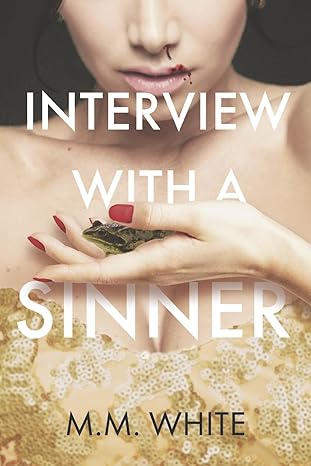

Interview With a Sinner by M.M. White presents a compelling narrative that intertwines the life of Hollace, a professional mourner, with the curious quest of Marigold, a diminutive demi-goddess seeking to build her own civilization. Hollace’s job involves mourning at the graves of the unloved, a task she performs with detached professionalism. Her routine is disrupted when Marigold approaches her with an extraordinary proposition: to be the human subject of her research on creating a new civilization, with the aim of avoiding plagiarism from God’s own work. This encounter marks the beginning of a week filled with bizarre and unpredictable events for Hollace and an educational journey for Marigold.
M.M. White’s novel starts with an intriguing premise that quickly spirals into a whirlwind of chaos by the second chapter, maintaining a tone of unrelenting unpredictability throughout. The rapid introduction of characters from Hollace’s world, including some less savory individuals, sets a frantic pace. The narrative is peppered with absurd and disturbing encounters, contributing to the book’s overall sense of madness. Amidst the chaos, Marigold conducts interviews with Hollace and her acquaintances, delving into profound discussions on topics such as existence, free will, and morality. These conversations are among the highlights of the novel, offering thought-provoking insights into spirituality and the human condition. While Marigold’s role as an observer rather than an active participant in many instances does not detract from her mission, it adds an interesting layer to the narrative. This book is not for the faint-hearted. It is crude and provocative, featuring controversial and disturbing elements such as snuff films, discarded infants, illicit sexual encounters, and a sentient tumor worshiped by a cult. These elements are recurrent and form key parts of the plot, challenging the reader’s comfort zones. Marigold witnesses a broad spectrum of human behavior, where characters often do the right things for the wrong reasons, or vice versa, revealing glimpses of their inherent decency amidst the depravity.
Ultimately, the novel escalates to a bizarre and unexpected conclusion, leaving the characters profoundly changed. Despite its raw and unsettling content, Interview With a Sinner provides a unique exploration of human nature and spirituality, making it a thought-provoking read for those who can handle its more extreme aspects.
Pages: 199 | ASIN : B0D5DKXFBL




 LITERARY TITAN